Week 3 HW: Cell Free Protein Synthesis
COMPARE CELL-FREE REACTION COMPOSITIONS (20 minutes)
Why does the concentration of potassium glutamate and magnesium glutamate differ between compositions? Which is more sensitive?
Potassium and magnesium serve different roles in cells, and magnesium is prone to binding things like ATP, ADP, GDP, DNA, RNA, etc. This means that other components in the CFPS composition change the effective concentration of magnesium. Overall, magnesium is more sensitive, as it has a narrower optimal concentration.
Explain how a PEP+NTP reaction formulation is different from a Ribose+NMP reaction formulation.
A ribose+NMP formulation relies more on the metabolism of the lysate to regenerate ATP from ribose and to create NTPs from NMPs. A PEP+NTP formulation relies less on the lysate’s metabolism, providing “external” energy in the form of PEP.
Choose two cell-free reaction compositions from the literature, compare and contrast the choice of reagents and the concentration of reagents.
Note: A recommended starting point would be to review a least one published formulation, such as PANOx-SP (Jewett & Swartz 2004), a cost-optimized formulation from Olsen et al. (2026), and/or an AI-designed formulation from Smith et al. (2026).
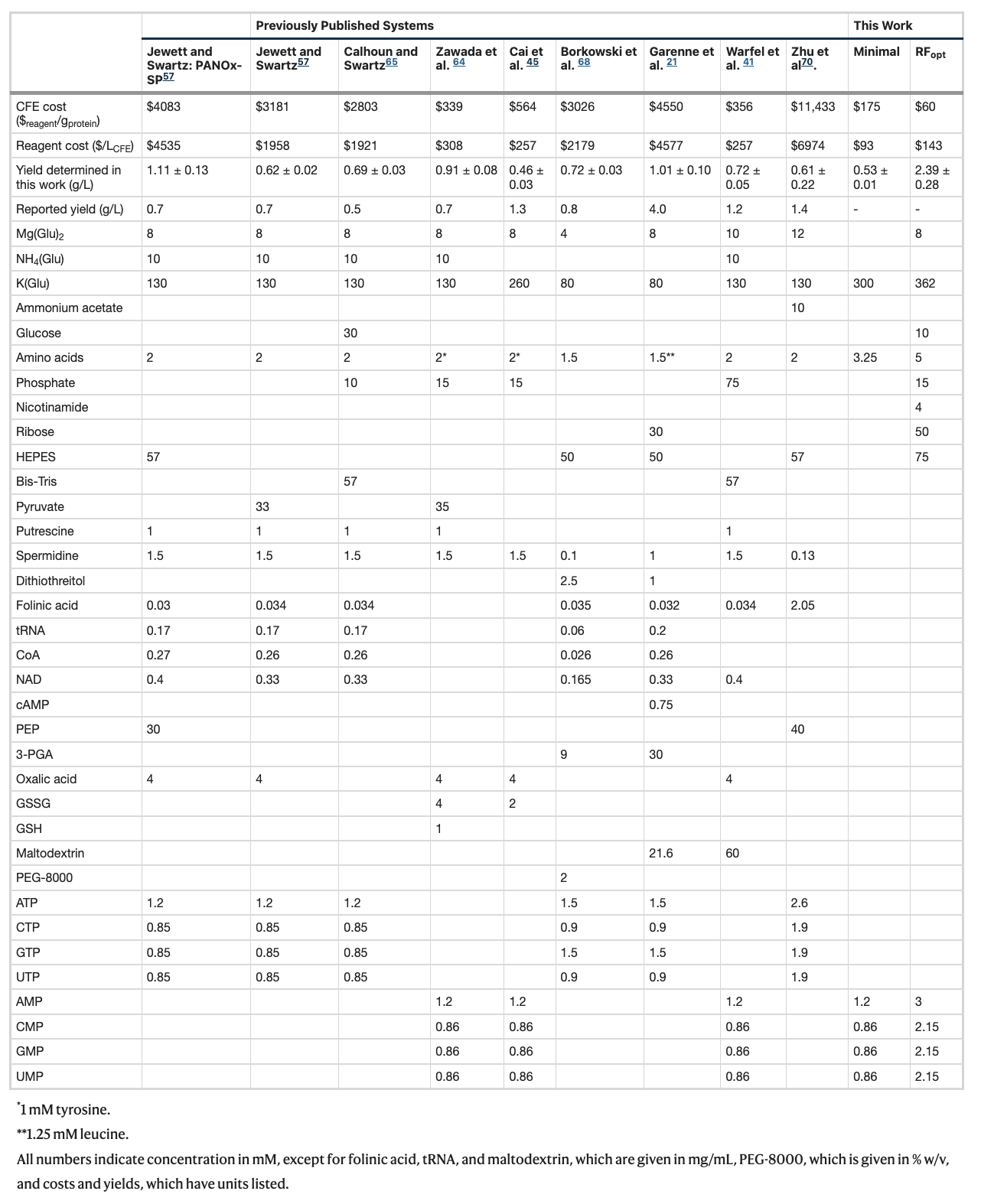 From Olsen et al, 2026
Comparing CFPS for immunoglobin synthesis (Cai et al., 2015) vs AI-designed CFPS system (Zhu et al, 2025) because they have similar yields but are very different prices
- Cai et al use glutamate as the sole energy source, having it feed into the TCA cycle while the AI-designed CFPS system uses PEP as an energy source
- Cai et al use NMPs while the AI-designed system uses NTPs
- Also, the AI-designed system uses double the concentration of nucleotides
- Cai et al use a lot more spermidine than the AI-designed system
- Cai et al use oxalic acid, while the AI-designed system does not
- Oxalic acid helps prevent unnecessary ATP use
DESIGN ONE REACTION COMPOSITION FOR EACH OF THE THREE PROTEINS (40 minutes)
Sign in to coopetition.htgaa.org and publish your first unique 20 µL CFPS reaction composition for each of the following (don’t worry, you can resubmit later):
sfGFP
PETase
Reteplase
For each composition, specify the reagents you would adjust from the relevant categories, including salts, energy sources, building blocks, cofactors, and redox components.
As a HTBAA research team, we will have the opportunity to suggest new reagents to add to the cell-free reagent inventory. Contribute (or upvote) at least one reagent to the “Community Reagents” section of the website and provide a short rationale. Include in your homework documentation how you decided on that specific reagent and provide links to any relevant research.
Visit the cfps-coopetition forum page to ensure you will be able to take part in the discussion. Bonus: send a note in the channel about a CFPS optimization idea that you have! If you would like clarification on aspects of the project, please message in this dedicated channel.
- sfGFP: based composition off of Cai et al, but did not include GSSG since sfGFP doesn’t have disulfide bonds
- PETase: added GSSG to the composition for sfGFP, since GSSG will allow for redox reactions to occur and for disulfide bonds to form
- Reteplase: added a small amount of DsbC to help disulfide bonds form correctly