Week 4 — TfCut2 formulation pilot
Ilknur Icke · HTBAA Fall 2026 · October 19, 2026 · AI-assisted
I submitted a five-mix TfCut2 pilot to assess the functional change associated with adding glucose above a matched basal formulation. It could support designing a separate experiment asking whether the effect of adding potassium oxalate differs between specified PEP and glucose formulations. Added DsbC is fixed at 5 µM throughout.
Status: no reactions have been run, no outcomes are forecast, and the pilot gate is pending. Assay-informed decision criteria remain unset. A satisfactory pilot would make the follow-up eligible for design and sample-size planning; it would not authorize an automatic 20-well run. Official validation receipts cover the proposed compositions, not biological success. The five-mix pilot was submitted to the course coopetition site on October 19, 2026. The conditional factorial has not been submitted.
Pilot batch · Official pilot validation · Pilot decision template · Analysis plan · Follow-up planning template
Submitted batch and receipt
Submitted October 19, 2026: view the five-mix batch on coopetition.
The site confirmed “Submitted 5 compositions.” Download the submission receipt. All five saved reagent lists, targets, the overall hypothesis and per-mix rationales were checked against the validated pilot. Every mix remains 20 µL with 5 µM added DsbC. Submission makes the proposal available for course selection; it does not establish that the reactions were selected, executed or measured.
The official interface generated new sample IDs under batch ilknur_icke_2026-10-20_68ub4y. The original validated export is retained unchanged, and the receipt maps its IDs to the submitted records:
| Condition | Submitted sample ID | Saved record ID |
|---|---|---|
| P1 | ilknur_icke_2026-10-20_68ub4y_1 | c6059hgb3e8eq7k |
| P2 | ilknur_icke_2026-10-20_68ub4y_2 | ev466zk681c029x |
| P3 | ilknur_icke_2026-10-20_68ub4y_3 | 6o3fld4u1f4sf34 |
| P4 | ilknur_icke_2026-10-20_68ub4y_4 | b3q665rlbx8k55z |
| P5 | ilknur_icke_2026-10-20_68ub4y_5 | l9uz2oe25856c92 |
P5 intentionally repeats the unchanged course reference, Cutinase_R2PC_016. The live validation reported an identical existing recipe; it was accepted within this batch. A reference measured in our own run is still needed to assess execution. The factorial remains conditional future work, and all assay and progression gates remain pending.
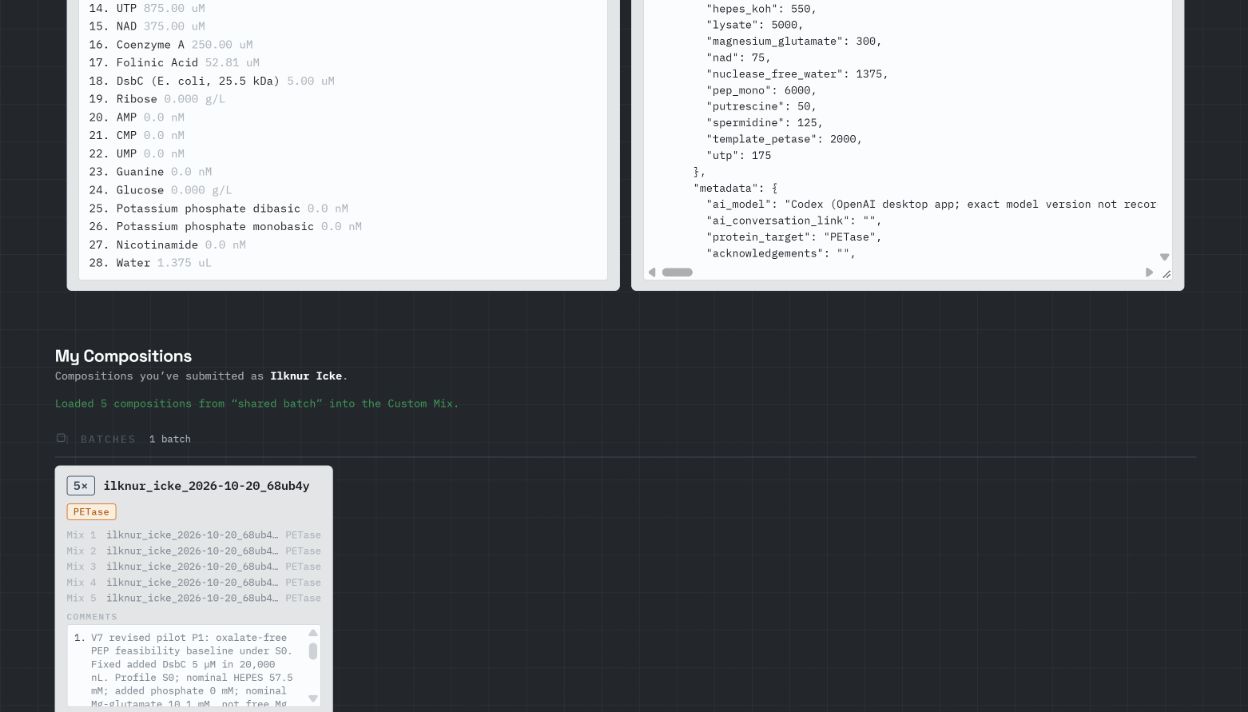
The receipt and screenshot record the state at submission. No new experimental outcomes are included.
Walkthrough and decision diagram
1. What the pilot actually compares
P2, P3 and P4 share the S1 backbone. S1 adds higher HEPES and phosphate together; S0 is the original support background. Added DsbC stays at 5 µM. Fixed total magnesium does not establish equal free magnesium across the formulations.
| Pilot | Added PEP/glucose | Support | Added oxalate | Role |
|---|---|---|---|---|
| P1 | PEP | S0 | None | PEP comparison under the original support inputs |
| P2 | Neither | S1 | None | Matched DNA-containing basal formulation |
| P3 | PEP | S1 | None | PEP formulation in S1 |
| P4 | Glucose | S1 | None | Glucose formulation in S1 |
| P5 | PEP | Course reference | 3.75 mM nominal | Fresh execution reference |
The primary contrast G = r(P4) − r(P2) estimates the functional change associated with adding glucose in S1. Secondary H = r(P3) − r(P2) provides context for PEP above the same basal formulation. P2 retains ATP, other nucleotides, glutamate and lysate; it is not energy-free. Neither contrast establishes glucose-driven ATP production. P1 versus P3 tests a combined support change rather than an individual HEPES or phosphate effect. There is no glucose/S0 arm and no S0 fallback.
2. Which controls answer which questions
| Control | Question answered |
|---|---|
| DNA-containing P2 | What activity remains in the matched S1 backbone without added PEP or glucose? |
| Fresh P5 reference | Is execution acceptable in this run under a prespecified reference criterion? |
| Matched no-template reactions | What background absorbance or hydrolysis occurs without the TfCut2 template? |
| Known pNP in matched matrices | Is product signal recovered acceptably across matrices? |
| Equal active TfCut2 added after CFPS to matched no-template mixtures | Do the spike results support acceptable comparability for the intended comparison? |
The last check requires performed and acceptable, not simply “checked.” Missing, failed or unresolved enzyme-interference checks mean hold the intended CFPS functional-output comparison until resolved. pNP recovery alone does not establish enzyme compatibility; automatic division by spike recovery is not a validated correction.
The incubated no-template spike matrices may differ chemically from DNA-containing spent samples. Passing supports assay comparability, while leaving residual matrix uncertainty; it does not prove that every matrix effect is absent or that protein abundance is equal. Interpret any accepted comparison as functional output under the specified assay, with that limit stated.
These controls require extra wells, materials and staff coordination. If they cannot be supported, an apparent-crude-mixture-activity study would need an explicit new rationale and decision plan. It is not an automatic fallback gate pass. Fresh F1–F4 matrices, including oxalate-containing mixtures, require their own checks.
3. What must happen before considering the follow-up
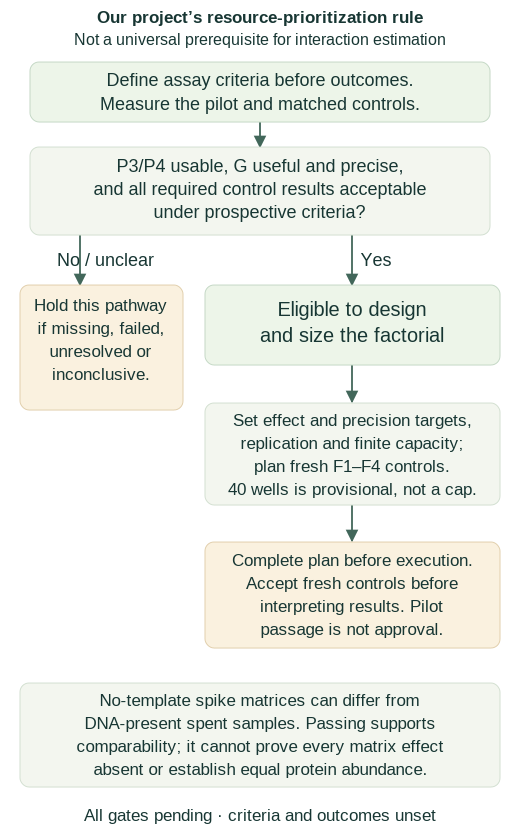
The pilot decision template remains pending. Establish the following prospectively from assay information and scientific priorities:
- A common rate unit and measurement basis, validated range, quantification limits and handling of censored/below-limit values.
- Reference, background, calibration, product-recovery and active-enzyme comparability criteria.
- A useful glucose-associated increment for G, required precision, uncertainty/decision rule and their rationale.
Do not invent numerical thresholds just to complete the document. Missing criteria or measurements cannot pass. For this project, require quantifiable, usable P3/P4 rates on the common validated basis and evaluate a useful positive G against its specified effect and precision requirements; report H and all underlying rates. This is a conservative resource-prioritization choice, not a universal statistical prerequisite for estimating an interaction.
Weak, failed or uncertain G evidence holds this proposed follow-up path while we reconsider the formulation, assay or replication. It does not establish that glucose cannot work or rule out a separately justified factorial. Any alternative path needs its own rationale and decision plan; there is no automatic pass.
A satisfactory pilot makes the factorial eligible for design and sample-size planning. It does not establish that a four-condition interaction can be estimated precisely with four technical replicates per condition. Complete the separate follow-up planning template, choosing relevant component-effect/interaction targets, precision requirements and replication using assay/pilot variability. Keep the gate pending until the corresponding requirements are met.
4. What the conditional factorial would establish
| Formulation | Without oxalate | With oxalate |
|---|---|---|
| PEP/S1 | F1 | F2 |
| Glucose/S1 | F3 | F4 |
F5 is a fresh course reference outside these four cells. Re-measure F1 and F3 in the fresh run even though their recipes repeat pilot conditions. Repeat matrix checks for all four cells.
The primary analysis stays on the additive rate scale:
E_PEP = r2 − r1; E_glucose = r4 − r3; I = E_glucose − E_PEP.
Report all four rates, both component effects and their uncertainty, alongside I. A hypothetical PEP change of 100 → 120 and glucose change of 20 → 24 gives I = 4 − 20 = −16, although both improve by 20%. Thus a negative additive interaction does not alone establish opposite signs or preferential biochemical inhibition. Relative effects can be exploratory for reliably positive, quantifiable baselines; do not change the primary scale after seeing outcomes.
This question concerns the supplied formulations and potassium-oxalate stock. It does not isolate free magnesium, ATP metabolism, protein mass or PET degradation. Extra basal ± oxalate formulations could address a stronger mechanistic question later; they are not required for the current two-formulation comparison.
5. Practical scope and current status
The pilot currently requests 20 experimental wells: four randomized technical replicates for each mix, plus extra controls. The follow-up has the same provisional allocation, subject to its separate precision and replication plan. The saved 40-well total across both stages is provisional, not a maximum; neither stage’s twenty wells are guaranteed sufficient or a cap. Independent runs may be needed.
At the saved allocation, estimated pilot reagents are about $113.94, and both stages about $227.88, excluding controls, labor and equipment. Availability still needs verification. The five-mix pilot has been submitted to the course site. No outcomes are measured, the criteria remain unset, and the follow-up remains conditional future work.
A. Design a batch of cell-free reactions
Question and rationale
My current question is: does adding glucose produce a useful change in TfCut2 functional activity above a matched S1 basal formulation? The intended endpoint is background-corrected initial soluble-ester hydrolysis rate measured in a validated assay. This is a functional-output comparison; it is not a measurement of ATP generation, protein mass or PET degradation.
Published glucose-supported CFPS compared glucose with synthesis without an added secondary energy substrate and adjusted buffer and magnesium conditions. That supports including a matched basal control and cautions against assuming that the course formulation will work with glucose. The paper also reported formulation-dependent oxalate effects; earlier work examined oxalate in PEP-based energy regeneration. These sources provide neither measured TfCut2 responses nor an effect size for this experiment. Calhoun and Swartz, 2005, full text, methods and Figure 2; Kim and Swartz, 2000, publisher record.
The conditional follow-up would ask whether adding potassium oxalate changes activity differently in the two specified energy formulations. Holding added DsbC at the course dose avoids simultaneously changing a folding helper. This does not establish that 5 µM DsbC is necessary or optimal.
Current batch: glucose versus a matched basal formulation
| Pilot | Added energy stock | Support | Added oxalate | Purpose |
|---|---|---|---|---|
| P1 | PEP | S0 | None | PEP baseline in the original support background |
| P2 | Neither PEP nor glucose | S1 | None | Matched basal formulation containing TfCut2 DNA |
| P3 | PEP | S1 | None | PEP formulation in the shared S1 background |
| P4 | Glucose | S1 | None | Glucose compared with the matched P2 baseline |
| P5 | PEP | Course reference | 3.75 mM nominal | Fresh positive execution reference |
P2, P3 and P4 have the same S1 backbone. P2 is neither energy-free nor a no-template blank: it retains ATP, other nucleotides, glutamate, lysate and TfCut2 DNA. The primary pilot contrast is G = r(P4) − r(P2). The secondary contrast H = r(P3) − r(P2) describes the PEP-associated change above the same basal formulation. Report all rates, both contrasts and their uncertainty. Glucose-associated functional benefit does not demonstrate a glucose-driven ATP mechanism.
P1 versus P3 compares a combined support change under PEP. S1 changes HEPES, phosphate and counterions together, so this contrast cannot isolate any one component. The pilot is not a complete energy × support factorial and supplies no glucose/S0 fallback.
| Support | HEPES-KOH stock, nL | Nominal total HEPES | Each phosphate-blend stock, nL | Total added phosphate |
|---|---|---|---|---|
| S0 | 550 | 57.5 mM | 0 | 0 |
| S1 | 900 | 75 mM | 200 | 10 mM |
The official kpo_monobasic_mix and kpo_dibasic_mix stocks are opposite 1.6:1 phosphate blends, each 0.5 M. Equal volumes combine their nominal mono/di inputs at 1:1; the stocks are not pure monobasic and dibasic phosphate. These additions do not establish the changing free phosphate pool during synthesis.
Where S1 came from and why it differs from the paper
S1 is my local label for an exploratory course formulation. It was defined in the original V7 batch builder by adapting the course reference, Cutinase_R2PC_016, to investigate concerns about glucose, buffering and phosphate raised by Calhoun and Swartz (2005). It is not a published TfCut2 recipe or a demonstrated optimum. S1 labels the shared buffer/phosphate support. P2 and P3 also use S1 and contain no added glucose. The paper’s glucose formulation and V7’s glucose condition P4, using S1 support, differ as follows:
| Input | Calhoun and Swartz glucose formulation | V7 glucose condition (P4, using S1) |
|---|---|---|
| Glucose | 30 mM | 5.5 g/L, approximately 30.5 mM |
| Buffer | 90 mM Bis-Tris | 75 mM nominal HEPES-KOH, using the course pH 7.5 stock |
| Added phosphate | 10 mM from dibasic potassium phosphate stock adjusted to pH 7.2 with acetic acid | 10 mM total from equal volumes of the two reverse phosphate blends; net nominal mono/di input ratio 1:1 |
| Nominal magnesium-glutamate input | 8 mM | 10.1 mM, including the course base-buffer contribution |
The paper values come from its methods and Table I (Calhoun and Swartz, 2005, pp. 607–610). Neither the stock pH nor the named buffer establishes the pH maintained during our reaction.
I used the mapped course stocks to make a practical 20 µL batch on the 25 nL transfer grid. The fixed base buffer already supplies 30 mM HEPES; adding 900 nL of 1 M HEPES-KOH supplies another 45 mM, giving 75 mM nominal total. Adding 200 nL of each 500 mM phosphate blend supplies 10 mM total added phosphate. The previously mapped blends were retained to keep the submitted matched design unchanged. The 75 mM HEPES level was a project choice to explore, not a value copied from Calhoun and Swartz’s optimum. On October 21, the course designer marked Bis-Tris as not in stock and suggested HEPES-KOH pH 7.5 as the closest substitute. This stock-availability guidance does not establish equivalent buffering or biological performance.
Keeping the course magnesium input and 5 µM added DsbC the same across P2, P3 and P4 makes the glucose-versus-basal comparison easier to interpret without changing a folding helper at the same time. It may miss a glucose-specific magnesium optimum, and more HEPES may not prevent acidification. P1 versus P3 tests the combined HEPES/phosphate support change, not either component alone. A negative pilot would therefore apply to this course adaptation, not glucose-supported CFPS in general. Fu et al.’s formulation informed the earlier V6 alternative; it was not the source of S1. Olsen et al.’s 75 mM HEPES example is context from a different formulation, not the historical derivation of S1.
PEP is 6,000 nL of 100 mM stock, or 30 mM final. Glucose is 550 nL of 200 g/L stock, or 5.5 g/L, approximately 30.53 mM final. Similar molarity does not match carbon input, usable energy or ATP yield. Omitted stock volume is replaced with water.
| Pilot | Energy stock, nL | Support | Oxalate stock, nL | Water, nL |
|---|---|---|---|---|
| P1 | PEP 6,000 | S0 | 0 | 1,375 |
| P2 | Neither PEP nor glucose | S1 | 0 | 6,625 |
| P3 | PEP 6,000 | S1 | 0 | 625 |
| P4 | Glucose 550 | S1 | 0 | 6,075 |
| P5 | PEP 6,000 | Course reference | 150 | 1,225 |
P5 exactly reproduces Cutinase_R2PC_016, including its S0 HEPES/phosphate inputs. It anchors execution quality; it does not replace matched S1 baselines. Its 150 nL of 500 mM potassium-oxalate stock supplies 3.75 mM nominal added solute.
Fixed recipe backbone
All ten saved pilot/follow-up recipes use 20 µL total and the official course PETase target, corresponding to the TfCut2 template. The following fixed transfers are in nL; the tables above and below specify the remaining ingredients.
| Fixed reagent | nL | Fixed reagent | nL |
|---|---|---|---|
| Lysate | 5,000 | TfCut2 DNA (template_petase) | 2,000 |
| Base buffer | 2,000 | DsbC, 100 µM stock | 1,000 |
| Magnesium glutamate | 300 | Ammonium glutamate | 200 |
| Amino-acid mixture 17 | 400 | Folinic acid | 50 |
| CoA | 100 | NAD | 75 |
| Putrescine | 50 | Spermidine | 125 |
| ATP | 250 | CTP | 175 |
| GTP | 175 | UTP | 175 |
These inputs give 5 µM added DsbC, 10.1 mM nominal magnesium including base buffer, 1.25 mM ATP, and 0.875 mM each CTP/GTP/UTP. Equal total magnesium does not establish equal free magnesium after changing PEP, phosphate or other ligands. Lysate contributions are not fully quantified. Each recipe totals 20,000 nL, with positive transfers on the 25 nL grid. Exact formulation plan.
Measurement controls and the intended claim
Measure initial pNP production in matched matrices using a common validated dilution, temperature, substrate concentration and linear time window. Record the rate units and basis explicitly before evaluating outcomes. The intended comparison concerns CFPS-produced functional output as assayed, with direct matrix interference shown to be acceptably controlled; it does not distinguish protein amount from folding or other causes of functional change.
| Control | Purpose | Limit |
|---|---|---|
| DNA-containing P2 basal formulation | Compare glucose and PEP additions with the same basal reaction | Cannot remove every energy source or establish an ATP mechanism |
| Fresh P5 reference | Check same-run reaction and assay execution | Cannot establish glucose-associated benefit |
| Matched no-template/background reactions | Estimate background hydrolysis and absorbance | Cannot exclude enzyme inhibition |
| Known pNP product in matched assay matrices | Test product recovery and calibration | Cannot establish unaffected enzyme catalysis |
| Equal active TfCut2 added after CFPS to matched no-template mixtures | Test direct effects of residual ingredients on the enzyme assay | Supports comparability; cannot exclude every matrix effect, identify synthesis/folding changes or establish equal protein abundance |
The active-TfCut2 check must be performed and acceptable under prespecified comparability criteria. Missing, failed or unresolved checks mean hold the intended CFPS functional-output comparison and its follow-up until the issue is resolved. Passing pNP product recovery alone cannot pass this requirement. Dividing observed rates by spike recovery is not an automatic validated correction.
No-template mixtures incubated through CFPS can differ chemically from the DNA-containing spent samples because synthesis and substrate consumption differ. Acceptable spike recovery supports assay comparability; it does not prove that every matrix effect is absent or that samples contain equal amounts of protein. That limitation remains part of the functional-output interpretation even when the check passes.
If staff cannot support these checks, an apparent-crude-mixture-activity study could be designed with its own rationale and decision plan. That would be a different, explicitly chosen claim; it is not an automatic fallback that passes this gate. Repeat appropriate checks for every fresh F1–F4 assay matrix, including oxalate-containing matrices: the pilot does not validate the later matrices. Control plan; blank measurements.
Pilot decision gate: pending
Before interpreting results, establish assay-informed criteria in the pilot decision template:
- The common rate units/basis, validated range, quantification limits and treatment of censored or below-limit values.
- Reference acceptance, background, calibration and product-recovery requirements.
- Acceptable direct-enzyme-interference comparability, assessed separately from product recovery.
- A scientifically useful glucose-associated increment for G, the required precision, and the uncertainty/decision rule with their rationale.
These entries remain unset. They must be fixed prospectively using assay information and scientific priorities; arbitrary values must not be invented simply to complete the template. Missing measurements or criteria cannot pass. P3 and P4 must both have usable, quantifiable rates under a common validated assay basis; a rate barely above the limit is insufficient if uncertainty prevents a useful decision. Report H as context alongside the primary G contrast.
Requiring a useful positive G and quantifiable P3/P4 rates is this project’s conservative resource-prioritization gate. A positive glucose benefit is not a universal statistical prerequisite for estimating an energy-formulation × oxalate interaction. A different scientific priority could justify a factorial even without that benefit, provided its assay validity, precision and design are justified separately.
If G does not satisfy the prespecified useful-effect and precision requirements, or the evidence is inconclusive, hold this proposed follow-up path and reconsider the formulation, assay or replication. This does not establish that glucose cannot work. Any alternative study needs an explicit new rationale and decision plan; it does not inherit an automatic gate pass. A pilot passing every recorded criterion means eligible to design and size a fresh factorial, not automatically ready to execute the saved well allocation.
Conditional follow-up: formulation × oxalate
| Follow-up | Energy stock, nL | Support | Oxalate stock, nL | Water, nL |
|---|---|---|---|---|
| F1 | PEP 6,000 | S1 | 0 | 625 |
| F2 | PEP 6,000 | S1 | 150 | 475 |
| F3 | Glucose 550 | S1 | 0 | 6,075 |
| F4 | Glucose 550 | S1 | 150 | 5,925 |
| F5 | PEP 6,000 | Course reference | 150 | 1,225 |
F1–F4 cross two specified energy formulations with 0/3.75 mM nominal added potassium-oxalate solute in S1. F5 is a fresh course reference outside the factorial. Although P3/F1, P4/F3 and P5/F5 repeat recipes, their baselines must be measured again within the follow-up run. Provisional recipe export; validation.
For background-corrected initial rates r1–r4, define the PEP oxalate effect E_PEP = r2 − r1, the glucose oxalate effect E_glucose = r4 − r3, and the primary additive interaction:
I = E_glucose − E_PEP = (r4 − r3) − (r2 − r1).
The directional hypothesis is I < 0 on this absolute rate-difference scale. Report all four rates, both component effects, I and their uncertainties. A negative I alone does not establish opposite signs or preferential biochemical inhibition.
For a hypothetical illustration only, if PEP activity changes from 100 to 120 rate units and glucose from 20 to 24, I = 4 − 20 = −16 even though both increase by 20%. This is an additive interaction, not evidence that oxalate inhibits the glucose formulation. Relative effects may be exploratory only when baselines are reliably positive and quantifiable; do not switch the primary scale after seeing results.
A separate follow-up planning template must specify minimum relevant component effects and interaction, precision requirements and replication using assay/pilot variability before execution. Pilot precision for G does not establish precision for I. Four technical replicates per condition are merely the saved provisional planning request, not a power guarantee or a cap. Independent runs may be required. Confirm repeat reference and matrix-interference acceptance for the fresh run.
No extra basal ± oxalate conditions are required for this two-formulation comparison. They could support a stronger glucose-specific question in future work. The present comparison does not isolate an ATP mechanism, free-magnesium effect or oxalate-ion mechanism: the exact counterion stoichiometry of the supplied potassium-oxalate stock is not independently pinned down.
Feasibility and scope
The saved planning allocation requests four randomized technical replicates for each of five conditions: 20 experimental wells per stage, excluding additional controls. Technical replication estimates within-run variation; it is not independent biological replication or guaranteed power. The follow-up allocation must be reconsidered after pilot/assay planning. The saved 40 experimental wells across both stages are a provisional total, not a maximum or a cap.
At that provisional allocation, the current pilot reagent estimate is approximately $113.94, and both stages would total about $227.88 before controls, labor and equipment. DsbC alone is $112.64 per stage at the app price. Later sample allocation changes would change costs. These are not measured cost-per-activity results. Cost audit.
The official schema recognizes glucose, and the live site accepted the glucose-containing composition. The app lists glucose without a course export-key mapping; these direct exports use the official key. Validation and submission check composition constraints, not physical stock availability, course selection or experimental success. Only the five-mix pilot was submitted; the factorial remains future work. Confirm execution and control-material availability with the organizers.
B1. Current status of my optimization ideas
The current design is unmeasured. I am prioritizing a glucose-associated functional contrast above a matched basal formulation, with assay-validity and precision criteria established before outcome interpretation. Under my conservative resource-prioritization policy, satisfactory pilot evidence would support designing and sizing a fresh formulation–oxalate experiment. This is a project choice rather than a universal requirement to estimate an interaction; another path would require its own rationale and plan. I have not trained a TfCut2 surrogate or transferred an sfGFP forecast to it. Live validation flagged overlap for the intentionally repeated P5 course reference. Recipe distinctiveness would not establish biochemical novelty or superior performance. Previous local versions remain preserved.
B2. Comparing plate formats
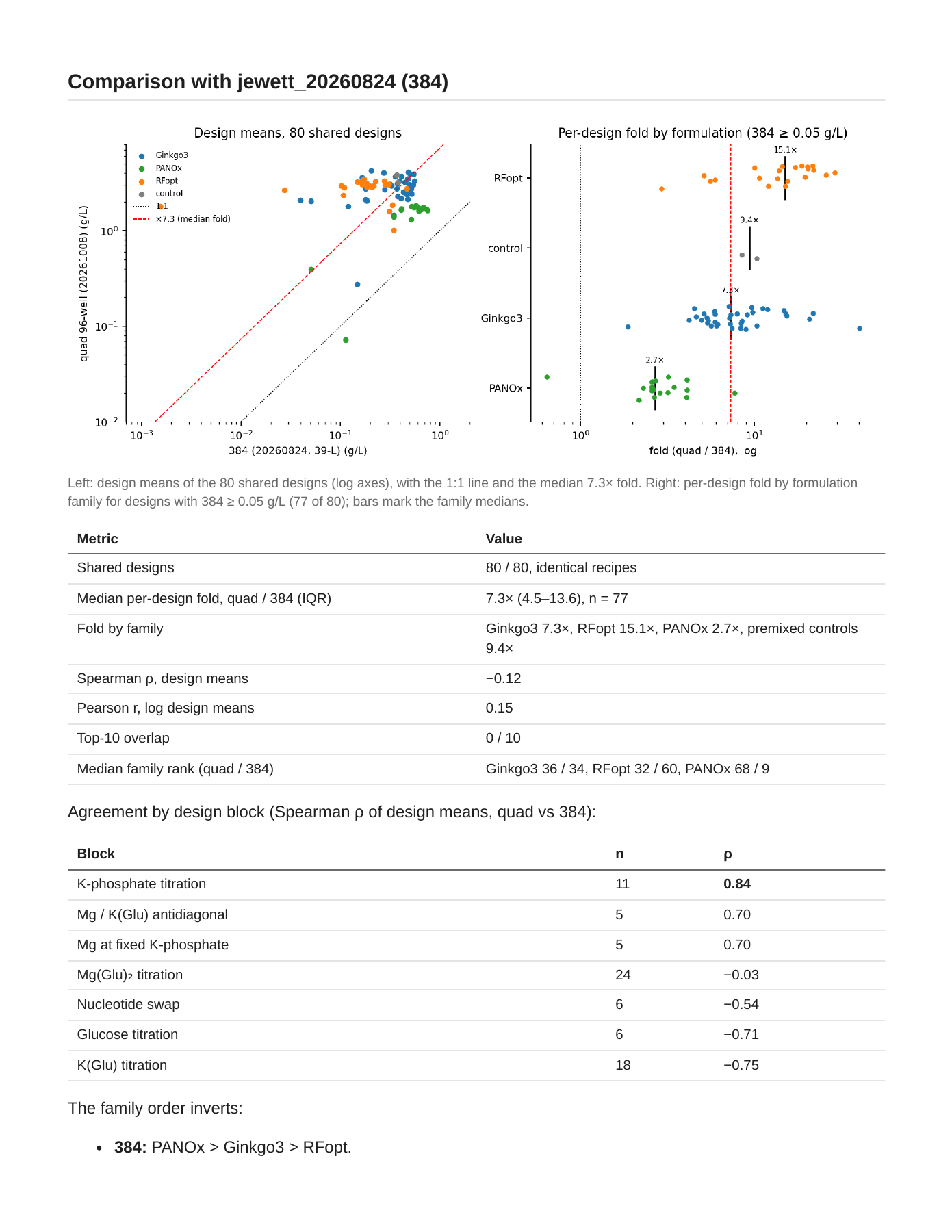
The supplied report shows higher sfGFP concentrations and different recipe rankings in the later deep-well setup. It also qualifies the assignment’s “same 20 µL” wording: the original incubation used 20 µL in a 384-well plate, while the later run incubated 40 µL across four 96-well deep-well plates, then transferred material to a 384-well read plate. The 20,000 nL JSON and read coordinates do not specify that later incubation vessel or volume. Report, p. 2.
Across 80 shared measured groups—78 disclosed recipes and two premixed controls—excluding report-listed isolated dropouts gives:
| Result | Original 384-well | Later deep-well |
|---|---|---|
| Median retained design-well concentration | 0.356 g/L | 2.714 g/L |
| Median within-group replicate CV | 14.56% | 7.20% |
| Groups with CV above 20% | 32/80 | 4/80 |
For 77 groups with original mean at least 0.05 g/L, the median paired increase was 7.32-fold (IQR 4.51–13.64). The official processed concentrations are already calibrated and dilution-corrected. Across all 80 group means, Spearman rank correlation was −0.125, with no shared top-ten members: this was not a uniform response multiplier. Reproduction data; CSV.
Better oxygen transfer could aid oxidative energy regeneration. Evaporation could increase concentration without a proportional increase in protein mass. Date, base-buffer lot, preparation, reaction volume, compression and reading also differ. Estimated calibration-shape differences were about 1.3-fold over the sample range; later standards were not incubated in deep wells and cannot correct incubation evaporation. The comparison therefore does not isolate a single cause. Report, pp. 2–3, pp. 7–9.
I would measure recovered volume and plate mass, compare protein mass with concentration, and vary aeration while matching volume, seals, humidity and lots. For my experiment, I would match physical execution within a stage and repeat its reference and baselines.
B3. One experiment-selection criterion
Expected interpretable information: prioritize a clear, matched comparison with feasible controls and prespecified decisions. A proposal should remain informative when results are weak or uncertain, without turning a noisy functional signal into a mechanistic claim.
C. Optional agentic contribution
I used Codex to develop the plan, map course stocks, validate compositions, analyze the supplied plate report and prepare this write-up. With my authorization, Codex used an agent token for live validation and the signed-in official interface to submit the five-mix pilot. The saved compositions were then checked against the validated export. The site generated new sample IDs; reagent volumes, targets, the overall hypothesis and per-mix rationales are unchanged. The receipt above records the ID mapping. No new measured data were generated. All earlier versions remain preserved locally.
AI assistance
Client: Codex, OpenAI desktop app; exact model version was not recorded. AI assisted with experimental reasoning, calculations, validation, analysis and writing. I remain responsible for explaining and justifying the design.
Design plan · Source mapping · Literature review · Official course package
References
Direct design rationale
- Calhoun, K. A., and Swartz, J. R. (2005). Energizing cell-free protein synthesis with glucose metabolism. Biotechnology and Bioengineering, 90(5), 606–613. The methods, Figure 2 and Table I motivate the glucose/basal comparison and explain why buffer, phosphate and magnesium matter; they do not validate V7 S1.
- Kim, D.-M., and Swartz, J. R. (2000). Oxalate improves protein synthesis by enhancing ATP supply in a cell-free system derived from Escherichia coli. Biotechnology Letters, 22, 1537–1542. This supports the PEP/oxalate background. The publisher abstract was reviewed; subscription full text was not obtained.
- Kim, D.-M., and Swartz, J. R. (2001). Regeneration of adenosine triphosphate from glycolytic intermediates for cell-free protein synthesis. Biotechnology and Bioengineering, 74(4), 309–316. This supplies context for glycolytic ATP regeneration. The abstract was reviewed; the discussion of detrimental oxalate effects in the glucose context follows Calhoun and Swartz’s account, not an independent review of this paper’s full text.
Related formulation, TfCut2 and computational context
- Olsen, M. L., et al. (2026). Design-driven optimization of low-cost reagent formulations for reproducible and high-yielding cell-free gene expression. Nature Communications, 17, 3478. Its RFopt formulation provides a 75 mM HEPES precedent in a different recipe, including different phosphate, magnesium and energy-substrate inputs; it is not the S1 formulation.
- Fu, C., et al. (2026). A cell-free platform for the high-efficiency synthesis and screening of PET hydrolase. Journal of Biotechnology, 417, 101–107. The supplied article and supplement informed the TfCut2/assay discussion and earlier V6 alternative. They did not provide measured TfCut2 responses across DsbC doses or the origin of S1.
- Smith, A. A., Wong, E. L., Donovan, R. C., et al. (2026). Using a GPT-5-driven autonomous lab to optimize the cost and titer of cell-free protein synthesis. bioRxiv preprint. This provides computational cost/titer optimization context, not evidence of TfCut2 performance or a trained TfCut2 surrogate. Author-hosted full text.
Course data and methods
- Official autonomous-CFPS course package: the course stock definitions, Pydantic validator and
Cutinase_R2PC_016reference used for the submitted compositions. - Supplied sfGFP plate-format report:
sfGFP_control_20260722-39-L_96w_report.pdf, the data source for Section B2; local reproduced analysis.
Assignment prompts
The following is Section 4 of the supplied revised assignment, with line wrapping normalized and its links retained.
4 WEEK 4 ASSIGNMENT CFPS REACTION DESIGN FOR SFGFP PETASE RETEPLASE
Due: October 20, 2026
Copy and paste this section (section 4) into your website!
- coopetition.htgaa.org is intended to support you as you answer these questions.
- Download the Pydantic model and raw data files for the coopetition here.
A DESIGN A BATCH OF CELL FREE REACTION COMPOSITIONS
When designing experiments, you’ll often want to compare several conditions that differ only slightly, such as one reagent at a few different concentrations, and batches let you submit those together. To make a batch, click “+ add mix” in the designer to copy your current composition into additional columns, change reagent(s) to a different concentration in each column, add an overall hypothesis plus a short rationale for each mix when submitting.
You should batch experimental conditions that are intended to be directly compared with each other. When we pick the final experimental conditions, we’ll try to include whole batches rather than splitting them up.
A batch is a JSON object with an overall experiment_hypothesis and a samples list. Each item in the list is a dictionary for one composition: a unique sample_id and reagent_list of reagent volumes in nL that sum to exactly 20,000, and metadata with that composition’s protein_target and comments.
For example, to specify a parameter sweep, you keep every sample identical except the reagent you’re varying, and adjust water to keep the total at 20,000 nL:
B RESEARCH TEAM DISCUSSION DATA ANALYSIS METASCIENCE
Research Team Discussion: We’d like a few HTBAA members to share their approach to experimental design during the recitation meeting on Thursday (5-6:30 PM ET) with the Adamala, Borkowski, and Styczynski labs. If you are willing to share a short 2-3 minute synopsis (no slides required), please sign up by Thursday (Oct 15).
Note: ideas at any stage are encouraged: a single hypothesis, an experimental batch you’re planning, broader topics you are investigating, or computational methods you are trying. The goal is to facilitate a rich discussion with these leading cell-free research labs and to welcome them to our community!
Even if you do not wish to sign up to share publicly, please document on your homework page the current status of your CFPS optimization ideas!
Data Analysis: Familiarize yourself with the autonomous-cfps repository. Experimental results are stored in
autonomous_cfps/data/reference_setand data analysis files are in thereference_resultsfolder. Review thesfGFP_control_20260722-39-L_96w_report.pdf. What does it show about how the same 20 µL sfGFP reaction performs in a 384-well plate versus a 96-well deep-well plate? Can you suggest what might explain some of the differences (for example: oxygen access, evaporation).Metascience: With hundreds of proposed reactions and a limited number of experimental wells during round 1 of the coopetition, deciding which experiments to run is itself a scientific question. A shared rubric, a set of criteria we score every proposal against, can make that choice transparent and fair. Propose one rubric criterion you think we should use to decide which experiments make it onto the plate, and explain in a sentence or two why it matters. Examples include novelty relative to what’s already been tested, the strength of the hypothesis, or the expected information gain.
C AGENTIC CONTRIBUTION OPTIONAL
coopetition.htgaa.org has been updated to allow for AI agents to programmatically create and submit CFPS compositions based on your guidance. Visit the Agent tab to generate an agent token which can be used for interacting with the website.
Your AI agent can design and submit reagent compositions (singly or in batches), edit, reorder or delete your contributions, star and comment on other compositions, suggest, upvote and comment on community reagents, add, edit and upvote papers in the literature list, and read the approved reagent list.
(optional) try making a CFPS design using your agent and document the experience on your webpage!
4 Use of AI
You are encouraged to use AI and online tools for this assignment to assist your reagent composition development process. As you will present your work during recitation, you must be able to explain and justify the reasoning behind your design.
If you use AI, ensure that you cite the AI client and your prompts used.