Week 2 HW: DNA Design
Part 0: Set up in Kernel
- Repository name: HA-Neural-Hydrogels_Israel_Herrera
- Folder: herrera-ha-neural
- Current construct: Bsub-UDPGlcDH-Bmeg-v1
- Initial construct name: Bsub-TuaD-expression-v1
I renamed the construct to distinguish the expression host, Bacillus subtilis, from the source of the selected enzyme, Bacillus megaterium.
Part 1: Define your expression target
What molecule are you expressing?
I am designing an expression module for UDP-glucose 6-dehydrogenase (UDP-GlcDH) from Bacillus megaterium.
This enzyme converts UDP-glucose into UDP-glucuronic acid, one of the two sugar precursors needed to produce hyaluronic acid (HA). My goal is to investigate whether additional expression of this enzyme could improve precursor availability in an engineered Bacillus subtilis host.
This connects to my HW1 proposal: producing HA for hydrogel microcolumns for dopaminergic tissue engineering research. The immediate output of this HW2 construct is an enzyme, not a complete scaffold.
What is the sequence?
I selected the coding sequence from iGEM part BBa_K1469002, imported through the iGEM Part Registry in Kernel.
The part is identified as UDP-glucose 6-dehydrogenase from Bacillus megaterium. Its coding sequence is 1,338 bp, including an ATG start codon and a TAA stop codon, and encodes a 445-amino-acid protein.
My initial plan referred to the native Bacillus subtilis tuaD gene. The selected part instead encodes an enzyme from Bacillus megaterium with the same general precursor-producing role. I therefore updated the target description and construct name.
The selected CDS occupies bases 121–1458 in the exported construct. Its complete DNA sequence and translated protein sequence are included in the GenBank file linked below.
Source: iGEM BBa_K1469002.
What host or chassis?
The proposed expression host is an engineered Bacillus subtilis strain.
For the broader HA-production project, I assume that the host also contains a functional hyaluronan synthase and can supply the other required precursor, UDP-N-acetylglucosamine. These are requirements of the broader system and are not supplied by this single-enzyme construct.
Increasing UDP-glucose dehydrogenase expression is a hypothesis to test. It does not establish that this reaction is the main bottleneck, and this enzyme alone is insufficient to produce HA.
Where does the product need to go?
UDP-glucose dehydrogenase should remain in the cytoplasm, where its substrates are available. I therefore did not add a secretion signal peptide or a targeting tag.
The enzyme is the intracellular expression target. HA is the downstream material intended for recovery and processing in the broader HW1 project.
Part 2: Design your genetic parts
Part 1 — Pveg promoter
Part type: Promoter.
Short name: Pveg.
Kernel part: Pveg_BBa_K143012.
Sequence, 5′→3′ — 97 bp:
AATTTTGTCAAAATAATTTTATTGACAACGTCTTATTAACGTTGATATAATTTAAATTTTATTTGACAAAAATGGGCTCGTGTTGTACAATAAATGT
Source: Kernel entry attributed to iGEM BBa_K143012.
Justification: I selected Pveg as a constitutive promoter for transcription in Bacillus subtilis, allowing expression without an added inducer.
Limitation: Its expression level in this particular construct has not been measured.
Part 2 — Ribosome binding site
Part type: Ribosome binding site (RBS).
Short name: RBS_K780001.
Kernel part: BBa_K780001.
Sequence, 5′→3′ — 16 bp:
ATATTAAGAGGAGGAG
Source: iGEM BBa_K780001, imported through Kernel.
Justification: I selected this part because its registry description identifies it as a strong RBS for Bacillus subtilis.
Limitation: “Strong” describes the source annotation, not a measured result for my construct. Translation also depends on the surrounding sequence and its spacing relative to the start codon.
Part 3 — Designed RBS–CDS spacer
Part type: Miscellaneous noncoding DNA.
Short name: RBS_CDS_spacer_7A.
Sequence, 5′→3′ — 7 bp:
AAAAAAA
Source: Designed for this construct.
Justification: I added seven adenines between the selected RBS part and the CDS to provide separation before the translation start codon.
Studies in Bacillus subtilis show that spacer length can affect protein production. This supports testing spacer designs, but does not establish that seven adenines are optimal for my particular RBS–CDS combination.
Limitation: This is an initial design assumption requiring experimental evaluation.
Part 4 — UDP-glucose dehydrogenase CDS
Part type: Coding sequence with start and stop codons.
Short name: UDPGlcDH_Bmeg.
Kernel part: BBa_K1469002.
Sequence: 1,338 bp; bases 121–1458 in the downloadable GenBank file. The sequence begins with ATG and ends with TAA.
Source: iGEM BBa_K1469002, identified as UDP-glucose 6-dehydrogenase from Bacillus megaterium.
Justification: This enzyme supplies UDP-glucuronic acid, allowing me to investigate one precursor-producing step relevant to HA biosynthesis.
Sequence check: Translation of the exported CDS gives 445 amino acids with no internal stop codons.
Limitation: The registry reports results involving co-expression with gtaB. Those results do not isolate the effect of this enzyme alone or establish the performance of my construct.
Part 5 — rrnB T1 terminator
Part type: Transcriptional terminator.
Short name: rrnB_T1.
Kernel part: BBa_B0010.
Sequence, 5′→3′ — 80 bp:
CCAGGCATCAAATAAAACGAAAGGCTCAGTCGAAAGACTGGGCCTTTCGTTTTATCTGTTGTTTGTCGGTGAACGCTCTC
Source: iGEM BBa_B0010, the rrnB T1 terminator from Escherichia coli.
Justification: I selected this terminator to end transcription after the CDS, with precedent for its inclusion in the related HA precursor-expression design BBa_K2593008.
Limitation: Its termination efficiency in my Bacillus subtilis construct remains unverified. Reported measurements in E. coli cannot be assumed to apply directly to this host.
Part 6 — pHY300PLK backbone
Part type: Backbone.
Short name: pHY300PLK_K4202016.
Kernel part: BBa_K4202016.
Sequence: 4,870 bp; bases 1539–6408 in the downloadable GenBank file.
Source: iGEM BBa_K4202016, imported through Kernel.
Justification: pHY300PLK is a shuttle vector for E. coli and Bacillus subtilis, providing replication functions and a tetracycline-resistance marker suitable for selection in B. subtilis.
Reference: Published nucleotide sequence of pHY300PLK.
Limitation: I assume that this registry entry retains the vector’s functional replication and selection elements. The exported backbone lacks detailed internal annotations, so these functions and the insertion-site integrity remain to be verified before physical construction.
Part 3: Assemble your construct
Construct organization
I assembled the parts in the following order:
Pveg → RBS → 7A spacer → UDP-GlcDH CDS → rrnB T1 terminator → pHY300PLK backbone
The exported construct is annotated as circular and contains 6,408 bp.
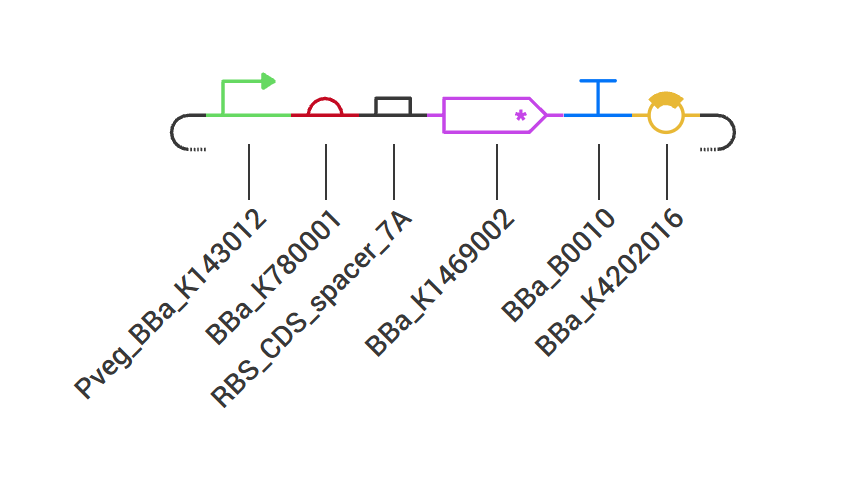
Figure 1. Kernel schematic showing the selected parts and the designed RBS–CDS spacer. Symbols are not drawn to scale.
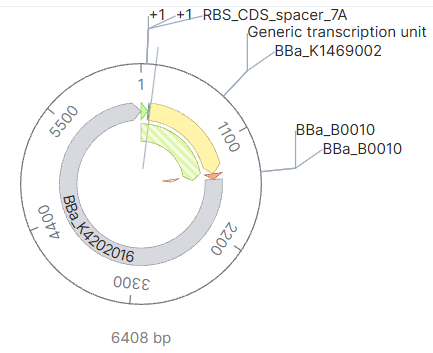
Figure 2. Circular map of the 6,408 bp construct.
Sequence-level checks
Analysis of the exported GenBank file confirmed:
- The annotated parts follow the intended order and orientation.
- The RBS contains 16 bases.
- The seven-adenine spacer is located immediately before the CDS.
- The CDS is 1,338 bp long, begins with ATG, and ends with TAA.
- The CDS encodes 445 amino acids without internal stop codons.
- The calculated protein sequence matches the translation exported by Kernel.
These checks confirm sequence organization and an intact coding frame. They do not demonstrate expression, enzyme activity, plasmid stability, or improved HA production.
Download: Annotated construct — GenBank.
Interpreting Kernel warnings
Kernel reported warnings requesting a double stop codon, Kozak and UTR parts, poly(A) signals, and recommended parts.
The CDS already ends in a valid TAA stop codon. I retained this single stop rather than changing the sequence solely to satisfy the program’s double-stop rule.
The Kozak and poly(A) warnings reflect expectations that do not match this bacterial expression design. I used an RBS and a bacterial transcriptional terminator. Bacteria can have untranslated regions, but the absence of separately labeled UTR parts does not establish that the transcript lacks them.
The “not recommended” messages do not explain their criteria. I therefore documented the sources and limitations of the selected parts rather than treating these messages as proof of biological incompatibility.
These design warnings are separate from the safety screen required in Part 4.
Part 4: Optimize and quality-check
Codon optimization — pending due to tool limitations
I opened Kernel’s coding-sequence optimization tool for BBa_K1469002 and disabled signal-peptide addition because the enzyme is intended to remain in the cytoplasm. However, the available host options did not include Bacillus subtilis, and I did not find an option to supply a custom codon-usage table. I therefore retained the original CDS rather than optimizing it for an unrelated organism. Codon optimization would change synonymous DNA codons while preserving the protein sequence, potentially affecting translation and expression in the selected host. No optimized sequence was generated, so a before-and-after comparison and host-specific optimization remain pending.
Sequence identity search — NCBI BLAST
I searched the 1,338 bp CDS of BBa_K1469002 using NCBI nucleotide BLAST against the core_nt database, without restricting the organism. The two highest-scoring matches were Priestia megaterium DSM 319 genome records CP120609.2 and CP001982.1, both showing 99.85% identity, an E-value reported as 0.0, and query coverage displayed as 100%
Biosecurity screening
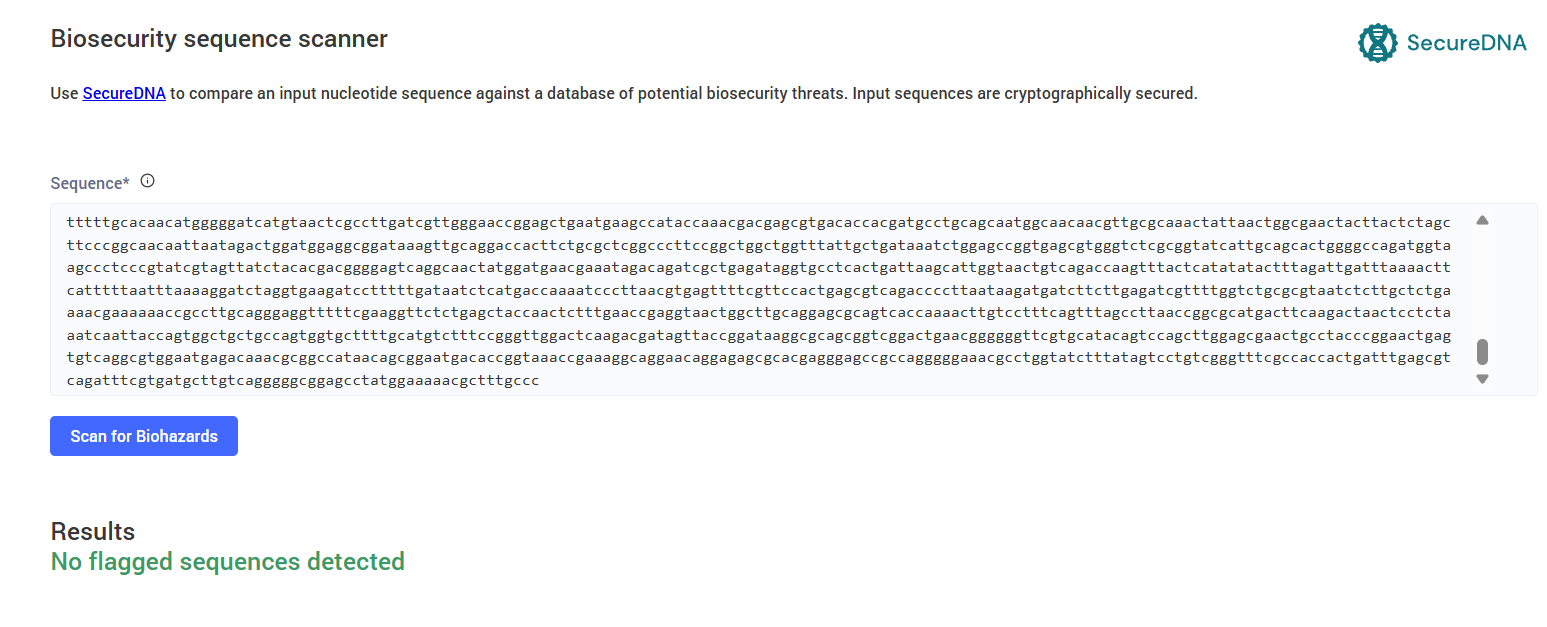
I screened the submitted construct DNA using Kernel’s Biosecurity sequence scanner, powered by SecureDNA. The tool compares nucleotide sequences against a database of potential biosecurity threats and returned “No flagged sequences detected.” No sequence alerts were reported for this submission. This result does not establish construct functionality or replace an assessment of the host and intended experimental use.
Part 5: From design to build
Proposed construction strategy
The current circular construct is 6,408 bp long, comprising a 1,538 bp expression cassette and a 4,870 bp backbone. For an initial prototype, I would obtain the expression cassette as synthetic DNA and assemble it into a verified pHY300PLK backbone using Gibson assembly. This approach joins DNA fragments with overlapping ends and would allow me to reuse the backbone rather than synthesize the entire plasmid (Gibson et al., 2009). Before ordering DNA, I would verify the insertion location and assembly junctions to ensure that essential backbone functions remain intact. The current software construct is therefore a preliminary design rather than a finalized build specification.
Synthesis constraints and sequence verification
The design contains a seven-adenine spacer and an inverted-repeat region associated with the terminator. These features warrant review during synthesis assessment, although their presence alone does not demonstrate that synthesis will fail. I have not yet obtained a supplier’s sequence-complexity report. If synthesis difficulties arise, the cassette could be divided into smaller fragments while preserving its intended biological functions.
Carr et al. (2004) demonstrated protein-mediated error correction using mismatch recognition to reduce errors in synthetic DNA. This supports including error correction where appropriate, followed by sequence verification of the assembled plasmid; error correction would not replace final verification.
Prototype versus production scale
For prototyping, I would build and sequence-verify a small number of constructs to compare expression and enzyme activity. For HA production at larger scale, the main requirement would be propagation of a validated engineered strain and control of the fermentation process, rather than repeated synthesis of the plasmid. Producing 10,000 scaffolds would not require ordering 10,000 DNA constructs. Plasmid retention and expression stability during cultivation would need to be demonstrated before scaling up.
References
Gibson, D. G., et al. (2009). Enzymatic assembly of DNA molecules up to several hundred kilobases. Nature Methods, 6, 343–345. https://doi.org/10.1038/nmeth.1318
Carr, P. A., et al. (2004). Protein-mediated error correction for de novo DNA synthesis. Nucleic Acids Research, 32(20), e162. https://doi.org/10.1093/nar/gnh160
Part 6: What don’t you know yet?
1. Will the expression cassette produce active enzyme?
The promoter, RBS, spacer, and terminator have not been experimentally validated together in this construct. An intact coding sequence does not guarantee sufficient expression or active protein. I would measure transcript abundance, protein expression, and UDP-glucose dehydrogenase activity, comparing the construct with an appropriate control. If necessary, I would compare alternative promoter or RBS designs.
2. Will increasing this enzyme’s expression improve HA production?
The design assumes that UDP-glucuronic acid availability limits HA production, but this has not been established. The engineered host must also supply the other precursor and express functional hyaluronan synthase. I would compare HA concentration, molecular-weight distribution, and cell growth between the parental HA-producing strain and the strain carrying this expression module. This would test whether the added module improves the desired material rather than merely increasing enzyme expression.
3. Will the plasmid remain functional and stable?
The backbone’s insertion site and functional features still require verification, and plasmid retention during prolonged cultivation is unknown. I would first verify the complete assembled sequence and its junctions, then evaluate plasmid retention and expression over successive generations under the intended cultivation conditions. These results would help determine whether the plasmid design is adequate or whether a different vector strategy should be considered.
AI assistance
AI client: OpenAI ChatGPT.
I used ChatGPT to explain genetic parts, help document design choices, interpret Kernel warnings, and analyze the exported GenBank sequence. AI assistance does not replace experimental validation.
AI Client: Consensus
Purpose of use: Literature research
The sequence checks reported here were performed on the exported file. Codon optimization, sequence searches, and safety-screen results are still pending.