I’m an organizer and designer based in/around Chicago. My interests center primarily around sustainability, focused around DIY and radically accessible processes of development that can augment daily urban life. My research background largely involved the use of fungi across lifestages as tools for intervention.
Contact info
Homework, Labs, and Projects
See the nav bar on the left to look through my work for How To
Biomanufacture Almost Anything (Fall 2026)!
(1) What you would like to biomanufacture and why?
Pigment(s) using mushroom spores, initially using Coprinus spp. native to Illinois’ ecology to evaluate/demonstrate the viability of using mushroom spores in this manner (5.).
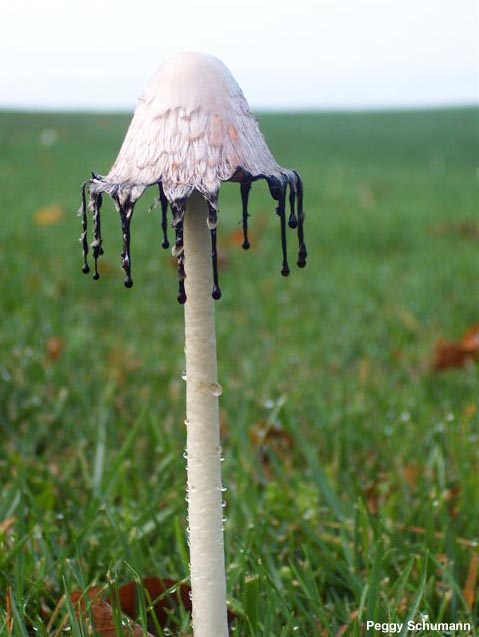
If successful, this could pave the way for further development of spore-based pigments to replace or augment the production and use of existing pigments. Coprinus spp. are initially selected since the spore slurry they produce is black, which is used very commonly across applications, and for their deliquiescent property, making pigment collection easier as well as possibly including endogenous products that can aid in viscosity/flow.
Following initial demonstration of viability, other species can be evaluated to broaden the possible range of pigments in this manner, such as Ganoderma spp., which produce reddish-brown spores, Chlorophylum molybdites to produce light green spores, Pluteus spp. to produce pink spores, and beyond.
The most interesting improvement spore-based inks pose is not in production however, but end-of-life. While spores will not germinate successfully when suspended in sterile distilled water, they very well may in the environment of typical waste streams. This feature could enhance the degradation of printed paper or fabric when disposed of, and may even be able to contribute to a larger ecosystem of waste degradation within landfills. For printed material with a very short lifespan requirement, this could massively increase the rate at which the underlying material and nutrients/compounds within are cycled. Furthermore, Coprinus comatus has been observed to be a very efficient accumulator of mercury in polluted soils, providing effective means of bioremediation and subsequent sequestration within printed products (6.).
While feasibility of this process in ballpoint pens and printers will be investigated, these are very large and established markets which would likely require a far longer R&D process to be effectively adoptable at scale. However, if successful, this could provide an off-ramp to the production and use of carbon pigments, and/or petroleum products typically used in black pigment based inks (3.). This process will likely be most suitable for use in printmaking, which often uses inks that require pigments derived from rare earth metals that can be difficult to source at times. Printmaking also allows for a level of flexibility in ink texture, as printmakers are often accustomed to tailoring ink viscosity to their needs.
(2) What living system would you use?
Mushroom producing fungi, more specifically, the deliquescing mushrooms produced by Coprinus comatus. C. comatus is selected as the initial model organism for this process as it is native to Illinois’ ecosystem and readily available, although similarly deliquescent fungi within the genus Coprinus would also be suitable for initial viability testing, as available.
Further exploration would likely include a much wider variety of spore producing fungi, aided by this initial characterization of the process of spore-based ink production.
(3) How would you use automation?
Automation could assist in the analysis of spore sizes and pigment by automating analysis of prepared slides using machine learning. Automation could also improve consistency if/when the process is scaled up by enabling high-throughput comparison of obtained samples. Depending on the usability of initial ink solutions, automated grinding and sifting may be necessary to increase ink flow, alter viscosity, and ensure consistency.
Coupling this with automated culturing could allow for selection and further cultivation of samples producing exceptionally pigmented or small spores to rapidly improve upon the initial product. As this is scaled up, automated liquid handling would greatly enhance the production rate of inoculant by expanding selected cultures into liquid media.
Robotic arms could also be used in trials to test the ink flow of prototype pens, but at this stage it’s unnecessary and may obscure an amount of tactile response data provided by hands-on human use.
(4) How much would you need to make, and how long would it take?
(a) How much?
The definition of meaningful scale in this case depends heavily on the range of applications deemed suitable from initial trials. For the purposes of this course, the project will function as a survey of possible applications using a semi-standardized batch of pigment suspended in distilled water as a neutral vehicle, enough to be used for testing applicability as ballpoint pen ink refill, inkjet printer ink refill, and as a potential pigment for screenprinting. While most inks used in this way are suspended in oil, or receive additional amendments to enhance their flow, distilled water is chosen as a sterile initial vehicle so as to best characterize the pigment itself in a cursory manner in order to match the timescale in which this leg of the project will be investigated. The vehicle in which the pigment is suspended, or more accurately the ratio between the two, will have to be altered slightly for applicability in screenprinting, as that process tends to use more viscous inks than used in pens and printers. Hopefully this can be achieved very simply by lowering the ratio of water/oil to pigment, or by allowing the ink mixture used in pens/printers to dry slightly before use so as to increase the pigment/water ratio.
In total, the goal of this initial investigation will be to produce enough pigment to:
refill 10 ballpoint pens (~30mL total, assuming a very high end of a pen’s volume range is at or below 3mL/pen (calculated using the dimensions of the largest refill found in “The Ultimate Guide to Pen Refills” published on JetPens.com in 2024 (1.))
refill 3 printer ink cartridges (~36mL total, assuming high end of ink cartridge volume range ~12mL/cartridge (2.)).
fill one 8 fluid oz. jar for screenprinting/ relief printing (~237mL)
Total Ink Required for initial trials: ~303mL
These volume estimates provide a starting point to begin trials, with some redundancy built in to ameliorate possible technical malfunctions. These volumes also include the volume of the vehicle in which the pigment should be suspended, so total pigment required will likely be <50% of this estimate to account for this (assuming less than 50% water/vehicle in the final product would hamper flow of ink). However, the growth process will be scaled to produce an amount at least equal to, if not exceeding, the total estimated volume as the initial requirements are intentionally kept low.
(b) How long?
The timescale required to produce this amount will be limited primarily by incubation/colonization rate of Coprinus comatus cultures within substrates, rather than the time taken to produce a certain volume of substrate as quite a lot of substrate can be produced/pasteurized within one batch. Expected yield per unit of substrate is unclear at this stage, but if one assumes a very low biological efficiency (amount of substrate consumed through/transformed by mushroom formation) at 10%, we would only need to produce ~6kg of substrate (~303mL*10=3.03L=3.03kg water, multiplied by 2 to generously account for greater density of substrate used, as hydration rate of final substrates is typically in the area of 65%w/w). Producing 6kg of substrate within a single batch of production/pasteurization is very feasible, which I am confident in as I used to process upwards of 45kg substrate for gourmet mushroom production multiple times a week when working in mushroom production. While the substrate stage is preceded by cultivation on grain colonized by agar, the amount that would be needed to produce adequate grain spawn and/or agar is similarly feasible within a small-medium batch.
Approximate time needed per stage (maximums):
Agar: 2 weeks or less for full colonization
Grain: 3 weeks for full colonization from agar (4.)
Substrate: ~3-4 weeks for colonization (4.)
Fruiting: ~1-2 weeks
Harvest + Deliquescence + Analysis: 1-2 weeks
Hands-on Trial: 1 week
While these are fairly general estimates based off long-standing experience with mushroom cultivation, it’s safe to assume the total process of cultivating Coprinus comatus mushrooms should take no longer than 14 weeks in total, and very likely less. Some of these processes may even be concurrent with one another in actuality, such as fruiting and harvesting/deliquescing as the greatest variation will likely be in the rate substrates produce mushrooms and Coprinus comatus needs to be harvested before reaching full maturity to avoid premature deliquescence.
This would, of course, change somewhat with large scale-production, but then the limitation would flip to facility size/ processing rate, and would also depend on what industry, or industries,this is determined to be viable within.
5. What don’t you know yet?
2-3 biggest technical unknowns:
-Reproducibility of exact means of culturing/cultivating mushrooms within the Coprinus genus (+allies such as Pseudocoprinus etc.) may prove to be more difficult than anticipated as they are not commonly cultivated commercially. This seems to be related primarily to the short shelf-life of these mushrooms, rather than ease of cultivation however (4.).
-The viscosity of final produced inks may vary depending on spore size. The ability to tailor this trait, or mill spores down to suit the final usage requires further research. The level of variation within spores produced from a single species, or across parallel replicants, will also affect this.
-Issues with premature spore germination could arise as the ink is applied to paper or other substrates, which will require monitoring periods for produced materials.
Falandysz J. Mercury bio-extraction by fungus Coprinus comatus: a possible bioindicator and mycoremediator of polluted soils? Environ Sci Pollut Res Int. 2016 Apr;23(8):7444-51. doi: 10.1007/s11356-015-5971-8. Epub 2015 Dec 26. PMID: 26705753; PMCID: PMC4846694.