Jay Handfield— HTBAA Fall 2026
About me
Contact info
Homework, Labs, and Projects
See the nav bar on the left to look through my work for How To Biomanufacture Almost Anything (Fall 2026)!
See the nav bar on the left to look through my work for How To Biomanufacture Almost Anything (Fall 2026)!
Transparent polyethylene films used to build poly-tunnels and low cost greenhouses has transformed agriculture across the world.
These uses allow people to have a healthy diet of fresh fruit and vegetables all year around in a way that minimizes fossil-fuel used in heating and transportation (of course not eating fresh fruits and vegetables in the off-season is always lower impact). Unfortunately the plastic used to to cover these greenhouses is a fossil-fuel byproduct that only lasts 1-3 years before it needs to be disposed.
I would like the explore how to biomanufacture a biodegradable greenhouse plastic that could replace polyethylene and be directly recycled as fertilizer in compost on site when it needs to be replaced. Ideally the inputs for this biomanufacture would be agriculture waste products (like culled potatoes) in order to create a circular economy where agriculture areas can produce greenhouse plastic for local use from local materials. In addition to reducing demand for fossil-plastic this would also greatly reduce the transport costs and fuel used for shipping and and disposing of the plastic.
Of the plastics that can be produced with biological inputs there are very few that are transparent, flexible, and biodegradable. For example, transparent polyethylene chemically identical to fossil polyethylene can be made with biological inputs if you apply enough processing, but like its fossil twin is notnon-biodegradable. PLA is another transparent plastic that has biological inputs but doesn’t actually degrade in nature.
Chitosan is a derivative of chitin polymer naturally produced by arthopods, mollusks, and fungi. Many soil organisms can naturally break down chitin and chitosan so it biodegrades well. Chitosan is already used to make transparent films for high end food storage and medical usage (chitosan is naturally antibiotic). Today most chitosan is sourced from seafood waste in a very chemically intense process, which makes it too expensive for cheap agriculatural usage. My proposal is to develop a cheap low intensity process to grow zygomycetes fungi on agricultural by-products to produce chitosan and then feed this into a low intensity process to extract the chitosan and make transparent biodegradable plastic that can be used for greenhouses.
Some of the key steps in development would be
Let’s do some rough calculations to verify that this is a potentially feasible approach by making some reasonable choices about deployment of the technology and see where it leads.
This means about 100 tons of starch yields about 3 tons of chitosan which is roughly 1 hectare of greenshouse plastic. Let’s assume we only use culled potatoes produced in the US for the zygomycetes input.
If we assume the greenhouse plastic lasts about 3 years, then the culled potato crop of the US is just about enough to cover all the existing North American greenhouses with biodegradable plastic. Of course there are other potential sources of agricultural waste and inputs for the zygomycetes which would increase the output beyond the current usage in the US.
The above calculation demonstrates that this approach could potentially scale, but how do you actually incrementally deploy to get to that point?
Chitosan is currently pretty expensive on the open market, so the first farms that can produce decent chitosan may be able to sell it directly to existing commercial users at a good price (of course this will change as the supply goes up). Once a sufficient numbers of farms in the area are producing chitosan you can install plastic production facilities in or near the central processing plant to handle the chitosan in addition to the potatoes. Each plant usually services between around 40 farms, so they should be able to make around 800 tons of green greenhouse plastic, which they should be able to sell easily back to local agricultural usage.
This demonstrates that if (a big if) you can develop low capex/opex methods to produce chitosan and this bioplastic then there is at least one existing highly distributed network which chitosan production could bootstrap along to reach levels that could have a real impact on agricultural plastic usage in North America.
All on Gemini: Flash Extended
“How much land does USA have under polytunnels and poly film green houses with references and links?”
“How does that amount compare to China with references.”
“And how does that compare to the Alemria section of Spain with references?”
“And how much polyethylene film for covering gets consumed each year in dollars and mass for each country, along with estimate of lifespan of covering for a typical greenhouse in that country.”
“Are those annual consumption numbers taking the lifespan into account so the actual amount of polyethylene locked up in greenhouses average lifespan does consumption? So 30-50K metric tons in use for the US?”
“Can you expand the US numbers for the above stats to cover all of North America including references?”
“What is the total scale of potato farming in the US in terms of hectares and annual mass of crop? What is typical potato farm size in land cultivated with potatoes and typical annual yield? What is percentage of culled potatoes as potatoes go from farm to end user (grocery, consumer product, restaurants)”
“Are the culling percentages and yields any different for organic potatoes? What percentage of market is organic potatoes?”
“So a typical potato farm grows 20-25K metric tons of potatoes a year? How are they shipped off the farm? That is hundreds of semi trips for a single farm? Presumably they don’t get shipped very far before consumption/processing most of the time?”
“Where are the potatoes usually stored for curing? On the farm or at the central processing plant? Also How many farms/acres are in the 50-70 mile radius of a typical processing plant?”
“What percentage of the potato crops comes from concentrated areas with very high percentage of potato tillage and multiple processing facilities.”
“Can you give me references (especially ones that include process + recipes or review papers) of making transparent flexible film from chitosan?”
“Are there any other ways to make thin films from a solvent like this besides casting? I imagine casting gives high quality but is slow/hard to scale?”
“What methods are currently used for commercial plastic chitosan plastic production? I think the only commercial use I am aware of is for food/medical grade cling wrap like film? Is that the only commercial use?”
““By mass/dollar what fraction of chitosan plastic applications is for what type of product” . How doe this mass/dollar compare to overall plastic market? How does it compare to just they polyethylene market?”
“What drives the price of chitosan plastic costs? I guess it is cost of chitosan? Or is it cost of manufacture? Please give references Analyzing Chitosan Costs”
“Can you point me to articles, recipes, reviews of extracting chitosan from zygomycetes? Along with technical papers on scaling up those extraction methods.”
“And if fed on starch (plus some kind of nitrogen source)? What is the conversion fraction of starch to zygomycetes biomass and what fraction of the is biomass (ranges are fine)”
I am putting my work for this homework in ‘All repositories/HTBAA26_WilliamandMary/Jay Handfield/mycosporines’. There are several parts in that folder but the main construct is ‘mycosporine_enzyme_genes’
To make the durable greenhouse plastic from chitosan you of course need chitosan, but that is naturally created in relatively large amounts from many species of zygomycetes, so I am instead focussing for this homework on what needs to be produced to make the plastic resistant to UV radiation. Without UV protection the polymers that make up the chitosan will be damaged by the UV radiation and the radicals that the UV radiation generates. Over time this will cause the greenhouse plastic to lose its structural integrity leading to splits and cracks in the plastic. To protect the greenhouse plastic we need some natural susbstance that strongly absorbs UV light is transparent to visible light. It turns out that fungi and other microbes like cynabacteria naturally produce their own sunscreens called Mycosporing-like Amino Acids or MAAs, which are exactly what we need. For this homework I will focus on trying to produce MAAs in standard model organism.
MAAs are not a protein so you can’t simple encode the the protein directly as a DNA sequence. MAAs are produced by a sequence of enzymes that alter already occuring metabolic products, so instead of producing MAA directly you need to produce this sequence of enzymes. The gene sequences for these enzymes were first identified in The genetic and molecular basis for sunscreen biosynthesis in cyanobacteria. The main 3 enzymes in the pathway are MysA, MysB, and MysC (there are additional enzymes and variants that can act after these 3 enzyems can further modify the the MAA to tune the UV resistance, but I am gong to start with these 3).
MSIVQAKFEAKETSFHVEGYEKIEYDLVYVDGIFEIQNSALADVYQGFGRCLAIVDANVSRLYGNQIQAYFQYYGIELRLFPITITEPDKTIQTFERVIDVFADFKLVRKEPVLVVGGGLITDVVGFACSTYRRSSNYIRIPTTLIGLIDASVAIKVAVNHRKLKNRLGAYHASRKVFLDFSLLRTLPTDQVRNGMAELVKIAVVAHQEVFELLEKYGEELLRTHFGNIDATPEIKEIAHRLTYKAIHKMLELEVPNLHELDLDRVIAYGHTWSPTLELAPRLPMFHGHAVNVDMAFSATIAARRGYITIAERDRILGLMSRVGLSLDHPMLDIDILWRGTESITLTRDGLLRAAMPKPIGDCVFVNDLTREELAAALADHKELCTSYPRGGEGVDVYPVYQKELIGSVK
MTNVIVQPTARPVTPLGILTKQLEAIVQEVKQHPDLPGELIANIHQAWRLAAGIDPYLEECTTPESPELAALAKTTATEAWGEHFHGGTTVRPLEQEMLSGHIEGQTLKMFVHMTKAKKVLEIGMFTGYSALAMAEALPEDGLLVACEVDPYAAEIGQKAFQQSPHGGKIRVELDAALATLDKLAEAGESFDLVFIDADKKEYVAYFHKLLGSSLLAPDGFICVDNTLLQGEVYLPAEERSVNGEAIAQFNHTVAIDPRVEQVLLPLRDGLTIIRRIQP
MAQSLPLSSAPATPSLPSQTKIAAIIQNICTLALLLLALPINATIVFISLLVFRPQKVKAANPQTILISGGKMTKALQLARSFHAAGHRVVLVETHKYWLTGHRFSQAVDKFYTVPAPQDNPQAYIQALVDIVKQENIDVYIPVTSPVGSYYDSLAKPELSHYCEVFHFDADITQMLDDKFALTQKARSLGLSVPKSFKITSPEQVINFDFSGETRKYILKSIPYDSVRRLDLTKLPCATPEETAAFVRSLPITPEKPWIMQEFIPGKEFCTHSTVRNGELRLHCCCESSAFQVNYENVNNPQITEWVQHFVKELKLTGQISFDFIQAEDGTVYAIECNPRTHSAITTFYDHPQVAEAYLSQAPTTETIQPLTTSKPTYWTYHEVWRLTGIRSFTQLQRWLGNIWRGTDAIYQPDDPLPFLMVHHWQIPLLLLNNLRRLKGWTRIDFNIGKLVELGGD
For simplicity I am going focus on getting E. Coli to express these enzymes and produce MAA in their cyctoplasm so it can be extracted.
Organized this construct as a single operon controlling mulitple genes
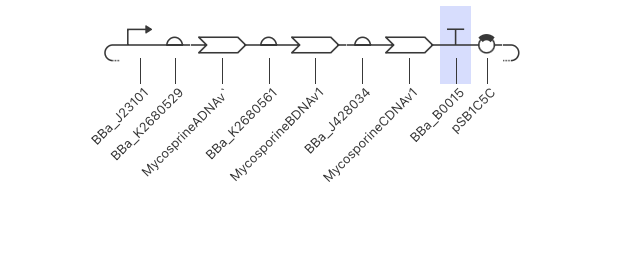
Since I got my sequences from unitprot as sequences of amino acids, I generated the CDS parts above using Kernel’s built in codon optimizer. I chose E. coli as the target since that is where I would initially deploy this operon. I didn’t not specify any restriction enzymes to avoid because I wasn’t sure what construction method I would use to assemble the construct.
I did a BLAST search for the entire DNA of my construct first. That ended up matching on very well on the 35 percent of the DNA that is the igem vector I included. When I narrowed my search to just the first mycosporine enzyme I got a 75% hit on “Stanieria cyanosphaera PCC 7437, complete genome” which I think makes sense because the original source before codon optimization as a cyanobacteria.
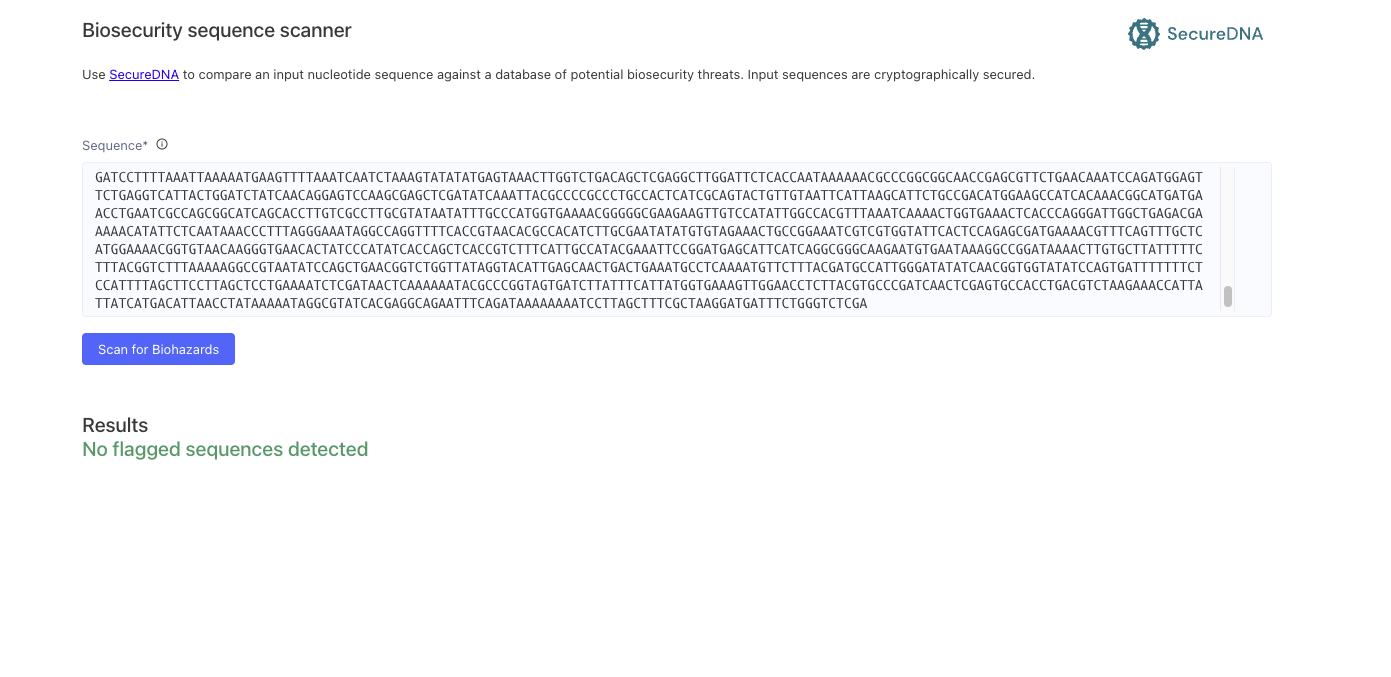
I used the Kernel security scan tool and it found no results:
I think if I wanted to build this in real life, I would use Golden Gate Assembly, since I used igem parts where they existed. I would have to revise the MysA, MysB, MysC sequences to remove the restriction sites for GoldenGate from the DNA and then order these sequences on an igem vector for assembly.
My DNA is made of standard igem parts and CDS regions that have already been replicated and don’t seem to have any repeat regions or other parts that would make them hard to synthesize.
I don’t think scaling in my project will be constrained by producing DNA, because once I get it a host synthesis by bacteria replication should be relatively reliable. I think the main scaling constraint will be in getting a microbe to produce large amounts of mycosporine with relatively inexpensive extraction. I don’t think E. coli will be suitable for full-scale because the only way to extract the product is destroy the cells, which means production involves a delicate balance of microbe health vs accumulating as much product as possible in the cytoplasm and expensive downstream extraction. I think in order to scale up mycosporine production I would need to change the host to be something like B subtilis which can be setup to naturally excrete in the mycosporine into the surrounding medium.
The immediate risk is that it is very hard to judge what expression levels we will get with the collection of promoters and RBS that were chosen. The constraints here are:
The other major long-term risks are