Week 2 HW: DNA Design & Applications
Kernel Setup
I am putting my work for this homework in ‘All repositories/HTBAA26_WilliamandMary/Jay Handfield/mycosporines’. There are several parts in that folder but the main construct is ‘mycosporine_enzyme_genes’
Expression Target
To make the durable greenhouse plastic from chitosan you of course need chitosan, but that is naturally created in relatively large amounts from many species of zygomycetes, so I am instead focussing for this homework on what needs to be produced to make the plastic resistant to UV radiation. Without UV protection the polymers that make up the chitosan will be damaged by the UV radiation and the radicals that the UV radiation generates. Over time this will cause the greenhouse plastic to lose its structural integrity leading to splits and cracks in the plastic. To protect the greenhouse plastic we need some natural susbstance that strongly absorbs UV light is transparent to visible light. It turns out that fungi and other microbes like cynabacteria naturally produce their own sunscreens called Mycosporing-like Amino Acids or MAAs, which are exactly what we need. For this homework I will focus on trying to produce MAAs in standard model organism.
MAAs are not a protein so you can’t simple encode the the protein directly as a DNA sequence. MAAs are produced by a sequence of enzymes that alter already occuring metabolic products, so instead of producing MAA directly you need to produce this sequence of enzymes. The gene sequences for these enzymes were first identified in The genetic and molecular basis for sunscreen biosynthesis in cyanobacteria. The main 3 enzymes in the pathway are MysA, MysB, and MysC (there are additional enzymes and variants that can act after these 3 enzyems can further modify the the MAA to tune the UV resistance, but I am gong to start with these 3).
Mys
MSIVQAKFEAKETSFHVEGYEKIEYDLVYVDGIFEIQNSALADVYQGFGRCLAIVDANVSRLYGNQIQAYFQYYGIELRLFPITITEPDKTIQTFERVIDVFADFKLVRKEPVLVVGGGLITDVVGFACSTYRRSSNYIRIPTTLIGLIDASVAIKVAVNHRKLKNRLGAYHASRKVFLDFSLLRTLPTDQVRNGMAELVKIAVVAHQEVFELLEKYGEELLRTHFGNIDATPEIKEIAHRLTYKAIHKMLELEVPNLHELDLDRVIAYGHTWSPTLELAPRLPMFHGHAVNVDMAFSATIAARRGYITIAERDRILGLMSRVGLSLDHPMLDIDILWRGTESITLTRDGLLRAAMPKPIGDCVFVNDLTREELAAALADHKELCTSYPRGGEGVDVYPVYQKELIGSVK
MysB
MTNVIVQPTARPVTPLGILTKQLEAIVQEVKQHPDLPGELIANIHQAWRLAAGIDPYLEECTTPESPELAALAKTTATEAWGEHFHGGTTVRPLEQEMLSGHIEGQTLKMFVHMTKAKKVLEIGMFTGYSALAMAEALPEDGLLVACEVDPYAAEIGQKAFQQSPHGGKIRVELDAALATLDKLAEAGESFDLVFIDADKKEYVAYFHKLLGSSLLAPDGFICVDNTLLQGEVYLPAEERSVNGEAIAQFNHTVAIDPRVEQVLLPLRDGLTIIRRIQP
MysC
MAQSLPLSSAPATPSLPSQTKIAAIIQNICTLALLLLALPINATIVFISLLVFRPQKVKAANPQTILISGGKMTKALQLARSFHAAGHRVVLVETHKYWLTGHRFSQAVDKFYTVPAPQDNPQAYIQALVDIVKQENIDVYIPVTSPVGSYYDSLAKPELSHYCEVFHFDADITQMLDDKFALTQKARSLGLSVPKSFKITSPEQVINFDFSGETRKYILKSIPYDSVRRLDLTKLPCATPEETAAFVRSLPITPEKPWIMQEFIPGKEFCTHSTVRNGELRLHCCCESSAFQVNYENVNNPQITEWVQHFVKELKLTGQISFDFIQAEDGTVYAIECNPRTHSAITTFYDHPQVAEAYLSQAPTTETIQPLTTSKPTYWTYHEVWRLTGIRSFTQLQRWLGNIWRGTDAIYQPDDPLPFLMVHHWQIPLLLLNNLRRLKGWTRIDFNIGKLVELGGD
For simplicity I am going focus on getting E. Coli to express these enzymes and produce MAA in their cyctoplasm so it can be extracted.
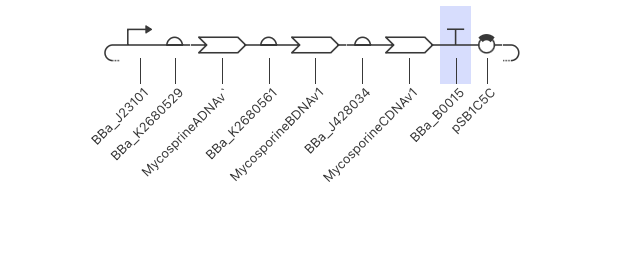
Part Design
- Prokaryotic host: E. Coli
- Transcription start: Anderson Constitutive Promoter, medium strength (J23101)
- Ribosome binding site (RBS): BCD12 medium strength (Ba_K2680529)
- Coding sequence: Protein sequence MysA (above), optimized for E. coli
- Ribosome binding site (RBS): BCD8 medium-high strength ()BBa_K2680561)
- Coding sequence: Protein sequence MysB (above), optimized for E. coli using Kernel Simple Algo
- Ribosome binding site (RBS): BCD1 high strength (BCD1 BBa_J428034)
- Coding sequence: Protein sequence MysC (above), optimized for E. coli using Kernel Simple Algo
- Terminator: Strong double terminator (BBa_B0015)
- Backbone: Standard igem level 0 plasmid: (pSB1C5C)
Part Selection
Organized this construct as a single operon controlling mulitple genes
- Promoter: Just want to produce these proteins at a steady clip that isn’t so high that it takes away from growth. An alternative is to have some kind of high strength inducible promoter that switches on after growth.
- Coding Sequences: This is the minimal chain of enzymes to produce the simplest MAA. Once this works can expand with additional enzymes and other genetic changes to try to maximize the metabolites that feed this chain.
- RBS: All of the proteins are going to be transcribed to the same RNA and all of them need to expressed in equal amounts. To counteract the decrease in ribosome binding frequency for later parts of the strand, I chose standard RBS parts that increase in strength for later CDS regions.
- Terminator: Just picked a standard very strong terminator to prevent bleed through during transcription.
Assembled Construct
Optimize And Quality Check
Codon Optimize
Since I got my sequences from unitprot as sequences of amino acids, I generated the CDS parts above using Kernel’s built in codon optimizer. I chose E. coli as the target since that is where I would initially deploy this operon. I didn’t not specify any restriction enzymes to avoid because I wasn’t sure what construction method I would use to assemble the construct.
BLAST Search
I did a BLAST search for the entire DNA of my construct first. That ended up matching on very well on the 35 percent of the DNA that is the igem vector I included. When I narrowed my search to just the first mycosporine enzyme I got a 75% hit on “Stanieria cyanosphaera PCC 7437, complete genome” which I think makes sense because the original source before codon optimization as a cyanobacteria.
Security Search
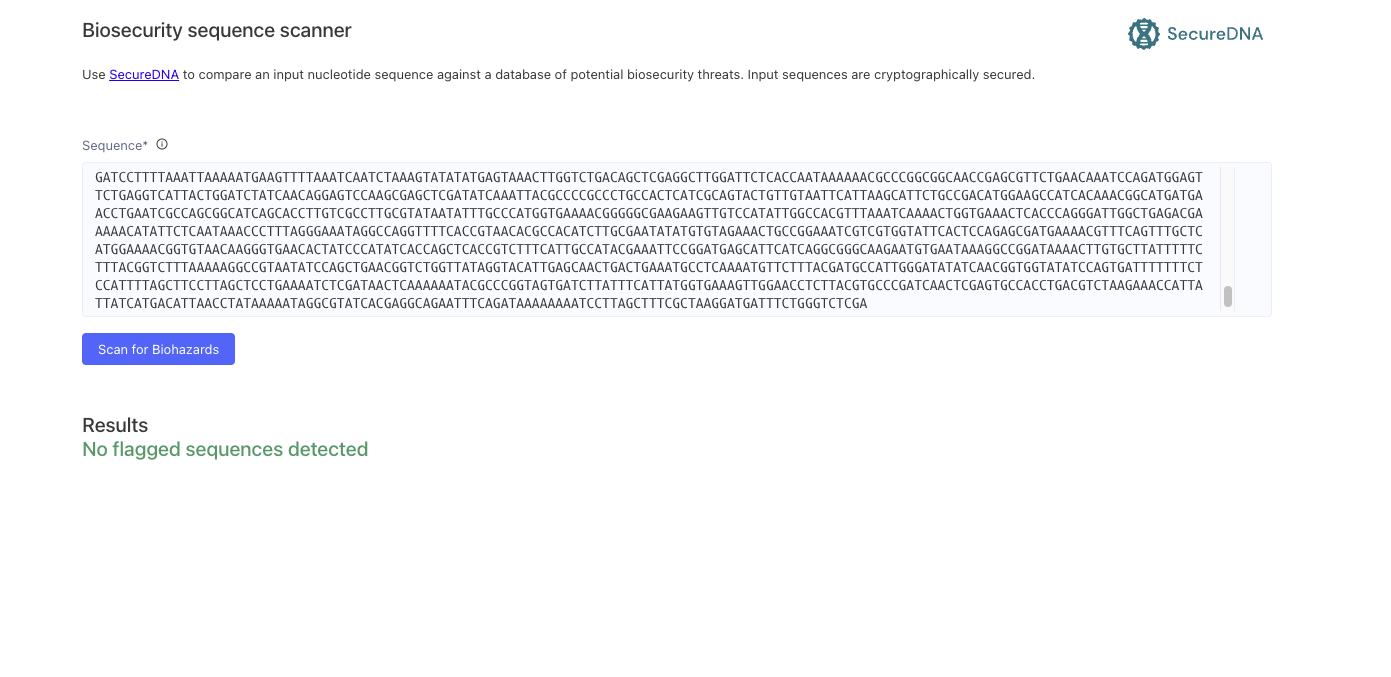
I used the Kernel security scan tool and it found no results:
From Design To Build
I think if I wanted to build this in real life, I would use Golden Gate Assembly, since I used igem parts where they existed. I would have to revise the MysA, MysB, MysC sequences to remove the restriction sites for GoldenGate from the DNA and then order these sequences on an igem vector for assembly.
My DNA is made of standard igem parts and CDS regions that have already been replicated and don’t seem to have any repeat regions or other parts that would make them hard to synthesize.
I don’t think scaling in my project will be constrained by producing DNA, because once I get it a host synthesis by bacteria replication should be relatively reliable. I think the main scaling constraint will be in getting a microbe to produce large amounts of mycosporine with relatively inexpensive extraction. I don’t think E. coli will be suitable for full-scale because the only way to extract the product is destroy the cells, which means production involves a delicate balance of microbe health vs accumulating as much product as possible in the cytoplasm and expensive downstream extraction. I think in order to scale up mycosporine production I would need to change the host to be something like B subtilis which can be setup to naturally excrete in the mycosporine into the surrounding medium.
Unknown Risks
The immediate risk is that it is very hard to judge what expression levels we will get with the collection of promoters and RBS that were chosen. The constraints here are:
- Want to make sure we produce balanced amounts of each enzyme in the cytoplasm.
- Need to produce enough enzyme to produce detectable amounts of mycosporine, but not so much as to endanger growth or health of the cells.
The other major long-term risks are
- Can you extract mycosporine products at scale in a very inexpensive way.
- Does the mycosporine actually improve the UV resitance of chitosan plastic (if not why bother with any of this work and what to do instead)