Hi! I’m Adán, a Biomedical Engineering student from Mexico. I’ve always been curious about how science can be used to understand and solve real-world problems, which is one of the reasons I decided to study biomedical engineering.
During my studies, I’ve become particularly interested in tissue engineering and the possibility of using engineering and biological approaches to help regenerate or recreate tissues. I’m especially excited about biofabrication because it brings together things I really enjoy: science, technology and biology.
See the nav bar on the left to look through my work for How To
Biomanufacture Almost Anything (Fall 2026)!
Subsections of Jesus Adan Lopez Castro — HTBAA Fall 2026
Week 1 HW: Final Project Ideas
Biomanufacturing of a Standardized GelMA Product from Recombinant Gelatin
1. What to biomanufacture and why?
I would like to biomanufacture a standardized gelatin methacryloyl (GelMA) product using molecularly defined recombinant gelatin as its starting material. The goal would not simply be to produce recombinant gelatin, but to develop an integrated manufacturing workflow in which recombinant gelatin is produced under controlled conditions and subsequently converted into GelMA through an automated and standardized methacrylation process. The final product would be a more precisely defined GelMA material for tissue engineering and 3D cell culture.
I am interested in this problem because gelatin is widely used as the starting material for GelMA, yet animal-derived gelatin is inherently heterogeneous, and its properties can vary depending on its source and processing history. This variability can propagate into the resulting GelMA. Garces et al. (2023) compared eight commercially available gelatin products from different manufacturers and found that differences in gelatin source and characteristics influenced the degree of functionalization of the resulting GelMA and the properties of the resulting hydrogel microparticles. Moreover, when they compared two batches of the same porcine gelatin product, they observed a significant difference in the degree of functionalization of the resulting GelMA. These findings indicate that variability can occur both between different gelatin products and between batches of the same product.
However, variability in GelMA is not determined exclusively by the starting gelatin. The GelMA manufacturing process itself can introduce additional variation through factors such as the degree of methacryloylation and reaction conditions. Zhu et al. (2019) demonstrated that a controlled GelMA synthesis strategy produced five independent batches with high consistency in degree of methacryloylation, structure, mechanical properties, degradation behavior, and cell viability. This suggests that controlling both the starting material and the subsequent manufacturing process could provide a more reproducible route to GelMA.
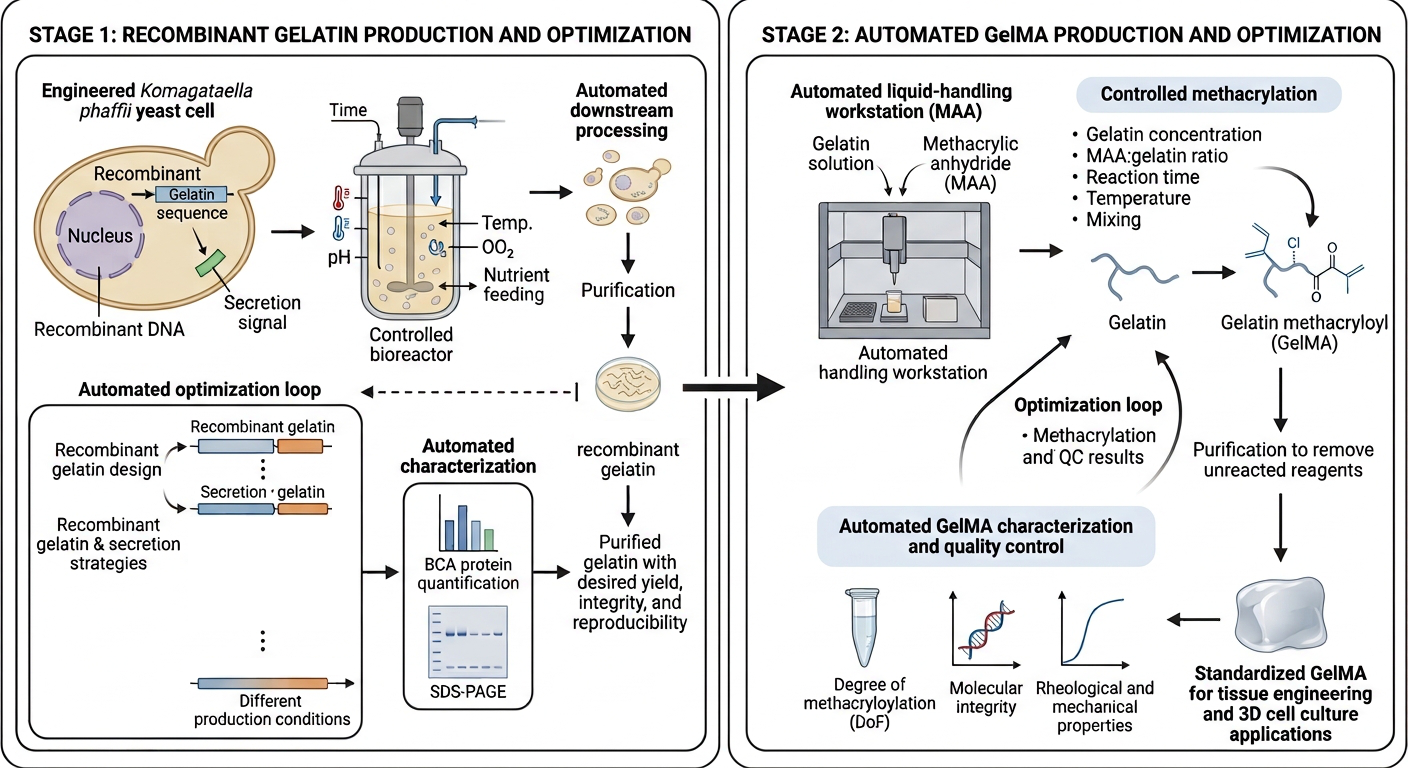
My proposed approach is therefore to address variability at two stages of the manufacturing chain. First, I would use an engineered microbial system such as Komagataella phaffii to produce molecularly defined recombinant gelatin with controlled composition. Second, I would automate the conversion of this gelatin into GelMA, controlling parameters such as gelatin concentration, methacrylic anhydride-to-gelatin ratio, reaction time, temperature, and mixing conditions. Automated sampling and quality-control assays could then be used to characterize each batch and feed the results back into subsequent production cycles.
The central question would be whether combining a more precisely defined recombinant starting material with an automated and controlled GelMA synthesis process can produce a GelMA material with improved batch-to-batch consistency. The objective would therefore be not only to manufacture recombinant gelatin, but to establish a reproducible biomanufacturing pipeline from biological production of the starting material to the final GelMA biomaterial.
The motivation is to create a more controlled biomaterial platform for tissue engineering and 3D cell culture. A standardized GelMA product could reduce variability associated with both the biological source of gelatin and manual processing during methacrylation, making experimental results easier to reproduce and compare across experiments and laboratories. The broader goal would be to demonstrate how biological production, automated processing, and quality control could be integrated into a single manufacturing workflow for a widely used biomaterial.
2. What living system would you use?
I would use the yeast Komagataella phaffii (formerly Pichia pastoris) as the manufacturing chassis for producing the recombinant gelatin that will serve as the starting material for GelMA production. This choice is based on previous work demonstrating that P. pastoris can produce and secrete recombinant gelatin proteins at bioreactor scale. Gellermann et al. (2019), for example, produced a gelatin-mimetic protein based on the α1 chain of human collagen type I in P. pastoris. The producing strain was cultivated in a 30-L bioreactor, and the recombinant protein was secreted into the culture medium at a final concentration of 3.4 g/L.
At a high level, the system would begin with a genetically engineered K. phaffii strain containing the DNA sequence encoding the recombinant gelatin, together with a secretion signal to direct the protein into the yeast’s secretory pathway. Previous work with recombinant gelatin in P. pastoris used the Saccharomyces cerevisiae α-mating-factor prepro signal for this purpose (Werten et al., 1999).
The main inputs would therefore be the engineered yeast strain, the genetic information encoding the target gelatin, a secretion signal, nutrients and carbon sources for cell growth and protein production, and a controlled bioreactor environment.
The biological processes would occur in several stages. First, the yeast would grow and generate biomass from the supplied nutrients and carbon source. The recombinant gelatin gene would then be expressed, leading the cells to synthesize the target protein. The secretion signal would direct the recombinant protein through the yeast’s secretory pathway and into the culture medium. Recombinant gelatin secretion through this strategy has been experimentally demonstrated in P. pastoris.
The immediate output would therefore be a culture medium containing secreted recombinant gelatin. The cells could then be removed, followed by purification and characterization of the recombinant protein. In the Gellermann et al. study, the recombinant gelatin mimetic was recovered from cell-free culture medium and purified by size-exclusion chromatography.
The final output of this stage would be purified recombinant gelatin with a defined amino-acid sequence and controlled production history.
I would use automation to identify and optimize the combination of biological design and production conditions that produces recombinant gelatin with the desired characteristics and reproducibility, and then automate its conversion into standardized GelMA.
First, I would use an automated liquid-handling platform such as Opentrons to test different biological designs of K. phaffii in parallel. Protein concentration could be measured using a BCA assay and microplate reader, while SDS-PAGE could be used to evaluate protein integrity and detect degradation. The best-performing biological design would then be tested in parallel microbioreactors, such as the ambr® 15, under different production conditions. The microbioreactors could monitor and control variables such as temperature, pH, dissolved oxygen, and feeding conditions during cultivation. After each production run, BCA and SDS-PAGE would again be used to evaluate protein yield and integrity. This iterative approach would allow the effects of both biological design and production conditions to be systematically evaluated and would accelerate the identification of a reproducible recombinant gelatin production process.
Once the recombinant gelatin production process has been optimized, I would extend the automation to the GelMA manufacturing stage. An automated liquid-handling system could control the gelatin concentration, methacrylic anhydride-to-gelatin ratio, reaction time, temperature, and mixing conditions during methacrylation. Automated sampling could then be used for quality control, including measurement of the degree of methacryloylation and protein integrity. The results could be used to identify the reaction conditions that consistently produce GelMA with the desired degree of functionalization.
The overall workflow would therefore combine automated biological optimization with automated chemical processing and quality control:
This would allow variability to be addressed both at the level of the starting material and during the subsequent GelMA manufacturing process.
4. How much would you need to make, and how long would it take?
For the purpose of this estimate, I will define a standard production batch as 5 g of final GelMA. This scale represents a commercially relevant research-scale quantity of GelMA. The estimation is performed backward from the desired final product and includes the optimization of the recombinant gelatin production system followed by its conversion into GelMA.
The proposed optimization would be divided into two stages. The first stage would optimize the biological design of the Komagataella phaffii production system. Different recombinant gelatin designs and secretion strategies would be screened using automated liquid handling. Protein concentration would be evaluated using BCA assays, while SDS-PAGE would be used to evaluate protein integrity and degradation. The objective would be to identify the biological design providing the best combination of recombinant gelatin yield and protein integrity.
The second stage would optimize the production conditions for the selected biological design. Parallel microbioreactors would be used to systematically evaluate variables such as temperature, pH, dissolved oxygen, and feeding conditions. The main outputs would be recombinant gelatin concentration, protein integrity, and production reproducibility. Design of Experiments could be used to evaluate the effects and interactions of these variables systematically.
The exact duration of this optimization phase has not yet been established because the number of biological designs, production conditions, experimental replicates, and optimization iterations has not been defined. Therefore, no arbitrary duration is assigned to the optimization stage. Instead, automation and parallelization would be used to reduce the elapsed time required to evaluate the selected experimental conditions.
Once the biological design and production conditions have been optimized, the resulting production process would be used for the standardized 5-g GelMA batch.
The estimation is performed backward from the final GelMA product. Zhu et al. (2019) reported GelMA synthesis yields of approximately 88–94% across independent batches. Therefore, a nominal recovery of 90% is assumed for this estimation. The amount of recombinant gelatin required would consequently be:
5 g GelMA / 0.90 = 5.56 g recombinant gelatin
Gellermann et al. (2019) reported a recombinant gelatin-mimetic production concentration of 3.4 g/L in a 30-L Pichia pastoris bioreactor. As a baseline assumption, the proposed K. phaffii system is assumed to initially achieve the same production performance of 3.4 g/L.
Using this reference value:
5.56 g / 3.4 g/L = 1.64 L culture
A 20% process-loss margin is assumed to account for losses during harvesting and purification:
1.64 L × 1.20 ≈ 2.0 L
Therefore, approximately 2 L of production culture would be used as the initial basis for producing one 5-g GelMA batch.
Importantly, the 3.4 g/L value is considered a baseline rather than the expected final performance of the optimized system. The purpose of the optimization stage is to identify biological designs and production conditions that improve recombinant gelatin production while maintaining the desired protein integrity and reproducibility. In an ideal optimized system, the production titer could therefore be higher than the published reference value, reducing the culture volume required for a 5-g GelMA batch. However, because the optimization has not yet been experimentally performed, no specific improvement in production titer is assumed in this calculation.
Time Estimation
The time estimate includes the optimization phase conceptually, followed by production of the final standardized GelMA batch. However, because the optimization design has not yet been experimentally defined, its duration is reported separately rather than being assigned an arbitrary value.
Gellermann et al. (2019) reported approximately 80 h of cultivation for recombinant gelatin production in P. pastoris. This value is therefore used as the reference cultivation time for the optimized production stage.
After purification, the recombinant gelatin would be converted into GelMA using the protocol described by Loessner et al. (2016). Their Nature Protocols procedure reports that preparation of the GelMA polymer requires approximately 1–2 weeks. This published duration is used directly rather than assigning independent estimated times to the individual downstream processing steps.
Therefore, excluding the optimization phase:
Recombinant gelatin production: ~80 h (~3.3 days)
GelMA preparation following Loessner et al. (2016): ~1–2 weeks
Total production cycle after optimization: ~10–17 days
The optimization phase would occur before this production cycle and would be performed using parallelized automated experiments. Its duration remains not established because it depends on the number of biological designs, production conditions, replicates, and optimization iterations ultimately selected.
Key Values and Assumptions
Parameter
Value
Basis
Target GelMA batch
5 g
Commercial research-scale target
Assumed GelMA recovery
90%
Zhu et al. (2019)
Recombinant gelatin required
5.56 g
Backward calculation
Reference recombinant gelatin titer
3.4 g/L
Gellermann et al. (2019)
Initial assumed titer
3.4 g/L
Assumption: proposed system initially matches published performance
Theoretical culture volume
1.64 L
Backward calculation
Culture volume with 20% loss margin
~2 L
Assumed process-loss margin
Recombinant gelatin cultivation
80 h (~3.3 days)
Gellermann et al. (2019)
GelMA preparation
1–2 weeks
Loessner et al. (2016)
Production cycle excluding optimization
~10–17 days
Calculated from published times
Optimization duration
Not established
Depends on experimental design
The proposed manufacturing workflow would therefore consist of two optimization stages followed by standardized production. First, automated screening would identify the biological design of K. phaffii that provides the best combination of recombinant gelatin yield and integrity. Second, parallel microbioreactors would be used to optimize the production conditions for that biological design. Once the optimized process is established, approximately 2 L of culture would be used as the initial production basis for a 5-g GelMA batch, followed by GelMA synthesis using the Loessner et al. protocol.
The 3.4 g/L reference value should be interpreted as a conservative starting point for the scale calculation rather than a limitation of the proposed system. The optimization is specifically intended to improve production performance, but the magnitude of that improvement cannot be quantified until the optimization experiments are performed.
5. What don’t you know yet?
Which recombinant gelatin design and production conditions will provide the required combination of yield, integrity, and reproducibility?
The optimal recombinant gelatin sequence, secretion strategy, and K. phaffii production conditions are not yet known for our specific application. Different designs could affect secretion efficiency, protein integrity, degradation, and final yield. This would need to be experimentally determined through parallel screening of biological designs followed by optimization of culture conditions. Key measurements would include gelatin concentration, protein integrity, degradation, and batch-to-batch variability.
Can the recombinant gelatin be consistently converted into GelMA with a controlled degree of methacryloylation and predictable hydrogel properties?
Even with a well-defined recombinant gelatin starting material, the methacrylation step may introduce variability. We need to determine whether automated control of gelatin concentration, methacrylic anhydride-to-gelatin ratio, reaction conditions, and mixing can produce GelMA with a reproducible degree of methacryloylation.
Can the process maintain the same performance when moving from automated screening to meaningful-scale production?
The proposed 2-L production volume is based on a published recombinant gelatin titer and includes an assumed 20% process-loss margin. These values are engineering assumptions rather than experimentally demonstrated performance for our system. It is therefore unknown whether the optimized process can maintain yield, protein quality, and reproducibility when transferred from parallel microbioreactors to a larger production bioreactor and subsequently to a 5-g GelMA batch. This would need to be experimentally validated through scale-up runs and comparison of batch-to-batch product characteristics.
References
Garces, D. G., Appoldt, L. J., Egner, J., Leister, N., & Hubbuch, J. (2023). The effect of gelatin source on the synthesis of gelatin-methacryloyl and the production of hydrogel microparticles. Gels, 9(12), 927. https://doi.org/10.3390/gels9120927
Zhu, M., Wang, Y., Ferracci, G., Zheng, J., Cho, N.-J., & Lee, B. H. (2019). Gelatin methacryloyl and its hydrogels with an exceptional degree of controllability and batch-to-batch consistency. Scientific Reports, 9, 6863. https://doi.org/10.1038/s41598-019-42186-x
Gellermann, P., Schneider-Barthold, C., Bolten, S. N., Overfelt, E., Scheper, T., & Pepelanova, I. (2019). Production of a recombinant non-hydroxylated gelatin mimetic in Pichia pastoris for biomedical applications. Journal of Functional Biomaterials, 10(3), 39. https://doi.org/10.3390/jfb10030039
Loessner, D., Meinert, C., Kaemmerer, E., Martine, L. C., Yue, K., Levett, P. A., Klein, T. J., Melchels, F. P. W., Khademhosseini, A., & Hutmacher, D. W. (2016). Functionalization, preparation and use of cell-laden gelatin methacryloyl-based hydrogels as modular tissue culture platforms. Nature Protocols, 11(4), 727–746. https://doi.org/10.1038/nprot.2016.037
Song, X., Chu, T., Shi, W., & He, J. (2024). Expression, characterization, and application of human-like recombinant gelatin. Bioresources and Bioprocessing, 11, 69. https://doi.org/10.1186/s40643-024-00785-1
Werten, M. W. T., & de Wolf, F. A. (2005). Reduced proteolysis of secreted gelatin and Yps1-mediated α-factor leader processing in a Pichia pastoris kex2 disruptant. Applied and Environmental Microbiology, 71(5), 2310–2317. https://doi.org/10.1128/AEM.71.5.2310-2317.2005
Prompts and AI Use
ChatGPT was used for the conceptualization of this homework. The prompts used are the following:
I have no experience with biomanufacturing processes; help me to answer based on the use of K. phaffii for making recombinant gelatin, describing at a high level what goes into the system, which biological processes will be involved in the system using K. phaffii, what comes out.
Help me to identify which automated processes I could use for this goal, technologies for measurement.
Answer by stating the technologies required to identify the biological design and optimize production variables, and explain why this is useful for the project.
Let’s estimate how much time it would take to produce a standard batch that is sold for GelMA, specify assumptions in the backward estimation, key values for the estimation, and sources.
Week 2 HW: DNA Design
Biomanufacturing of a Standardized GelMA Product from Recombinant Gelatin
Part 1: What are you expressing?
What molecule are you expressing?
I am producing a recombinant human-like gelatin protein called hlrGEL6, which will be used as the starting material for the subsequent synthesis of gelatin methacryloyl (GelMA).
hlrGEL6 is a recombinant gelatin construct containing six repeated gelatin peptide monomers (GEL1) within a single 426-amino-acid polypeptide. The six GEL1 peptide monomers are connected by GS-linkers. The use of a defined recombinant gelatin sequence is intended to reduce the compositional variability associated with animal-derived gelatin.
What is the sequence?
I would use the optimized hlrGEL6 gene sequence reported by Song et al. (2024) to encode the recombinant human-like gelatin protein hlrGEL6. The optimized gene is 1,301 bp in total, including the cloning and expression elements, with the gel6 coding sequence itself comprising 1,260 bp.
The published DNA construct also contains an XhoI restriction site at the 5′ end and a NotI restriction site at the 3′ end for cloning. The construct includes a KEX2 cleavage site at the 5′ end of gel6 and a C-terminal 6×His tag for downstream purification and characterization.
The hlrgel6 coding sequence reported by Song et al. will therefore serve as the genetic template for my proposed Komagataella phaffii production system.
I will use the yeast Komagataella phaffii (Pichia pastoris) as the production chassis. This organism is particularly relevant to the proposed project because the hlrGEL6 construct has already been experimentally expressed and secreted in P. pastoris, providing a demonstrated starting point for the proposed biomanufacturing workflow.
Where does the product need to go?
The recombinant gelatin needs to be secreted into the culture medium. Therefore, the expression construct includes an N-terminal secretion signal that directs hlrGEL6 through the yeast secretory pathway.
Secretion into the culture medium allows the cells to be separated from the recombinant gelatin before downstream purification and characterization. The purified hlrGEL6 would then serve as the starting material for the subsequent methacrylation step to produce GelMA.
Part 2: Design Your Genetic Parts
Layer
Part Name
Part Type (Kernel)
Sequence Source / Origin
Justification
Transcription start
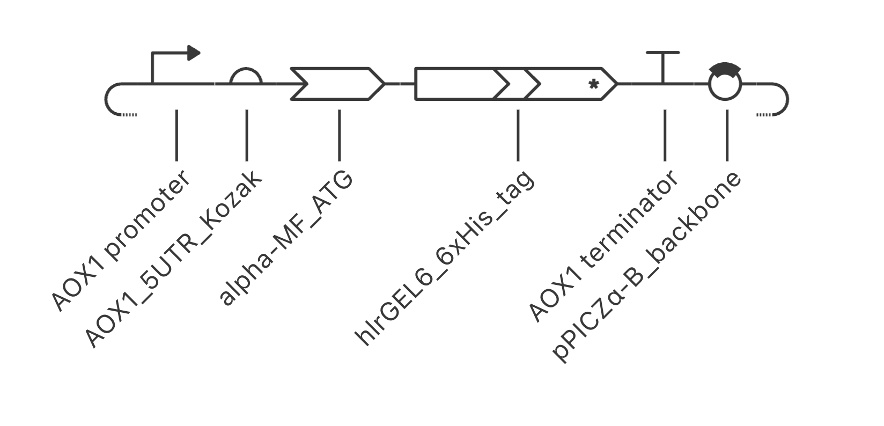
AOX1 promoter
Promoter
Komagataella phaffii (pPICZα-B vector)
Strong, methanol-inducible promoter that drives tightly regulated and high-level expression in P. pastoris.
Translation start
AOX1 5′ UTR & Yeast Kozak
5′ UTR
Komagataella phaffii (Native 5′ UTR embedded in AOX1 promoter)
Recruits the 40S ribosomal subunit and provides the yeast Kozak consensus context for efficient translation initiation at the start codon.
Directs the nascent polypeptide into the eukaryotic secretory pathway and enables endogenous signal processing via Kex2 endopeptidase.
Coding sequence
hlrGEL6_CDS
CDS (-start -stop)
Human collagen type III derivative (Song et al., 2024), codon-optimized for P. pastoris
Encodes six tandem GEL1 domains separated by flexible GS linkers in-frame for high-yield expression of human-like recombinant gelatin.
Purification tag
6×His Tag
Tag
Synthetic C-terminal tag (pPICZα-B vector; Song et al., 2024)
Facilitates downstream purification of the secretable recombinant protein using immobilized metal affinity chromatography (Ni-NTA), as validated by Song et al. (2024).
Transcription stop
AOX1 terminator
Terminator
Komagataella phaffii (pPICZα-B vector)
Provides native transcription termination, mRNA cleavage, and 3′ polyadenylation signals required for transcript stability.
Supplies the pUC origin of replication, Zeocin selection marker (Bleo^R), and a unique SacI restriction site for genomic integration via homologous recombination.
Part 3: Assemble Your Construct
Part 4: Optimize and Quality-Check
Codon Optimization
The hlrGEL6 sequence was codon-optimized using the Asimov engine to maximize expression in Komagataella phaffii (Pichia pastoris), selecting Saccharomyces cerevisiae as the closest available host proxy in the tool.
The algorithm systematically replaced low-frequency yeast codons (e.g., CGT → AGA for Arg, GGA → GGT for Gly) with host-preferred triplets, eliminating translational bottlenecks across the repetitive Gly-X-Y domains while preserving 100% primary amino acid identity.
The optimization was strictly restricted to the coding region, keeping the upstream α-MF cleavage site intact, maintaining the C-terminal 6×His tag in-frame with a tandem stop codon (TGA TAA), and removing internal restriction sites and mRNA secondary structures.
Biosecurity
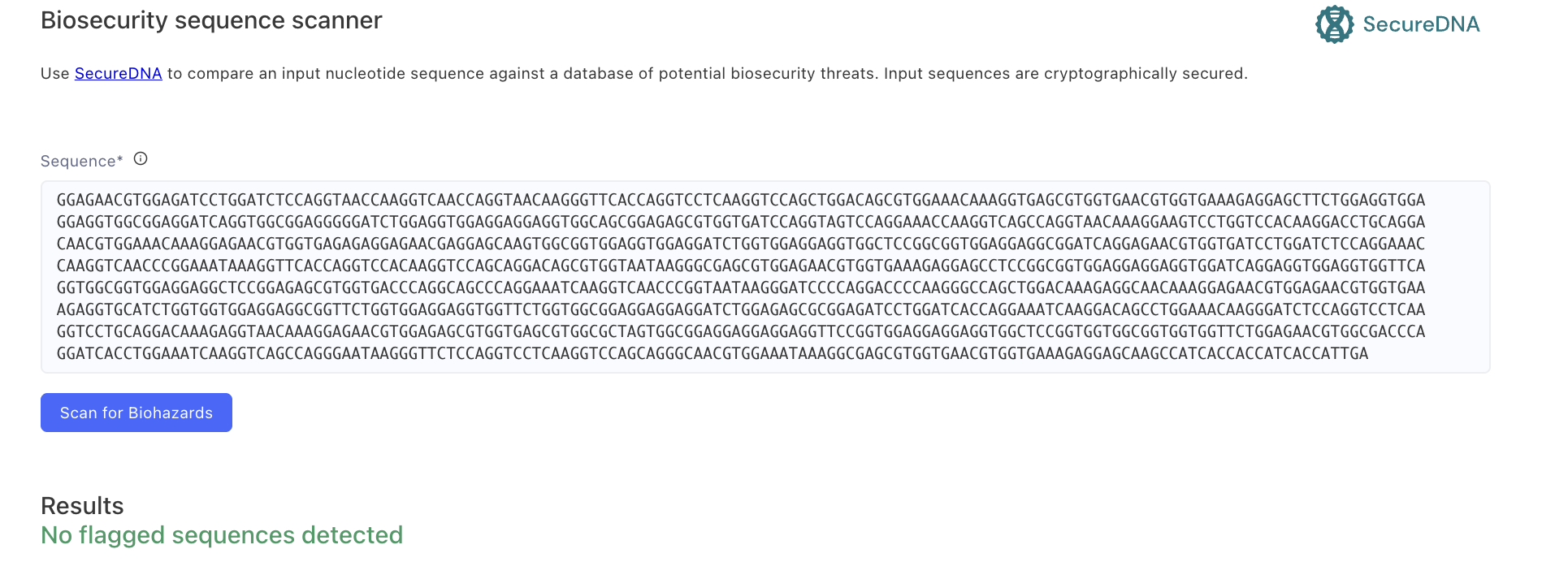
Biosecurity analysis was performed on the hlrGEL6 sequence using Kernel’s automated screening tool. The analysis identified no biosecurity threats, confirming the construct’s suitability for recombinant expression.
BLAST Search
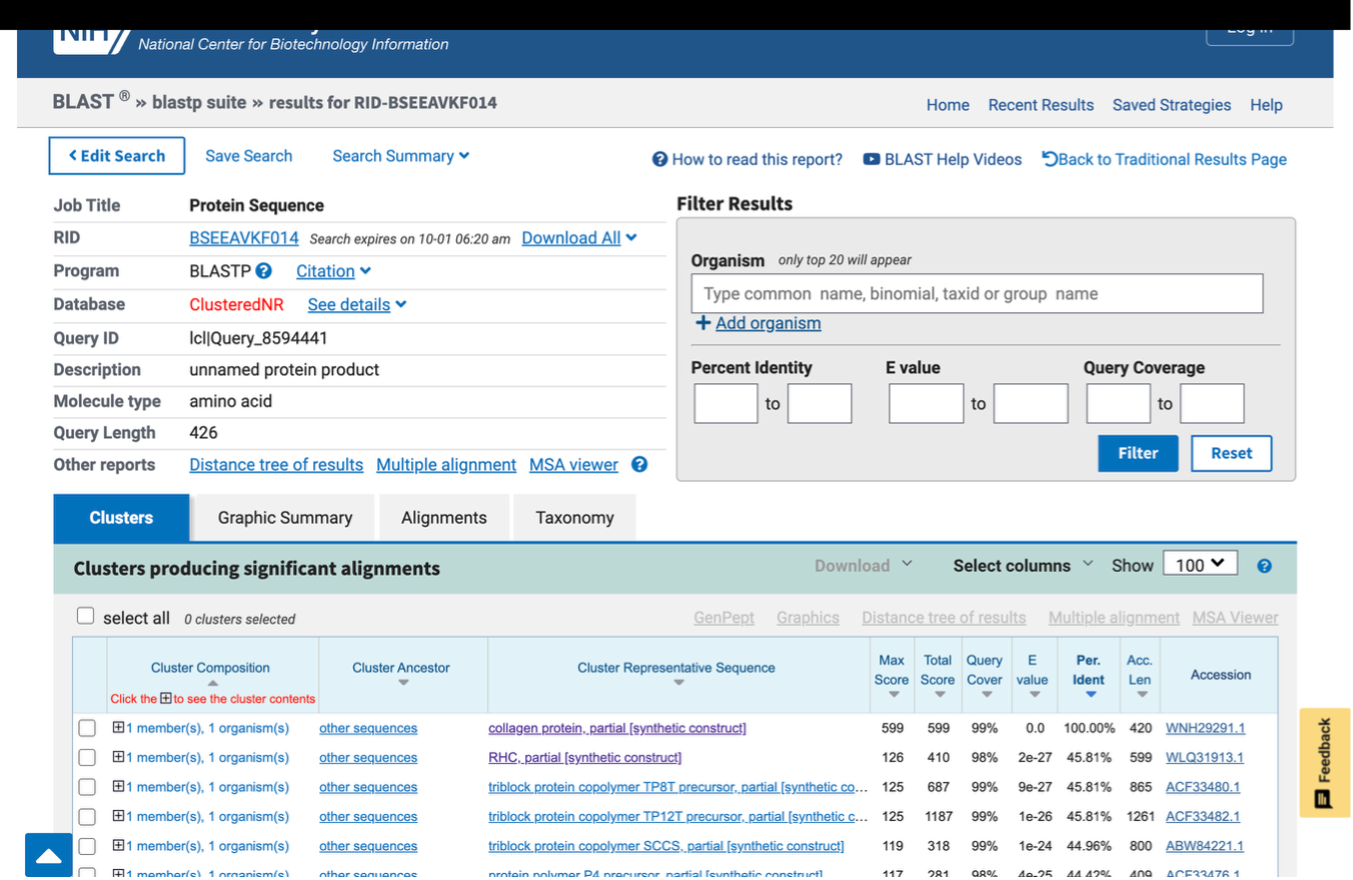
The hlrGEL6 protein sequence was queried against the NCBI database using BLASTP to verify its correspondence with the published construct.
The query returned 100% identity over 420 residues with 99% query coverage against the deposited sequence WNH29291.1 (GenBank OR365074.1; Song et al., 2024), confirming that the designed sequence matches its source.
The six unaligned C-terminal residues correspond to the 6×His tag, which is absent from the deposited record.
The remaining hits showed identity values of up to 45%, indicating only partial similarity to previously reported sequences.

Part 5: From design to build
1. Construction Strategy and Justification
For the construction of a multigenic or medium-length construct (~3–5 kb), the most efficient strategy is to order commercially available synthetic DNA fragments of intermediate size (~1–1.5 kb) and assemble them using isothermal assembly (Gibson et. al., 2009).
Length and complexity rationale: Synthesizing a long construct as a single block directly through oligonucleotide synthesis involves high costs and a substantial accumulation of mutations. Conversely, assembling the entire construct starting exclusively from pools of individual oligonucleotides synthesized on microchips requires complex selection and multiplex amplification steps to achieve sufficient concentrations for efficient bimolecular priming (Gibson et. al., 2009; Gibson et. al., 2009)
Gibson isothermal assembly enables the covalent joining of multiple DNA fragments with 40–450 bp overlaps in a single reaction at 50 °C through the combined action of T5 exonuclease, Phusion DNA polymerase, and Taq DNA ligase. This methodology can be used for assemblies ranging from small DNA junctions to complete genomes without leaving scars (Gibson et. al., 2009).
2. Synthesis Constraints and Error Correction
Chemical oligonucleotide synthesis is limited by per-cycle coupling efficiencies, which result in typical error rates of approximately 1 mutation per 160–600 bp (Gibson et. al., 2009).
Design limitations: Synthesis is negatively affected by sequences with very high or very low GC content, tandem repeats, and stable secondary structures. The most frequent chemical failures (~44–59%) are single-base deletions resulting from incomplete coupling or incomplete deprotection (Carr et. al., 2004)
Impact of assembly and error correction:
• Enzymatic error correction with MutS: The MutS protein from Thermus aquaticus can be used to recognize and bind heteroduplexes containing mismatches and short insertions/deletions (Carr et. al., 2004).
• Filtering the MutS-bound fractions reduces the error rate by approximately 15-fold, reaching 1 error per 10,000 bp (Carr et. al., 2004).
• This transforms the screening process: for a 2.5 kb gene, only one correct clone needs to be sequenced instead of dozens (Carr et. al., 2004).
• Solid-phase hybridization selection: As an alternative, hybridization of construction oligonucleotides against selection oligonucleotides immobilized on magnetic beads can eliminate truncated or mutated sequences, reducing the error rate from 1/160 bp to 1/1,394 bp before amplification and assembly (Tian et. al., 2004)
3. Prototype vs. Scale-Up Production
Prototype (Proof-of-Concept Phase): To experimentally validate one or a few design variants, the most suitable approach is one-pot isothermal assembly at 50 °C using commercially available DNA fragments, followed by transformation into E. coli and sequencing of 1–3 clones (Gibson et. al, 2009)
Scale-Up (Mass Production): To synthesize large combinatorial libraries or collections of complete genomes/operons, the process can be transferred to photoprogrammable microchip-based systems (e.g., Xeotron/Atactic 4K or ultra-high-density NimbleGen arrays) (Tian et. al. 2004). In this workflow:
• Thousands of oligonucleotides are synthesized in parallel on the chip.
• They are cleaved from the chip and amplified by PCR using primers containing restriction sites for Type IIS enzymes (such as BsaI or BseRI), which remove the adapters.
• They undergo mass hybridization purification using streptavidin-coated beads.
• Multiple genes are assembled simultaneously through Polymerase Assembly Multiplexing (PAM) in a single thermocycling reaction.
Key Unknowns and Risk Mitigation
1. Optimization of Gelatin Production and Secretion
The main risk is that gelatin accumulates intracellularly or that the secretion machinery becomes saturated, reducing the extracellular yield required to formulate functional bioinks.
How to Determine This
Design a library of construct variants testing different signal peptides (secretion tags) and different levels of codon optimization.
To generate these variants efficiently, multiplex gene synthesis using programmable microchips, as described in Tian et al. (2004), could be used. This method enables the synthesis of thousands of construction and selection oligonucleotides to assemble multiple genes in a single step.
The secreted gelatin would then be quantified using an ELISA assay on the culture supernatant to identify the optimal variant.
2. Fidelity in the Synthesis and Assembly of Repetitive Sequences
Gelatin consists of highly repetitive amino acid sequences, which makes de novo DNA synthesis more challenging and substantially increases the rate of structural errors.
How to Determine This
To reduce synthesis errors in the gene, a filtering step using the MutS protein would be implemented. MutS binds to DNA mismatches, allowing defective molecules to be separated from the desired products and achieving a 15-fold reduction in errors, as described by Carr et al. (2004).
To assemble the final construct, a one-step isothermal in vitro recombination method at 50 °C would be evaluated. This method uses the coordinated action of a 5′ exonuclease, a DNA polymerase, and a DNA ligase.
This approach allows multiple overlapping DNA molecules to be joined in a single reaction and is capable of assembling fragments of up to several hundred kilobases, as described in Gibson et al. (2009).
3. Protein Folding and Functionality
There is a possibility that, even if gelatin is secreted in large quantities, it may lack adequate proline hydroxylation if the host does not possess the necessary enzymatic machinery, which would affect its thermal gelation properties.
How to Determine This
Extract the secreted gelatin and perform rheological tests by measuring the storage and loss moduli as a function of temperature.
If the extrusion and gelation behavior is not optimal, the next design step would be to co-express a recombinant prolyl hydroxylase in the same host.
References
Carr, P. A., et al. (2004). Protein-mediated error correction for de novo DNA synthesis.
Gibson, D. G., et al. (2009). Enzymatic assembly of DNA molecules up to several hundred kilobases. Nature Methods.
Song, X., Chu, T., Shi, W., & He, J. (2024). Expression, characterization, and application of human-like recombinant gelatin.
Tian, J., et al. (2004). Accurate multiplex gene synthesis from programmable DNA microchips.
CAGER Vector Database. pPICZ-alpha B Vector Map and Sequence (Accession No. 021.A.E5-6). Resource Center for Genetic Resources, Institute of Bioorganic Chemistry. Retrieved from https://mbio.bas-net.by/cager/vectors/021.A.E5-6.html