Week 1 HW: Final Project Ideas
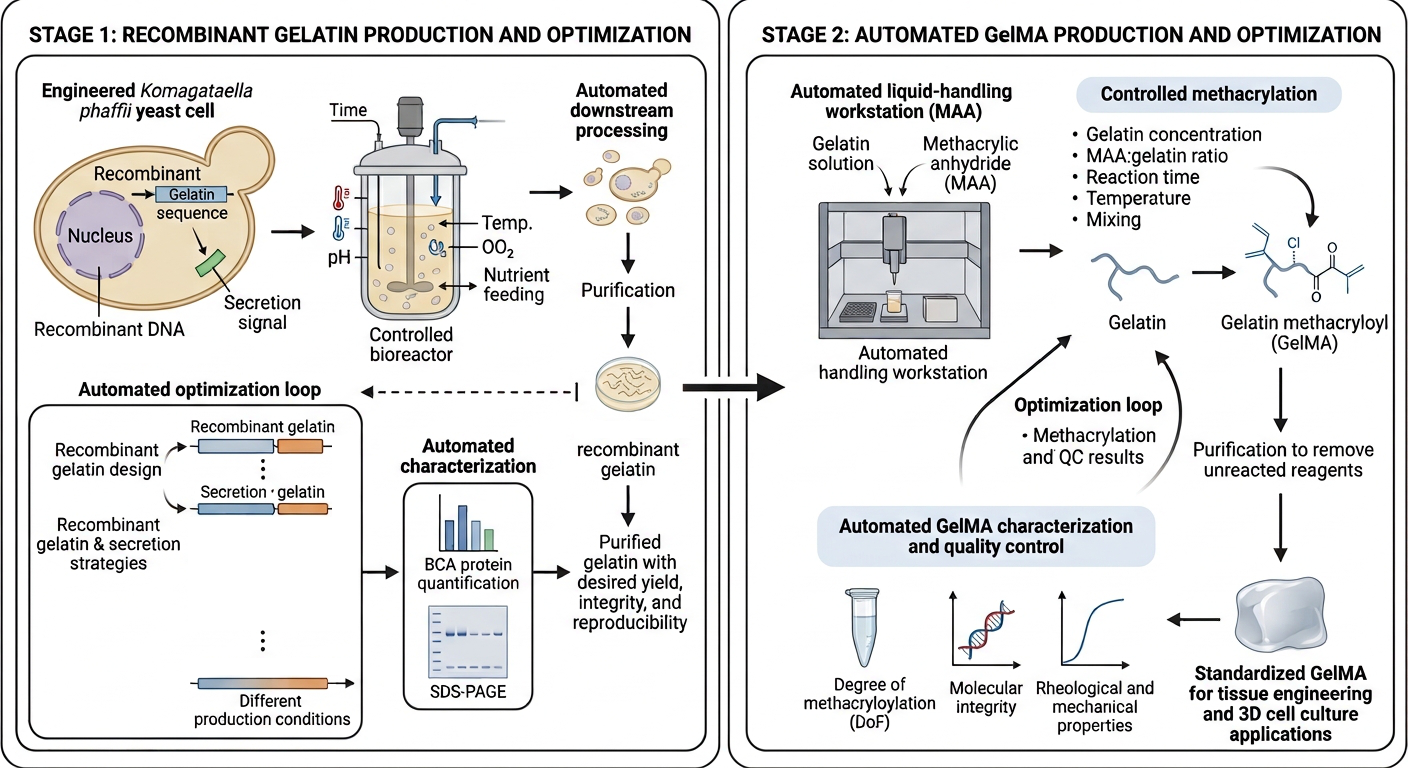
Biomanufacturing of a Standardized GelMA Product from Recombinant Gelatin
1. What to biomanufacture and why?
I would like to biomanufacture a standardized gelatin methacryloyl (GelMA) product using molecularly defined recombinant gelatin as its starting material. The goal would not simply be to produce recombinant gelatin, but to develop an integrated manufacturing workflow in which recombinant gelatin is produced under controlled conditions and subsequently converted into GelMA through an automated and standardized methacrylation process. The final product would be a more precisely defined GelMA material for tissue engineering and 3D cell culture.
I am interested in this problem because gelatin is widely used as the starting material for GelMA, yet animal-derived gelatin is inherently heterogeneous, and its properties can vary depending on its source and processing history. This variability can propagate into the resulting GelMA. Garces et al. (2023) compared eight commercially available gelatin products from different manufacturers and found that differences in gelatin source and characteristics influenced the degree of functionalization of the resulting GelMA and the properties of the resulting hydrogel microparticles. Moreover, when they compared two batches of the same porcine gelatin product, they observed a significant difference in the degree of functionalization of the resulting GelMA. These findings indicate that variability can occur both between different gelatin products and between batches of the same product.
However, variability in GelMA is not determined exclusively by the starting gelatin. The GelMA manufacturing process itself can introduce additional variation through factors such as the degree of methacryloylation and reaction conditions. Zhu et al. (2019) demonstrated that a controlled GelMA synthesis strategy produced five independent batches with high consistency in degree of methacryloylation, structure, mechanical properties, degradation behavior, and cell viability. This suggests that controlling both the starting material and the subsequent manufacturing process could provide a more reproducible route to GelMA.
My proposed approach is therefore to address variability at two stages of the manufacturing chain. First, I would use an engineered microbial system such as Komagataella phaffii to produce molecularly defined recombinant gelatin with controlled composition. Second, I would automate the conversion of this gelatin into GelMA, controlling parameters such as gelatin concentration, methacrylic anhydride-to-gelatin ratio, reaction time, temperature, and mixing conditions. Automated sampling and quality-control assays could then be used to characterize each batch and feed the results back into subsequent production cycles.
The central question would be whether combining a more precisely defined recombinant starting material with an automated and controlled GelMA synthesis process can produce a GelMA material with improved batch-to-batch consistency. The objective would therefore be not only to manufacture recombinant gelatin, but to establish a reproducible biomanufacturing pipeline from biological production of the starting material to the final GelMA biomaterial.
The motivation is to create a more controlled biomaterial platform for tissue engineering and 3D cell culture. A standardized GelMA product could reduce variability associated with both the biological source of gelatin and manual processing during methacrylation, making experimental results easier to reproduce and compare across experiments and laboratories. The broader goal would be to demonstrate how biological production, automated processing, and quality control could be integrated into a single manufacturing workflow for a widely used biomaterial.
2. What living system would you use?
I would use the yeast Komagataella phaffii (formerly Pichia pastoris) as the manufacturing chassis for producing the recombinant gelatin that will serve as the starting material for GelMA production. This choice is based on previous work demonstrating that P. pastoris can produce and secrete recombinant gelatin proteins at bioreactor scale. Gellermann et al. (2019), for example, produced a gelatin-mimetic protein based on the α1 chain of human collagen type I in P. pastoris. The producing strain was cultivated in a 30-L bioreactor, and the recombinant protein was secreted into the culture medium at a final concentration of 3.4 g/L.
At a high level, the system would begin with a genetically engineered K. phaffii strain containing the DNA sequence encoding the recombinant gelatin, together with a secretion signal to direct the protein into the yeast’s secretory pathway. Previous work with recombinant gelatin in P. pastoris used the Saccharomyces cerevisiae α-mating-factor prepro signal for this purpose (Werten et al., 1999).
The main inputs would therefore be the engineered yeast strain, the genetic information encoding the target gelatin, a secretion signal, nutrients and carbon sources for cell growth and protein production, and a controlled bioreactor environment.
The biological processes would occur in several stages. First, the yeast would grow and generate biomass from the supplied nutrients and carbon source. The recombinant gelatin gene would then be expressed, leading the cells to synthesize the target protein. The secretion signal would direct the recombinant protein through the yeast’s secretory pathway and into the culture medium. Recombinant gelatin secretion through this strategy has been experimentally demonstrated in P. pastoris.
The immediate output would therefore be a culture medium containing secreted recombinant gelatin. The cells could then be removed, followed by purification and characterization of the recombinant protein. In the Gellermann et al. study, the recombinant gelatin mimetic was recovered from cell-free culture medium and purified by size-exclusion chromatography.
The final output of this stage would be purified recombinant gelatin with a defined amino-acid sequence and controlled production history.
High-level process:
Engineered K. phaffii + nutrients → yeast growth → recombinant gene expression → gelatin synthesis → secretion → cell removal → purification → molecularly defined recombinant gelatin → GelMA synthesis
3. How would you use automation?
I would use automation to identify and optimize the combination of biological design and production conditions that produces recombinant gelatin with the desired characteristics and reproducibility, and then automate its conversion into standardized GelMA.
First, I would use an automated liquid-handling platform such as Opentrons to test different biological designs of K. phaffii in parallel. Protein concentration could be measured using a BCA assay and microplate reader, while SDS-PAGE could be used to evaluate protein integrity and detect degradation. The best-performing biological design would then be tested in parallel microbioreactors, such as the ambr® 15, under different production conditions. The microbioreactors could monitor and control variables such as temperature, pH, dissolved oxygen, and feeding conditions during cultivation. After each production run, BCA and SDS-PAGE would again be used to evaluate protein yield and integrity. This iterative approach would allow the effects of both biological design and production conditions to be systematically evaluated and would accelerate the identification of a reproducible recombinant gelatin production process.
Once the recombinant gelatin production process has been optimized, I would extend the automation to the GelMA manufacturing stage. An automated liquid-handling system could control the gelatin concentration, methacrylic anhydride-to-gelatin ratio, reaction time, temperature, and mixing conditions during methacrylation. Automated sampling could then be used for quality control, including measurement of the degree of methacryloylation and protein integrity. The results could be used to identify the reaction conditions that consistently produce GelMA with the desired degree of functionalization.
The overall workflow would therefore combine automated biological optimization with automated chemical processing and quality control:
biological design screening → recombinant gelatin production → gelatin characterization → automated methacrylation → GelMA characterization
This would allow variability to be addressed both at the level of the starting material and during the subsequent GelMA manufacturing process.
4. How much would you need to make, and how long would it take?
For the purpose of this estimate, I will define a standard production batch as 5 g of final GelMA. This scale represents a commercially relevant research-scale quantity of GelMA. The estimation is performed backward from the desired final product and includes the optimization of the recombinant gelatin production system followed by its conversion into GelMA.
The proposed optimization would be divided into two stages. The first stage would optimize the biological design of the Komagataella phaffii production system. Different recombinant gelatin designs and secretion strategies would be screened using automated liquid handling. Protein concentration would be evaluated using BCA assays, while SDS-PAGE would be used to evaluate protein integrity and degradation. The objective would be to identify the biological design providing the best combination of recombinant gelatin yield and protein integrity.
The second stage would optimize the production conditions for the selected biological design. Parallel microbioreactors would be used to systematically evaluate variables such as temperature, pH, dissolved oxygen, and feeding conditions. The main outputs would be recombinant gelatin concentration, protein integrity, and production reproducibility. Design of Experiments could be used to evaluate the effects and interactions of these variables systematically.
The exact duration of this optimization phase has not yet been established because the number of biological designs, production conditions, experimental replicates, and optimization iterations has not been defined. Therefore, no arbitrary duration is assigned to the optimization stage. Instead, automation and parallelization would be used to reduce the elapsed time required to evaluate the selected experimental conditions.
Once the biological design and production conditions have been optimized, the resulting production process would be used for the standardized 5-g GelMA batch.
The estimation is performed backward from the final GelMA product. Zhu et al. (2019) reported GelMA synthesis yields of approximately 88–94% across independent batches. Therefore, a nominal recovery of 90% is assumed for this estimation. The amount of recombinant gelatin required would consequently be:
Gellermann et al. (2019) reported a recombinant gelatin-mimetic production concentration of 3.4 g/L in a 30-L Pichia pastoris bioreactor. As a baseline assumption, the proposed K. phaffii system is assumed to initially achieve the same production performance of 3.4 g/L.
Using this reference value:
A 20% process-loss margin is assumed to account for losses during harvesting and purification:
Therefore, approximately 2 L of production culture would be used as the initial basis for producing one 5-g GelMA batch.
Importantly, the 3.4 g/L value is considered a baseline rather than the expected final performance of the optimized system. The purpose of the optimization stage is to identify biological designs and production conditions that improve recombinant gelatin production while maintaining the desired protein integrity and reproducibility. In an ideal optimized system, the production titer could therefore be higher than the published reference value, reducing the culture volume required for a 5-g GelMA batch. However, because the optimization has not yet been experimentally performed, no specific improvement in production titer is assumed in this calculation.
Time Estimation
The time estimate includes the optimization phase conceptually, followed by production of the final standardized GelMA batch. However, because the optimization design has not yet been experimentally defined, its duration is reported separately rather than being assigned an arbitrary value.
Gellermann et al. (2019) reported approximately 80 h of cultivation for recombinant gelatin production in P. pastoris. This value is therefore used as the reference cultivation time for the optimized production stage.
After purification, the recombinant gelatin would be converted into GelMA using the protocol described by Loessner et al. (2016). Their Nature Protocols procedure reports that preparation of the GelMA polymer requires approximately 1–2 weeks. This published duration is used directly rather than assigning independent estimated times to the individual downstream processing steps.
Therefore, excluding the optimization phase:
- Recombinant gelatin production: ~80 h (~3.3 days)
- GelMA preparation following Loessner et al. (2016): ~1–2 weeks
- Total production cycle after optimization: ~10–17 days
The optimization phase would occur before this production cycle and would be performed using parallelized automated experiments. Its duration remains not established because it depends on the number of biological designs, production conditions, replicates, and optimization iterations ultimately selected.
Key Values and Assumptions
| Parameter | Value | Basis |
|---|---|---|
| Target GelMA batch | 5 g | Commercial research-scale target |
| Assumed GelMA recovery | 90% | Zhu et al. (2019) |
| Recombinant gelatin required | 5.56 g | Backward calculation |
| Reference recombinant gelatin titer | 3.4 g/L | Gellermann et al. (2019) |
| Initial assumed titer | 3.4 g/L | Assumption: proposed system initially matches published performance |
| Theoretical culture volume | 1.64 L | Backward calculation |
| Culture volume with 20% loss margin | ~2 L | Assumed process-loss margin |
| Recombinant gelatin cultivation | 80 h (~3.3 days) | Gellermann et al. (2019) |
| GelMA preparation | 1–2 weeks | Loessner et al. (2016) |
| Production cycle excluding optimization | ~10–17 days | Calculated from published times |
| Optimization duration | Not established | Depends on experimental design |
The proposed manufacturing workflow would therefore consist of two optimization stages followed by standardized production. First, automated screening would identify the biological design of K. phaffii that provides the best combination of recombinant gelatin yield and integrity. Second, parallel microbioreactors would be used to optimize the production conditions for that biological design. Once the optimized process is established, approximately 2 L of culture would be used as the initial production basis for a 5-g GelMA batch, followed by GelMA synthesis using the Loessner et al. protocol.
The 3.4 g/L reference value should be interpreted as a conservative starting point for the scale calculation rather than a limitation of the proposed system. The optimization is specifically intended to improve production performance, but the magnitude of that improvement cannot be quantified until the optimization experiments are performed.
5. What don’t you know yet?
Which recombinant gelatin design and production conditions will provide the required combination of yield, integrity, and reproducibility? The optimal recombinant gelatin sequence, secretion strategy, and K. phaffii production conditions are not yet known for our specific application. Different designs could affect secretion efficiency, protein integrity, degradation, and final yield. This would need to be experimentally determined through parallel screening of biological designs followed by optimization of culture conditions. Key measurements would include gelatin concentration, protein integrity, degradation, and batch-to-batch variability.
Can the recombinant gelatin be consistently converted into GelMA with a controlled degree of methacryloylation and predictable hydrogel properties? Even with a well-defined recombinant gelatin starting material, the methacrylation step may introduce variability. We need to determine whether automated control of gelatin concentration, methacrylic anhydride-to-gelatin ratio, reaction conditions, and mixing can produce GelMA with a reproducible degree of methacryloylation.
Can the process maintain the same performance when moving from automated screening to meaningful-scale production? The proposed 2-L production volume is based on a published recombinant gelatin titer and includes an assumed 20% process-loss margin. These values are engineering assumptions rather than experimentally demonstrated performance for our system. It is therefore unknown whether the optimized process can maintain yield, protein quality, and reproducibility when transferred from parallel microbioreactors to a larger production bioreactor and subsequently to a 5-g GelMA batch. This would need to be experimentally validated through scale-up runs and comparison of batch-to-batch product characteristics.
References
Garces, D. G., Appoldt, L. J., Egner, J., Leister, N., & Hubbuch, J. (2023). The effect of gelatin source on the synthesis of gelatin-methacryloyl and the production of hydrogel microparticles. Gels, 9(12), 927. https://doi.org/10.3390/gels9120927
Zhu, M., Wang, Y., Ferracci, G., Zheng, J., Cho, N.-J., & Lee, B. H. (2019). Gelatin methacryloyl and its hydrogels with an exceptional degree of controllability and batch-to-batch consistency. Scientific Reports, 9, 6863. https://doi.org/10.1038/s41598-019-42186-x
Gellermann, P., Schneider-Barthold, C., Bolten, S. N., Overfelt, E., Scheper, T., & Pepelanova, I. (2019). Production of a recombinant non-hydroxylated gelatin mimetic in Pichia pastoris for biomedical applications. Journal of Functional Biomaterials, 10(3), 39. https://doi.org/10.3390/jfb10030039
Loessner, D., Meinert, C., Kaemmerer, E., Martine, L. C., Yue, K., Levett, P. A., Klein, T. J., Melchels, F. P. W., Khademhosseini, A., & Hutmacher, D. W. (2016). Functionalization, preparation and use of cell-laden gelatin methacryloyl-based hydrogels as modular tissue culture platforms. Nature Protocols, 11(4), 727–746. https://doi.org/10.1038/nprot.2016.037
Song, X., Chu, T., Shi, W., & He, J. (2024). Expression, characterization, and application of human-like recombinant gelatin. Bioresources and Bioprocessing, 11, 69. https://doi.org/10.1186/s40643-024-00785-1
Werten, M. W. T., van den Bosch, T. J., Wind, R. D., Mooibroek, H., & de Wolf, F. A. (1999). High-yield secretion of recombinant gelatins by Pichia pastoris. Yeast, 15(11), 1087–1096. https://doi.org/10.1002/(SICI)1097-0061(199908)15:11%3C1087::AID-YEA436%3E3.0.CO;2-F
Werten, M. W. T., & de Wolf, F. A. (2005). Reduced proteolysis of secreted gelatin and Yps1-mediated α-factor leader processing in a Pichia pastoris kex2 disruptant. Applied and Environmental Microbiology, 71(5), 2310–2317. https://doi.org/10.1128/AEM.71.5.2310-2317.2005
Prompts and AI Use
ChatGPT was used for the conceptualization of this homework. The prompts used are the following:
- I have no experience with biomanufacturing processes; help me to answer based on the use of K. phaffii for making recombinant gelatin, describing at a high level what goes into the system, which biological processes will be involved in the system using K. phaffii, what comes out.
- Help me to identify which automated processes I could use for this goal, technologies for measurement.
- Answer by stating the technologies required to identify the biological design and optimize production variables, and explain why this is useful for the project.
- Let’s estimate how much time it would take to produce a standard batch that is sold for GelMA, specify assumptions in the backward estimation, key values for the estimation, and sources.