Week 2 HW: DNA Design
Biomanufacturing of a Standardized GelMA Product from Recombinant Gelatin
Part 1: What are you expressing?
What molecule are you expressing?
I am producing a recombinant human-like gelatin protein called hlrGEL6, which will be used as the starting material for the subsequent synthesis of gelatin methacryloyl (GelMA).
hlrGEL6 is a recombinant gelatin construct containing six repeated gelatin peptide monomers (GEL1) within a single 426-amino-acid polypeptide. The six GEL1 peptide monomers are connected by GS-linkers. The use of a defined recombinant gelatin sequence is intended to reduce the compositional variability associated with animal-derived gelatin.
What is the sequence?
I would use the optimized hlrGEL6 gene sequence reported by Song et al. (2024) to encode the recombinant human-like gelatin protein hlrGEL6. The optimized gene is 1,301 bp in total, including the cloning and expression elements, with the gel6 coding sequence itself comprising 1,260 bp.
The published DNA construct also contains an XhoI restriction site at the 5′ end and a NotI restriction site at the 3′ end for cloning. The construct includes a KEX2 cleavage site at the 5′ end of gel6 and a C-terminal 6×His tag for downstream purification and characterization.
The hlrgel6 coding sequence reported by Song et al. will therefore serve as the genetic template for my proposed Komagataella phaffii production system.
The sequence is the following:
What host or chassis?
I will use the yeast Komagataella phaffii (Pichia pastoris) as the production chassis. This organism is particularly relevant to the proposed project because the hlrGEL6 construct has already been experimentally expressed and secreted in P. pastoris, providing a demonstrated starting point for the proposed biomanufacturing workflow.
Where does the product need to go?
The recombinant gelatin needs to be secreted into the culture medium. Therefore, the expression construct includes an N-terminal secretion signal that directs hlrGEL6 through the yeast secretory pathway.
Secretion into the culture medium allows the cells to be separated from the recombinant gelatin before downstream purification and characterization. The purified hlrGEL6 would then serve as the starting material for the subsequent methacrylation step to produce GelMA.
Part 2: Design Your Genetic Parts
| Layer | Part Name | Part Type (Kernel) | Sequence Source / Origin | Justification |
|---|---|---|---|---|
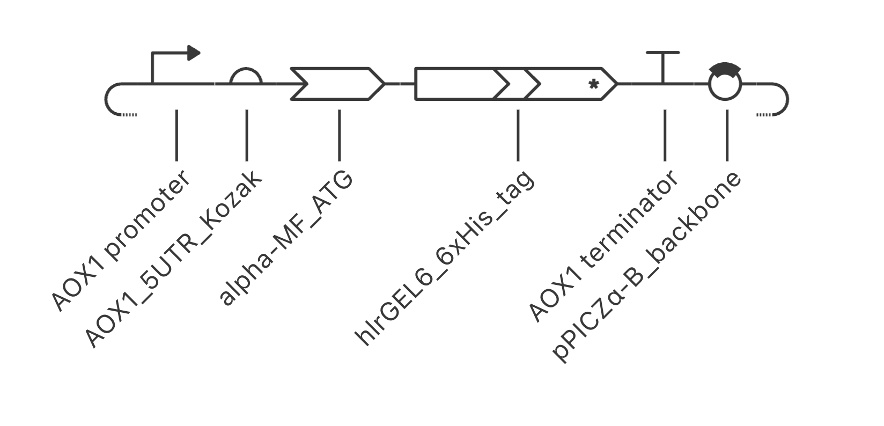
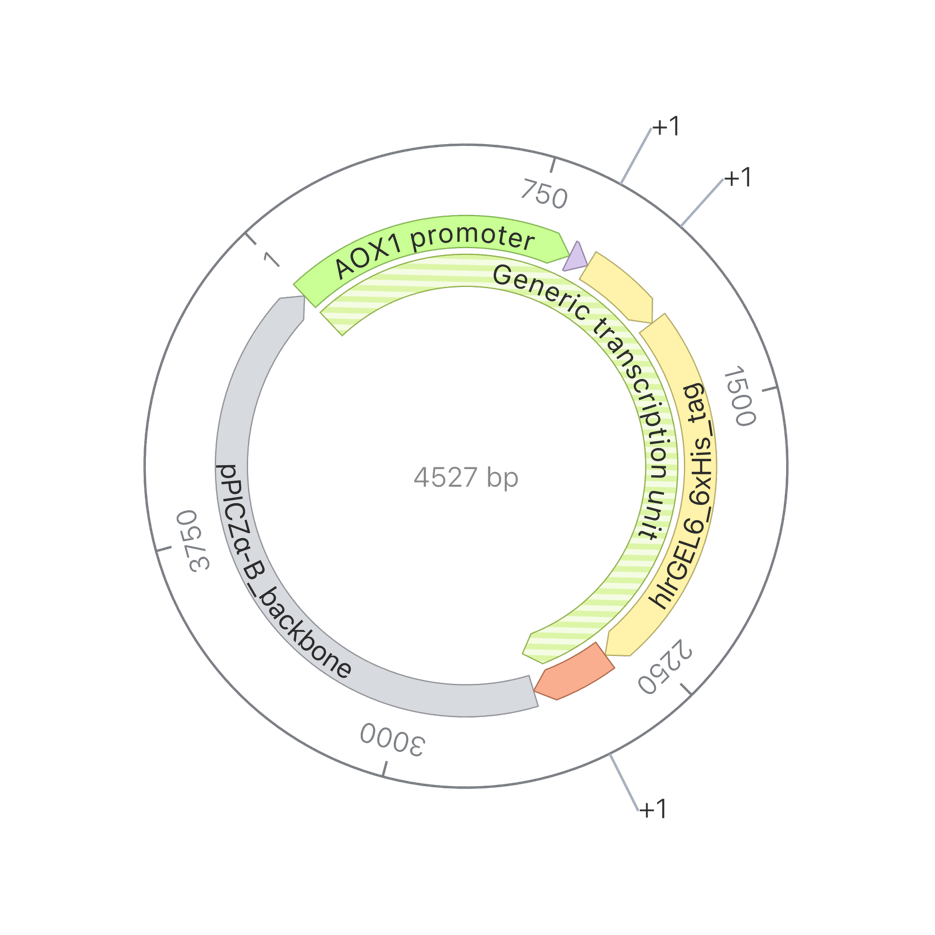
| Transcription start | AOX1 promoter | Promoter | Komagataella phaffii (pPICZα-B vector) | Strong, methanol-inducible promoter that drives tightly regulated and high-level expression in P. pastoris. |
| Translation start | AOX1 5′ UTR & Yeast Kozak | 5′ UTR | Komagataella phaffii (Native 5′ UTR embedded in AOX1 promoter) | Recruits the 40S ribosomal subunit and provides the yeast Kozak consensus context for efficient translation initiation at the start codon. |
| Targeting & Processing | α-MF signal peptide / KEX2 site | Targeting / Protease Cleavage Site | Saccharomyces cerevisiae (α-mating factor prepro signal) | Directs the nascent polypeptide into the eukaryotic secretory pathway and enables endogenous signal processing via Kex2 endopeptidase. |
| Coding sequence | hlrGEL6_CDS | CDS (-start -stop) | Human collagen type III derivative (Song et al., 2024), codon-optimized for P. pastoris | Encodes six tandem GEL1 domains separated by flexible GS linkers in-frame for high-yield expression of human-like recombinant gelatin. |
| Purification tag | 6×His Tag | Tag | Synthetic C-terminal tag (pPICZα-B vector; Song et al., 2024) | Facilitates downstream purification of the secretable recombinant protein using immobilized metal affinity chromatography (Ni-NTA), as validated by Song et al. (2024). |
| Transcription stop | AOX1 terminator | Terminator | Komagataella phaffii (pPICZα-B vector) | Provides native transcription termination, mRNA cleavage, and 3′ polyadenylation signals required for transcript stability. |
| Vector context | pPICZα-B backbone | Backbone / 3′ UTR | Commercial yeast expression vector (pPICZα-B; CAGER Vector Database) | Supplies the pUC origin of replication, Zeocin selection marker (Bleo^R), and a unique SacI restriction site for genomic integration via homologous recombination. |
Part 3: Assemble Your Construct
Part 4: Optimize and Quality-Check
Codon Optimization
The hlrGEL6 sequence was codon-optimized using the Asimov engine to maximize expression in Komagataella phaffii (Pichia pastoris), selecting Saccharomyces cerevisiae as the closest available host proxy in the tool.
The algorithm systematically replaced low-frequency yeast codons (e.g., CGT → AGA for Arg, GGA → GGT for Gly) with host-preferred triplets, eliminating translational bottlenecks across the repetitive Gly-X-Y domains while preserving 100% primary amino acid identity.
The optimization was strictly restricted to the coding region, keeping the upstream α-MF cleavage site intact, maintaining the C-terminal 6×His tag in-frame with a tandem stop codon (TGA TAA), and removing internal restriction sites and mRNA secondary structures.
Biosecurity
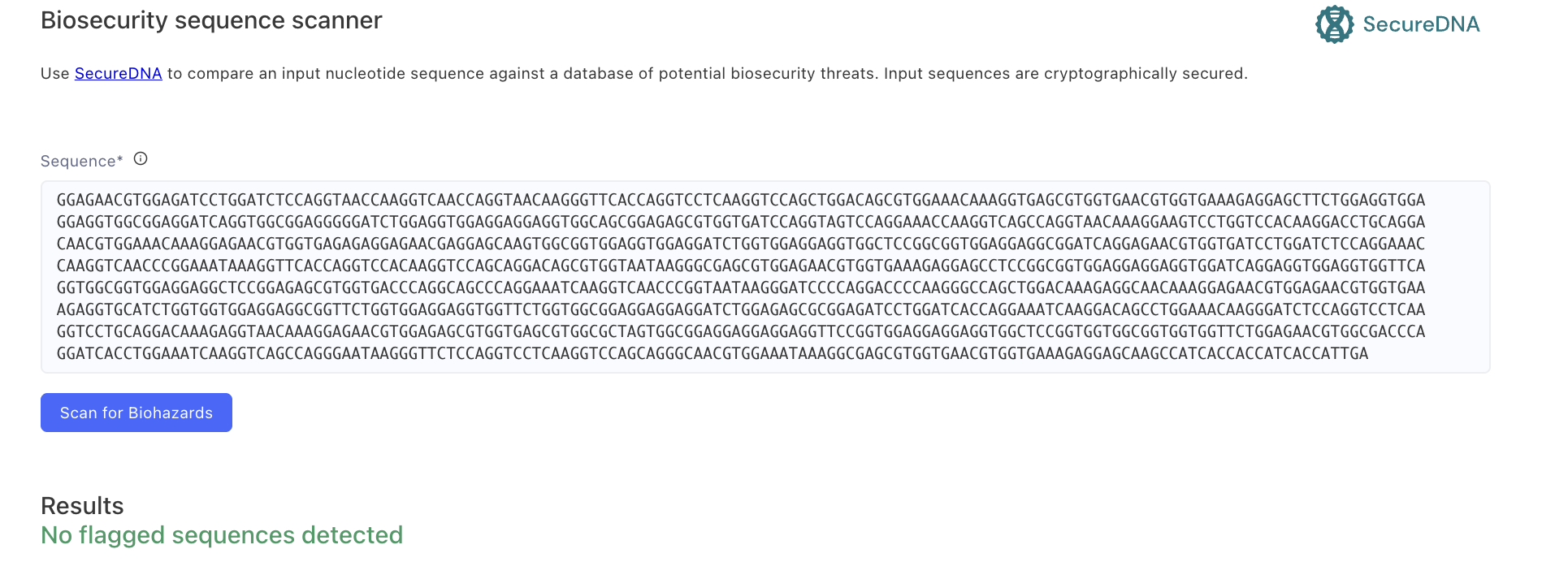
Biosecurity analysis was performed on the hlrGEL6 sequence using Kernel’s automated screening tool. The analysis identified no biosecurity threats, confirming the construct’s suitability for recombinant expression.
BLAST Search
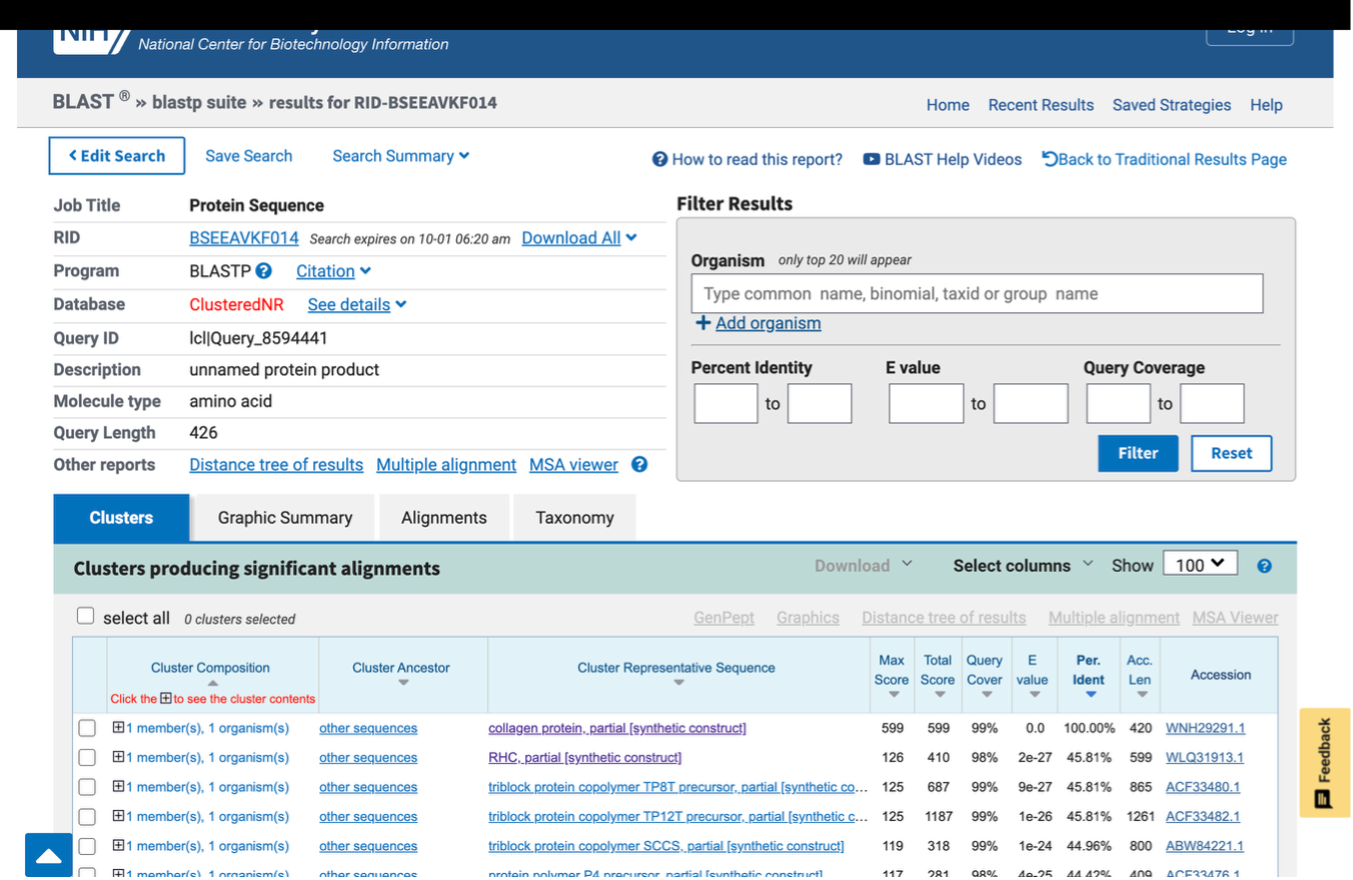
The hlrGEL6 protein sequence was queried against the NCBI database using BLASTP to verify its correspondence with the published construct.
The query returned 100% identity over 420 residues with 99% query coverage against the deposited sequence WNH29291.1 (GenBank OR365074.1; Song et al., 2024), confirming that the designed sequence matches its source.
The six unaligned C-terminal residues correspond to the 6×His tag, which is absent from the deposited record.
The remaining hits showed identity values of up to 45%, indicating only partial similarity to previously reported sequences.
Part 5: From design to build
1. Construction Strategy and Justification
For the construction of a multigenic or medium-length construct (~3–5 kb), the most efficient strategy is to order commercially available synthetic DNA fragments of intermediate size (~1–1.5 kb) and assemble them using isothermal assembly (Gibson et. al., 2009). Length and complexity rationale: Synthesizing a long construct as a single block directly through oligonucleotide synthesis involves high costs and a substantial accumulation of mutations. Conversely, assembling the entire construct starting exclusively from pools of individual oligonucleotides synthesized on microchips requires complex selection and multiplex amplification steps to achieve sufficient concentrations for efficient bimolecular priming (Gibson et. al., 2009; Gibson et. al., 2009) Gibson isothermal assembly enables the covalent joining of multiple DNA fragments with 40–450 bp overlaps in a single reaction at 50 °C through the combined action of T5 exonuclease, Phusion DNA polymerase, and Taq DNA ligase. This methodology can be used for assemblies ranging from small DNA junctions to complete genomes without leaving scars (Gibson et. al., 2009).
2. Synthesis Constraints and Error Correction
Chemical oligonucleotide synthesis is limited by per-cycle coupling efficiencies, which result in typical error rates of approximately 1 mutation per 160–600 bp (Gibson et. al., 2009). Design limitations: Synthesis is negatively affected by sequences with very high or very low GC content, tandem repeats, and stable secondary structures. The most frequent chemical failures (~44–59%) are single-base deletions resulting from incomplete coupling or incomplete deprotection (Carr et. al., 2004) Impact of assembly and error correction: • Enzymatic error correction with MutS: The MutS protein from Thermus aquaticus can be used to recognize and bind heteroduplexes containing mismatches and short insertions/deletions (Carr et. al., 2004). • Filtering the MutS-bound fractions reduces the error rate by approximately 15-fold, reaching 1 error per 10,000 bp (Carr et. al., 2004). • This transforms the screening process: for a 2.5 kb gene, only one correct clone needs to be sequenced instead of dozens (Carr et. al., 2004). • Solid-phase hybridization selection: As an alternative, hybridization of construction oligonucleotides against selection oligonucleotides immobilized on magnetic beads can eliminate truncated or mutated sequences, reducing the error rate from 1/160 bp to 1/1,394 bp before amplification and assembly (Tian et. al., 2004)
3. Prototype vs. Scale-Up Production
Prototype (Proof-of-Concept Phase): To experimentally validate one or a few design variants, the most suitable approach is one-pot isothermal assembly at 50 °C using commercially available DNA fragments, followed by transformation into E. coli and sequencing of 1–3 clones (Gibson et. al, 2009) Scale-Up (Mass Production): To synthesize large combinatorial libraries or collections of complete genomes/operons, the process can be transferred to photoprogrammable microchip-based systems (e.g., Xeotron/Atactic 4K or ultra-high-density NimbleGen arrays) (Tian et. al. 2004). In this workflow: • Thousands of oligonucleotides are synthesized in parallel on the chip. • They are cleaved from the chip and amplified by PCR using primers containing restriction sites for Type IIS enzymes (such as BsaI or BseRI), which remove the adapters. • They undergo mass hybridization purification using streptavidin-coated beads. • Multiple genes are assembled simultaneously through Polymerase Assembly Multiplexing (PAM) in a single thermocycling reaction.
Key Unknowns and Risk Mitigation
1. Optimization of Gelatin Production and Secretion
The main risk is that gelatin accumulates intracellularly or that the secretion machinery becomes saturated, reducing the extracellular yield required to formulate functional bioinks.
How to Determine This
Design a library of construct variants testing different signal peptides (secretion tags) and different levels of codon optimization.
To generate these variants efficiently, multiplex gene synthesis using programmable microchips, as described in Tian et al. (2004), could be used. This method enables the synthesis of thousands of construction and selection oligonucleotides to assemble multiple genes in a single step.
The secreted gelatin would then be quantified using an ELISA assay on the culture supernatant to identify the optimal variant.
2. Fidelity in the Synthesis and Assembly of Repetitive Sequences
Gelatin consists of highly repetitive amino acid sequences, which makes de novo DNA synthesis more challenging and substantially increases the rate of structural errors.
How to Determine This
To reduce synthesis errors in the gene, a filtering step using the MutS protein would be implemented. MutS binds to DNA mismatches, allowing defective molecules to be separated from the desired products and achieving a 15-fold reduction in errors, as described by Carr et al. (2004).
To assemble the final construct, a one-step isothermal in vitro recombination method at 50 °C would be evaluated. This method uses the coordinated action of a 5′ exonuclease, a DNA polymerase, and a DNA ligase.
This approach allows multiple overlapping DNA molecules to be joined in a single reaction and is capable of assembling fragments of up to several hundred kilobases, as described in Gibson et al. (2009).
3. Protein Folding and Functionality
There is a possibility that, even if gelatin is secreted in large quantities, it may lack adequate proline hydroxylation if the host does not possess the necessary enzymatic machinery, which would affect its thermal gelation properties.
How to Determine This
Extract the secreted gelatin and perform rheological tests by measuring the storage and loss moduli as a function of temperature.
If the extrusion and gelation behavior is not optimal, the next design step would be to co-express a recombinant prolyl hydroxylase in the same host.
References
Carr, P. A., et al. (2004). Protein-mediated error correction for de novo DNA synthesis.
Gibson, D. G., et al. (2009). Enzymatic assembly of DNA molecules up to several hundred kilobases. Nature Methods.
Song, X., Chu, T., Shi, W., & He, J. (2024). Expression, characterization, and application of human-like recombinant gelatin.
Tian, J., et al. (2004). Accurate multiplex gene synthesis from programmable DNA microchips.
CAGER Vector Database. pPICZ-alpha B Vector Map and Sequence (Accession No. 021.A.E5-6). Resource Center for Genetic Resources, Institute of Bioorganic Chemistry. Retrieved from https://mbio.bas-net.by/cager/vectors/021.A.E5-6.html