Week 1 HW: Final Project Ideas
HTBAA Homework #1 DAVID TOLEDO
1. What do you want to make? →
I would like to biomanufacture bacterial cellulose hydrogel sheets that could be developed into wound dressings. As a Bioengineering student, I am particularly interested in how biological systems can be used to create materials with biomedical applications. I find it fascinating that a living microorganism can produce a material that we could potentially use to support human health. Bacterial cellulose has several interesting properties, including its ability to retain water and form a three-dimensional network of nanofibers. These characteristics make it a promising material for wound-dressing research. This was actually a related idea of a project I’ve been working on more related to diabetes wounds in the Cleveland Clinic hackathon that is currently going on in my college.
For more detailed info check the postulation document! (it’s in spanish btw):
INFORME TÉCNICO ACTUALIZADO: PARCHE INTELIGENTE PARA MONI…
My initial goal would be to manufacture small, consistent sheets measuring 10 × 10 cm. I would like to investigate their water retention, mechanical properties, and suitability as a potential wound-dressing material.Eventually, I would also be interested in exploring whether the cellulose could be combined with engineered proteins or other biological molecules to give it additional functions. For this first project, however, I would focus on producing and characterizing the cellulose itself, rather than developing a clinically approved medical product.
2. What living system could make it? →
I would use the bacterium Komagataeibacter xylinus, which is known for its ability to produce bacterial cellulose. There’s a lot of investigations about this and the one we initially thought to use in our project was this one :
The process would be:
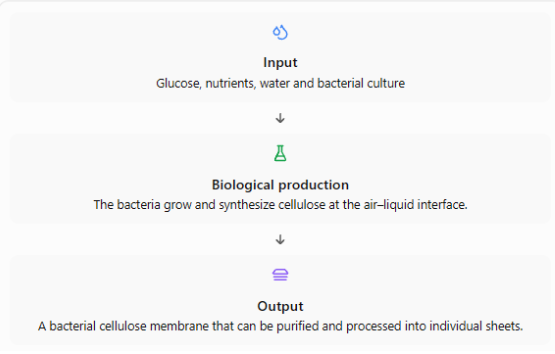
I would begin with static cultivation, allowing the bacteria to form a cellulose membrane at the surface of the culture medium. After cultivation, the material would be harvested, purified, washed and cut into the desired dimensions.Static cultivation is particularly interesting because it can produce continuous cellulose films, although it presents challenges related to production area and processing time.My initial assumption is that the selected bacterial strain could produce enough cellulose to form a continuous sheet with suitable mechanical properties.
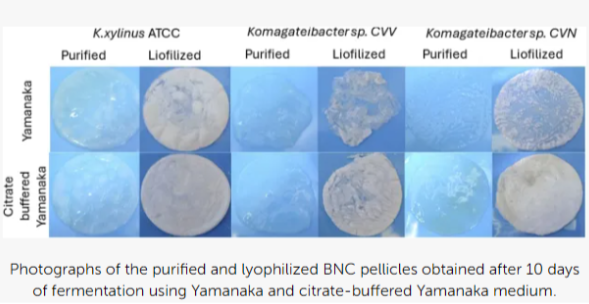
Photograms of the purified and lyophilized BNC pellicles obtained after 10 days of fermentation using Yamanaka and citrate-buffered Yamanaka medium.
3. How could automation help you make it? →
I would initially use an Opentrons Flex liquid-handling robot to automate part of the experimental workflow.
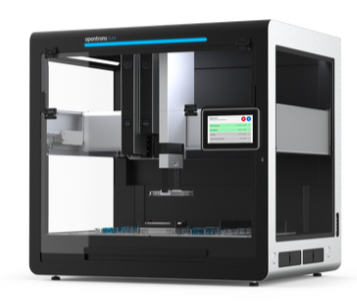
During the early stages, I would need to compare different culture conditions to determine which ones produce cellulose most efficiently. For example, I could investigate how changes in nutrient concentration, pH and culture composition affect cellulose production.The Opentrons system could help prepare experimental media and distribute precise liquid volumes across multiple samples. Its programmable liquid-handling capabilities make it suitable for this type of laboratory workflow. I would also like to automate data collection, using sensors to monitor variables such as temperature and pH.The main advantage would be reproducibility. Instead of preparing every experiment manually, I could compare multiple conditions while reducing variation introduced by manual liquid handling.At a larger manufacturing scale, I would need a different automation system, such as programmable pumps to fill larger cultivation trays and automated systems for harvesting and processing the cellulose.The Opentrons robot would therefore be used mainly for research and optimization, not for filling industrial-scale production vessels.
4. What would it take to make it at a meaningful scale?
a. How much?
For my initial project, I would like to produce 100 experimental bacterial cellulose wound-dressing sheets, each measuring 10 × 10 cm. I chose this scale because it would allow me to evaluate the material’s properties, compare production conditions, and investigate whether the manufacturing process could produce consistent results. These would be research samples, not dressings ready for clinical use.
For this preliminary estimate, I will assume that each sheet contains approximately 0.5 g of dry bacterial cellulose. Producing 100 sheets would therefore require 50 g of dry cellulose. However, some material would likely be lost during harvesting, purification, cutting, and quality control. Assuming a 20% loss, I would need to produce approximately 62.5 g of dry bacterial cellulose.
A 2024 study reported a bacterial cellulose yield of approximately 7 g/L after six days of cultivation using Komagataeibacter xylinus under specific culture conditions. For my project, I will assume a more conservative yield of 5 g/L after seven days. Based on this assumption, producing 62.5 g of cellulose would require approximately 12.5 liters of bacterial culture.
These values are preliminary estimates. The actual cellulose yield, material losses, and amount required per sheet would need to be determined experimentally.
b. How long would it take?
I would initially use shallow cultivation trays measuring 20 × 20 cm, each containing approximately 400 mL of culture medium. Since I would need 12.5 liters of culture, this would require approximately 32 cultivation trays operating simultaneously. Each tray would provide enough surface area to produce a cellulose membrane that could theoretically be divided into four 10 × 10 cm sheets, assuming sufficient thickness and uniformity.
I estimate that cellulose production would take approximately seven days. I would then allow three additional days for harvesting, purification, cutting, and preliminary quality control.
Therefore, the entire production process would take approximately 10 days, assuming that all trays can be cultivated in parallel and the processing equipment has sufficient capacity.
At this scale, automation could help prepare and distribute the culture medium, monitor cultivation conditions, and reduce variability between batches. For example, a liquid-handling robot could prepare different media formulations during the experimental stage, while programmable pumps and sensors could support larger-scale cultivation.
One important limitation is that bacterial cellulose production depends not only on culture volume but also on the available cultivation surface area. Producing larger quantities would require more trays, additional space, or a different cultivation system.
Overall, this pilot-scale experiment would help me determine whether bacterial cellulose could be produced consistently before considering a larger manufacturing process.
5. What i dont kow yet
1. Can I consistently produce cellulose with the required properties?
I would need to determine whether different cultivation conditions produce significant differences in cellulose thickness, mechanical strength and water retention.Producing cellulose is one thing, but producing hundreds of nearly identical sheets is another.
2. How can I increase production without compromising material quality?
Static cultivation requires a relatively large surface area. I would need to investigate whether cultivation trays could be stacked or redesigned to improve space efficiency while maintaining sufficient oxygen availability and consistent cellulose production.
3. Can the material be safely developed into a wound dressing?
Producing cellulose does not automatically make it suitable for medical use. I would need to investigate purification, removal of bacterial residues, sterilization, biocompatibility and the effects of processing on the material’s properties. I would also need to evaluate whether the manufacturing process could meet the quality requirements of a medical product before considering any clinical application.
REFERENCES USED:
Núñez D, Oyarzún P, Cáceres R, Elgueta E and Gamboa M (2024) Citrate-buffered Yamanaka medium allows to produce high-yield bacterial nanocellulose in static culture using Komagataeibacter strains isolated from apple cider vinegar. Front. Bioeng. Biotechnol. 12:1375984. doi: 10.3389/fbioe.2024.1375984.
Dong Hoon Hur, Hong-Soon Rhee, Jae Hyung Lee, Woo Yong Shim, Tae Yong Kim, Sang Yup Lee, Jin Hwan Park, Ki Jun Jeong,Enhanced production of cellulose in Komagataeibacter xylinus by preventing insertion of IS element into cellulose synthesis gene, Biochemical Engineering Journal, Volume 156, 2020, 107527, ISSN 1369-703X, https://doi.org/10.1016/j.bej.2020.107527.
Link: https://www.sciencedirect.com/science/article/pii/S1369703X20300425
Hodel, K. V. S., Machado, B. A. S., Sacramento, G. d. C., Maciel, C. A. d. O., Oliveira-Junior, G. S., Matos, B. N., Gelfuso, G. M., Nunes, S. B., Barbosa, J. D. V., & Godoy, A. L. P. C. (2022). Active Potential of Bacterial Cellulose-Based Wound Dressing: Analysis of Its Potential for Dermal Lesion Treatment. Pharmaceutics, 14(6), 1222. https://doi.org/10.3390/pharmaceutics14061222
AI AND PROMPTS USED
I used Chatgpt to organize my brainstorming ideas. (The prompts were in Spanish)
Prompt 1:
Te paso la primera tarea de HTBAA. Me interesa bastante la parte de biomateriales, SynBio y protein engineering. También estoy trabajando en un proyecto relacionado con heridas diabéticas.Veamos qué podríamos biomanufacturar que conecte con eso. Algo que se pueda plantear desde un living system y que tenga sentido llevarlo a una escala mayor pero nada muy complicado obviamente
Prompt 2
Me gusta lo de la celulosa bacteriana. Podríamos enfocarnos en producir las membranas como material base para apósitos como mi trabajo con cleveland no se si lo recuerdaes .La parte de incorporar otras moléculas la podemos dejar como algo a futuro porque creo que es mas dificil. Por ahora quiero que el objetivo sea producir el material y evaluar sus propiedades ayúdame a ordenar esa idea para la primera pregunta.
Prompt 3
Para el living system, yo se que hay uno que se llama aldo como komagatoiber o algo asi.Quiero explicar el proceso desde el medio de cultivo hasta obtener las membranas. Input, producción y output, sin entrar todavía en un protocolo experimental completo.Revisa que tenga sentido y ayúdame a redactarlo.
Prompt 4
Para automatización, estaba pensando en trabajar con diferentes condiciones de cultivo. Concentración de nutrientes, pH, temperatura y ver cómo afectan la producción de celulosa. Mi profe cuando hacia ideas de clevelan menciono a Opentrons para poder preparar las muestras. después cambiaría al pasar a una escala mayor obaiemtne pero es bueno para empezar .No quiero que quede como que el robot hace absolutamente todo el proceso.
Prompt 5
No me queda muy clara esta parte de meaningful scale. Podríamos empezar con unas 100 membranas de 10 × 10 cm, algo como un lote piloto para caracterización.Ayúdame a desarrollar los cálculos. Necesitamos considerar la cantidad de celulosa seca, el rendimiento del microorganismo, volumen de cultivo, pérdidas y tiempo de producción. Que los números tengan sentido y estén respaldados o identificados como supuestos.
Prompt 6
Para los unknowns, creo que lo principal sería conseguir membranas uniformes, mantener el rendimiento al escalar y asegurar que el material pueda utilizarse en una aplicación biomédica. Ayúdame a ordenar estos puntos. Quiero que quede claro qué tendría que medir o validar experimentalmente.
Prompt 7
Ya tenemos la idea general. Ahora ayúdame a ordenar todo en inglés siguiendo las preguntas del homework. Mantén la conexión con mi proyecto de heridas diabéticas y los aspectos técnicos que hemos discutido. En la parte de meaningful scale, explica los cálculos en texto, sin fórmulas de LaTeX. Que se entienda de dónde salen las cantidades y cuáles son supuestos. No lo hagas demasiado formal. Quiero que mantenga un estilo de estudiante universitario, técnico pero fácil de entender.