Week 2 HW: DNA Design
HTBAA Homework #2: DNA Design
Part 0: Set up in Kernel
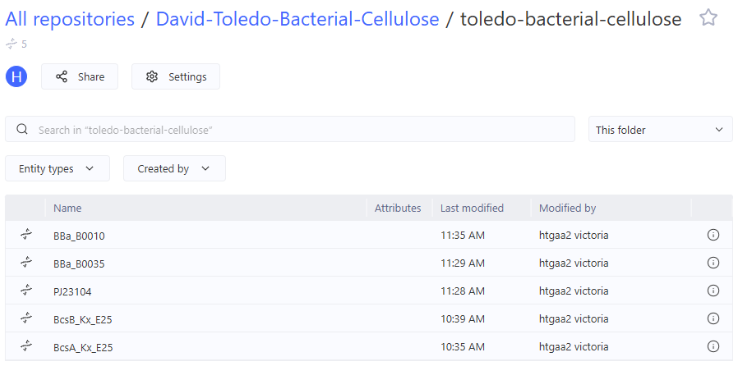
My project is stored in the David-Toledo-Bacterial-Cellulose repository, inside the toledo-bacterial-cellulose folder.
Part 1: Define your expression target
Expression target
My project aims to produce bacterial cellulose for wound-dressing applications. Since cellulose itself is not a protein, I chose to express BcsA and BcsB, two core components of the bacterial cellulose synthase complex.
BcsA is the catalytic subunit responsible for cellulose biosynthesis, while BcsB is another core component of the cellulose synthase machinery.
Rather than reconstructing the complete cellulose biosynthesis pathway, my initial design focuses on expressing these two core components while using the native cellulose synthesis, export, and organization machinery already present in Komagataeibacter xylinus.
Sequence source
I used the native bcsA and bcsB coding sequences from Komagataeibacter xylinus E25. The complete genome of this strain is available through NCBI under accession CP004360.1.
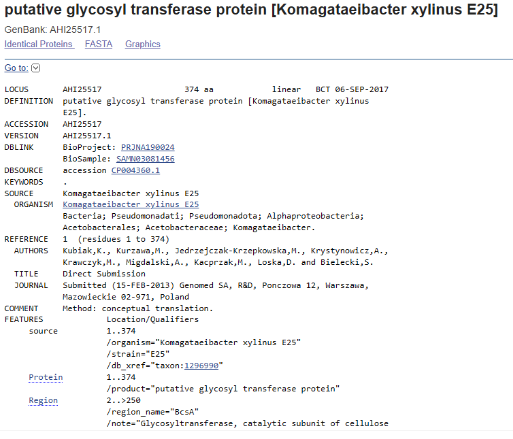
BcsA corresponds to locus tag H845_451 and encodes a 745-amino-acid cellulose synthase catalytic subunit. Its GenBank protein accession is AHI24410.1, and its coding sequence corresponds to CP004360.1:474401–476638.
BcsB corresponds to locus tag H845_452 and encodes an 811-amino-acid cellulose synthase subunit. Its GenBank protein accession is AHI24411.1, and its coding sequence corresponds to CP004360.1:476625–479060.
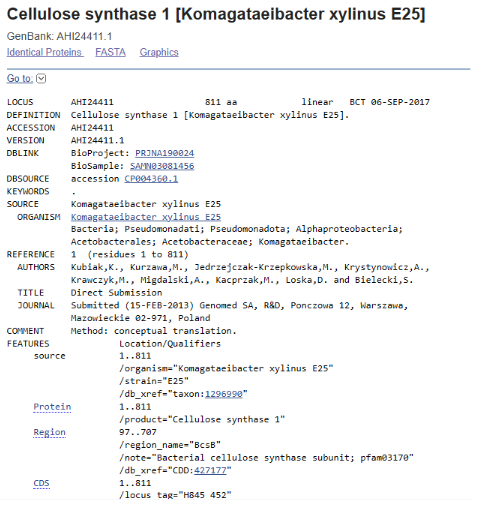
Both native coding sequences were retrieved from NCBI and imported into Kernel as CDS (+start +stop) parts.
Host/chassis
I selected Komagataeibacter xylinus as the host because it is naturally capable of producing bacterial cellulose and was already the living system selected in Homework #1.
Using the native cellulose-producing host allows the designed construct to operate alongside the endogenous machinery involved in cellulose synthesis, export, and organization.
Product localization
BcsA and BcsB function as components of the cellulose synthase machinery associated with the bacterial cell envelope rather than as freely secreted proteins. The cellulose produced by this machinery is subsequently translocated and assembled outside the cell with the participation of the remaining native Bcs components.
For this initial design, I therefore do not add an artificial secretion signal to BcsA or BcsB, since the construct is intended to work with the native cellulose biosynthesis machinery of K. xylinus.
Part 2: Design your genetic parts
For the expression construct, I designed the following basic cassette:
5′ – PJ23104 – RBS – BcsA – RBS – BcsB – Terminator – 3′
The genetic parts used in the design are:
| Part | Type | Source / sequence | Justification |
|---|---|---|---|
| PJ23104 | Promoter | Constitutive promoter | Selected to provide constitutive transcription of the BcsA/BcsB expression cassette. |
| BBa_B0035 | RBS | Standard RBS | Provides translation initiation for each CDS. |
| BcsA | CDS | H845_451 / AHI24410.1 | Catalytic cellulose synthase subunit. |
| BcsB | CDS | H845_452 / AHI24411.1 | Core component of the cellulose synthase machinery. |
| BBa_B0010 | Terminator | Standard terminator | Provides defined transcription termination. |
| pSEVA331Bb-derived | Vector context | pBBR1 ori + Cm resistance | Broad-host-range plasmid context for Komagataeibacter. |
Part 3: Assemble your construct
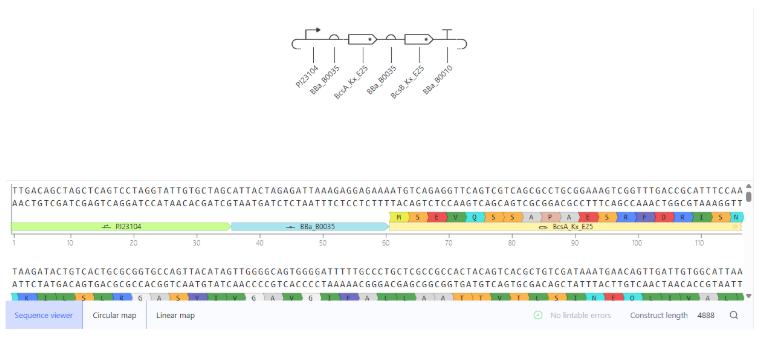
I assembled the expression cassette in Kernel in the following 5′→3′ order:
PJ23104 → BBa_B0035 → BcsA_Kx_E25 → BBa_B0035 → BcsB_Kx_E25 → BBa_B0010
The construct has a total length of 4,888 bp.
PJ23104 drives constitutive transcription of the cassette, while an independent BBa_B0035 RBS is positioned upstream of each coding sequence to support translation of both BcsA and BcsB. BBa_B0010 is positioned downstream of BcsB to terminate transcription.
I inspected the assembled sequence in Kernel’s Sequence Viewer. Both BcsA and BcsB were imported from their native NCBI coding sequences as CDS (+start +stop) parts, preserving their expected start and stop codons and reading frames.
Kernel translated the coding regions in the Sequence Viewer and reported “No lintable errors” for the assembled construct. The construct map was also inspected to confirm that all parts were in the intended order and forward orientation.

The expression cassette is intended to be inserted into the pSEVA331Bb-derived vector context described in Part 2.
Part 4: Optimize and quality-check
Codon optimization
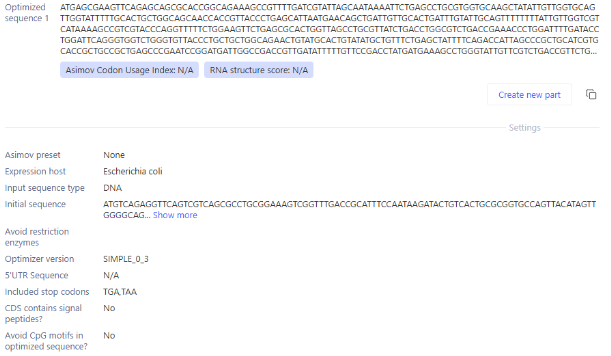
I tested Kernel’s codon optimization tool using the native BcsA coding sequence.
Kernel does not currently provide Komagataeibacter xylinus as an expression host. Therefore, I performed an exploratory optimization of BcsA using Escherichia coli as the expression host rather than replacing the native sequence in my final construct.
Kernel generated an alternative codon-optimized sequence using the Simple v0.3 algorithm.
A nucleotide pairwise alignment between the native and optimized BcsA sequences gave 66.20% pairwise identity, showing that substantial synonymous recoding can occur when adapting a gene to a different host.
Codon usage matters because organisms differ in their preferred synonymous codons, which can influence translation efficiency and protein expression.
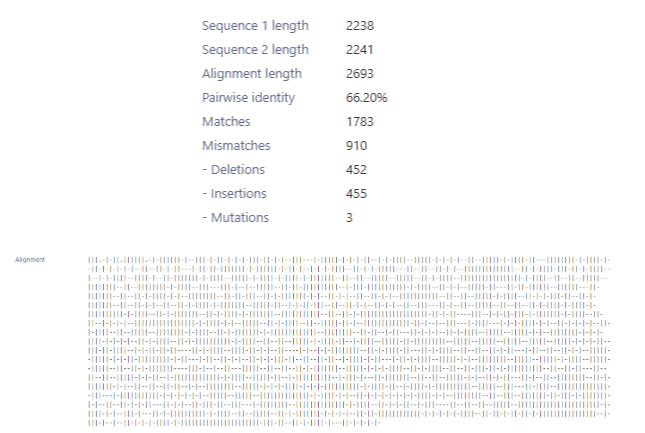
Because BcsA and BcsB in my design are already native sequences from K. xylinus E25, and Kernel cannot optimize specifically for this host, I retained the native CDS sequences in the final construct rather than using the E. coli-optimized sequence.
Sequence similarity search
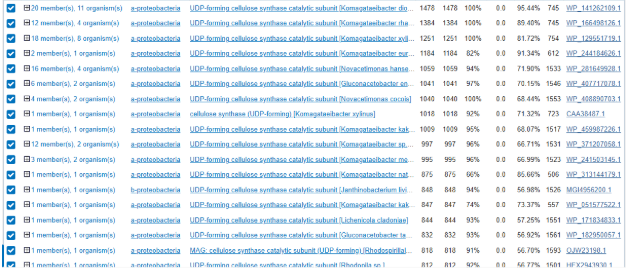
I performed a BLASTp search of BcsA (AHI24410.1) against the NCBI ClusteredNR database.
The search returned multiple significant matches to UDP-forming cellulose synthase catalytic subunits. The highest-ranked cluster showed 100% query coverage, 95.44% sequence identity, and an E-value of 0.0. Additional high-scoring homologs were found among Komagataeibacter species.
These results are consistent with BcsA being a naturally occurring cellulose synthase protein rather than a novel engineered protein and support the functional annotation used in the construct.
Biosecurity screening
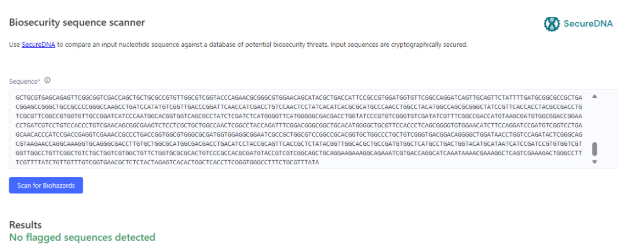
I screened the complete 4,888 bp BcsAB expression construct using Kernel’s SecureDNA biosecurity sequence scanner.
SecureDNA compares nucleotide sequences against its biosecurity screening system for potentially concerning sequences.
The scan returned “No flagged sequences detected.” Therefore, no biosecurity flags requiring redesign were identified for the submitted construct.
Part 5: From design to build
Build strategy
My final expression cassette is 4,888 bp long. For an initial prototype, I would not synthesize the entire construct as one long DNA molecule. Instead, I would order the design as a small number of synthetic DNA fragments and assemble them into the pSEVA331Bb-derived vector using Gibson Assembly.
Each fragment would be designed with overlapping ends compatible with its neighboring fragment and with the linearized vector. Gibson Assembly is appropriate for this design because it allows multiple DNA fragments with overlapping ends to be joined into a single construct in one assembly reaction.
Gibson et al. demonstrated this approach for assembling DNA molecules considerably larger and more complex than the cassette designed here (Gibson et al., 2009).
I would prefer this strategy over building the construct directly from an oligonucleotide pool. Oligo-pool approaches are especially useful when many different sequences need to be synthesized in parallel, whereas this project currently requires only one defined BcsA/BcsB expression cassette.
Synthesis constraints and error correction
DNA synthesis is not error-free, and longer sequences increase the chance that at least one synthesis error will occur.
My construct also contains two relatively large coding regions, BcsA and BcsB, so dividing the cassette into smaller synthetic fragments would make synthesis and verification more manageable.
Sequence-dependent properties such as repetitive regions, extreme GC content, or secondary structure can also make synthesis and assembly more difficult. Before ordering the fragments, I would therefore use the synthesis provider’s sequence screening to identify problematic regions and, where possible, introduce synonymous changes that preserve the encoded protein.
After assembly, the resulting construct would be sequence-verified before being introduced into K. xylinus.
Error correction could also be incorporated before final assembly. Carr et al. demonstrated that mismatch-recognizing proteins can enrich correctly synthesized DNA by identifying and removing error-containing molecules, illustrating how error-correction methods can improve the fidelity of de novo synthesized DNA (Carr et al., 2004).
Prototype versus scale
For the prototype, I would synthesize one set of fragments, assemble the BcsA/BcsB cassette into the selected vector, verify the assembled sequence, and test the resulting construct in K. xylinus.
At this stage, the main objective is to determine whether increased expression of BcsA and BcsB actually improves bacterial cellulose production.
At larger scale, I would not continuously synthesize new DNA for every cellulose production batch. Once a validated construct and strain are obtained, the DNA design becomes a reusable biological production system.
Scaling would therefore focus on maintaining the engineered strain and increasing bacterial cellulose cultivation rather than repeatedly synthesizing the 4,888 bp construct.
If I later wanted to test many promoter, RBS, or BcsA/BcsB variants in parallel, higher-throughput DNA synthesis approaches would become more useful. For example, Kosuri et al. described selective amplification of DNA from high-density oligonucleotide pools as a scalable strategy for producing many different synthetic genes simultaneously (Kosuri et al., 2010).
Part 6: What don’t you know yet?
1. Will PJ23104 provide an appropriate expression level in K. xylinus?
The first uncertainty is whether the constitutive PJ23104 promoter will provide an appropriate level of BcsA and BcsB expression in K. xylinus.
Stronger expression is not necessarily equivalent to higher cellulose production, since excessive expression could impose a metabolic burden on the cells.
I would test this by comparing the current construct with variants containing promoters of different strengths. Expression could be measured at the RNA level using RT-qPCR, while growth and cellulose production would be measured in parallel.
This would allow me to identify whether increasing BcsA/BcsB expression actually improves production without strongly affecting cell growth.
2. Will the additional BcsA and BcsB function correctly with the native cellulose synthesis machinery?
My design assumes that additional BcsA and BcsB can interact correctly with the endogenous cellulose synthesis machinery already present in K. xylinus.
However, because cellulose synthesis depends on a larger membrane-associated complex, increasing only these two components may not increase the activity of the complete system.
I would compare the engineered strain with the unmodified K. xylinus strain under the same cultivation conditions. In addition to confirming expression of BcsA and BcsB, I would measure cellulose production to determine whether the additional copies produce a functional improvement.
3. Will the construct actually increase bacterial cellulose production and preserve the desired material properties?
Even if the construct increases expression of BcsA and BcsB, the most important unknown is whether this translates into more useful bacterial cellulose.
I would therefore compare the engineered and control strains using cellulose yield after a defined cultivation period. I would also compare properties relevant to the wound-dressing application, such as membrane thickness, water retention, and mechanical strength.
If expression increases but cellulose production does not, this would indicate that BcsA/BcsB expression is not the main limiting step and that other components of the cellulose biosynthesis pathway or cultivation conditions should be investigated next.
References
Carr, P. A. et al. (2004). Protein-mediated error correction for de novo DNA synthesis. Nucleic Acids Research, 32, e162. https://doi.org/10.1093/nar/gnh160
Gibson, D. G. et al. (2009). Enzymatic assembly of DNA molecules up to several hundred kilobases. Nature Methods, 6, 343–345. https://doi.org/10.1038/nmeth.1318
Kosuri, S. et al. (2010). Scalable gene synthesis by selective amplification of DNA pools from high-fidelity microchips. Nature Biotechnology, 28, 1295–1299. https://doi.org/10.1038/nbt.1716
Kong, D. S. et al. (2007). Parallel gene synthesis in a microfluidic device. Nucleic Acids Research, 35, e61. https://doi.org/10.1093/nar/gkm121
Tian, J. et al. (2004). Accurate multiplex gene synthesis from programmable DNA microchips. Nature, 432, 1050–1054. https://doi.org/10.1038/nature03151
Elowitz, M. B. & Leibler, S. (2000). A synthetic oscillatory network of transcriptional regulators. Nature, 403, 335–338. https://doi.org/10.1038/35002125
Stanton, B. C. et al. (2014). Genomic mining of prokaryotic repressors for orthogonal logic gates. Nature Chemical Biology, 10, 99–105. https://doi.org/10.1038/nchembio.1411