Week 1 HW: Final Project Ideas
Feed Mars: Programmable crop biomanufacturing for extreme environments on Earth and beyond
An automated biomanufacturing platform for deconstructing the natural seed and rebuilding it as a programmable crop starting unit for defined environments, from controlled agriculture on Earth to Mars.
Executive Summary
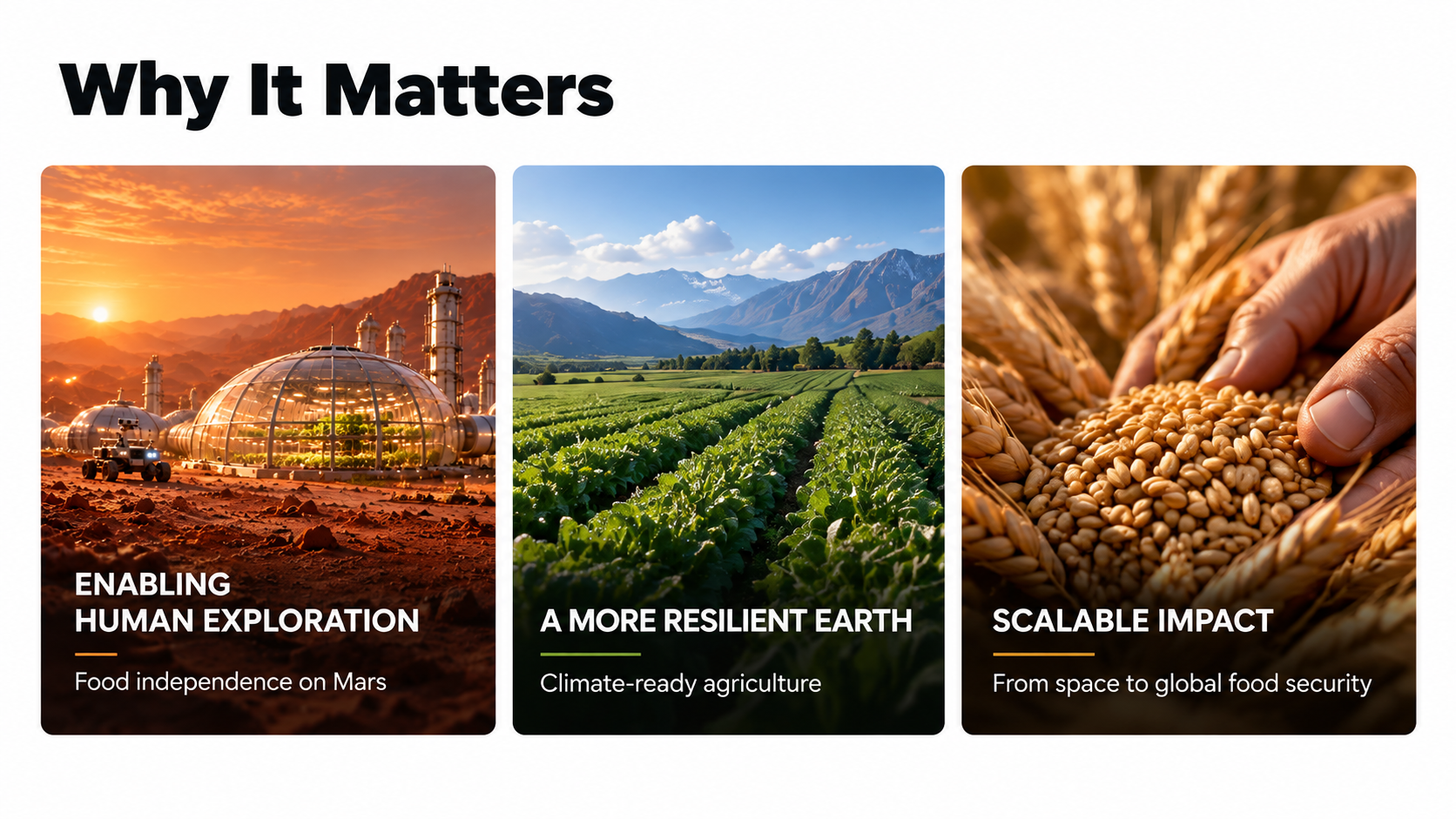
Long-duration human settlement beyond Earth will require food-production systems that keep operating with limited resupply, limited labor, and strict constraints on water, energy, nutrients, and growing space. Mars is an extreme version of that problem, but many of the same constraints already exist on Earth in controlled-environment agriculture, plant breeding facilities, and remote or resource-limited settings.
My idea is to biomanufacture a programmable crop starting unit: a manufactured biological system that contains only the functions needed to reliably start a crop in a defined environment.
A natural seed is an extraordinary piece of biological engineering, but it is optimized for survival in an unknown environment. It carries dormancy, a protective coat, and enough stored reserves to emerge from deep soil after an unpredictable delay. In a controlled habitat, many of those functions are unnecessary. At the same time, functions that such a habitat does need are absent: synchronized germination, a defined microbial partner, programmed nutrient release, and a verifiable quality specification.
In wheat, the embryo that actually becomes the plant is only a few percent of the kernel’s mass. Most of the rest is support function. Feed Mars asks:
Which functions of a natural seed must remain intrinsic to the embryo, and which can be removed, replaced, or manufactured?
The first experiment does not require synthetic embryos. It uses natural wheat embryos excised from seed as the developmental core and replaces the seed’s stored reserves and protective layers with an engineered capsule. Each later version removes one more dependency on the natural seed:
intact seed → embryo + artificial endosperm → programmed capsule → embryo decoupled from seed maturation → manufactured developmental core
I call the Mars-oriented implementation of this product class a Mars Seed Unit, and the automated platform that deconstructs, rebuilds, tests, qualifies, and manufactures these units Feed Mars.
Automation is not optional in this architecture. The capsule design space (reserves, nutrients, germination signals, matrix, microbial partners, environment) is combinatorial, and, unlike bulk seed coating, every unit is an individual assembly operation.
To make the idea concrete, I built a first-order engineering scenario for a hypothetical 100-person Mars settlement. Under the assumptions used here, the system would need to support approximately:
- 9.1 metric tons of edible wheat per year
- 1,630 m² of active crop canopy
- 3.4 million crop starting units per year (including reserve) at a field-typical planting density, and up to ~14 million at the densities used in high-yield controlled-environment studies
- only ~3–4 kg of embryonic developmental core per year, the part of the unit that actually becomes the plant
- ~17 full-time workers if embryos were excised by hand (at an assumed 100 embryos per person-hour), versus ~170 operating hours per year on an automated two-line system
- ~3.8–6.4 GWh of electricity per year for lighting alone
This calculation shaped the project in two ways. First, the biological starting material is tiny compared with the energy and infrastructure needed to turn it into food, so a redesigned starting unit is only worth building if it reduces the burden of the whole growing system. Second, the moment the seed is deconstructed, automated assembly and qualification become the central manufacturing problem.
1. What would I like to biomanufacture, and why?
The product: a programmable crop starting unit
I would like to biomanufacture a programmable crop starting unit: a designed biological package that reproducibly initiates crop growth under a specified operating environment.
The unit is built from four layers:
- Developmental core. Initially a natural wheat embryo excised from mature seed; later, embryos harvested before seed maturation; eventually, developmental tissue produced without flowering.
- Artificial endosperm and matrix. A hydrogel capsule that replaces the stored reserves and physical protection normally supplied by the endosperm and seed coat.
- Programmed functions. Nutrients, germination signals, controlled release, and defined microbial partners, added only where they measurably improve performance.
- Qualification record. A batch-linked specification describing core identity, capsule composition, manufacturing history, viability, environmental test conditions, and expected probability of successful establishment.
The Mars Seed Unit is the Mars-oriented implementation of this product class.
Why redesign the seed at all?
A fair objection is that wheat seed is already nearly ideal: about 40 mg, desiccation tolerant, storable for years, and self-replicating at roughly 1.5% of each harvest.
My answer is that a natural seed solves a different problem. It is optimized for survival under uncertainty. A controlled habitat, and Mars most of all, is the opposite case: every growing condition is engineered and known in advance. In that setting, a starting unit could be optimized for performance under a known specification instead.
Functionally, a wheat seed bundles:
| Seed function | Needed in a controlled habitat? | Feed Mars question |
|---|---|---|
| Developmental program (embryo) | Yes | Must remain biological; can its supply be decoupled from seed maturation? |
| Stored reserves (endosperm) | Partly; light is available from day one | How much reserve does a seedling actually need under controlled light? |
| Physical protection (seed coat) | Reduced | Can a manufactured matrix replace it? |
| Desiccation tolerance and dormancy | Mainly for long-term storage | Can on-demand local manufacturing replace long-term storage? |
| Germination control | Yes, but synchronized rather than delayed | Can germination timing be programmed by the capsule? |
| Microbiome interface | Useful if defined | Can a defined partner be packaged with the core? |
| Standard format and identity | Yes | Can each unit carry a verifiable specification? |
Design requirement: at every stage, the developmental core must remain regenerable from the crop itself. Feed Mars manufactures the package around the core; it must not break the local reproduction loop that makes plants valuable for regenerative life support.
V1–V4: removing one dependency on the natural seed at a time
V4 is the destination. The important feature of this roadmap is that V1 already tests V4’s central assumption: that the functions of a seed can be separated from the embryo and manufactured. The later versions do not add unrelated features; each removes one more dependency on the natural seed.
Why this is biomanufacturing
Feed Mars links several biological manufacturing processes.
Developmental-core supply. Wheat plants produce embryos (initially inside mature seed), edible grain, and phenotype data. In V4, plant tissue itself becomes a manufactured input.
Capsule manufacturing. Hydrogel matrices, nutrient formulations, and germination signals are prepared, dosed, and formed into capsules around each embryo.
Microbial manufacturing (V2 onward). Selected microorganisms are cultivated, concentrated, stabilized, and incorporated into the capsule.
Qualification. Every batch is linked to evidence that the units meet a defined specification. A future lot-release specification could include:
This qualification layer is what turns the concept from an agricultural input into a manufactured biological product with an operating envelope.
Why Mars?
A Mars-class food-production system would need to reproduce biological material locally, recycle water and nutrients, operate under limited energy, minimize labor, detect biological failure early, and maintain traceability.
Mars matters for this project for a specific reason: it is the most extreme case of a fully engineered, fully known growing environment. That is exactly the condition under which a starting unit designed for a known specification should have the largest advantage over a seed designed for uncertainty.
The deployment assumed here is inside a pressurized, controlled agricultural habitat, not direct exposure of wheat to the Martian surface.
Why wheat?
Wheat is a benchmark chassis, not the claimed optimum crop for Mars. It is useful because its genetics and agronomy are extensively characterized, it produces a nutritionally relevant staple grain, embryo excision and culture are established laboratory techniques, and it has a long history in controlled-environment life-support research (Salisbury et al., 1987; Bugbee & Salisbury, 1988).
Wheat is also a demanding test case for V4. Regeneration of wheat from tissue has historically been difficult and genotype-dependent, although recent work has shown that expressing a GRF4–GIF1 fusion protein substantially increases the efficiency and speed of wheat regeneration and the number of transformable genotypes (Debernardi et al., 2020). If the framework works in wheat, it should be transferable to crops that are easier to regenerate.
The durable capability is not ownership of one wheat variety. It is the ability to deconstruct, redesign, manufacture, and qualify crop starting systems for a target environment.
Earth-first relevance
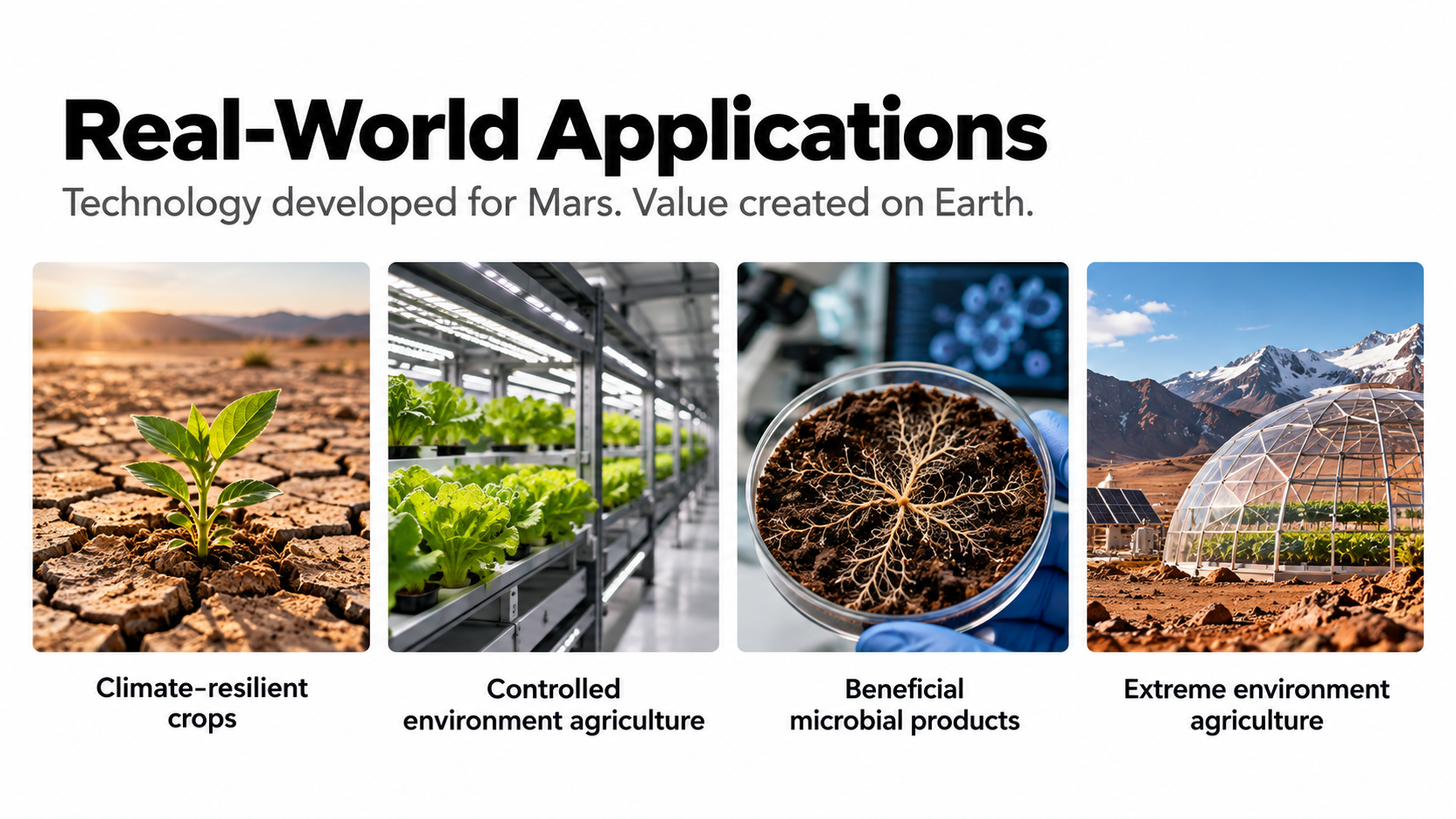
Mars is the long-term design pressure, but the enabling technologies should create value on Earth first. The most direct near-term applications are:
- Plant breeding and research facilities, where excising and culturing embryos can shorten generation time and where uniform, synchronized establishment is valuable.
- Automated embryo handling and encapsulation, a capability that artificial-seed research has long pursued for mass propagation (Rihan et al., 2017).
- Microbial seed and propagule treatments for greenhouse and field agriculture.
- Biological quality control for engineered propagation products.
Controlled-environment production of wheat as a commodity food is not a realistic Earth market: the lighting estimate in Section 4 alone corresponds to hundreds of kWh per kilogram of grain. The Earth-first path is therefore through breeding, propagation technology, and biological QC, not through indoor wheat farming.
Mars provides the long-term design constraint. Earth provides the first experimental and commercial environment.
2. What living system would I use?
Feed Mars initially uses wheat embryos as the developmental core and, from V2 onward, defined plant-associated microorganisms as programmable partners. Non-living engineered materials (hydrogels, nutrients, signals) make up the rest of the unit.
Wheat embryo as the developmental core
| Element | Role |
|---|---|
| Inputs | Excised embryo, artificial-endosperm capsule (hydrogel + carbohydrate + minerals + signals), water, CO₂, light, controlled temperature and humidity |
| Biological processes | Germination, seedling establishment, vegetative growth, flowering, grain filling |
| Outputs | Edible grain, a new source of embryos for the next production cycle, phenotype and resource-use data |
The wheat plant is simultaneously the food-production organism, part of the life-support infrastructure, and the source of the next generation’s developmental cores.
Artificial endosperm and matrix
The first capsule would follow established artificial-seed methods, in which propagules are encapsulated in calcium alginate beads that can contain nutrients and growth regulators (Rihan et al., 2017). Capsule variables include alginate concentration, bead size, carbohydrate and mineral content, and germination signals (for example, the balance of gibberellin and abscisic acid).
Defined microbial partners (V2)
Plant-associated microbes can influence nutrient acquisition, growth, pathogen resistance, and stress response (Trivedi et al., 2020), and microbial delivery through seed coatings is an established agricultural practice (Rocha et al., 2019). In Feed Mars, a microbial partner is a designable module inside the capsule, not the center of the project. Its value must be measured against the added fermentation, stabilization, storage, and QC burden.
Once the core is decoupled from the seed, genotype × microbiome × environment interaction becomes a well-defined sub-question of V2 rather than the project’s defining hypothesis.
The V1 hypothesis
Establishment and full-lifecycle grain yield of an encapsulated wheat embryo depend on artificial-endosperm composition, and at least one composition achieves establishment and yield within a defined margin of intact seed under controlled conditions.
V1 would compare four groups:
- Intact seed (reference),
- Excised embryo on standard culture medium (the established laboratory baseline),
- Encapsulated embryo without reserves (tests how much the capsule matrix alone matters),
- Encapsulated embryo with artificial-endosperm formulations (the design space).
A useful additional variant is an embryo with a defined fraction of its own endosperm left attached, which titrates how much natural reserve is actually needed.
The long-term V4 design space
Conceptually, V4 performance can be written as:
This is the design space Feed Mars ultimately aims to search.
3. How would automation help?
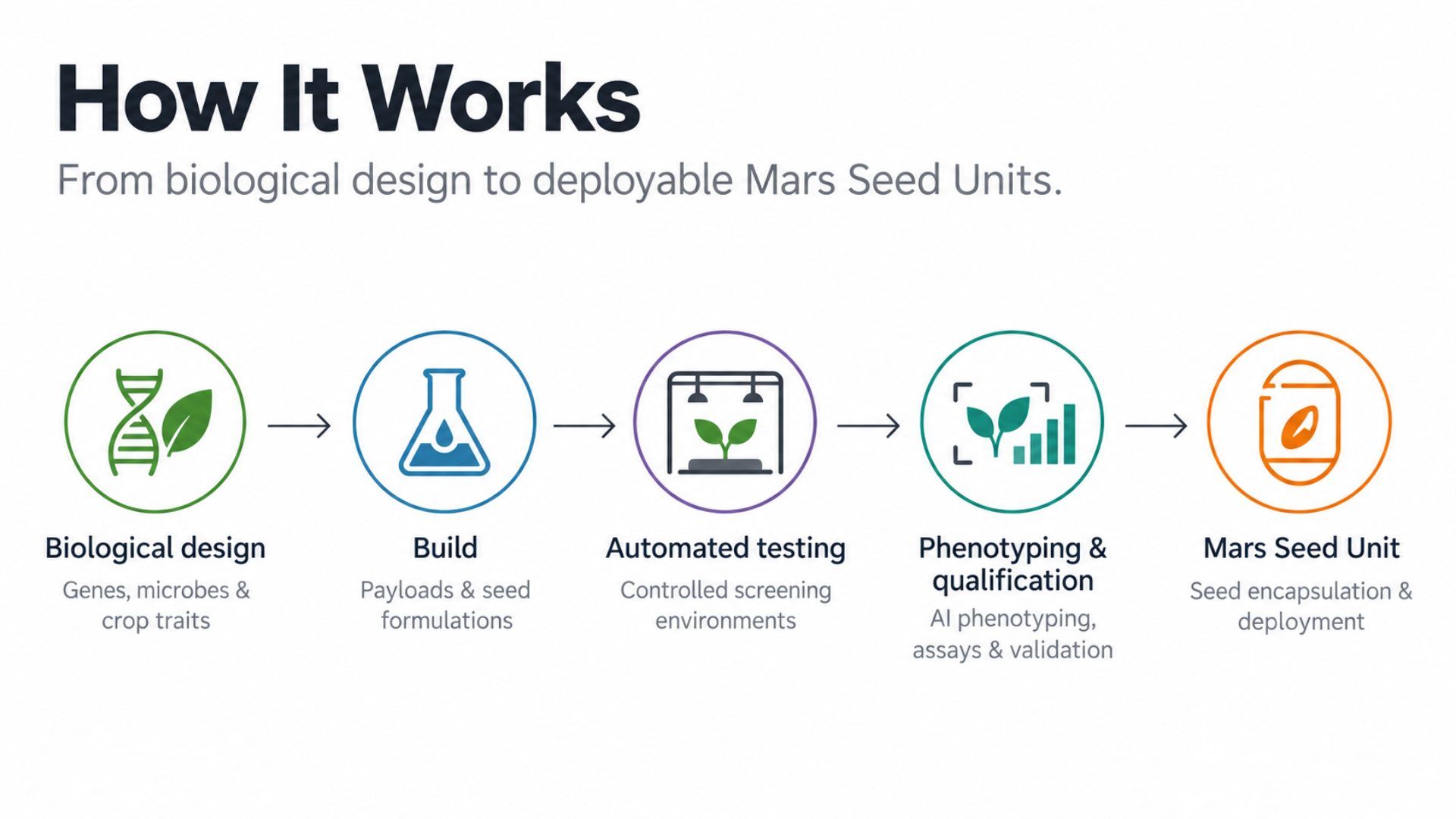
The role of automation in Feed Mars is to make seed deconstruction experimentally searchable in discovery and physically possible in manufacturing. High-throughput, automated workflows are increasingly used to accelerate biomanufacturing design cycles (Petzold & Mukhopadhyay, 2025); Feed Mars applies that logic to a plant developmental system.
The V1 design space is combinatorial
That is before adding bead size, embryo source, environmental regimes, or microbial partners. Even so, Feed Mars would not run full factorial designs at plant scale. It would use staged screening: fast capsule and seedling assays to prune the space, then fractional-factorial or Bayesian-optimization designs for full-lifecycle validation, with explicit testing of whether early phenotypes predict final grain yield.
A multi-scale prototype architecture
Layer 1: capsule build and screen (V1 core)
This is where automation fits most naturally.
- Liquid-handling robots such as Opentrons can prepare and dispense capsule formulations (alginate, carbohydrate, minerals, hormones) and form beads by dispensing into calcium chloride. In the prototype, embryos would be excised and loaded by hand; that manual step is itself measured, because its rate determines the manufacturing problem in Section 4b.
- Plate-based germination and seedling imaging tracks germination time, root and shoot emergence, and early growth for thousands of capsules in parallel.
- Machine vision and ML-assisted phenotyping convert images into quantitative traits and rank capsule designs.
This layer is a direct extension of my research background in microfluidics, imaging, and automated phenotype-driven selection.
Layer 2: plant-scale validation
The best capsule designs move into programmable growth chambers with control over light, temperature, humidity, CO₂, irrigation, and nutrients, and are grown through the full lifecycle to measure grain yield.
A platform such as FarmBot Genesis could serve as an accessible prototype for robotic planting, watering, localized treatment, and repeated imaging. Because FarmBot is designed for widely spaced crops, dense wheat canopies would be measured at the plot level rather than plant by plant. FarmBot is a prototyping tool, not the Mars production architecture.
Layer 3: enabling modules for V2–V4
These tools belong to later stages rather than to the minimum viable V1 system:
- Digital microfluidics for miniaturized screening of microbial strains and capsule formulations,
- Cell-free systems for rapid prototyping of biological functions before moving them into living microbial partners,
- DNA-design tools for engineered microbial payloads, biosensors, or reporters,
- Automated embryo excision using machine vision and robotic handling (V1–V3 manufacturing),
- Plant regeneration and developmental engineering, including morphogenic regulators, for tissue-derived developmental cores (V4),
- Cloud Lab automation for standardized microbial and analytical assays.
Later robustness layer: altered gravity
Mars gravity (≈0.38 g) is a fixed condition, not a design variable, so it is treated as one dimension of the operating environment. After designs perform reproducibly at 1 g, compact experiments on germination, root orientation, and plant–microbe interaction could be run on a Random Positioning Machine operated in a partial-gravity mode. The RPM is an analogue, not a perfect simulation of Mars gravity; its role is robustness testing, not primary discovery.
How long does one discovery cycle take?
A rough estimate for one V1 design–build–test–learn round:
| Stage | Assumptions | Time |
|---|---|---|
| Embryo excision (prototype, manual) | 4,800 embryos at ~100/person-hour | ~48 person-hours |
| Capsule build | Liquid handler forms beads in 24-well plates → 200 plates | ~1 week, including setup |
| Seedling screen | ~50 plates per chamber, 2 chambers → 2 runs × ~14 days | ~4 weeks |
| Full-lifecycle validation | Top ~20 designs × 3 environments × 10 plants, plus intact-seed and naked-embryo controls (~660 plants) | ~90 days |
| Analysis and redesign | Statistical models and next-round selection | ~1–2 weeks |
| One DBTL round | ~4 months |
Plate capacity, chamber count, and excision rate are assumptions to be measured. The key point is that the full-lifecycle stage dominates cycle time, which is why validating early phenotypes as predictors of grain yield is essential.
Discovery loop and manufacturing loop
| Discovery platform | Production platform |
|---|---|
| Hundreds of capsule designs | A few validated designs |
| Manual excision, liquid-handler encapsulation | Automated excision and encapsulation lines |
| Plate-based seedling screens | Inline optical inspection of every unit |
| Flexible growth chambers | Standardized production canopy |
| Data generation | QC, traceability, continuous release |
Discovery explores the design space of the starting unit. Production reproduces a validated design reliably, unit by unit.
What gets automated?
| Stage | Technology | Purpose |
|---|---|---|
| Design | Experimental-design software, Bayesian optimization | Choose which capsule designs to test next |
| Build | Opentrons / liquid handling | Prepare formulations and form capsules |
| Screen | Plate-based imaging, machine vision | Quantify germination and seedling phenotypes |
| Grow | Programmable growth chambers, FarmBot prototype | Standardize full-lifecycle validation |
| Measure | Imaging, environmental sensors, analytical assays | Quantify phenotype, yield, and resource use |
| Select | Image analysis, ML-assisted ranking | Prioritize designs |
| Manufacture | Automated embryo excision, encapsulation lines | Assemble validated units |
| Qualify | Inline optical inspection, germination sampling, traceability | Release units that meet specification |
| Later (V2–V4) | Microbial culture, DMF, cell-free, DNA design, regeneration engineering | Add or replace crop-starting functions |
What should the system optimize?
The objective is not maximum yield. For a Mars settlement, the food requirement is fixed, so a better formulation is a constrained optimization:
NASA life-support studies use Equivalent System Mass (ESM) to translate mass, volume, power, cooling, and crew time into a common mass-equivalent basis (Levri et al., 2003). Using the 10th-percentile output rather than the mean builds reliability directly into the requirement. This formulation is a proposed Feed Mars objective, not a standard NASA metric, and ESM factors depend on mission architecture.
This framing sets the bar for V1–V4. A redesigned starting unit is only valuable if it lowers the burden of the whole growing system: for example by making establishment more uniform, shortening the crop cycle, reducing failure variance, or lowering energy per kilogram of grain enough to outweigh the cost of excision, encapsulation, and QC.
Connection to my research background
My research focuses on high-throughput biological screening using microfluidics, imaging, machine learning, automated phenotype recognition, and real-time biological selection. The physical scale in Feed Mars is different, but the logic is the same:
The transferable capability is automated phenotype-driven biological selection, applied here first to capsule designs and eventually to manufactured developmental cores.
4. How much would I need to make, and how long would it take?
For this assignment, I define meaningful scale as supplying the wheat production cycle of a hypothetical 100-person Mars base for one year. This is an engineering design case, not a prediction of the diet or agricultural architecture of a future Mars settlement.
4a. How much?
Assumptions
| Parameter | Value | Type | Basis |
|---|---|---|---|
| Population | 100 people | Scenario choice | — |
| Wheat consumption | 250 g/person/day | Scenario choice | ≈835 kcal/day, roughly one-third of a ~2,500 kcal diet |
| Grain yield | 1.4 kg/m²/crop (≈15.6 g/m²/day) | Engineering assumption | Below the 23–57 g/m²/day edible biomass reported for optimized controlled environments (Salisbury et al., 1987) |
| Crop cycles | 4/year (≈90 days) | Assumption | Turnaround time covered by the area margin |
| Planting density | 470 units/m²/crop | Field-typical assumption | High-yield controlled-environment studies used ~2,000 plants/m² (Bugbee & Salisbury, 1988); see sensitivity below |
| Thousand-kernel weight | ~40 g | Assumption | Typical range for bread wheat |
| Embryo fraction of kernel mass | ~2.5% (≈1 mg/embryo) | Order-of-magnitude assumption | To be measured for the chosen genotype |
| Capsule | 4 mm alginate bead (≈34 µL), 3% alginate | Assumption | Typical artificial-seed encapsulation conditions (Rihan et al., 2017) |
| Manual embryo excision rate | ~100 embryos/person-hour | Assumption, to be measured | — |
| Automated assembly | 10,000 units/hour/line, 2 lines | Design target | — |
| Lighting (upper bound) | 600 W/m² electrical | Literature value | Salisbury et al. (1987) |
| Lighting (LED baseline) | 1,000 µmol/m²/s at 2.8 µmol/J | Engineering scenario | Modern horticultural LED |
| Photoperiod | 18 h/day | Assumption | — |
| Operational area margin | 25% | Assumption | — |
| Manufacturing reserve | 10% | Assumption | — |
Food requirement
Annual edible wheat requirement: ~9.1 metric tons.
Using approximately 334 kcal per 100 g of whole wheat:
Wheat supplies a substantial fraction of dietary energy in this scenario, but not the complete diet.
Crop production area
- ~1,630 m² active wheat canopy
- ~2,040 m² installed cultivation capacity
- ~16 m² active canopy per person
As a sanity check, Salisbury et al. (1987) estimated 12–30 m² per person for a complete controlled-environment life-support diet at their higher yields. This scenario uses 16 m² per person for about one-third of dietary energy, consistent with its more conservative yield assumption.
Annual crop starting unit requirement
Manufacturing target: ~3.4 million crop starting units/year
The more architecture-independent way to state this requirement is in terms of established plants:
This links manufacturing quantity directly to the qualification specification: every percentage point of establishment probability changes how many units must be built.
What is actually being manufactured?
For 3.4 million units:
For comparison, 3.4 million whole seeds would weigh about 136 kg, about 1.5% of the annual harvest. The part of a year’s wheat supply that actually becomes the plants weighs only a few kilograms. Everything else in the seed is support function, which is exactly what Feed Mars proposes to redesign.
The stored-reserve question is also quantitative. A natural wheat endosperm holds on the order of 30 mg of reserves. A 4 mm capsule at a typical culture-medium sugar concentration of 3% (w/v) holds about:
Whether a seedling under controlled light from day one needs ~30 mg of reserves or ~1 mg is a measurable question, and it is central to V1.
Planting-density sensitivity
Planting density is the most sensitive parameter for manufacturing scale:
| Planting density | Units/year (incl. reserve) | Embryo mass | Hydrogel volume | Manual excision (FTE)* | Automated assembly (2 lines) |
|---|---|---|---|---|---|
| 470 units/m² | ~3.4 M | ~3.4 kg | ~115 L | ~17 | ~170 h |
| 1,000 units/m² | ~7.2 M | ~7.2 kg | ~245 L | ~36 | ~360 h |
| 2,000 units/m² | ~14.3 M | ~14.3 kg | ~486 L | ~72 | ~717 h |
*At 100 embryos/person-hour and 2,000 working hours per person per year.
For a 100-person settlement, manual assembly would require between one-sixth and nearly three-quarters of the entire population. Automated embryo excision and encapsulation is therefore not an optimization; it is a precondition for this architecture to exist.
Energy sanity check
Upper bound (literature power density):
Salisbury et al. (1987) reported 23–57 g/m²/day of edible biomass at about 600 W/m². Pairing that power density with this scenario’s lower yield of ~15.6 g/m²/day makes this estimate an upper bound.
LED baseline (photon-flux-based):
For perspective, the upper-bound case is ~175 kWh of electricity per person per day to deliver ~835 kcal of wheat, and nearly all lighting power ends up as heat that the habitat must remove. These figures cover lighting only; they exclude cooling, pumps, water treatment, nutrient delivery, capsule and microbial manufacturing, robotics, computing, and food processing.
Design insight: the starting material is tiny; the energy needed to turn it into food is not. This echoes the “what to take and what to make” framing used for space biomanufacturing (Averesch et al., 2023). It also sets the bar for Feed Mars: a redesigned starting unit is only justified if it reduces the burden of the growing system, not merely the mass of the unit.
4b. How long would manufacturing take?
I divide V1 manufacturing into four processes:
- embryo supply (seed multiplication),
- capsule-medium preparation,
- embryo excision and encapsulation,
- qualification and release.
Embryo supply: the V1 biological critical path
In V1 and V2, each embryo comes from one mature seed, so the seed count still sets the supply of developmental cores.
Assume one parent seed produces an average of 30 qualified daughter seeds. This is conservative at 470 plants/m²: 1.4 kg/m² of grain from ~19 g/m² of sown seed is a ~74-fold increase.
The multiplication factor depends on planting density. At 2,000 plants/m², the same yield corresponds to only ~17.5 kernels per plant (1,400 g ÷ 40 mg ÷ 2,000), so reaching ~14.3 million units would take three generations (~270 days):
This scenario applies when a newly qualified genotype must be scaled from a small master stock. For an established genotype, seed could be retained from the previous harvest. Speed-breeding approaches can shorten wheat generation time (Watson et al., 2018), while post-harvest dormancy can lengthen it. In V3, harvesting immature embryos could bypass grain filling, drying, and dormancy altogether; embryo rescue has been used in breeding for this purpose, and its value in production is one of the things V3 is designed to test.
Capsule-medium preparation
About 115 L of hydrogel and a few kilograms of alginate, carbohydrate, and minerals per year are small quantities. Media can be prepared in parallel with seed multiplication and are not rate-limiting.
Excision and encapsulation
This is where the architecture differs most from seed treatment. Bulk seed coating of 136 kg would take hours in a drum or fluidized-bed coater. Here, every unit is assembled individually:
Because encapsulated embryos do not store like dry seed, production should run continuously and just in time, synchronized with staggered planting rather than as one annual batch:
The engineering problem shifts from peak throughput to reliable daily operation: embryo excision accuracy, capsule uniformity, contamination control, and inline inspection.
Microbial manufacturing (V2 module)
If a microbial partner is added at an illustrative 10⁷ viable cells per unit:
| Viability loss before planting | Required culture volume |
|---|---|
| None | ~34 L |
| 1 log (90%) | ~340 L |
| 2 log (99%) | ~3,400 L |
Even with large losses, microbial production is not the bottleneck. Survival in the capsule is a formulation design target (Rocha et al., 2019), and the capsule’s wet matrix may be more hospitable to microbes than a dry seed coat, which is itself worth testing.
Qualification and release
Because units cannot wait weeks in storage for germination tests, release must rely on process control plus sampling:
- inline optical inspection of every embryo and capsule,
- capsule composition and size tolerance,
- statistical sampling for germination and establishment,
- contamination testing,
- traceability from parent plant to deployed unit.
Germination tests take days, so they verify the process rather than gate each daily lot. Building infrastructure for this kind of automated measurement and release is exactly the type of enabling capability that biomanufacturing still lacks in many domains (Asin-Garcia et al., 2025).
First-deployment timeline (V1, new genotype)
| Stage | Approximate time |
|---|---|
| Seed multiplication from master stock | ~180 days (470/m²) to ~270 days (2,000/m²) |
| Capsule-medium preparation | Parallel |
| First planting cycle (~0.84 M units) assembled on 2 automated lines | ~42 hours |
| Initial qualification | ~7 days |
| Time to first full-scale planting | ~6–9 months |
After the first planting, the system runs as a continuous pipeline: embryo supply, daily assembly, sampling-based release, planting, harvest, and embryo recovery.
5. What do I not know yet?
1. Can an encapsulated embryo match an intact seed?
This is the core V1 question and the first test of V4’s central assumption. I need to measure:
- germination and establishment probability relative to intact seed,
- how much artificial reserve is needed, and in what form (sugar, starch, minerals, signals),
- whether early seedling vigor predicts full-lifecycle grain yield, not just seedling biomass,
- how excision damage and embryo maturity affect outcomes,
- and whether performance differs across genotypes.
If encapsulated embryos consistently underperform, the roadmap should retreat toward partial endosperm retention rather than full replacement.
2. Can the architecture survive without seed-like storage?
Encapsulated propagules generally lack the desiccation tolerance and multi-year storability of dry seed. Feed Mars may need to trade long-term storage for on-demand local manufacturing. I need to measure:
- how long capsules remain viable, and under what conditions,
- whether partial drying or cold storage is possible,
- how much seed stock must still be held as a safety reserve,
- and what the added dependence on continuously operating automation costs in reliability.
3. Does redesigning the starting unit reduce total system burden?
Removing seed functions matters only if it improves the whole growing system. Candidate benefits include:
- more uniform establishment and canopy closure,
- shorter crop cycles (especially in V3),
- lower variance in yield,
- programmed functions that reduce nutrient, water, or energy demand.
These must outweigh the costs of excision, encapsulation, QC, and automation, measured in the same accounting framework (ESM). Since lighting dominates energy use, even a small reduction in days to canopy closure could matter more than any change to the unit itself.
Additional questions for later stages
- V4 regeneration: can wheat developmental cores be produced reliably from tissue at useful scale and genotype range? Regeneration remains a major open problem, although morphogenic regulators such as GRF4–GIF1 have improved it (Debernardi et al., 2020).
- Genetic and developmental stability: do tissue-derived cores remain stable over repeated production cycles?
- Genotype × microbiome × environment (V2): do defined microbial partners add reproducible value inside the capsule?
- Energy: which combination of light intensity, photoperiod, density, and cycle length minimizes system burden?
- Biosafety and planetary protection: how are engineered organisms and microbes managed in a closed habitat?
- Nutrient recycling: at a harvest index of ~0.40–0.45, the scenario produces roughly 11–14 t/year of straw and chaff that must return to the nutrient loop.
- Altered gravity: when should partial-gravity testing enter the program?
Technology roadmap
| Version | Architecture | Dependency removed | Main question | Primary output |
|---|---|---|---|---|
| V1: Deconstruct | Natural embryo + artificial-endosperm capsule | Endosperm, seed coat | Can reserve and protective functions be externalized? | Validated capsule design + automated screening platform |
| V2: Program | + microbial partners, signals, controlled release | Fixed seed-intrinsic functions | Which added functions improve system performance? | Programmed crop starting unit |
| V3: Decouple from maturation | Immature embryos from growing plants | Grain filling, drying, dormancy | Can the reproductive cycle be shortened? | Faster-cycle production system |
| V4: Decouple from sexual reproduction | Tissue-derived developmental core + programmed capsule | Flowering and pollination | Can crop initiation become fully manufacturable? | Programmable crop starting unit |
V4 is not a decorative future extension. It is the destination, and V1 already tests its central assumption.
Project thesis
A natural seed is optimized for survival in an unknown environment. A crop starting unit for a controlled habitat can be optimized for reliable performance in a known one.
Feed Mars proposes to deconstruct the seed one function at a time, starting with natural embryos and engineered capsules, and to use automation to find out which functions are worth redesigning and to manufacture the result unit by unit.
The programmable crop starting unit is the product; the Mars Seed Unit is its first extreme-environment application. Feed Mars is the automated biomanufacturing system that deconstructs the natural seed, rebuilds it for a defined environment, and qualifies it at scale.
References
Asin-Garcia, E., Fawcett, J. D., Batianis, C., & Martins dos Santos, V. A. P. (2025). A snapshot of biomanufacturing and the need for enabling research infrastructure. Trends in Biotechnology, 43(5), 1000–1014. https://doi.org/10.1016/j.tibtech.2024.10.014
Averesch, N. J. H., Berliner, A. J., Nangle, S. N., et al. (2023). Microbial biomanufacturing for space-exploration—what to take and when to make. Nature Communications, 14, 2311. https://doi.org/10.1038/s41467-023-37910-1
Bugbee, B. G., & Salisbury, F. B. (1988). Exploring the limits of crop productivity. I. Photosynthetic efficiency of wheat in high irradiance environments. Plant Physiology, 88(3), 869–878. https://doi.org/10.1104/pp.88.3.869
Debernardi, J. M., Tricoli, D. M., Ercoli, M. F., Hayta, S., Ronald, P., Palatnik, J. F., & Dubcovsky, J. (2020). A GRF–GIF chimeric protein improves the regeneration efficiency of transgenic plants. Nature Biotechnology, 38, 1274–1279. https://doi.org/10.1038/s41587-020-0703-0
Levri, J. A., Fisher, J. W., Jones, H. W., Drysdale, A. E., Ewert, M. K., Hanford, A. J., Hogan, J. A., Joshi, J. A., & Vaccari, D. A. (2003). Advanced Life Support Equivalent System Mass Guidelines Document (NASA/TM-2003-212278). NASA Ames Research Center.
Petzold, C. J., & Mukhopadhyay, A. (2025). From bench to biofactory: High-throughput technologies and automated workflows to accelerate biomanufacturing. Current Opinion in Biotechnology, 94, 103320. https://doi.org/10.1016/j.copbio.2025.103320
Rihan, H. Z., Kareem, F., El-Mahrouk, M. E., & Fuller, M. P. (2017). Artificial seeds (principle, aspects and applications). Agronomy, 7(4), 71. https://doi.org/10.3390/agronomy7040071
Rocha, I., Ma, Y., Souza-Alonso, P., Vosátka, M., Freitas, H., & Oliveira, R. S. (2019). Seed coating: A tool for delivering beneficial microbes to agricultural crops. Frontiers in Plant Science, 10, 1357. https://doi.org/10.3389/fpls.2019.01357
Salisbury, F. B., Bugbee, B. G., & Bubenheim, D. (1987). Wheat production in controlled environments. Advances in Space Research, 7(4), 123–132.
Trivedi, P., Leach, J. E., Tringe, S. G., Sa, T., & Singh, B. K. (2020). Plant–microbiome interactions: From community assembly to plant health. Nature Reviews Microbiology, 18, 607–621.
Watson, A., Ghosh, S., Williams, M. J., et al. (2018). Speed breeding is a powerful tool to accelerate crop research and breeding. Nature Plants, 4(1), 23–29. https://doi.org/10.1038/s41477-017-0083-8
AI Use Disclosure
AI clients used:
- OpenAI ChatGPT (GPT-5.6 Sol)
- Anthropic Claude (Claude Opus 5.5)
Representative prompts included:
“Help me organize the current Mars biomanufacturing project, identify what is already established, and clarify the next steps without restarting ideation.”
“Define the manufacturing target clearly and build a back-of-the-envelope model for the amount required to support wheat production for a 100-person Mars base. Clearly distinguish literature-supported facts, engineering assumptions, and calculated outputs.”
“Critically check the calculations for wheat demand, cultivation area, annual starting-unit requirement, lighting energy, seed multiplication, microbial inoculum scale, and automated processing throughput.”
“Cross-check the calculations and cited literature, and draft revisions to the assumptions table, planting-density sensitivity analysis, lighting-energy framing, microbial viability and coating-throughput estimates, experimental-design strategy, and objective function.”
“Analyze this document in detail, especially whether the logic is sound and the numbers are correct.”