See the nav bar on the left to look through my work for How To
Biomanufacture Almost Anything (Fall 2026)!
Subsections of <YOUR NAME HERE> — HTBAA Fall 2026
Week 1 HW: Final Project Ideas
Biomanufacturing an Antimicrobial, Breathable Prosthetic Bio-Liner via In Situ Biotemplating
Student: Juan Baquerizo (Active Global Contributor - Ecuador)
Course: MAS.S65 / How to Biomanufacture (Almost) Anything (Fall 2026)
Instructors: David Sun Kong, Ph.D., George Church, Joseph Jacobson
Assignment: Homework #1 — Project Proposal
(1) What you would like to biomanufacture and why?
Target Output
The goal of this project is to biomanufacture a customized, antimicrobial, and breathable prosthetic socket bio-liner produced via in situ biotemplating inside customized 3D-printed molds (FDM).
The finished device is a seamless, elastomeric hydrogel sleeve composed of an ultra-pure bacterial cellulose (BC) nanofibrillar matrix, plasticized with medical-grade glycerol and surface-functionalized with recombinant antimicrobial peptides (AMPs).
Motivation and Clinical Importance
The prosthetic socket is the primary load-bearing mechanical interface connecting an amputee’s residual limb to their prosthetic hardware. Standard commercial liners rely almost universally on synthetic non-porous elastomers (silicone, polyurethane, or thermoplastic elastomer/TPE). While they provide cushioning, they introduce severe clinical complications:
Maceration and Dermatitis: Synthetic elastomers are impermeable. In warm and humid climates—such as the equatorial regions of Ecuador—sweat remains trapped against the skin. This continuously macerates the stratum corneum, causing friction blisters, severe skin breakdown, and contact dermatitis.
Recurrent Infections: Trapped moisture, mechanical friction, and elevated skin temperature create an ideal environment for pathogenic bacteria (Staphylococcus aureus, Pseudomonas aeruginosa). Dermal infections routinely force amputees to suspend prosthesis use for weeks or months.
Prohibitive Cost and Accessibility: Commercial silicone liners cost between $300 and $1,200 USD each, require replacement every 6 to 12 months, and rely on fragile international supply chains. For public healthcare systems and amputees in developing countries, this recurring cost is unsustainable.
Bacterial cellulose offers a natural biological solution: it forms an ultra-pure, 3D nanofibrillar hydrogel network with high tensile strength, high fluid capacity, and intrinsic vapor permeability. By growing cellulose directly inside patient-matched molds (modeled from 3D scans and printed on desktop FDM printers) and functionalizing the matrix with recombinant AMPs, this project creates a customized, breathable, and infection-resistant interface tailored for decentralized manufacturing.
(2) What living system would you use?
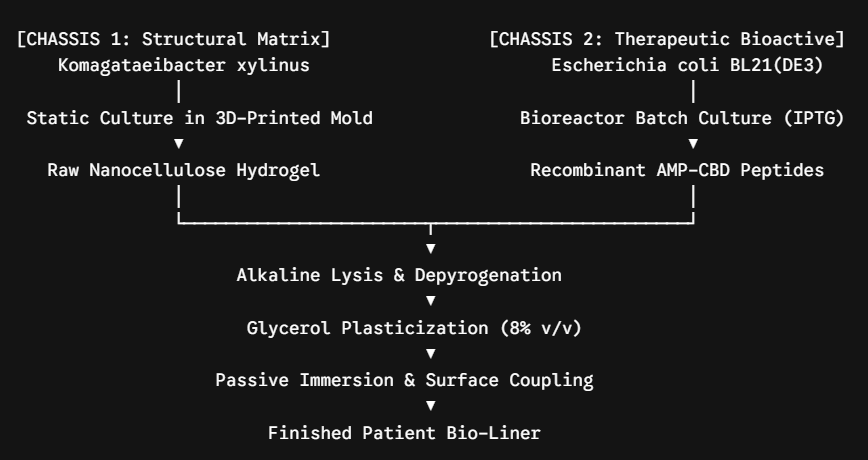
A modular biological architecture is used, splitting structural matrix synthesis from therapeutic biofunctionalization:
Therapeutic Chassis:Escherichia coli BL21(DE3) or an E. coli-based cell-free protein synthesis (CFPS) platform.
Inputs, Biological Processes, and Outputs
Inputs:
Culture Broth: Modified Hestrin-Schramm (HS) medium consisting of glucose (20 g/L) or locally refined cane sugar, peptone (5 g/L), yeast extract (5 g/L), disodium phosphate (Na2HPO4, 2.7 g/L), and citric acid (1.15 g/L), adjusted to pH 5.0.
Biotemplate Mold: A negative truncated cone matching the patient’s residual limb, 3D-printed in PETG/PLA with gas-permeable sidewall micropores.
Peptide Expression Elements: Terrific Broth growth medium, IPTG chemical inducer, and an expression plasmid encoding an antimicrobial peptide (Magainin-2 or Dermcidin derivative) fused to a Cellulose-Binding Domain (CBD).
Biological Processes:
Membrane-bound cellulose synthase complexes in K. xylinus polymerize UDP-glucose into linear beta-1,4-glucan chains.
Extruded microfibrils crystallize and self-assemble into a coherent, 3D nanofibrillar pellicle along the air-liquid boundary within the 3D-printed mold.
Concurrently, E. coli expresses the hybrid AMP-CBD fusion protein under the control of the T7 promoter upon IPTG induction.
Outputs and Post-Processing:
The harvested raw cellulose sleeve is treated in 0.5 M NaOH at 80°C for 60 minutes to eliminate bacterial biomass and endotoxins, producing an acellular white scaffold.
The scaffold is neutralized, washed with sterile water, and incubated in an 8% v/v glycerol solution to achieve elastomeric flexibility.
The plasticized sleeve is immersed in the recombinant peptide solution; the high-affinity CBD tag anchors the antimicrobial peptides across the nanofibrils without blocking their bactericidal action.
(3) How would you use automation?
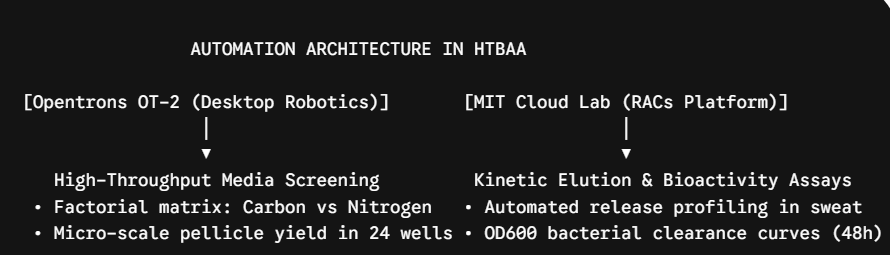
Automation will address process bottlenecks across two key stages: desktop liquid handling and cloud lab screening.
1. Media Formulation Optimization via Desktop Liquid Handling (Opentrons OT-2)
Workflow: Optimization of growth kinetics and pellicle density.
Automation Implementation: An Opentrons OT-2 robot will execute Design of Experiments (DoE) protocols in 24-deep-well plates. The system will systematically dispense varying ratios of carbon sources (analytical glucose vs. low-cost agricultural molasses), nitrogen levels, and organic buffers. Automated periodic optical density and dry-weight measurements will identify the fastest pellicle assembly conditions without manual pipetting errors.
2. Elution Kinetics and Bioactivity Assays in the MIT Cloud Lab
Workflow: Verifying peptide retention and antimicrobial stability under continuous contact with human perspiration.
Automation Implementation: Using the Reconfigurable Automation Carts (RACs) within the MIT Cloud Lab, standardized cellulose discs functionalized with fluorophore-tagged peptides will be exposed to simulated sweat (saline buffer, pH 5.5). Automated robotic arms will transfer wash fractions to plate readers every 30 minutes over a 48-hour schedule to track peptide release rates, while scheduled inoculations against challenge strains (S. aureus) will quantify clearance kinetics via automated OD600 spectrophotometry.
(4) How much would you need to make, and how long would it take?
(a) How Much? (Scale Definition & Calculations)
The target production scale is a pilot clinical batch to equip 100 transtibial amputees (N = 100) at a regional orthopedic center.
Anatomical Parameters (Per Bio-Liner):
Geometry: Closed-end hollow truncated cone
Proximal radius (r1): 6.0 cm
Distal radius (r2): 4.0 cm
Vertical height (h): 25.0 cm
Hydrogel wall thickness (t): 0.5 cm (5 mm, clinical cushioning standard)
Surface Area and Volume Calculations:
Slant height (g):
g = sqrt(h² + (r1 - r2)²)
g = sqrt(25² + (6 - 4)²) = sqrt(625 + 4) = sqrt(629) = 25.08 cm
AMP per unit = 838.2 cm² × 15 µg/cm² = 12,573 µg = 12.6 mg
Total purified AMP for 100 units: 100 × 12.6 mg = 1.26 g of peptide
(b) How Long? (Manufacturing Timeline & Throughput)
1. Bacterial Cellulose Synthesis Kinetics (K. xylinus)
Under optimized static culture at 30°C, K. xylinus generates pellicle thickness at approximately 0.8 mm per day.
Growth time to reach 5 mm thickness:
5.0 mm / (0.8 mm/day) = 6.25 days (approx. 7 days / 1 week per batch)
2. Parallel Bioreactor Production
Operating a modular bank of 15 custom 3D-printed molds simultaneously:
Batches needed: 100 units / 15 units per batch = 6.67 -> 7 production cycles
Total cultivation time: 7 batches × 7 days = 49 days (7 weeks)
3. Recombinant Peptide Synthesis (E. coli)
Standard benchtop expression in E. coli yields between 0.5 g/L and 1.0 g/L of target protein.
To produce the required 1.26 g of AMP, a single 3-Liter working volume batch in a 5 L benchtop bioreactor yields approx. 1.8 g of protein.
Fermentation and affinity purification take 48 hours (2 days), conducted during Week 1.
Manufacturing Phase
Operational Duration
Infrastructure Used
Phase 1: Peptide Synthesis & Purification
2 days (Week 1)
5 L benchtop fermenter + chromatography column
Phase 2: Parallel Cellulose Culture
7 weeks (Weeks 1–7)
15 parallel 3D-printed molds in incubator bank
Phase 3: Chemical Clearing & Functionalization
1 week (Week 8)
NaOH clearing bath, glycerol wash, AMP immersion
Total Turnaround Time
~8 weeks
Pilot batch of 100 finished liners
(5) What don’t you know yet? (Technical Unknowns & Bottlenecks)
Three primary engineering uncertainties require experimental resolution:
Interlaminar Delamination under Multiaxial Dynamic Shear: Bacterial cellulose possesses high in-plane tensile strength, but its layered fibril deposition makes it susceptible to shear-induced delamination. In a prosthetic socket, cyclic gait causes significant vertical compression combined with rotational and shear stresses. Universal mechanical testing (tensile, compression, and peel tests after 100,000 cycles) is required to ensure the plasticized hydrogel will not separate during regular walking.
Oxygen Depletion across Deep Vertical 3D Profiles: K. xylinus is an obligate aerobe that preferentially synthesizes cellulose at the air-liquid boundary. In a vertical conical cavity 25 cm deep, oxygen diffusion into the lower regions is naturally restricted. Without intervention, this gradient would cause non-uniform wall thickness, resulting in a thin, fragile distal end. We need to experimentally determine whether gas-permeable silicone microporous mold walls provide sufficient passive aeration or if forced micro-perfusion is required.
Peptide Immobilization Durability in Acidic Human Sweat: Human perspiration contains salts (NaCl), urea, and lactic acid at pH levels between 4.5 and 6.5, alongside native skin proteases. It remains to be determined whether physical affinity binding via the Cellulose-Binding Domain (CBD) is robust enough to prevent rapid washout during heavy sweating, or if chemical covalent crosslinking (such as EDC/NHS coupling) will be necessary to ensure long-term antimicrobial protection.
AI Disclosure and Attribution
Tool: Google Gemini (Fall 2026 Interactive Bioengineering Assistant).
Scope of Assistance: Used for brainstorming cross-disciplinary connections between FDM 3D printing, medical devices, and biomanufacturing; structuring back-of-the-envelope volumetric and mass yield equations; referencing growth parameters for K. xylinus and E. coli; and translating/formatting the proposal to match all five required questions of HTBAA Homework #1.
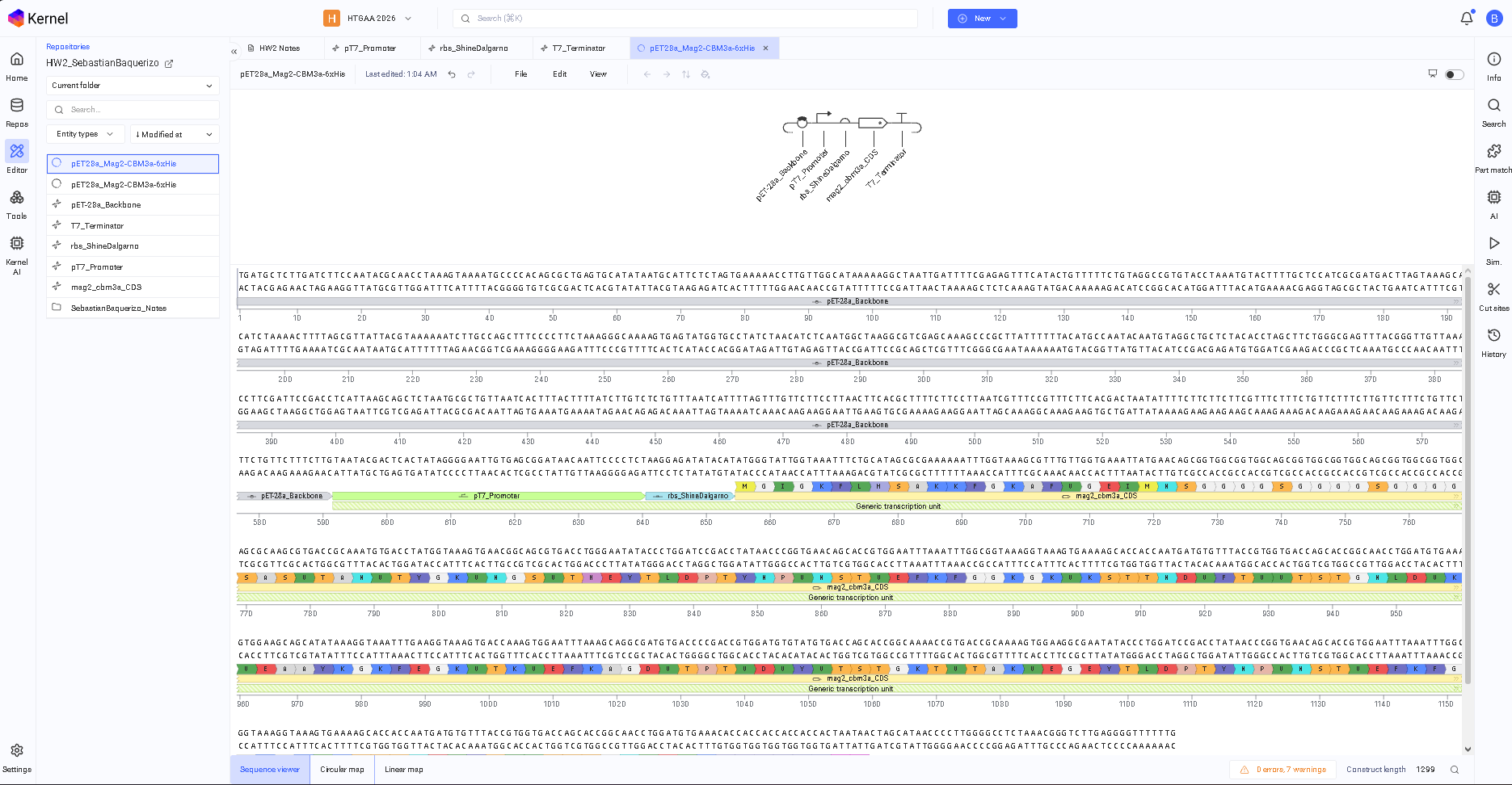
I created a Kernel repository for my project and a folder named HW2_SebastianBaquerizo within the HTBAA 2026 workspace; here, I included all the steps requested in the HW2 document.
PART 1: Define Expression Target
1. What molecule are you expressing?
I am expressing Mag2-CBM3a-6xHis, a chimeric, bifunctional antimicrobial fusion protein designed to functionalize bacterial nanocellulose hydrogels.
Because my project from Homework #1 produces a personalized biomaterial (bacterial nanocellulose synthesized by Komagataeibacter xylinus) to manufacture breathable prosthetic socket bio-liners, the structural material itself is produced by an extracellular biosynthetic machinery rather than encoded directly by a single expression cassette. The Mag2-CBM3a-6xHis fusion protein serves as the critical therapeutic bio-agent that confers broad-spectrum bactericidal activity directly onto the inert cellulose nanofibrils.
The N-terminal Magainin-2 domain acts via toroidal pore formation to rapidly permeabilize opportunistic dermal pathogens (such as Staphylococcus aureus and Pseudomonas aeruginosa), while the CBM3a domain provides spontaneous, irreversible thermodynamic anchoring onto the crystalline $\beta$-1,4-glucan fibrils. Expressing and engineering this chimeric construct allows for localized infection control, mitigating dermal ulcerations and sweat-induced maceration without compromising cellular biocompatibility.
2. What is the sequence and where does it come from?
Protein / Gene Target: Chimeric Antimicrobial Fusion Protein (Magainin-2 – Gly-Ser Linker – Family 3 Carbohydrate-Binding Module – 6xHis tag)
Source Organisms:
Xenopus laevis (African clawed frog; native producer of Magainin-2)
Clostridium thermocellum (anaerobic thermophile; native producer of CipA cellulosomal scaffoldin)
Tormo, J., Lamed, R., Chirino, A. J., Morag, E., Bayer, E. A., Shoham, Y., & Steitz, T. A. (1996). Crystal structure of a bacterial family-III cellulose-binding domain: a general mechanism for protein-cellulose binding. The EMBO Journal, 15(21), 5739–5751.
3. What host or chassis?
Host Chassis:Escherichia coli BL21(DE3)
Justification: While the structural biomaterial producer from HW1 is Komagataeibacter xylinus, E. coli BL21(DE3) is selected as the recombinant protein expression chassis for high-yield synthesis and functional characterization of the antimicrobial fusion. It features an integrated chromosomal $\lambda\text{DE3}$ lysogen driving high-fidelity T7 RNA polymerase expression under the IPTG-inducible lacUV5 promoter, allowing tightly controlled protein induction. Moreover, BL21(DE3) is deficient in both the cytoplasmic Lon protease and the outer-membrane OmpT protease ($\text{lon}^-$, $\text{ompT}^-$), effectively eliminating premature proteolytic cleavage of the terminal peptide tags and linker regions during batch culture.
Targeting Sequence Requirement: No secretion signal peptide (such as PelB, OmpA, or PhoA) is attached.
Justification: Magainin-2 exhibits potent membrane-disruptive activity against Gram-negative envelopes. Directing the nascent peptide into the periplasm or extracellular environment via a translocation signal would cause premature host membrane damage, depolarizing the inner membrane and killing the host cells prior to reaching adequate biomass. Expressing the construct cytoplasmically—fused to the structurally rigid and highly soluble CBM3a carrier—neutralizes basal intracellular toxicity during exponential growth. The recombinant protein is retained within the cytoplasm until late-exponential phase IPTG induction, followed by mechanical cell lysis, centrifugation, and immobilized metal affinity chromatography (IMAC) purification via the C-terminal 6xHis-tag.
Strong, IPTG-inducible promoter recognized specifically by orthogonal T7 RNA polymerase. The downstream lac operator ensures tight repression during exponential growth to prevent leaky, toxic expression of the antimicrobial peptide before induction.
Optimized Shine-Dalgarno consensus sequence engineered to minimize secondary mRNA structures and position the 30S ribosomal subunit efficiently at the start codon for high translation initiation rates in E. coli.
Coding Sequence
mag2_cbm3a_CDS
Coding Sequence (CDS)
Chimeric Xenopus laevis Magainin-2, flexible $(\text{Gly}_4\text{Ser})_3$ linker, and Clostridium thermocellum CBM3a sequence (Source: UniProt P11006 and P29724; codon-optimized for E. coli)
Encodes the core bifunctional therapeutic protein. Magainin-2 provides broad-spectrum bactericidal activity against dermal pathogens via pore formation, while CBM3a enables spontaneous, non-covalent anchoring onto the bacterial nanocellulose hydrogel network.
Encodes a C-terminal polyhistidine tag allowing high-yield downstream affinity purification of the soluble fusion protein via immobilized metal affinity chromatography ($\text{Ni}^{2+}\text{-NTA}$ IMAC) and Western blot verification.
Transcription Stop
T7_Terminator
Terminator
CTAGCATAACCCCTTGGGGCCTCTAAACGGGTCTTGAGGGGTTTTTTG (Source: Standard T7 terminator / Kernel database)
Forms a stable, GC-rich RNA hairpin stem-loop structure followed by a poly-U tract that terminates T7 RNA polymerase transcription efficiently, isolating the cassette and preventing destabilizing readthrough into vector elements.
Provides a medium-copy pBR322/ColE1 replication origin for balanced metabolic burden, an aminoglycoside 3’-phosphotransferase gene conferring Kanamycin resistance, and a constitutive lacI repressor cassette to silence basal transcription.
PART 3: Assemble Your Construct
Assembly Hierarchy and Architecture
The recombinant expression cassette was assembled into the commercial vector framework following a strict $5’ \rightarrow 3’$ directional transcription/translation hierarchy:
The construct maintains an unbroken open reading frame of 636 bp (210 codons) from the canonical initiation methionine (ATG) through the Magainin-2 peptide, the flexible $(\text{Gly}_4\text{Ser})_3$ linker, the CBM3a module, and the C-terminal 6xHis tag, terminating with tandem TAATAA nonsense codons. No frameshift mutations or unpredicted internal stops were introduced during assembly.
PART 4: Optimize and Quality-Check
1. Codon Optimization
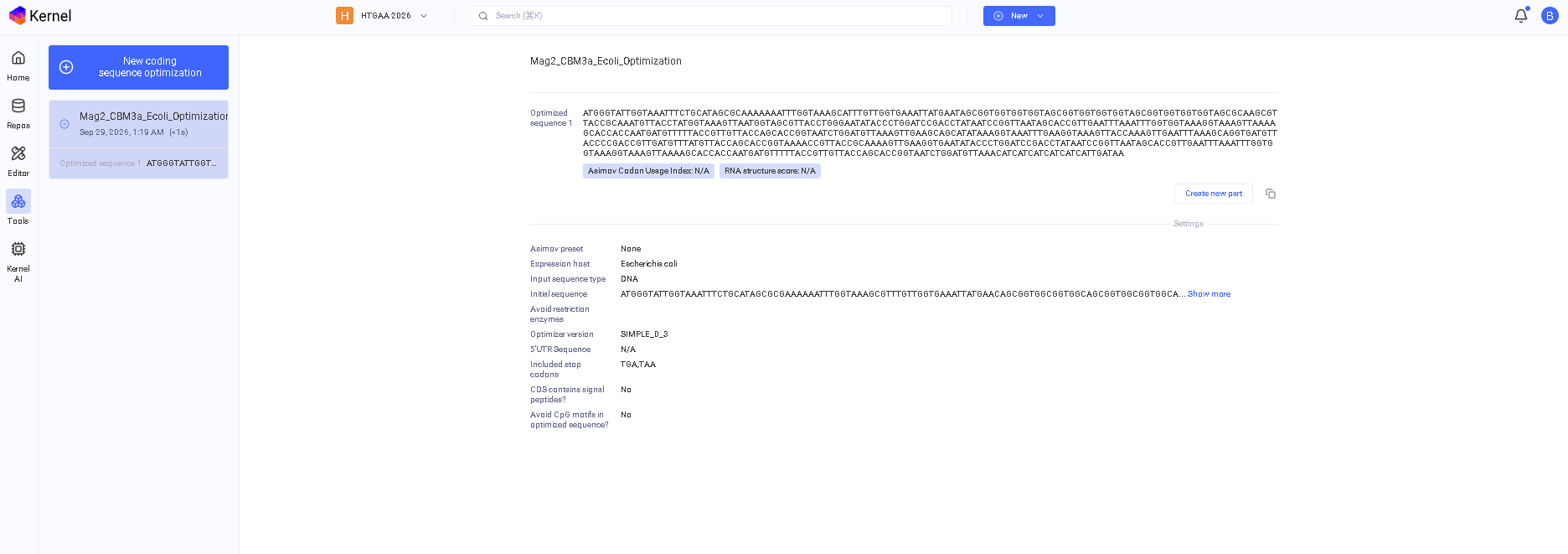
Objective: Adapt the synthetic chimeric gene (mag2_cbm3a_CDS) for efficient translation in the bacterial expression chassis Escherichia coli BL21(DE3).
Algorithm & Parameters: Evaluated using the Asimov Simple v0.3 algorithm, configuring Escherichia coli as the expression host and eliminating rare transfer RNA (tRNA) codons.
Findings: Rare codons that cause ribosomal stalling and premature translation arrest were replaced with synonymous host-preferred codons. The GC content was stabilized across the entire reading frame (~50%), preventing deleterious hairpin structures at the mRNA level.
2. Biosecurity Screening (Safety Screen)
Objective: Verify that the engineered sequence is compliant with biosecurity standards and does not present dual-use hazards or regulated biological threats.
Tool Used: Kernel Biosecurity Sequence Scanner powered by SecureDNA.
Findings: The full 708 bp expression cassette sequence was evaluated against cryptographic databases of restricted toxins and viral/bacterial pathogens. The scan returned No flagged sequences detected, confirming the construct is safe and non-hazardous for standard laboratory synthesis.
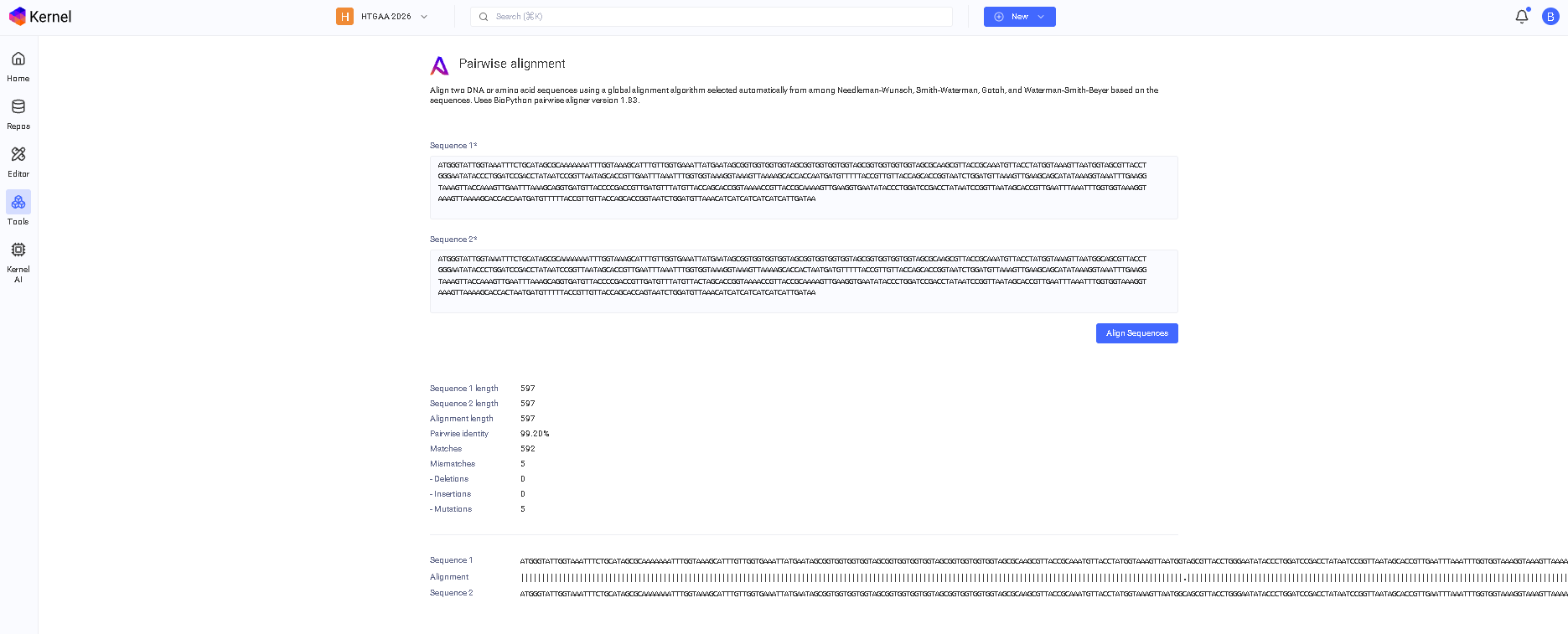
3. Sequence Alignment (Pairwise Verification)
Objective: Validate that codon optimization retained complete sequence fidelity and did not introduce non-synonymous amino acid mutations or frameshifts.
Tool Used: Global pairwise alignment algorithm (BioPython v1.83 engine in Kernel).
Results:
Pairwise Identity:99.20%
Alignment Length: 597 bp
Exact Matches: 592
Deletions / Insertions: 0 / 0
Mismatches (Synonymous Mutations): 5
Conclusion: The 5 mismatches correspond strictly to synonymous codon changes engineered to optimize translation kinetics in E. coli. The resulting peptide sequence remains 100% identical to the intended Mag2-CBM3a-6xHis primary structure.
AI Disclosure and Attribution
Tool: Google Gemini (Interactive Bioengineering Assistant, Fall 2026).
Assistance Scope: Assisted in selecting genetic elements for the pET-28a expression cassette, verifying biological mechanisms (antimicrobial membrane disruption vs. carbohydrate-binding module thermodynamics), translating codon optimization parameters, and structuring the technical write-up to comply with HTBAA Homework #2 requirements.