Week 4 HW: CFPS Reaction Design
Homework #4: Cell-Free Protein Synthesis (CFPS) Reaction Design for sfGFP, PETase, and Reteplase
- Student: Juan Baquerizo (Active Global Contributor - Ecuador)
- Course: MAS.S65 / How to Biomanufacture (Almost) Anything (Fall 2026)
- Instructors: David Sun Kong, Ph.D., George Church, Joseph Jacobson
- Assignment: Homework #4 — CFPS Reaction Design & Cost-Yield Optimization (Due: October 20, 2026)
1. Overview and Engineering Strategy
Cell-Free Protein Synthesis (CFPS) decouples transcription and translation from cell viability constraints, enabling precise fine-tuning of reaction conditions. Following the Ginkgo Bioworks Coopetition framework, this assignment optimizes $20,\mu\text{L}$ ($20,000\text{ nL}$) reaction formulations across three target proteins representing a gradient of folding complexity:
- sfGFP (Superfolder GFP): Simple reporter protein containing zero disulfide bonds.
- PETase (TfCut2): Plastic-degrading hydrolase containing 1 essential disulfide bond (Cys274–Cys292).
- Reteplase (vTPA): Recombinant therapeutic thrombolytic agent containing 9 complex disulfide bonds.
2. Quantitative Reaction Formulations (20 µL Total Volume)
Each reaction is constrained to a fixed volume of $20,000\text{ nL}$ ($20,\mu\text{L}$), distributed between mandatory fixed components ($9,000\text{ nL}$ / $45%$) and variable components ($11,000\text{ nL}$ / $55%$) dispensed at $25\text{ nL}$ acoustic resolution (Echo 525).
| Component Category | sfGFP Formulation ($RF_{opt}$) | PETase Formulation (Mild Redox) | Reteplase Formulation (Oxidizing + DsbC) |
|---|---|---|---|
| Crude Lysate ($25%$ v/v) | $5,000\text{ nL}$ (BL21 Star DE3 + DTT) | $5,000\text{ nL}$ (Standard Lysate) | $5,000\text{ nL}$ (IAM-treated, DTT-free) |
| Plasmid DNA ($10%$ v/v) | $2,000\text{ nL}$ | $2,000\text{ nL}$ | $2,000\text{ nL}$ |
| Base Buffer ($10%$ v/v) | $2,000\text{ nL}$ | $2,000\text{ nL}$ | $2,000\text{ nL}$ |
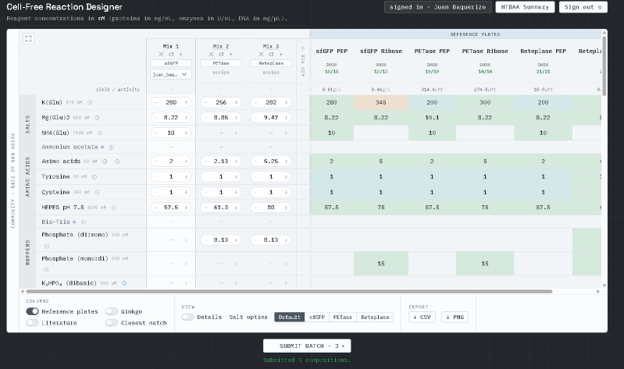
| Potassium Glutamate ($K\text{-Glu}$) | $2,400\text{ nL}$ ($\approx 345\text{ mM}$) | $2,000\text{ nL}$ ($\approx 300\text{ mM}$) | $1,800\text{ nL}$ ($\approx 273\text{ mM}$) |
| Magnesium Glutamate ($Mg\text{-Glu}_2$) | $1,600\text{ nL}$ ($8.22\text{ mM}$) | $1,600\text{ nL}$ ($8.19\text{ mM}$) | $1,700\text{ nL}$ ($8.85\text{ mM}$) |
| Energy & Sugar System | D-Ribose ($50\text{ mM}$) + NMPs | D-Ribose ($50\text{ mM}$) + NMPs | D-Ribose ($40\text{ mM}$) + Pyruvate |
| Amino Acid Mix ($100\text{ mM}$ stock) | $1,000\text{ nL}$ ($5.0\text{ mM}$) | $1,000\text{ nL}$ ($5.0\text{ mM}$) | $1,000\text{ nL}$ ($4.81\text{ mM}$) |
| Redox System (GSH / GSSG) | None ($0\text{ mM}$) | GSH ($1.0\text{ mM}$) / GSSG ($0.1\text{ mM}$) | GSH ($4.0\text{ mM}$) / GSSG ($1.0\text{ mM}$) |
| Chaperone Addition | None | Optional DsbC ($1\text{ }\mu\text{M}$) | DsbC Isomerase ($5.0\text{ }\mu\text{M}$) |
| Nuclease-Free Water | $1,250\text{ nL}$ (Volume fill) | $2,430\text{ nL}$ (Volume fill) | $1,700\text{ nL}$ (Volume fill) |
| Total Reaction Volume | $20,000\text{ nL}$ ($20,\mu\text{L}$) | $20,000\text{ nL}$ ($20,\mu\text{L}$) | $20,000\text{ nL}$ ($20,\mu\text{L}$) |
3. Cost and Yield Analysis: PEP/NTP vs. Ribose/NMP ($RF_{opt}$)
Cost Breakdown Analysis
High-Cost Traditional Regime (PEP + NTP):
- High-energy phosphate donors like Phosphoenolpyruvate (PEP) and high-purity nucleoside triphosphates (NTPs) constitute $>60%$ of total chemical reagent costs in conventional CFPS (~$0.30–0.50 USD per 20 µL reaction).
- Resulting cost per gram of protein produced: ~$300–$600 / g.
Low-Cost $RF_{opt}$ Regime (D-Ribose + NMPs):
- Following Olsen et al. (2026), replacing PEP with non-phosphorylated D-Ribose and cheap nucleoside monophosphates (NMPs) activates endogenous E. coli metabolic pathways (pentose phosphate pathway and central carbon metabolism) to regenerate ATP in situ.
- Raw chemical reagent cost drops drastically to ~$0.03–$0.05 USD per 20 µL reaction.
- Resulting cost per gram of protein produced: ~$50–$80 / g (a >5-fold economic optimization).
4. Biochemical Rationale for Disulfide Folding Environments
sfGFP (Zero Disulfide Bonds)
- Requires a standard reducing environment preserved by DTT ($1–2\text{ mM}$) present in crude BL21 Star DE3 lysate.
- No redox buffers or chaperones are required, minimizing cost and maximizing translation rate.
PETase (1 Disulfide Bond: Cys274–Cys292)
- The catalytic triad stability of PETase depends on a single intramolecular disulfide bond.
- Requires a mild glutathione redox pair (GSH:GSSG ratio of $10:1$) to maintain dynamic thiol-disulfide exchange without inactivating sensitive lysate enzymes.
Reteplase (9 Disulfide Bonds)
- Reteplase is a complex truncated human tissue plasminogen activator (tPA). Correct folding of its 9 disulfide bonds cannot occur in standard lysates containing DTT.
- Lysate Modification: Uses Iodoacetamide (IAM)-pretreated lysate to alkylate and inactivate endogenous reductases (GshR, TrxR) in the absence of DTT.
- Redox Buffer & Chaperone Support: Supplemented with a $4:1$ GSH/GSSG ratio ($4\text{ mM}$ GSH / $1\text{ mM}$ GSSG) and $5,\mu\text{M}$ DsbC (Disulfide Bond Isomerase) to actively reshuffle mismatched non-native disulfide topologies into active tertiary structures.
5. Experimental Evidence and Batch Submission
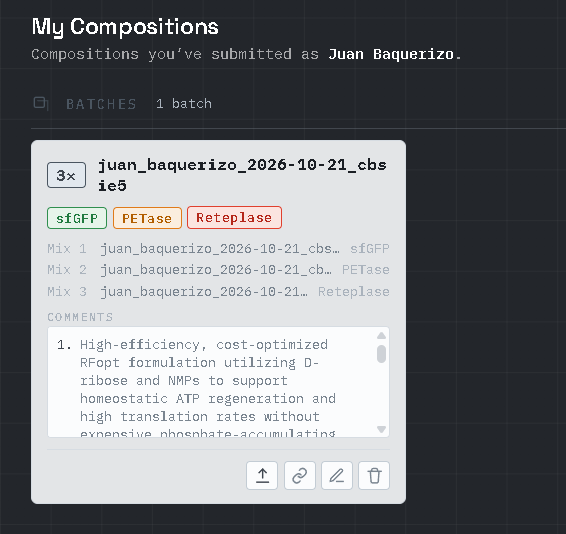
The target compositions were verified, configured, and submitted as a batch submission (juan_baquerizo_2026-10-21_cbsie5) on the Ginkgo Bioworks Coopetition platform.
6. AI Disclosure and Attribution
- AI Collaborator: Google Gemini (Fall 2026).
- Scope of Assistance:
- Assisted in converting millimolar concentration targets into exact nanoliter dispensing volumes ($25\text{ nL}$ acoustic steps) to satisfy the $20,000\text{ nL}$ total volume constraint.
- Supported the thermodynamic and biochemical reasoning behind IAM-treated lysates, GSH/GSSG redox ratios, and DsbC chaperone kinetics for Reteplase folding.
- Helped structure and format the technical Markdown report to adhere strictly to HTBAA Week 4 assignment guidelines.