Week 6 HW: Non-Model Organisms
HTBAA Homework #6: Exploring Non-Model Organisms for Biomanufacturing
- Student: Juan Baquerizo (Active Global Contributor - Ecuador)
- Course: MAS.S65 / How to Biomanufacture (Almost) Anything (Fall 2026)
- Instructors: David Sun Kong, Ph.D., George Church, Joseph Jacobson
- Platform: Cultivarium Portal, Data Vault, and Taxonomy Browser
- Target Organism: Komagataeibacter xylinus (NCIB 5346 / ATCC 11142)
Part 0: Getting Started on The Cultivarium Portal
I registered for access to the Cultivarium Portal, navigated through the Taxonomy Browser, and explored the platform’s multi-omics, growth predictions, and genetic tool repositories. The Portal provides accessible strain-level metadata, growth media compositions, functional origins of replication (ORIs), antibiotic susceptibility profiles (MIC90), and reported genetic transformation protocols for non-model chassis.
Part 1: Explore Non-Model Organisms
1. Organism Selection and Justification
- Chosen Non-Model Organism: Komagataeibacter xylinus (NCIB 5346 / ATCC 11142).
- Justification: In Homework #1, I proposed biomanufacturing a custom, breathable, antimicrobial prosthetic socket bio-liner. K. xylinus is the benchmark non-model obligate aerobe capable of secreting pure, 3D nanofibrillar bacterial cellulose (BC) hydrogels directly at the air-liquid interface. Unlike plant cellulose, K. xylinus BC is free of lignin and hemicellulose, exhibiting extraordinary tensile strength, high water retention, and high gas permeability—making it an ideal biological matrix for prosthetic interfaces.
- Identification Method: Search conducted via the Cultivarium Portal AI and MicroScopus by searching for “bacterial cellulose biosynthesis”, “UDP-glucose bcsA operon”, and “pellicle-forming acetic acid bacteria”.
2. Target Strain Data Table
Below is the summary of metadata and culture predictions retrieved directly from the Cultivarium Portal entry for Komagataeibacter xylinus NCIB 5346:
| Category | Data |
|---|---|
| Species Name | Komagataeibacter xylinus |
| Strain Name | Komagataeibacter xylinus NCIB 5346 (ATCC 11142 / DSMZ 2325 / BacDive 86) |
| Link | https://portal.cultivarium.org/taxonomy/strains?id=126658 |
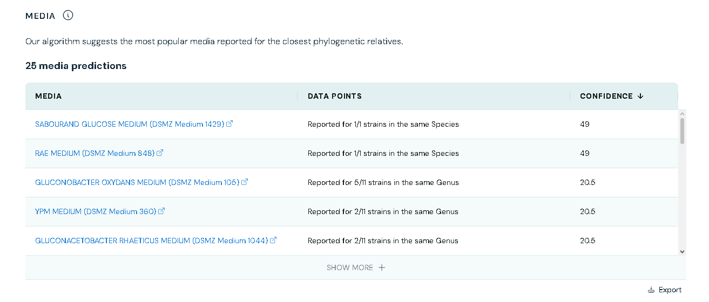
| Growth Media and Temperature | Hestrin-Schramm (HS) / RAE Medium; Optimum Temperature: $26.9^\circ\text{C}$ (Range: $11.4 - 34.6^\circ\text{C}$), Aerobic. |
| Susceptible Antibiotics, and MIC90 | Kanamycin ($\text{MIC}{90} \approx 50,\mu\text{g/mL}$), Ampicillin ($\text{MIC}{90} \approx 100,\mu\text{g/mL}$). |
| Functional ORIs | pBBR1 broad-host-range replication origin, p15A derivatives. |
| Genome Size | ~3,500,000 bp (3.50 Mb) |
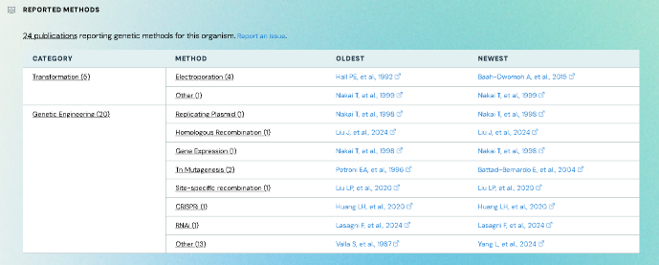
| Number of Publications Listed | 24 publications reporting genetic methods |
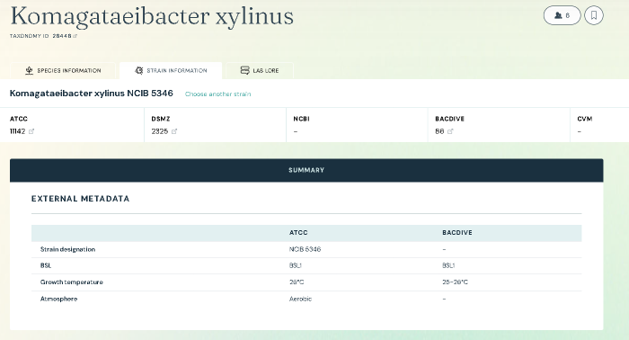
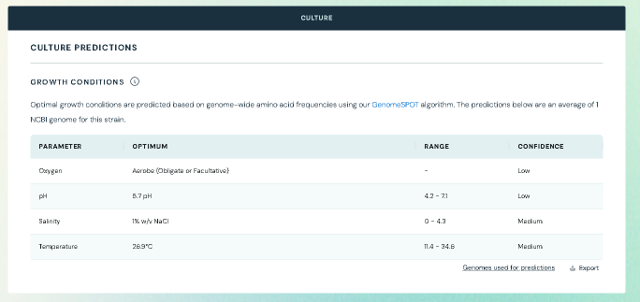
Information Utility and Missing Data Analysis
- What I Can Do With This Information: Knowing the predicted optimal growth temperature ($26.9^\circ\text{C}$), pH (5.7), and aerobic requirement enables precise benchtop culture design for 3D biotemplating in FDM molds. Functional ORIs (pBBR1) and selection markers allow plasmid vector construction for genetic engineering (e.g., overexpressing the bcsABCD operon to boost cellulose yield).
- Missing Information & Why It Is Needed: Specific electroporation pulse parameters (kV/cm, capacitance, recovery buffers) and exact promoter strength profiles under static versus agitated conditions are missing from the baseline entry. This information is critical to transform K. xylinus reliably without damaging its outer membrane structure.
3. Species Information & Genetic Methods
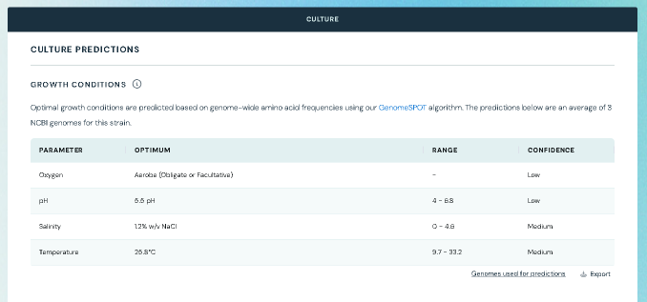
Revising the Reported Methods and Media Predictions tabs on the Cultivarium Portal provides a historic overview of genetic tools adapted for this species:
- Available Genetic Methods:
- Transformation: Electroporation (4 publications).
- Genetic Engineering: Replicating Plasmids (1 publication), Homologous Recombination (1 publication), Transposon Mutagenesis (2 publications), Site-specific Recombination (1 publication), CRISPRi (1 publication), RNAi (1 publication).
- Number of Methods Available: 7 distinct genetic methodology categories (24 total publications).
- Range of Years (Oldest–Newest): 1987 (Valla S, et al. - early genetic studies) / 1992 (Hall PE, et al. - first electroporation) to 2024 (Lasagni F, et al. / Liu J, et al. - RNAi, Homologous Recombination).
- Suggested Next Closest Organism: Komagataeibacter medellinensis NBRC 3288 or Gluconobacter oxydans. Available methods include electroporation with pBBR1 shuttle vectors and Gibson assembly-mediated genomic knockouts.
Part 2: Explore Neighbor Strains
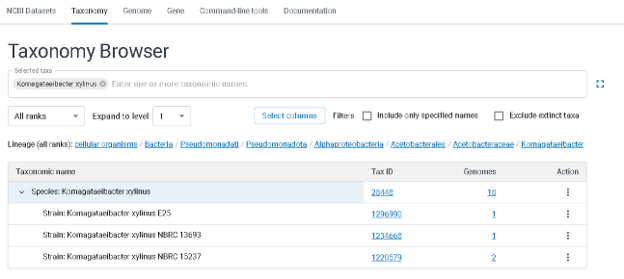
When strain-specific quantitative details (such as exact antibiotic MIC90 levels or validated replication origins) are absent in the primary target entry, phylogenetic neighbors within the same family (Acetobacteraceae) or genus (Komagataeibacter) provide essential baseline approximations.
| Neighbor Species | Related Level (e.g., genus, family) | Category | Data |
|---|---|---|---|
| Komagataeibacter medellinensis NBRC 3288 | Genus | Genome Size | 3,420,150 bp (~3.42 Mb) |
| Gluconobacter oxydans 621H | Family (Acetobacteraceae) | Susceptible Antibiotics and MIC90 | Kanamycin ($\text{MIC}_{90} \approx 50,\mu\text{g/mL}$), Ampicillin resistant |
| Komagataeibacter rhaeticus DSM 1044 | Genus | Recommended Growth Media | DSMZ Medium 1044 / RAE Medium (DSMZ 848) |
| Komagataeibacter hansenii ATCC 23769 | Genus | Functional Plasmid ORIs | Broad-host-range pBBR1 replication origin |
Part 3: From Information to Delivery — What Don’t You Know Yet?
1. Synthesis of Knowns vs. Unknowns
- What is Known: Komagataeibacter xylinus is an obligate aerobe optimized for growth at $26–30^\circ\text{C}$ in Hestrin-Schramm (HS) / RAE medium at pH 5.5–6.0. Broad-host-range plasmids utilizing the pBBR1 replication origin can be maintained, and transformation via electroporation has been established in literature since 1992.
- What is Missing: Strain-specific electroporation efficiency parameters (kV/cm pulse waveforms and recovery buffers), long-term plasmid retention stability during static multi-day fermentation without antibiotic pressure, and oxygen availability dynamics inside thick 3D-printed molds.
- Confidence Assessment: I feel moderately confident in designing basic culture and material harvesting protocols based on established HS medium compositions. However, confidence is lower regarding high-yield genetic engineering and uniform 3D biotemplating without empirical validation.
2. Analysis of Key Unknowns and Experimental Plans
Risk 1: Oxygen Depletion Gradients in Deep 3D Biotemplates
- The Problem: K. xylinus is strictly aerobic and synthesizes cellulose at the air-liquid interface. In deep, custom 3D molds (such as a full prosthetic socket liner), vertical oxygen gradients will cause uneven pellicle thickness and structural anisotropy.
- Proposed Experiment: Construct vertical 3D-printed PETG molds equipped with gas-permeable silicone/PDMS membrane windows. Culture K. xylinus under static conditions for 7 days at $27^\circ\text{C}$.
- Readouts & Insights: Measure pellicle thickness profile across 10 cross-sectional depth levels using Optical Coherence Tomography (OCT) and Scanning Electron Microscopy (SEM). This will confirm whether multi-directional oxygen diffusion yields homogenous nanocellulose density.
Risk 2: Plasmid Instability and Segregational Loss During Multi-Day Fermentation
- The Problem: Biosynthesis of the bio-liner requires a 5-to-7-day static culture. Maintaining antibiotic selection (e.g., Kanamycin) in large volumes is costly and may degrade over time, leading to plasmid loss and loss of antimicrobial peptide (AMP) expression.
- Proposed Experiment: Transform K. xylinus with a pBBR1-sfGFP construct. Pass the culture through a 7-day static production cycle in HS medium with and without continuous antibiotic selection.
- Readouts & Insights: Perform daily flow cytometry and fluorescence microplate reader measurements to calculate the percentage of GFP-positive cells ($f_{\text{plasmid}}$) over time. If plasmid retention falls below 80%, genomic integration (e.g., via Tn5 transposon or CRISPR-Cas) will be required instead of episomal vectors.
Risk 3: Low Transformation Efficiency Due to Extracellular Matrix Secretion
- The Problem: Active K. xylinus cells secrete dense extracellular polymeric substances (EPS) and glucan microfibrils, which hinder electroporation cuvette insertion and reduce DNA uptake efficiency.
- Proposed Experiment: Test a grid of pre-transformation washing protocols (using cellulase pre-treatment to clear surface microfibrils) combined with varying electroporation field strengths (12.5 kV/cm, 15.0 kV/cm, 17.5 kV/cm) and recovery times (2 h vs 4 h).
- Readouts & Insights: Quantify colony-forming units per microgram of plasmid DNA ($\text{CFU}/\mu\text{g DNA}$). This identifies the threshold voltage that achieves maximum transformation efficiency without compromising cell viability.
Part 4: Final Project Reflection & AI Disclosure
1. Integration of Cultivarium Resources into Final Project Design
For my final project proposal—the Bio-Liner (a custom 3D-biotemplated prosthetic socket liner composed of bacterial nanocellulose secreted by Komagataeibacter xylinus and functionalized with engineered antimicrobial peptides)—the Cultivarium ecosystem provides critical bioengineering data to transition from theoretical design to living system execution.
- Specific Tool: Cultivarium Data Vault & GenomeSPOT Predictive Algorithm.
- Relevance & Intended Use: The GenomeSPOT algorithm predicts optimal growth parameters (pH, temperature, salinity, oxygenation) based on genome-wide amino acid frequencies. I intend to use these predictive models alongside the Data Vault’s growth curve repositories to fine-tune the Hestrin-Schramm (HS) media formulation and incubation temperature ($26.9^\circ\text{C}$ optimal prediction) inside micro-perforated 3D molds. This minimizes trial-and-error iterations when optimizing nanocellulose yield and mechanical tensile strength for prosthetic socket interfaces.
- PRISM Integration: Furthermore, leveraging high-throughput screening data from PRISM will inform microfluidic droplet encapsulation assays if we screen variants of K. xylinus or co-culture conditions for enhanced cellulose secretion rates.
2. Cultivarium Portal AI Agent Evaluation
The Cultivarium Portal AI agent was utilized during the initial exploration of non-model organisms and strain identification.
Helpful Recommendations:
- Successfully identified Komagataeibacter xylinus as the primary obligate aerobe for bacterial cellulose synthesis.
- Recommended valid phylogenetic neighbors within the Acetobacteraceae family (K. medellinensis, G. oxydans) to fill baseline parameter gaps like genome size and functional plasmid origins (pBBR1).
- Suggested standard Hestrin-Schramm (HS) and RAE growth media formulations.
Limitations & Shortcomings:
- Struggled with precise quantitative protocols for transformation efficiency (e.g., specific electroporation voltage waveforms in $\text{kV/cm}$ required to penetrate the dense extracellular polymeric matrix of pellicle-forming strains).
- Provided generic broad-host-range plasmid suggestions without accounting for long-term plasmid retention stability during multi-day static fermentation runs without selection pressure.
AI Disclosure and Attribution
- AI Collaborators: Cultivarium Portal AI & Google Gemini (Fall 2026).
- Scope of Assistance:
- Conducted taxonomy cross-referencing and non-model organism strain selection for bacterial nanocellulose biomanufacturing.
- Formulated risk analysis and experimental validation strategies for 3D biotemplating and oxygen depletion dynamics.
- Structured technical documentation and Markdown tables following HTBAA Homework #6 specifications.