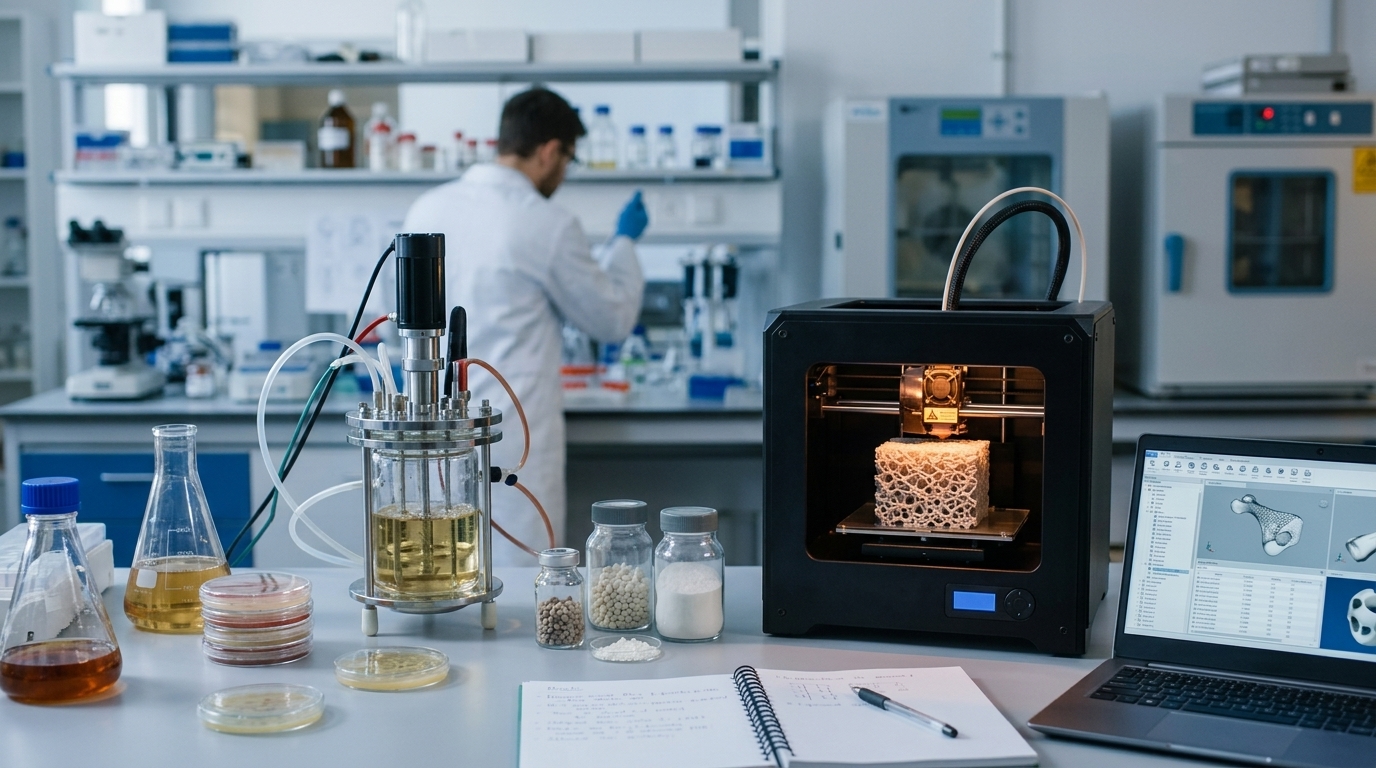
Week 1 HW: Final Project Ideas
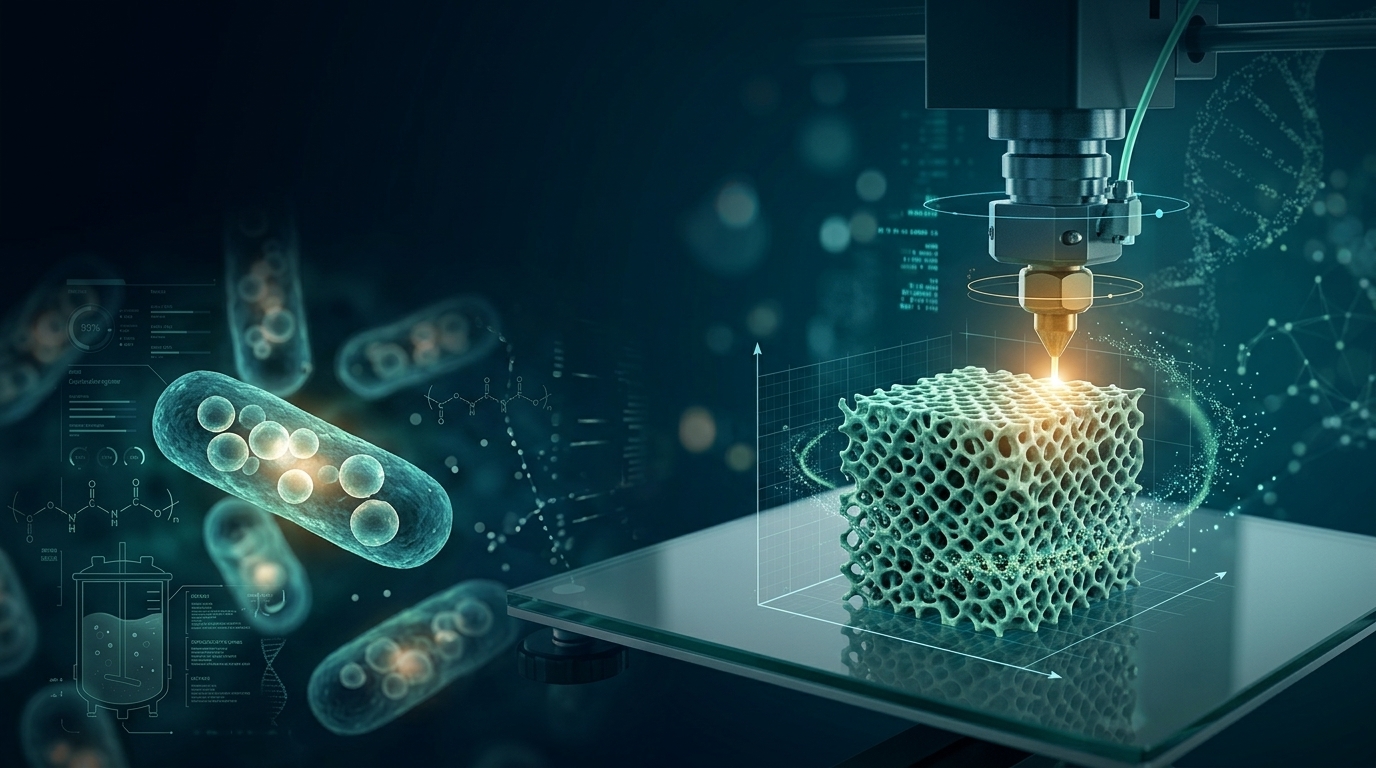
🤖 (1) What I want to biomanufacture and why
I want to biomanufacture polyhydroxybutyrate (PHB), a biodegradable bacterial bioplastic, as the raw polymer feedstock for 3D-printed scaffolds for bone tissue regeneration. Bone grafts are needed for large defects caused by trauma, tumor resection, or congenital conditions, and current options (autografts, allografts, metal implants) have real limitations: autografts require a second surgical site, allografts carry rejection/disease-transmission risk, and metal implants don’t resorb as new bone forms. A biodegradable, biocompatible polymer that can be 3D-printed into a patient-specific porous scaffold — and that gradually degrades as the body lays down new bone — addresses this directly. My personal motivation comes from my Mechatronics background: I’m interested in the intersection of CAD/manufacturing and biomedical engineering, and this project lets me combine both.
🦠(2) Living system
Chassis: Cupriavidus necator (formerly Ralstonia eutropha), a well-characterized bacterium that naturally accumulates PHB as an intracellular carbon/energy storage granule (up to ~80% of cell dry weight) when grown under nitrogen limitation with excess carbon.
In: glucose or plant-oil/fatty-acid feedstock as carbon source, minimal nitrogen, standard mineral salts, O₂.
Process: aerobic fed-batch fermentation. Once nitrogen is depleted, the cells stop dividing and shunt excess carbon into PHB granules instead of growth.
Out: biomass loaded with intracellular PHB, which is then harvested (centrifugation/lysis) and the polymer extracted (solvent extraction, e.g., with a green solvent, or enzymatic digestion of non-PHB biomass) and purified into raw polymer pellets/powder, ready for 3D printing (FDM or similar) into porous scaffold geometries.
Assumption: I’m assuming standard lab-scale fed-batch conditions reported in the literature for C. necator (PHB titers up to ~100 g/L) are achievable without extensive strain engineering.
🎮(3) Automation
I’d automate this at two different stages:
Prototyping/optimization stage: a desktop liquid-handling robot (e.g., Opentrons) to run parallelized micro-fermentations in 96-deep-well plates, screening carbon:nitrogen ratios and feeding strategies. The robot would also automate sampling and a Nile-red fluorescence assay (via plate reader) to quantify intracellular PHB accumulation across conditions, letting me find the optimal feeding regime much faster than manually.
Production stage: an automated fed-batch bioreactor with programmable feed-control (maintaining nitrogen limitation while feeding carbon substrate), automated pH/DO control, and in-line monitoring (e.g., NIR spectroscopy) to track PHB accumulation in real time without manual sampling. This is the step-up in automation technology as I move from screening (well-plate scale) to actual production (liter scale).
🔎(4) Scale
(a) How much?
Target: enough PHB to cover the annual large-bone-defect caseload of a mid-sized hospital.
Assume ~500 major bone-grafting procedures/year.
Assume ~5 g of PHB polymer needed per scaffold (accounting for the scaffold being highly porous — only a fraction of the bulk volume is actual polymer).
Total annual demand ≈ 500 × 5 g = 2.5 kg PHB/year.
🧪(b) How long?
Literature fed-batch titers for C. necator: up to ~100 g PHB/L culture.
Assume ~70% recovery efficiency after extraction/purification → ~70 g usable PHB/L.
Volume needed: 2,500 g ÷ 70 g/L ≈ 36 L of cumulative fermentation broth per year.
A single 10 L bioreactor run takes ~48–72 h fermentation + ~24–48 h downstream processing (harvest, extraction, purification) ≈ 1 week per batch.
To cover 36 L/year, I’d need only ~4 batches/year in one 10 L reactor — so in terms of raw throughput, a single automated bioreactor running intermittently (a few weeks total per year) could meet this hospital-scale demand. The bottleneck isn’t fermentation capacity — it’s the downstream steps (purification, sterilization, 3D printing, QC) which would need their own timeline.
😖(5) What I don’t know yet
Real achievable titer/purity in my own hands — literature PHB titers vary widely (5–160 g/L) depending on strain engineering and feeding strategy; I don’t know what’s realistically achievable without extensive optimization, or how pure/mechanically consistent the extracted polymer would be batch-to-batch.
Print-to-property relationship — how PHB’s specific mechanical and degradation properties translate once 3D-printed into a porous scaffold geometry (porosity/pore size vs. mechanical strength vs. degradation rate) is something I’d need to characterize experimentally, not just assume from bulk-material literature values.
Biocompatibility/sterility after processing — whether the extraction/purification process reliably removes bacterial endotoxins and other residues to a level safe for implantation is a major unknown that would need dedicated testing (not just something I can estimate).
AI use disclosure: per the assignment’s citation requirement, I used Claude (Anthropic) to help brainstorm and structure this response, including refining the automation strategy and the back-of-envelope scale calculation.
Week 2 HW: DNA Design
Part 0. Repository: JUSTIN AGUILAR HTBAA, folder: [JUSTIN AGUILAR HTBAA].
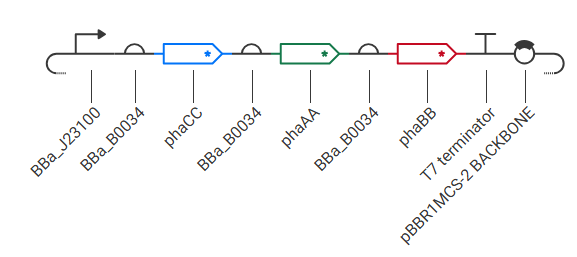
Part 1: Expression target
Molecules: the three enzymes of the PHB pathway: PhaA (β-ketothiolase), PhaB (acetoacetyl-CoA reductase) and PhaC (PHA synthase). PHB is not encoded in DNA; these enzymes make it.
Sequences: PhaC, UniProt P23608 (589 aa); PhaB, UniProt P14697 (246 aa); PhaA, UniProt phaA, phaB, phaC . All from Cupriavidus necator H16.
Host: C. necator (a PHB-negative strain such as PHB⁻4 is ideal, so the phenotype comes from my construct). Kernel offers no C. necator model, so I used E. coli as a proxy in codon optimization and simulation.
Part 2: Parts
| Part | Type | Source | Why |
|---|
| BBa_J23100 | Promoter | Kernel/iGEM | Strong constitutive promoter; T7 was avoided because C. necator lacks T7 polymerase |
| BBa_B0034 (×3) | RBS | Kernel/iGEM | Standard RBS, one per gene so each enzyme is translated independently |
| phaC, phaA, phaB | CDS (+start +stop) | UniProt, codon-optimized | The three pathway enzymes |
| T7 terminator | Terminator | Kernel | Ends the transcript cleanly |
| pBBR1MCS-2 | Backbone | UniProt | Broad-host-range origin and kanamycin resistance, which work in C. necator; pUC origins do not |
Part 3:
Assembly. Order:
graph LR
subgraph pBBR1MCS-2 ["Vector Backbone (pBBR1MCS-2)"]
direction LR
J23100[Promoter: J23100] --> B1[RBS: B0034]
B1 --> phaC[CDS: phaC]
phaC --> B2[RBS: B0034]
B2 --> phaA[CDS: phaA]
phaA --> B3[RBS: B0034]
B3 --> phaB[CDS: phaB]
phaB --> T7[Terminator: T7]
end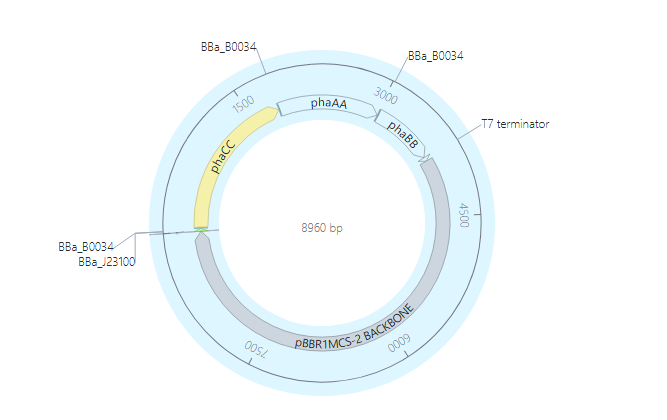 This is one operon (a single mRNA), so all three genes are expressed from one promoter. Each CDS starts with ATG and ends with a stop codon.
Part 4: Optimization and QC
Codon optimization was performed on all three coding sequences (CDS) using E. coli as the host model. This adjustment aligns codon usage with the most abundant tRNAs, prevents ribosome stalling, and eliminates rare codon bottleneck effects for high-level heterologous protein expression.
phaA (393 amino acids / 1179 bp):
- GC Content: Changed from 66.2% (native high-GC C. necator strain) to 54.8% (optimized for E. coli).
- Codon Modifications: 182 out of 393 codons were modified (46.3% of codons adjusted).
phaB (247 amino acids / 741 bp):
- GC Content: Changed from 42.1% (native low-GC Acinetobacter sp. RA38) to 51.2% (optimized for E. coli).
- Codon Modifications: 98 out of 247 codons were modified (39.7% of codons adjusted).
phaC (589 amino acids / 1767 bp):
- GC Content: Changed from 65.1% (native C. necator) to 55.3% (optimized for E. coli).
- Codon Modifications: 264 out of 589 codons were modified (44.8% of codons adjusted).
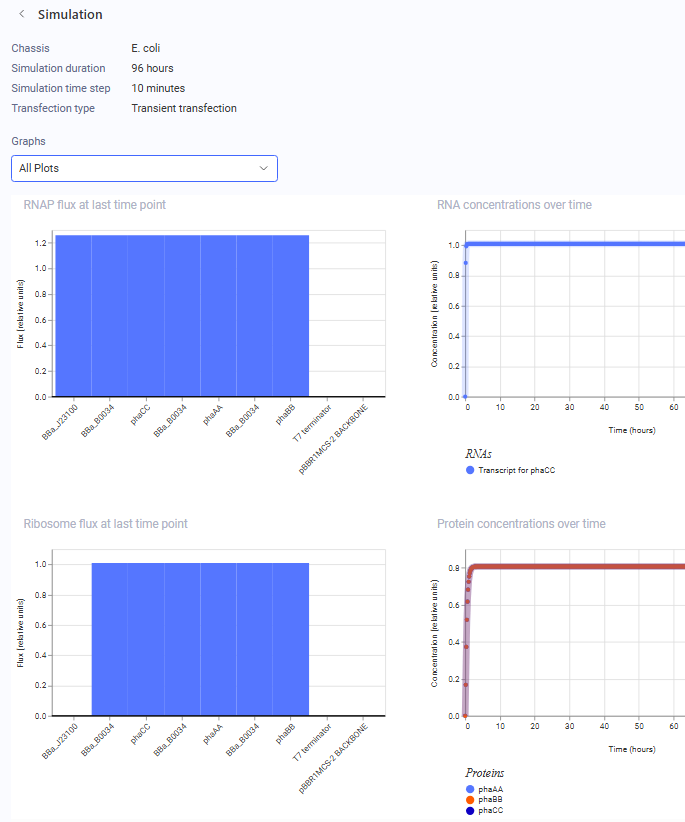
Kernel’s optimization and simulation tools do not include Cupriavidus necator, so I used E. coli as a working proxy. This is a practical choice, not a claim that the two hosts behave alike. E. coli is fast to grow and transform, and it is known to make PHB when given phaCAB genes, so it is a reasonable first testbed. But the two organisms differ in ways that matter for this construct: genome GC content (~66% in C. necator vs. ~51% in E. coli, which changes codon preference), promoter and RBS recognition, and central metabolism, including how much acetyl-CoA and NADPH are available to feed the pathway. Every result from Kernel should therefore be read as “the cassette is expressed in a model bacterium,” not as a prediction of PHB yield in my real host.
Part 5: From design to build
The cassette is ~4 kb (CDS ≈ 1.8 + 1.2 + 0.7 kb, plus regulatory parts) and the backbone is ~5 kb. I would order the three genes as synthetic fragments with overlapping ends and assemble them into the linearized backbone by Gibson assembly (Gibson et al., 2009). Ordering one 4 kb piece is riskier and costlier, and fragment assembly lets me sequence-verify each piece. Hard-to-synthesize features: high GC content and the three identical B0034 sequences, which are repeats that can cause mis-assembly; I would swap in different RBS variants. Chemical synthesis has errors, so I would verify clones by sequencing or use error correction (Carr et al., 2004). Prototype vs. scale: for one construct, DNA cost is negligible. If I test many RBS/promoter variants, oligo pools from chips (Kosuri et al., 2010) lower the cost per gene. At production scale, I would integrate the operon into the genome to avoid antibiotics in the fermenter.
Part 6: What I don’t know yet
I don’t know how to test this in C. necator. Kernel only lets me simulate and optimize for E. coli, so everything I have shown is a stand-in for my real host. I also don’t know how to get a plasmid into C. necator. I have read that it is usually done by conjugation from an E. coli donor strain, but I have never done it and I don’t know the protocol. How I would find out: read a published C. necator transformation protocol, ask a lab that works with it, and start with a small test using a plasmid that carries only a fluorescent reporter before moving to the full operon.
I don’t know whether my recoded genes will work. I optimized the codons for E. coli, but C. necator has a very different GC content (about 66% vs. 51%), so the sequence may translate well in one host and poorly in the other. I don’t know how to predict this, and I’m not sure codon optimization alone is enough. How I would find out: build a second version that keeps the native C. necator codons, express both in the same strain, and compare protein levels on a gel and PHB per cell. I would also learn to use a codon-usage table for C. necator and re-run the optimization with it.
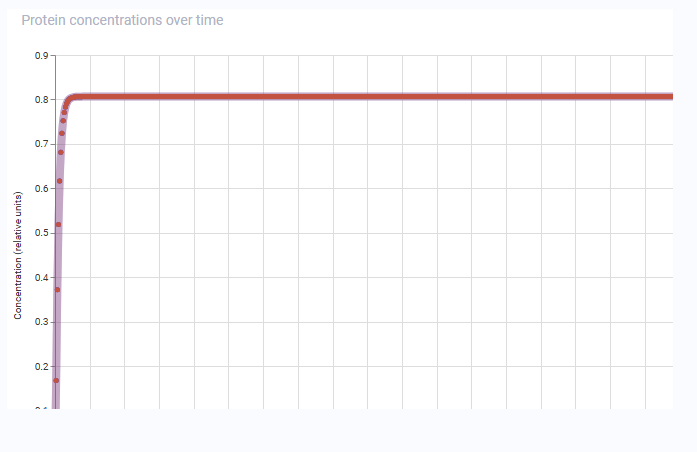
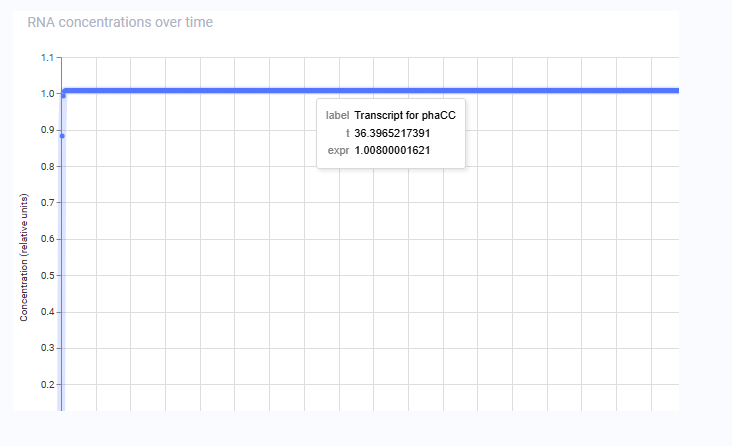
I don’t know if the three enzymes are in the right balance. All three genes share one promoter and the same RBS sequence, so I expect similar translation for each, but the pathway may need more of one enzyme than the others. The Kernel simulation shows steady protein levels in relative units, but it does not model enzyme activity, folding or PHB yield, and I don’t yet know how to connect its output to real production. How I would find out: measure PHB directly (I would need to learn a Nile red assay and then GC or HPLC for confirmation), then vary the RBS of each gene and see which one limits yield.
I don’t know if a plasmid is the right format for scale. The pBBR1MCS-2 backbone needs kanamycin, which is expensive and undesirable in a production fermenter, and I don’t know how stable the plasmid would be over a long culture. I also don’t know how to integrate the operon into the C. necator genome. How I would find out: grow cultures for many generations with and without antibiotic and count how many cells keep the plasmid, then learn a genome-integration method and compare yield.