Week 1 HW: Final Project Ideas
🤖 (1) What I want to biomanufacture and why
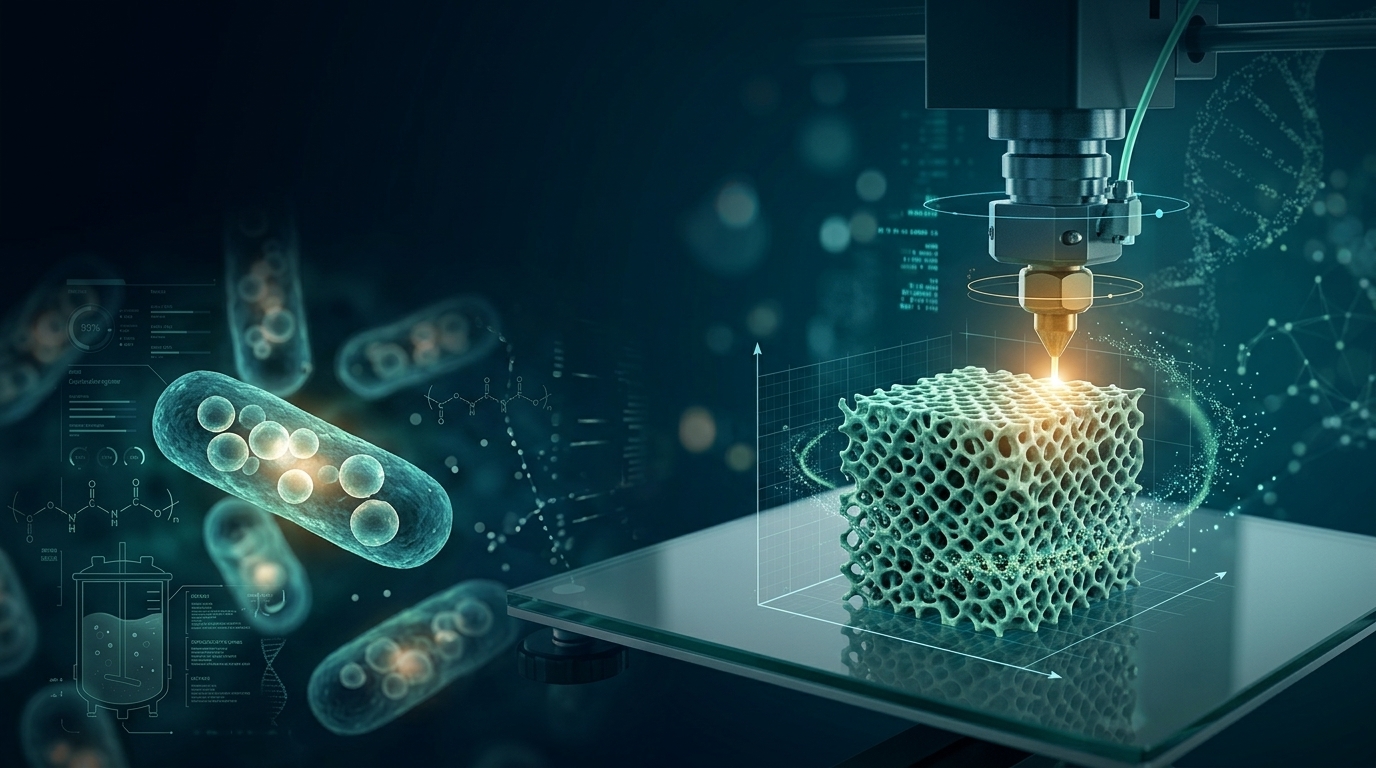
I want to biomanufacture polyhydroxybutyrate (PHB), a biodegradable bacterial bioplastic, as the raw polymer feedstock for 3D-printed scaffolds for bone tissue regeneration. Bone grafts are needed for large defects caused by trauma, tumor resection, or congenital conditions, and current options (autografts, allografts, metal implants) have real limitations: autografts require a second surgical site, allografts carry rejection/disease-transmission risk, and metal implants don’t resorb as new bone forms. A biodegradable, biocompatible polymer that can be 3D-printed into a patient-specific porous scaffold — and that gradually degrades as the body lays down new bone — addresses this directly. My personal motivation comes from my Mechatronics background: I’m interested in the intersection of CAD/manufacturing and biomedical engineering, and this project lets me combine both.
🦠(2) Living system
Chassis: Cupriavidus necator (formerly Ralstonia eutropha), a well-characterized bacterium that naturally accumulates PHB as an intracellular carbon/energy storage granule (up to ~80% of cell dry weight) when grown under nitrogen limitation with excess carbon.
In: glucose or plant-oil/fatty-acid feedstock as carbon source, minimal nitrogen, standard mineral salts, O₂. Process: aerobic fed-batch fermentation. Once nitrogen is depleted, the cells stop dividing and shunt excess carbon into PHB granules instead of growth. Out: biomass loaded with intracellular PHB, which is then harvested (centrifugation/lysis) and the polymer extracted (solvent extraction, e.g., with a green solvent, or enzymatic digestion of non-PHB biomass) and purified into raw polymer pellets/powder, ready for 3D printing (FDM or similar) into porous scaffold geometries.
Assumption: I’m assuming standard lab-scale fed-batch conditions reported in the literature for C. necator (PHB titers up to ~100 g/L) are achievable without extensive strain engineering.
🎮(3) Automation
I’d automate this at two different stages:
Prototyping/optimization stage: a desktop liquid-handling robot (e.g., Opentrons) to run parallelized micro-fermentations in 96-deep-well plates, screening carbon:nitrogen ratios and feeding strategies. The robot would also automate sampling and a Nile-red fluorescence assay (via plate reader) to quantify intracellular PHB accumulation across conditions, letting me find the optimal feeding regime much faster than manually. Production stage: an automated fed-batch bioreactor with programmable feed-control (maintaining nitrogen limitation while feeding carbon substrate), automated pH/DO control, and in-line monitoring (e.g., NIR spectroscopy) to track PHB accumulation in real time without manual sampling. This is the step-up in automation technology as I move from screening (well-plate scale) to actual production (liter scale).
🔎(4) Scale
(a) How much? Target: enough PHB to cover the annual large-bone-defect caseload of a mid-sized hospital.
Assume ~500 major bone-grafting procedures/year. Assume ~5 g of PHB polymer needed per scaffold (accounting for the scaffold being highly porous — only a fraction of the bulk volume is actual polymer). Total annual demand ≈ 500 × 5 g = 2.5 kg PHB/year.
🧪(b) How long?
Literature fed-batch titers for C. necator: up to ~100 g PHB/L culture. Assume ~70% recovery efficiency after extraction/purification → ~70 g usable PHB/L. Volume needed: 2,500 g ÷ 70 g/L ≈ 36 L of cumulative fermentation broth per year. A single 10 L bioreactor run takes ~48–72 h fermentation + ~24–48 h downstream processing (harvest, extraction, purification) ≈ 1 week per batch. To cover 36 L/year, I’d need only ~4 batches/year in one 10 L reactor — so in terms of raw throughput, a single automated bioreactor running intermittently (a few weeks total per year) could meet this hospital-scale demand. The bottleneck isn’t fermentation capacity — it’s the downstream steps (purification, sterilization, 3D printing, QC) which would need their own timeline.
😖(5) What I don’t know yet
Real achievable titer/purity in my own hands — literature PHB titers vary widely (5–160 g/L) depending on strain engineering and feeding strategy; I don’t know what’s realistically achievable without extensive optimization, or how pure/mechanically consistent the extracted polymer would be batch-to-batch. Print-to-property relationship — how PHB’s specific mechanical and degradation properties translate once 3D-printed into a porous scaffold geometry (porosity/pore size vs. mechanical strength vs. degradation rate) is something I’d need to characterize experimentally, not just assume from bulk-material literature values. Biocompatibility/sterility after processing — whether the extraction/purification process reliably removes bacterial endotoxins and other residues to a level safe for implantation is a major unknown that would need dedicated testing (not just something I can estimate).
AI use disclosure: per the assignment’s citation requirement, I used Claude (Anthropic) to help brainstorm and structure this response, including refining the automation strategy and the back-of-envelope scale calculation.