Week 3 HW: Cell-Free Protocols
A. Compare cell-free reaction compositions
Why does the concentration of potassium glutamate and magnesium glutamate differ between compositions? Which is more sensitive?
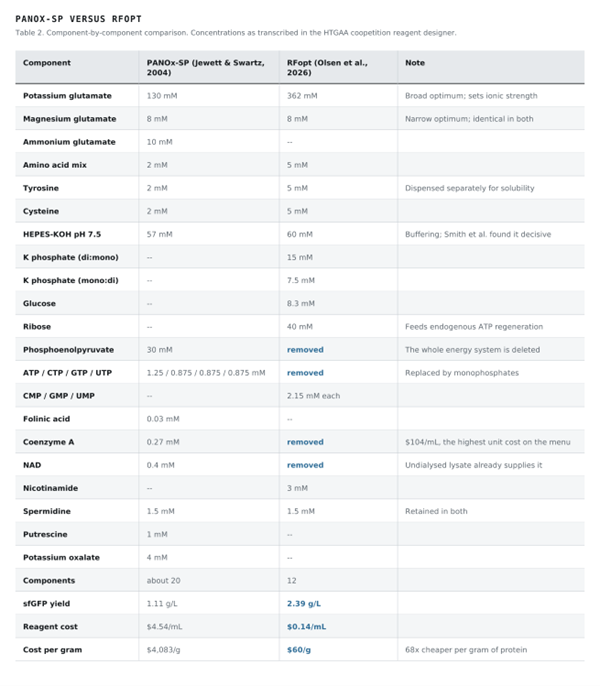
Potassium glutamate sits around 130 mM in standard formulations and as high as 362 mM in cost-optimised ones; magnesium glutamate sits at 8–12 mM in almost all of them. The order-of-magnitude gap exists because the two ions do different jobs. Potassium sets ionic strength and osmolarity, reproducing the 100–200 mM potassium pool of the E. coli cytoplasm that ribosome conformation and tRNA binding evolved in. Its optimum is broad: tens of millimolar in either direction change yield gradually. Magnesium is catalytic and structural. It neutralises the phosphate backbone of RNA, is required for association of the 30S and 50S ribosomal subunits, for T7 RNA polymerase catalysis, and for aminoacyl-tRNA binding at the ribosome. Its optimum is narrow and sharply peaked. Magnesium is decisively the more sensitive of the two. Below its optimum, ribosomal subunits dissociate and transcription stalls; above it, the ribosome is over-stabilised, translational fidelity drops, and mRNA secondary structure is stabilised against unwinding. A few millimolar either way collapses the reaction. This also explains why magnesium varies between published compositions while potassium does not vary for the same reason. Two causes. First, the lysate itself carries magnesium, and the amount differs batch to batch. Second, several reaction components chelate Mg²⁺ — nucleotide triphosphates, phosphoenolpyruvate and inorganic phosphate all bind it — so a PEP + NTP formulation needs more added magnesium than an NMP formulation with no PEP. Olsen et al. (2026) make this explicit, re-determining the optimum magnesium and phosphate concentrations for every lysate batch and every lysate concentration. A note on the counter-ion: both salts are supplied as glutamate rather than chloride or acetate, because glutamate is the dominant physiological anion in E. coli and supports higher yields.
Explain how a PEP + NTP reaction formulation is different from a Ribose + NMP reaction formulation.
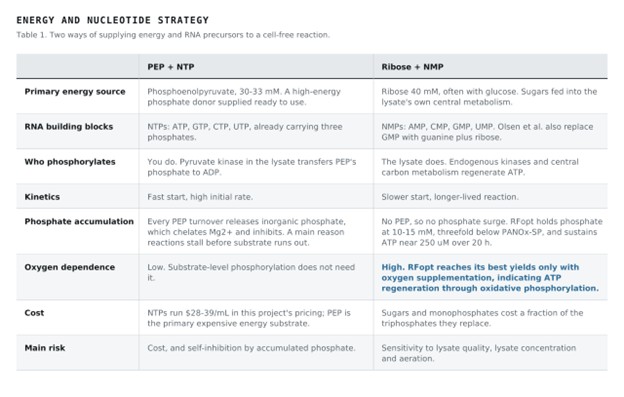
The difference is who does the phosphorylation: you, or the lysate. In a PEP + NTP formulation the energy is bought pre-phosphorylated. Phosphoenolpyruvate is a high-energy phosphate donor, and pyruvate kinase already present in the lysate transfers its phosphate to ADP to regenerate ATP; the nucleotides arrive already as triphosphates. The reaction starts fast and reaches high initial rates. It carries two costs. The first is money: PEP and the triphosphates are among the most expensive components, with CTP, GTP and UTP priced at $28–39/mL in this project. The second is self-poisoning: every turnover of PEP releases inorganic phosphate, which accumulates, chelates magnesium and inhibits the reaction. This is why PANOx-SP reactions stop producing after a few hours rather than running out of substrate.
In a ribose + NMP formulation cheap precursors are supplied and the lysate’s own metabolism phosphorylates them. Endogenous kinases convert nucleoside monophosphates to triphosphates, and ribose feeds central carbon metabolism to regenerate ATP. Olsen et al. (2026) found that GMP could be replaced entirely by guanine plus ribose with no loss of yield, and UMP by its base plus ribose with some loss. With no PEP there is no phosphate surge: their optimised system holds phosphate at 10–15 mM, threefold lower than PANOx-SP, and sustains ATP near 250 µM across a 20-hour reaction.
The trade is speed and robustness against cost and longevity. PEP + NTP buys a fast start with expensive reagents and builds up its own inhibitor. Ribose + NMP is far cheaper and lasts longer, but it leans on the lysate’s intact metabolism, which makes it sensitive to lysate quality and concentration, and oxygen-dependent: Olsen’s optimised formulation reached its highest yields only with 100% oxygen supplementation, indicating that ATP regeneration runs through oxidative phosphorylation rather than substrate-level phosphorylation.
Choose two cell-free reaction compositions from the literature, compare and contrast the choice of reagents and the concentration of reagents.
I compared PANOx-SP (Jewett & Swartz, 2004) with RFopt (Olsen et al., 2026), and read both against the AI-designed formulations of Smith et al. (2026). Concentrations are taken as transcribed in the HTGAA coopetition reagent designer, so that the two are stated on the same basis.