<YOUR NAME HERE> — HTBAA Fall 2026
About me
Contact info
Homework, Labs, and Projects
See the nav bar on the left to look through my work for How To Biomanufacture Almost Anything (Fall 2026)!
See the nav bar on the left to look through my work for How To Biomanufacture Almost Anything (Fall 2026)!
I would like to have a better idea of how well biomanufacturing would scale in costs for producing a colourant with similar light wavelength to that of a common synthetic dye. As the world continues to manage pollution produced from mass-produced synthetic dyes, biomanufacturing may provide an alternative means of producing dyes at an industrial scale. Ever since I’ve read about the prospect of creating colour through biological systems, I’ve wondered whether biomanufacturing could provide a practical alternative.
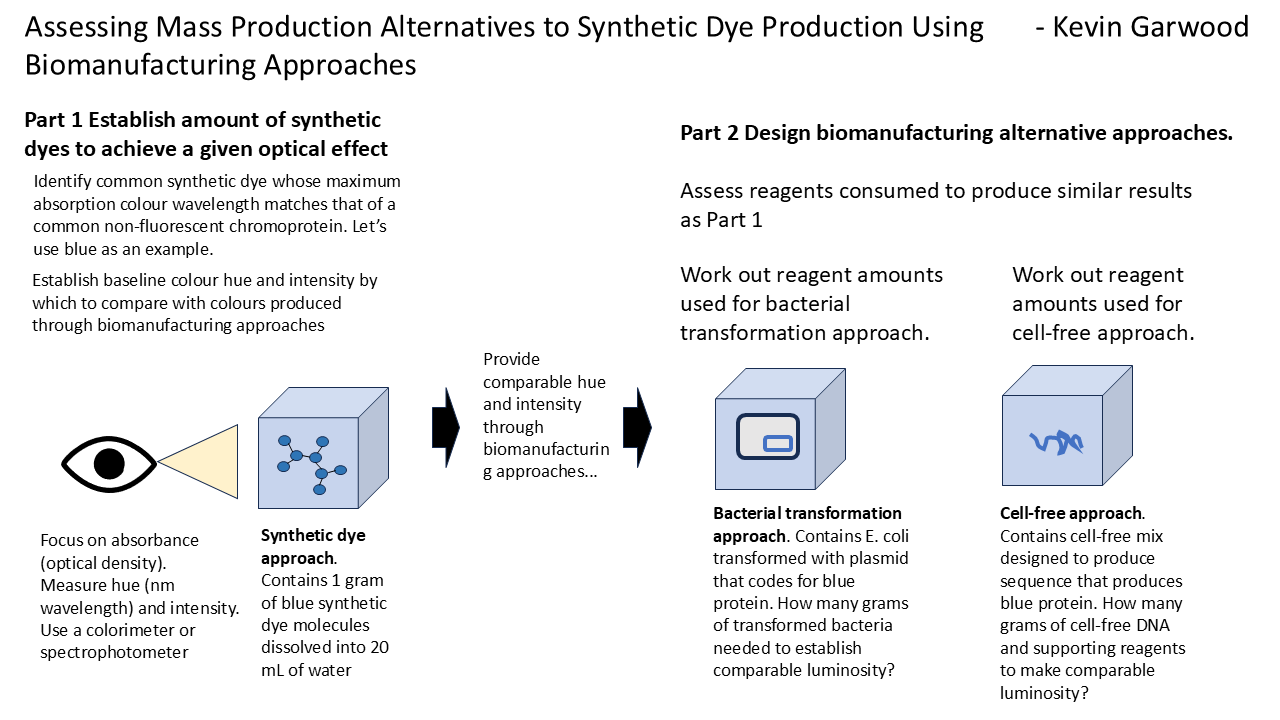
I think my experiment would go something like this….
I would use two living systems: a cell-free system and a bacterial one, both trying to produce the same protein.
I would use tools like Benchling to identify the protein. And then I would likely need to design some sort of OpenTrons program that would make each solution of colourant and then find some way to measure hue and saturation.
I don’t know how much, but I suspect there may be some sources of existing dye performance characteristics that I could use to provide an estimate. I think biomanufacturing would not be perfect, so I would probably need to research what factors could influence how concentrated the biomanufactured mixes would be.
I don’t know – see (a)
I’m familiar with some fluorescent proteins but I’m not familiar with coloured proteins that are not fluorescent. I don’t know which standard synthetic dye to pick – I might even choose the protein first and then choose the synthetic dye with the closest hue. I don’t know how well the biomanufactured colourants would adhere to surfaces. I don’t know how to estimate yields of either cell-free-based dyes or cell-based dyes.