Recently graduated with a Biotechnology degree from the University of Tehran and a to-be student of Microbial Biotechnology in the same department. My passion in synthetic biology, bioengineering, systems biology, and computational biology has brought me to computational enzyme engineering, and the crossroads of automation, bioproduction, and biocomputation is where it will take me.
Contact info
Homework, Labs, and Projects
See the nav bar on the left to look through my work for How To
Biomanufacture Almost Anything (Fall 2026)!
Subsections of KOUROSH AFSHINJOO — HTBAA Fall 2026
Week 1 HW: Final Project Ideas
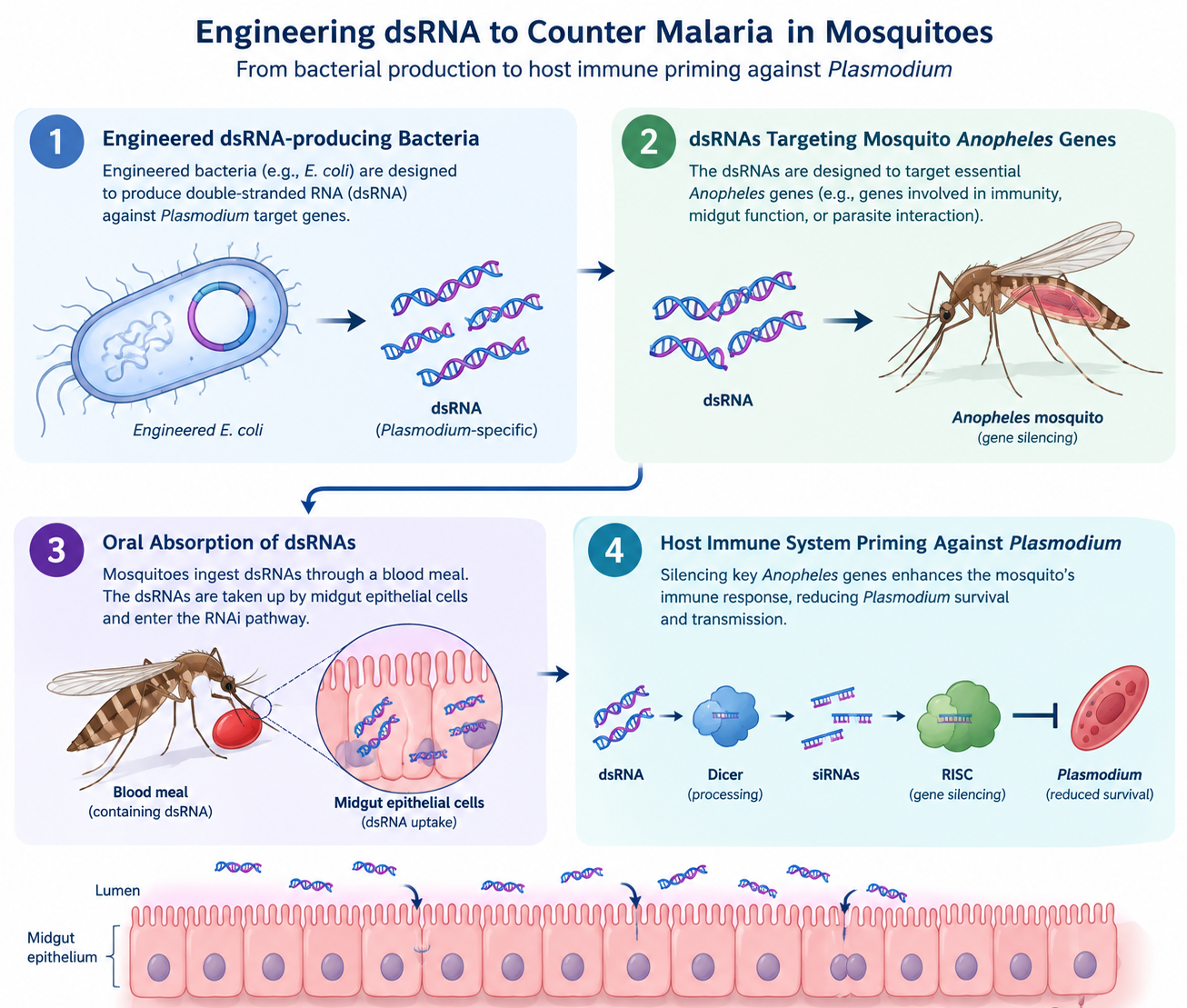
Final Project Idea: Microbially-delivered dsRNA Inhibitors for Preventing the Spread of Malaria
NOTE: Since I still have not concluded background research on the topic, expect this HW to be updated during the comning days. Also, the graphical abstract is mostly AI-generated and serves as a placeholder for a more polished handcrafted figure.
QUESTION 1: Malaria as a global crisis
As of 2026, malaria remains a critical global health concern, with the latest WHO World Malaria Report (latest issue published in 2025) placing the estimated number of cases at 282 million and death tolls at around 610,000 across 80 malaria-endemic countries in 2024 (World Health Organization, 2025). The corresponding global malaria mortality rate was estimated at 13.8 deaths per 100,000 population at risk. Dividing the estimated deaths by the estimated number of cases gives a crude case-fatality ratio of approximately 0.22% (World Health Organization, 2025). A great share of cases occur in sub-Saharan Africa, with the WHO African Region accounting for approximately 94% of global malaria cases and 95% of global malaria deaths in 2024, while substantial burdens are also present in South-East Asia, the Eastern Mediterranean, the Western Pacific, and the Americas (World Health Organization, 2025). As it could be deduced from the dispersion, the burden of malaria is strongly associated with socioeconomic conditions, vector ecology, housing, climate, and unequal access to prevention, diagnosis, and treatment rather than poor hygiene alone.
Sparked by my interest in engineering biocontrol agents as a countermeasure for insect-based pests and disease vectors, I propose designer double-stranded RNA (dsRNA) molecules as my bioproduct of choice. dsRNA can trigger RNA interference (RNAi), a sequence-specific gene-silencing mechanism in which long dsRNA is processed by Dicer proteins into small interfering RNAs (siRNAs), which are in turn incorporated into Argonaute-containing RNA-induced silencing complexes (known as RISCs) to recognize complementary messenger RNAs and trigger their degradation (Zhu and Palli, 2020; Christiaens et al., 2020).
dsRNAs are attractive as their targeting specificity is primarily encoded in their respective nucleotide sequence, allowing a potentially programmable bioproduct in which a new target can be addressed by changing the RNA sequence rather than redesigning an entirely new active compound. RNAi-based pest control has already progressed beyond laboratory proof-of-concept. For instance, in 2023, the U.S. Environmental Protection Agency registered Calantha, a sprayable dsRNA pesticide targeting the Colorado potato beetle, making it the first externally applied sprayable dsRNA pesticide approved for commercial use (U.S. Environmental Protection Agency, 2023; Sun et al., 2025).
RNAi itself has also been extensively investigated in Anopheles mosquitoes, which, alongside Aedes aegypti, are known as the primary vectors of malaria (Gonzales-Wartz et al., 2024). A 2024 review summarized RNAi studies conducted between 2000 and 2023 across different Anopheles species, tissues, and Plasmodium infections, highlighting numerous mosquito genes whose knockdown altered parasite development or vector competence (Yadav et al., 2024). More recently, Dong et al. demonstrated that the conserved mosquito prefoldin–CCT/TRiC chaperonin system can act as a transmission-blocking target across multiple Anopheles–Plasmodium combinations. RNAi-mediated silencing of prefoldin subunits or CCT/TRiC partners reduced P. falciparum oocyst loads and disrupted mosquito midgut integrity, producing microbiota-mediated immune priming against the parasite (Dong et al., 2025).
A major design consideration follows from these previous studies. Rather than directly targeting Plasmodium transcripts, I propose targeting mosquito genes required for parasite development or transmission. Plasmodium species lack the canonical Dicer/Argonaute machinery required for conventional RNAi, and the parasite has consequently been described as an RNAi-deficient organism (Baum et al., 2009; Ménard et al., 2022). Although a non-canonical RNAi system can be artificially introduced into Plasmodium berghei, this does not establish that externally supplied dsRNA would trigger conventional RNAi in wild-type malaria parasites (Hentzschel et al., 2020).
QUESTION 2: E. coli cell-free and cellular systems as development and delivery platforms
The production of large quantities of sequence-specific dsRNA remains an important bottleneck for the practical implementation of RNAi. Escherichia coli provides an attractive biological manufacturing platform because dsRNA-producing strains such as HT115(DE3) can be programmed by introducing a DNA construct containing the desired target sequence. In adult Anopheles gambiae, Taracena et al. demonstrated oral RNAi using long dsRNA produced in E. coli HT115(DE3). Heat-killed dsRNA-producing bacteria were suspended in sucrose and provided to adult mosquitoes, resulting in knockdown of target genes and observable phenotypes without the need for microinjection (Taracena et al., 2022).
The endgoal is not only to deliver the dsRNAs to the mosquito, but it also consists of ensuring ample persistence of the dsRNA-expressing host (either live or heat-killed), all in order to slowly release dsRNA to the mosquito host and create a sustained immune response against Plasmodium. Therefore, the choice of host should not be generally limited to E. coli at this stage and must be broadened to include other prominent bacteria that are capable of colonizing mosquito’s midgut.
QUESTION 3: Use of robotic automation for rapid screening of multiplex dsRNA candidates
A central challenge of designing sequence-specific dsRNA inhibitors is that target selection cannot be simply reduced to identifying an essential gene. Different dsRNAs targeting the same transcript can produce substantially different knockdown efficiencies because of sequence composition, target accessibility, RNA stability, cellular uptake, transcript abundance, and the properties of the intracellular RNAi machinery (Zhu and Palli, 2020). Moreover, targeting multiple genes simultaneously may improve robustness but can also introduce off-target or synergistic effects. In their 2022 paper, Taracena et al. specifically noted the possibility of simultaneous targeting of multiple mosquito genes while emphasizing that the efficacy and interactions of such combinations remain to be established (Taracena et al., 2022).
As such, the design and optimization process could greatly benefit from robotic liquid-handling systems to automate the generation and screening of a dsRNA candidate library. Though underexplored, I could identify precedents of automated functional screening in Anopheles. Particularly, Mameli et al. recently demonstrated a genome-wide CRISPR screening platform in Anopheles mosquito cells capable of identifying genes associated with cellular fitness and immune-related functions (Mameli et al., 2025).
For this project, the robotic system is anticipated to primarily serve as a design–build–test-learn (DBTL) loop. Candidate mosquito genes would first be selected computationally according to their relevance and impact on Plasmodium retention, conservation across mosquito populations (particularly those of the genus Anopheles), expression in relevant tissues, and predicted off-target risk (potentially based on transcriptomics data). Multiple dsRNA sequences could then be generated for each target, screened individually, and subsequently tested in combinations. Initial screening could use mosquito cell systems to identify strong knockdown candidates before more costly whole-mosquito experiments are considered; alternatively, cell-free reactions could be based on E. coli RNAse III-deficient lysate, containing a template of the target mRNA fused to that of a reporter gene. The key output would therefore be a set of experimentally supported dsRNA candidates, rather than a single sequence selected from computational prediction.
QUESTION 4: Back-of-the-envelope estimates
An estimate of the dsRNA dosage requirements were constructed from existing Anopheles RNAi experiments. Intrathoracic injection studies commonly use approximately 200 ng dsRNA per adult mosquito. For example, several Anopheles studies have used approximately 69 nL of a 3 µg/µL dsRNA solution, corresponding to roughly 207 ng per mosquito (Kwon et al., 2021; Kumari et al., 2020). This should only be considered a benchmark for injected systemic RNAi, however, because oral delivery does not necessarily produce the same effective intracellular dose.
$$
\text{Dosage}_\text{Anopheles} = D_A = 200 ng
$$
$$
E_\text{Delivery} = ?
$$
$$
\text{Yield} = Y ~= 1 mg/mL
$$
The oral Anopheles gambiae delivery study of Taracena et al. provides a second useful reference point. The 400 µL aliquot of dsRNA-producing bacterial suspension used each day contained approximately 4.6 µg of dsRNA, although the investigators did not individually measure how much dsRNA was actually ingested by each mosquito (Taracena et al., 2022). Consequently, the important unknown is not simply how much dsRNA can be manufactured, but what fraction survives delivery, is ingested, crosses the gut barrier, enters the relevant cells, and engages the RNAi machinery.
QUESTION 5: The unknowns
I expect the first challenge to be delivery efficiency. RNAi can be highly effective once dsRNA reaches the cytoplasm, but uptake across the mosquito gut, degradation by nucleases, transport between tissues, intracellular trafficking, and access to the relevant cell type can all become limiting steps. RNAi efficiency is highly variable across insects, and mechanisms including dsRNA degradation, cellular uptake, intracellular transport, systemic spreading, and properties of the target transcript can all influence the final phenotype (Zhu and Palli, 2020; Christiaens et al., 2020).
Inaugurably, one of the largest theoretical unknowns of the project that need to be resolved before appropriate candidate designs could be short-listed for experimental validation are the genes or cellular machinery that serve as the ‘hubs’ of the biological system interfacing Plasmodium with the vector host. The recent PFDN–CCT/TRiC study illustrates both the opportunity and the problem: disruption of the prefoldin complex reduced P. falciparum infection, but also compromised midgut integrity and could cause mosquito mortality through bacterial proliferation (Dong et al., 2025). To address this challenge, methods such as combinatorial ablation studies could be computationally implemented.
Acknowledging use of AI
ChatGPT v5.6 was used to polish the drafted text (with the exception of paragraph(s) #4 of QUESTION 1, for which AI served as a coauthor), search for and expand the range of references and sources used in writing this assignment, as well as preliminary feasibility and plausibility checks.
OBSOLETE Project Idea: Hybrid Cell-free Systems for Sustained Bioproduction
Note: For the sake of recording my previous idea, I have decided to preserve this section. For the time being, I am focused on the topic previously discussed.
The greatest improvement in the productive powers of labour, and
the greater part of the skill, dexterity, and judgement with which it
is anywhere directed, or applied, seem to have been the effects of
the division of labour.
Opening paragraph of Wealth of Nations (BOOK I), by Adam Smith
Questions 1 and 2: The Target
Cell-free systems, as open systems, are strong alternatives for traditional cellular bioproductive hosts, especially in the case of value-added products whose benefits exceed the costs of setting up a cell-free based platform. In particular, cell-free platforms lead to increased stability and higher titres of most compounds as they do not channel energy into cellular growth and division, their metabolic profile can be accurately adjusted, and reduce the need for complex downstream purification processes ().
However, despite these advantages, there stands a persistent challenge where cell-free systems, both extract-based and reconstituted, are considered: Carriers of energy and cofactors are difficult to regenerate without supplementation with expensive reagents. By regenerating lost high-energy molecules and key cofactors, the required load of supplemented cofactors could be drastically reduced, resulting in decreased cost of production.
In an attempt to extend the lifespan of batch bioproductive cell-free platforms, I aim to dedicate my final project to the investigation of the following key questions:
1. PRIMARY QUESTION: How can cell-free systems be coupled with specialized energy-regenerating cell-free modules or cellular hosts, allowing for prolonged bioproduction of metabolites or proteins?
2. SECONDARY QUESTION: Which bioreactor architectures can theoretically achieve the greatest yield at the end of a fermentative cycle?
My proposed system uses limonene production as a benchmark for syntrophic, cell-free biomanufacturing. The reason behind this choice is that limonene is a well-established cell-free target: a 27-enzyme system has converted glucose to limonene while regenerating ATP and NAD(P)H, reaching 12.5 g/L and remaining productive for at least five days without additional enzymes or cofactors (Korman et al., 2017). A second study demonstrated a more modular approach in which multiple enzyme-enriched E. coli lysates were mixed to construct the limonene pathway (Dudley et al., 2019). The well-established limonene biosynthetic pathway, added to the industrial and economic value of limonene and its derivaties, make it the appropriate benchmark for testing out customized cell-free platforms.
Week 2 HW: DNA Design
DNA Design: Makeshift Target Identification, Double-stranded RNA Design, and Circuit Design
1. Overview
As it was previously discussed, my proposed final project aims to biomanufacture a microbial platform to slow down and impede the spread of malaria, a globally burdensome illness caused by members of a genus of protists known as Plasmodia, which are borne by mosquito vectors of genera Anopheles and Aedes. While the **, **, and ** microbial chasses themselves were shown to be naturally capable of exerting inhibitory effects on Plasmodium spp., it is hypothesised that by engineering them to express and deliver double-stranded RNA (dsRNA) molecules to the mosquito vector, RNA intereference could be triggered against mosquito genes that play a role in promoting Plasmodium infection and retention.
To realise this goal, the first step is to perform systems analysis on a defined set of host and Plasmodium signaling pathways involved in immunity and infection, respectively. Table 1 presents the most important pathways known to be involved and the extent to which each pathway has been explored or analysed.
Pathway
Role
Genes/Proteins Involved
Molecular Mechanism
Importance
Extent of Knowledge
Table 1. Summary of the pathways involved in host immunity against Plasmodium or promoting midgut colonisation, infection, and retention of the pathogen.
Week 3 HW: Cell-free Protocols
Subsections of Week 3 HW: Cell-free Protocols
Coopetition Atlas: A Wholesome Reference on Reagents
Coopetition Atlas
This interactive atlas explains the biochemical roles of
the reagents used in my CFPS design.