Week 1 HW: Final Project Ideas
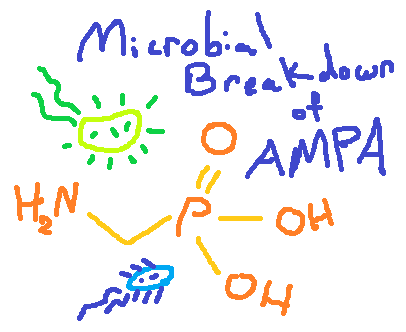
Final Project: Microbial Breakdown of Aminomethylphosphonate in Water
- What would you like to make, and why?
I would like to engineer an organism that can lower the levels of Aminomethylphosphonic acid in water samples.
Glyphosate (Round-Up) is one of the most common pesticides used globally. It is a post-emergence, non-selective herbicide, meaning it affects only plants that have sprouted and are growing above the soil. It works by binding to 5-enolpyruvylshikimate-3-phosphate synthase (EPSPS) and blocking the synthesis of aromatic amino acids, effectively stopping the plant from replicating DNA. (NPIC) This pathway is not present in animals, making the human risk of acute glyphosate toxicity low, though its status as a carcinogen is hotly debated. Additionally, it can have ecotoxic effects on aquatic life despite the absence of the EPSPS pathway. (Aquatic Toxicology 2022)
What is certain is that glyphosate and its main metabolite, AMPA, are relatively persistent in soil and have been found in waterways across the US. (DNR) This contradicts conventional wisdom that glyphosate is immobile in soil and raises the question of how to contain future runoff.
Aminomethylphosphonic acid, or AMPA, is the most common metabolite of glyphosate. In water, microbes will typically break glyphosate down into both AMPA and glyoxylate over the span of 3-90 days. Less well-studied is the environmental fate of AMPA, which has a median half life of 119 days in water. (NPIC) Despite its persistence, AMPA is frequently overlooked as a pollutant despite having the same toxicological and herbicidal effects as glyphosate. (Water Research 2017)
These chemicals regularly escape containment (USGS 2020) and their long term effects on the environment are as of yet unclear. Microbial soil conditioners exist that break down glyphosate into AMPA, but none act on AMPA specifically. I believe a microbial treatment that targets AMPA would be a useful tool in environmental remediation.
- What living system would you use?
This study (Agronomy 2025) found 21 genera and 46 bacterial species related to glyphosate degradation. Bacillus, Pseudomonas, Ochrobactrum are the most common in the AMPA breakdown pathway. I may also look into yeasts and I may use a combination of organisms. The strain I choose will have to be non-pathogenic, which may limit my options.
- How would you use automation?
I’m currently unsure how to incorporate automation, but given my limited time to access the lab, I plan to use it as much as possible. ChiTownBio has access to an Opentrons liquid-handling robot I may use to eliminate human error in the genetic modification process. I may also have access to a GC/MS through City Colleges of Chicago, which will allow me to analyze the water concentration of both glyphosate and AMPA.
- How much would you need to make, and how long would it take to do so?
a) How much?
I’m unsure how many plates of the carrier organism I’ll need to culture and on what media. For the reagents, a 250mg sample of pure AMPA and a small bottle of glyphosate from a farm supply store are within my personal budget.
b) How long?
Enough time to cultivate organism, modify its genes, isolate the organisms that the modifications ‘take’ with, then allow the culture to grow in water, sample the water, and run through GC/MS. In the interest of time I expect to have multiple cultures running at once. Based on the existing research on the breakdown of glyphosate in soil, I hope to have some provable AMPA degradation in water within three months.
- What don’t you know yet?
I’m unsure which carrier organisms are best suited for this purpose. I’m also unsure if I will have access to GC/MS or other AMPA assays beyond what is available at ChiTownBio. Once I identify a carrier organism, I will also need to determine which AMPA breakdown pathway to target and which genes to attempt to implant.