Week 1 HW: Final Proyect Ideas
What you would like to biomanufacture and why?
My motivation stems from a deep personal and professional commitment to women’s health. I believe that gynecology and maternal care are historically underserved areas in science, and my long-term goal as a scientist is to develop accessible technologies for women. I have already taken steps toward this mission by conducting research in breast cancer using AI models, which sparked my passion for early diagnostic tools.
Additionally, I have solid foundational experience in materials science; my undergraduate thesis focused on synthesizing chitosan-based polymeric films loaded with propolis and copper oxide nanoparticles for surgical wound healing.Building upon that expertise, I now want to pivot towards maternal health by biomanufacturing biodegradable breast pads engineered with a biosensor for the early detection of mastitis, designed specifically for breastfeeding mothers . This pad will feature a soft sodium alginate matrix cross-linked with calcium chloride (CaCl₂), a natural and non-toxic polysaccharide framework capable of safely encapsulating a safe biosensor.
This innovation addresses both a critical clinical need and an environmental crisis. Lactational mastitis affects between10% to 33% of breastfeeding women, with 17% of them abandoning breastfeeding due to severe complications like breast abscesses (WHO, 2000). The global breast pads market relies on synthetic consumables that generate tons of plastic waste. By engineering these pads from biodegradable biomaterials, this project will drastically reduce single-use plastic waste while delivering a life-changing diagnostic tool for maternal care.
What living system would you use?
Approach A: Microbial Cell System The first approach utilizes a safe, Biosafety Level 1 (BSL-1) biological chassis, such as Escherichia coli or Bacillus subtilis safe strains. The bacterial genetic circuit will be engineered to trigger a visible chromatic signal in response to increased salinity and high osmolality. Since medical literature demonstrates that breast milk experiences a sharp rise in sodium concentration during early-stage mastitis, we will use this ionic shift as our target biomarker. Consequently, the encapsulated bacteria within the
alginate matrix will act as a real-time visual indicator, undergoing a localized color shift upon direct contact with the affected milk.
Approach B: Cell-Free Protein Synthesis (CFPS) System This approach eliminates the regulatory challenges of using living organisms near postpartum skin. The incorporation of CFPS systems into sodium alginate is strongly supported by recent scientific literature; for instance, Green et al. (2025) noted that the porous alginate architecture actually enhances the performance of CFPS systems by inducing a molecular crowding effect that favors the molecular interactions necessary for transcription and translation. In this system, the osmosensitive machinery and an enzymatic reporter are extracted from the cells and embedded directly into the polymeric matrix alongside a colorimetric substrate.
                 Approach A:microbial system       Approach B:cell-free system
                 -----------------------------     ----------------------------
                 +-------------------------+       +-------------------------+
                 | Genetic circuit design  |       |  Cell extract isolation |
                 | Promoter + chromatic    |       |  Gene expression        |
                 | reporter                |       |  machinery              |
                 +-----------+-------------+       +-----------+-------------+
                             |                                 |
                             v                                 v
                 +-------------------------+       +-------------------------+
                 |    Prepare bio-ink      |       |    Prepare bio-ink      |
                 | Alginate + living       |       | Alginate + extract +    |
                 | bacteria                |       | substrate               |
                 +-----------+-------------+       +-----------+-------------+
                             |                                 |
                             v                                 v
                 +-------------------------+       +-------------------------+
                 | Pour into hemispherical |       | Pour into hemispherical |
                 | mold                    |       | mold                    |
                 +-----------+-------------+       +-----------+-------------+
                             |                                 |
                             v                                 v
                 +-------------------------+       +-------------------------+
                 |  Crosslink with CaCl2   |       |  Crosslink with CaCl2   |
                 +-----------+-------------+       +-----------+-------------+
                             |                                 |
                             v                                 v
                 +-------------------------+       +-------------------------+
                 |   Living bacterial      |       |   Vacuum freeze-drying  |
                 |   patch                 |       +-----------+-------------+
                 |                         |                   |
                 |   >>> Color shift on    |                   v
                 |       high sodium <<<   |       +-------------------------+
                 +-------------------------+       |  Shelf-stable CFPS      |
                                                    |  patch                 |
                                                    |                        |
                                                    |  >>> Color shift on    |
                                                    |      high sodium <<<   |
                                                    +-------------------------+

  --------------------------------------------------------------------------
  Key assumptions (both approaches):
   - Alginate / bio-component ratios: to be tested experimentally
   - Uniform CaCl2 penetration through the full gel thickness
   - Cell viability / machinery reactivation over time
  --------------------------------------------------------------------------
How would you use automation?
Inspired by Jun et al. (2025) and Petzold & Mukhopadhyay (2025), this framework demonstrates how every stage of biosensor manufacturing and operation can be fully automated within a centralized cloud lab. This integrated infrastructure connects robotic systems, automated liquid handling, and centralized data managementto repeat the Design–Build–Test–Learn (DBTL) cycle with minimal manual intervention.
The workflow operates across three main stages:
Phase 0: Formulation Screening: To handle highly viscous biomaterials (such as alginate, collagen, or chitosan) and reduce experimental variability, a Formulatrix Mantis dispenser utilizes microfluidic chips to precise-screen multiple initial formulations.
The DBTL Core (Build & Design): Once formulation variables are locked, a robotic liquid-handling station controls parameters like dispensing volume and flow rate into hemispherical molds.Concurrently, a separate automated station standardizes the CaCl₂ crosslinking step by strictly regulating spraying patterns, distance, and flow conditions.
Adaptable Architecture (Test & Learn): The automated pipeline dynamically shifts between two biological paths before undergoing real-time analytical monitoring:
*Microbial Path: Robotic arms execute genetic assembly and automated E. coli transformation. Cells are then placed in robotic incubators that manage nutrients, temperature, and agitation. Real-time kinetic monitoring is handled via integrated plate readers and on-line flow cytometers measuring optical density and single-cell fluorescence.
*Cell-Free (CFPS) Path: Bypassing cellular viability constraints, a high-throughput pipeline automates cell extraction via centrifugation and high-pressure lysis. After hydrogel deposition, the mixture enters an automated freeze-dryer for vacuum dehydration, yielding room-temperature stable biosensor powders.
Ultimately, active learning closes the loop. Instead of testing all variations, a machine learning model correlates fabrication inputs (alginate concentrations, crosslinking, thickness) with measured outputs (sensitivity and mechanical resistance) to intelligently select the next most informative experiments.
       +-------------------------------------------------------+

       |   PHASE 0: FORMULATION OPTIMIZATION (Screening)       |
       |   * Equipment: Formulatrix Mantis (Microfluidic chips)|
       |   * Action: Initial screening of viscosity variables  |
       |             and alginate proportions.                 |
       +---------------------------+---------------------------+
                                   |
                                   v
+---------------------------------------------------------------------+

|                        CLOUD LAB LOOP                               |
|  [Centralized robotic orchestration, control, and data logging]     |
+---------------------------------------------------------------------+
                                   |
    +------------------------------+------------------------------+

    |                                                             |
    v                                                             v
 [ DESIGN ]                                                    [ BUILD ]
+-----------------------------------+                       +-----------------------------------+

| Biological Preparation            |                       | Deposition and Crosslinking       |
|                                   |                       |                                   |
| --> MICROBIAL PATH:               |                       | * Liquid-Handling Station:        |
|     Robotic arms (genetic         |                       |   Volumetric and flow rate        |
|     assembly) + automated         |                       |   control of the hydrogel mix.    |
|     transformation into E. coli.  | --------------------> |                                   |
|                                   |                       | * Automated CaCl2 Station:        |
| --> CFPS PATH:                    |                       |   Standardized spray (control of  |
|     High-throughput lysis pipeline|                       |   distance, pattern, and flow).   |
|     (automated centrifugation +   |                       |                                   |
|     high-pressure lysis).         |                       |                                   |
+-----------------------------------+                       +-----------------+-----------------+
                                                                              |
                                                                              v
 [ LEARN ]                                                     [ TEST ]
+-----------------------------------+                       +-----------------------------------+

| Active Learning (ML)              |                       | Kinetic Monitoring & Incubation   |
|                                   |                       |                                   |
| * Analyzes: Physical fabrication  |                       | * CFPS Path:                      |
|   parameters vs measured outputs  |                       |   Automated freeze-dryer for      |
|   (sensitivity & resistance).     |                       |   vacuum dehydration.             |
|                                   | <-------------------- |                                   |
| * Action: Narrows down the        |                       | * Microbial Path:                 |
|   experimental space and dictates|                       |   Robotic incubators (thermal,    |
|   the design of the next batch.   |                       |   agitation & nutrient control)   |
|                                   |                       |   + Plate readers & on-line       |
|                                   |                       |   flow cytometry in real time.    |
+-----------------------------------+                       +-----------------------------------+
    |                                                             ^
    +-------------------------------------------------------------+
How much would you need to make, and how long would it take?
To provide an accurate cost estimate, a demographic model was developed using Google AI to project the breastfeeding population and their product consumption in Chihuahua City.
By cross-referencing INEGI census data with the state’s annual births (53,871), it was determined that the municipality accounts for 13,467 annual births (1,122 per month). Applying prevalence rates from the National Health and Nutrition Survey (ENSANUT) — 34.2% for exclusive breastfeeding (under 6 months) and 46% for continued breastfeeding (6 to 12 months) — the model estimates an active population of 5,398 breastfeeding mothers on any given day.
Based on this data, daily nursing pad consumption was projected across two stages: an early high-demand phase (7 units/day per mother) and a regulated stabilization phase (3 units/day per mother). Segmenting the population yields a theoretical need of 20,798 pieces daily. Considering that 80% of urban mothers in Mexico use disposable products, Chihuahua City consumes approximately 16,638 disposable nursing pads per day. Commercially, this translates to a monthly market demand of 500,000 units, or roughly 16,600 standard boxes (60-count presentation).
To create the manufacturing production cost assumptions, I used the following prompt in Claude AI:
The project consists of manufacturing 500,000 biodegradable breast pads for early detection of lactational mastitis. Each pad will use a soft sodium alginate matrix cross-linked with calcium chloride (CaCl₂), shaped in a hemispherical mold, and integrated with either a safe BSL-1 microbial biosensor or a cell-free protein synthesis (CFPS) biosensor capable of producing a visible colorimetric response to changes associated with mastitis. The manufacturing process includes automated preparation and mixing of alginate and biological components, high-precision liquid dispensing using systems such as the Formulatrix Mantis, automated deposition of a consistent volume into hemispherical molds, controlled CaCl₂ spraying for crosslinking, and, for the CFPS version, automated freeze-drying for long-term storage. The production line could integrate robotic liquid handling, automated molding and crosslinking, quality-control imaging, data collection, and active-learning algorithms to optimize formulation and manufacturing parameters while minimizing experimental iterations. The complete workflow could ultimately be integrated into a cloud-lab or automated manufacturing platform. The objective is to estimate the capital equipment, consumables, raw materials, labor, energy, automation, quality control, packaging, and operating costs required to manufacture 500,000 pads at production scale.
Based on this prompt, I analyzed the results obtained, verified the cost information sources, and used my own judgment to determine if the data seemed consistent and aligned with the project.
For the economic scenario considered, production is assumed to be divided equally between the two approaches: 50% of the pads using CFPS and 50% using the microbial system, corresponding to 250,000 units of each type. A 10% production loss/rejection rate is included.
PRODUCTION
--------------------------------------------------------------------
CFPS Production line                    | 250,000 pads
Microbial Production line               | 250,000 pads
Estimated production loss               | 10%

GEOMETRY AND FORMULATION OF THE PAD
--------------------------------------------------------------------
Hemisphere diameter                     | 12 cm
Thickness                               | 0.3 cm
Alginate volume per pad                 | 67.85840132 mL/pad
                                         | Calculation: hemisphere
                                         | diameter (2*pi*r^2 * thickness)
Alginate concentration                  | 2% w/v
Alginate per pad                        | 1.357168026 g/pad
CaCl2 applied per pad                   | 2 mL/pad
CaCl2 concentration                     | 1.5% w/v
CaCl2 per pad                           | 7.5 g/pad

CFPS BIOSENSOR LINE
--------------------------------------------------------------------
CFPS reaction per pad                   | 10 uL/pad (in-house CFPS
                                         | lysate)
                                         | Per Sun et al.: 0.03 USD/uL
                                         | (2017.igem.org/Team:EPFL/
                                         |  Description/Lysates)
Additional inputs (CFPS template DNA    | 0.03 USD/pad
+ cryoprotectant)                       |

MICROBIAL BIOSENSOR LINE
--------------------------------------------------------------------
Culture medium + fermentation supplies  | 0.05 USD/pad

PACKAGING
--------------------------------------------------------------------
Biodegradable/compostable packaging     | 0.01 USD/pad

ENERGY
--------------------------------------------------------------------
Industrial electricity cost             | 0.12 USD/kW (Avg IEC US)
Estimated average electrical demand     | 150 kW

EQUIPMENT INVESTMENT
--------------------------------------------------------------------
Formulatrix Mantis                      | 18,900 USD
                                         | (bimedis.com/a-item/liquid-
                                         |  handling-formulatrix-
                                         |  mantis-2196482)
TECAN Fluent 1080 Liquid Handling       | $32,995.00 USD
                                         | (dotmed.com/listing/liquid-
                                         |  handling/tecan/fluent-1080/
                                         |  5190684)
CFPS Kit PURExpress                     | $2,774.00 USD
                                         | (fishersci.com/shop/products/
                                         |  purexp-in-vitro-prot-syn-
                                         |  100/50591180)
Stainless-steel pilot lab bioreactor    | $15,836.20 USD
                                         | (spanish.alibaba.com/g/
                                         |  stainless-steel-bioreactor-
                                         |  price.html)

MATERIALS, CONSUMABLES AND BIOLOGICAL INPUTS
--------------------------------------------------------------------
Sodium alginate                         | $3,679.60 USD for 500,000
                                         | pads (alibaba.com/product-
                                         |  detail/SHAODI-High-Purity-
                                         |  Sodium-Alginate-Industrial_
                                         |  10000023881418.html)
CaCl2                                   | $632 USD for 500,000 pads
                                         | (alibaba.com/product-detail/
                                         |  Factory-99-Calcium-Chloride-
                                         |  95-Prills_1601894694160.html)
Culture medium                          | $76.44 USD
                                         | (alibaba.com/product-detail/
                                         |  Culture-Media-E-Coli-Broth-
                                         |  Medium_1601488759855.html)
--------------------------------------------------------------------
Estimated total production cost: ~$415,900 USD (~$0.83 USD/pad)
Based on these assumptions, the model estimates a total production cost of approximately $415,900 USD, corresponding to an estimated cost of $0.83 per pad. The half-and-half split is only for calculation purposes — in the initial steps, I would be deciding which of the two systems is best for the project.
It is important to note that this is a preliminary cost estimate, as labor costs have not yet been included. In addition, several manufacturing parameters — such as the final mold design, production layout, quality-control requirements, packaging infrastructure, and other auxiliary equipment — still need to be defined. Therefore, a more detailed quotation based on fewer assumptions and more finalized manufacturing specifications would likely result in a higher total cost. The current estimate should consequently be considered a preliminary reference for evaluating the economic feasibility of producing 500,000 pads at scale.
Organization and timeline (4 stages):
The target is to manufacture 500,000 usable breast pads per month. However, I would not initially divide production equally between the microbial and CFPS systems — the 50/50 distribution used in the cost estimate above was only an economic scenario. In practice, I would first use automated experimentation to determine which biological system should be selected for scale-up; once selected, manufacturing would be based primarily on that system.
The process was divided into four automated stages, detailed below:
+----------------------------------------------------------------+
|  STAGE 1: Automated screening & system selection                |
|  Equipment: Formulatrix Mantis                                  |
|  24 formulations tested (12 microbial + 12 CFPS)                |
|  Duration: ~1-2 weeks                                           |
+----------------------------------+-------------------------------+
                                   |
                                   v
+----------------------------------------------------------------+
|  STAGE 2: Preparation of selected biological system             |
|                                                                  |
|   Microbial path              |  CFPS path                      |
|   Pilot-scale bioreactor      |  Centrifugation + lysis +        |
|   growth & prep               |  separation + prep               |
|   ~24-48 hours                |  ~2-3 days                       |
|                                                                  |
|  (runs in parallel with alginate/equipment prep)                |
+----------------------------------+-------------------------------+
                                   |
                                   v
+----------------------------------------------------------------+
|  STAGE 3: Automated pad fabrication                              |
|  Equipment: TECAN Fluent 1080                                   |
|  100 molds/cycle, 1 cycle every 10 min = 600 pads/hr/station    |
|  8 parallel stations = 4,800 pads/hr                            |
|  Duration: ~5 days continuous operation (500,000 pads)          |
+----------------------------------+-------------------------------+
                                   |
                                   v
+----------------------------------------------------------------+
|  STAGE 4: Automated quality control & packaging                 |
|  - Computer vision: geometry, surface defects, uniformity       |
|  - Automated biological testing: biosensor response check       |
|  - Robotic handling -> biodegradable packaging                  |
+------------------------------------------------------------------+

  ------------------------------------------------------------------
  Overall estimated time: ~7-8 weeks
  (from start of screening to completion of the first 500,000-pad run,
   assuming final formulation already validated)
  ------------------------------------------------------------------
Estimated overall time: approximately 7–8 weeks from the beginning of automated screening to completion of the first 500,000-pad manufacturing run, assuming the final formulation has already been validated and the manufacturing line can operate with the assumed parallel throughput.
What don´t you know yet?
An important possible bottleneck is the stage 1 screening as a decision gate — the biological system must be selected before scaling up, so any delay in the 1–2 week screening phase pushes back the entire 7–8 week timeline.
Biological reliability over time — cell viability for the microbial system, and successful rehydration/reactivation after freeze-drying for the CFPS system — both assumed, not confirmed.
Cost figures were generated via an AI prompt (Claude AI) and reviewed/adjusted with judgment — not direct supplier quotes for every line item.
Bibliogaphy
Li, J., Wu, Y., He, J., & Huang, Y. (2016). A new insight to the effect of calcium concentration on gelation process and physical properties of alginate films. Journal Of Materials Science, 51(12), 5791-5801. https://doi.org/10.1007/s10853-016-9880-0
Mastitis: Causas y manejo. (s. f.). https://www.who.int/es/publications/i/item/WHO_FCH_CAH_00.13
Green, T. P., Talley, J. P., & Bundy, B. C. (2025). Recent Advances in Developing Cell-Free Protein Synthesis Biosensors for Medical Diagnostics and Environmental Monitoring. Biosensors, 15(8), 499. https://doi.org/10.3390/bios15080499
Jun, J., Hong, S., Park, J., Shin, J., & Lee, D. (2025). Automated and Programmable Cell-Free Systems for Scalable Synthetic Biology with a Focus on Biofoundry Integration. Journal Of Microbiology And Biotechnology, 35, e2507019. https://doi.org/10.4014/jmb.2507.07019
Petzold, C. J., & Mukhopadhyay, A. (2025). From bench to biofactory: high-throughput technologies and automated workflows to accelerate biomanufacturing. Current Opinion In Biotechnology, 94, 103320. https://doi.org/10.1016/j.copbio.2025.103320
Week 2 HW: DNA Design
Part 0: Set up in Kernel
Repository: Luisa Olivas HTBAA 2026 Folder: LuisaOlivas-SodiumAlginateAmilCP
Part 1: Define your expression target
The expressed molecule is chromoprotein — a non-fluorescent, non-enzymatic protein that folds into an intensely pigmented structure visible to the naked eye without any added substrate, UV light, or cofactor. Specifically, amilCP, derived from the coral Acropora millepora.
The coding sequence corresponds to iGEM Registry part BBa_K592009 (amilCP), a well-characterized part available in the iGEM Registry of Standard Biological Parts. It will be imported directly from the registry rather than designed de novo, since it is already codon-optimized and validated for expression in E. coli.
The host is E. coli, BSL-1 safe strain, matching the microbial biosensor approach proposed in HW1.
The product needs to go to cytoplasm. amilCP requires no secretion or membrane targeting — its color develops through intracellular folding and oxygen-dependent chromophore maturation, so the signal is visible directly within the bacterial cell body.
Part 2: Design your genetic parts
================================================================

LAYER: Transcription start
--------------------------------------------------------------
Part            | Promoter: ProU (Salt Stress Activated
                 | Promoter ProU)
Sequence/Source  | iGEM Registry part BBa_K220004 (658 bp),
                 | isolated by PCR from wild-type K-12 E. coli
                 | genomic DNA (iGEM09_Wisconsin-Madison, 2009).
                 | Imported directly from the iGEM Parts
                 | Registry / SynBioHub.
Justification    | This promoter is the sensing element of the
                 | entire design. It is natively upregulated by
                 | osmotic/salt stress in E. coli, which
                 | directly matches the target biomarker of
                 | this project: the sharp rise in sodium
                 | concentration in breast milk during
                 | early-stage mastitis. This part has direct
                 | precedent for this use case -- the same
                 | team used it to drive an RFP reporter under
                 | salt stress (BBa_K220006), confirming it
                 | functions as a visible-output osmotic
                 | biosensor.

LAYER: Translation start
--------------------------------------------------------------
Part            | RBS: BBa_B0034
Sequence/Source  | iGEM Registry, standard medium-strength
                 | ribosome binding site.
Justification    | Provides reliable, moderate-strength
                 | translation initiation for the downstream
                 | CDS without imposing excessive metabolic
                 | burden on the cell -- appropriate for a
                 | stable, low-copy reporter system.

LAYER: Coding sequence
--------------------------------------------------------------
Part            | CDS: amilCP
Sequence/Source  | iGEM Registry part BBa_K592009, a
                 | chromoprotein derived from the coral
                 | Acropora millepora.
Justification    | amilCP produces an intensely pigmented,
                 | non-fluorescent protein that is visible
                 | directly to the human eye upon correct
                 | folding -- no substrate, cofactor, or UV
                 | light required. This is essential for the
                 | intended use case: a nursing pad that a
                 | caregiver can read visually without any lab
                 | equipment. It is also the most extensively
                 | characterized and widely used chromoprotein
                 | in the iGEM Registry, giving strong
                 | precedent for reliable expression in E. coli.

LAYER: Targeting
--------------------------------------------------------------
Part            | None (cytoplasmic)
Sequence/Source  | --
Justification    | amilCP requires no secretion or membrane
                 | targeting; its chromophore matures and
                 | produces visible color entirely within the
                 | cytoplasm, so no signal peptide is needed.

LAYER: Transcription stop
--------------------------------------------------------------
Part            | Terminator: BBa_B0015 (double terminator)
Sequence/Source  | iGEM Registry, standard double terminator.
Justification    | Prevents transcriptional read-through into
                 | the vector backbone, ensuring clean and
                 | predictable expression of the reporter
                 | cassette.

LAYER: Vector context
--------------------------------------------------------------
Part            | Backbone: pSB1C3
Sequence/Source  | Standard iGEM BioBrick backbone, reused
                 | rather than designed from scratch.
Justification    | Provides a ColE1 origin of replication for
                 | stable plasmid maintenance in E. coli, and a
                 | chloramphenicol resistance marker (CmR) for
                 | antibiotic selection during construction and
                 | screening.
Part 3: Assemble your construct
Part 4: Optimize and quality-check
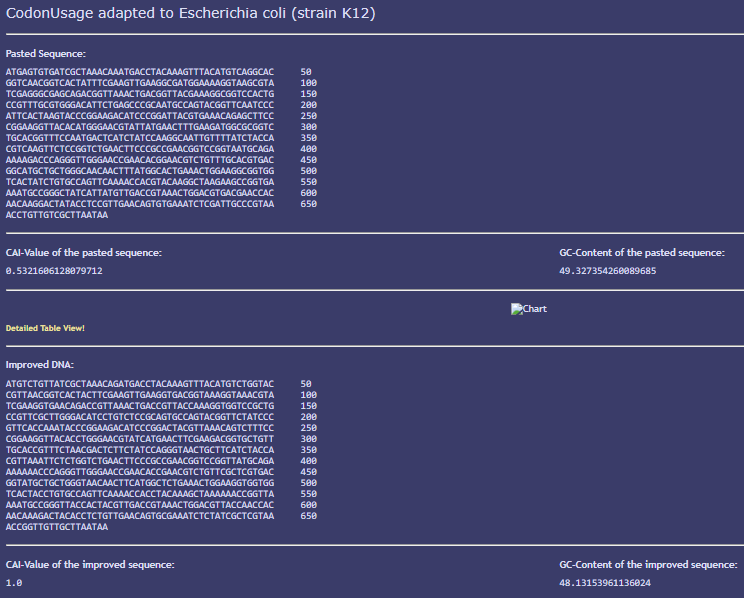
I ran codon optimization on the amilCP CDS using JCat, targeting Escherichia coli (K-12) as the expression host. The Codon Adaptation Index (CAI) improved from 0.53 in the original sequence to a perfect 1.0 after optimization, indicating that codon usage was fully adapted to E. coli’s tRNA abundance profile. GC content remained close to the E. coli genomic average (48.1% optimized vs. 50.7% genomic average, compared to 49.3% in the original sequence), confirming the optimization did not introduce an extreme GC bias that could complicate synthesis. The encoded amino acid sequence remained identical before and after optimization, confirming that only synonymous codon substitutions were made.
This screenshot shows the BLASTX (translated nucleotide-to-protein) search results for the codon-optimized amilCP coding sequence (669 bp query, RID: BPG64YRR016), run against the NCBI ClusteredNR protein database. Unlike the nucleotide-level BLASTN search — which failed to specifically identify the codon-optimized sequence due to synonymous codon substitutions — this translated search correctly identifies the encoded protein. The top-ranked cluster matches GFP-like non-fluorescent chromoprotein [Porites lutea] (XP_073233827.1) with 99% query coverage, 95.02% identity, and an E-value of 4e-157. The second-ranked cluster (NP_001310111.1) represents 89 member sequences from 23 different coral and related organisms, all annotated as the same GFP-like non-fluorescent chromoprotein, with 96.73% identity. These results confirm that, despite the nucleotide-level changes introduced by codon optimization, the CDS still encodes a bona fide member of the amilCP chromoprotein family — verifying that optimization preserved the protein’s identity and function.
Part 5: From design to build
Considering the methods covered in class, my construct can be broken down into two distinct scales of problem—and each calls for a different technique:
- Synthesis of individual fragments → Chip-based gene synthesis
The longest element in my design is the amilCP CDS (669 bp). This exceeds the practical limit of a single oligo synthesized via the phosphoramidite cycle (which operates reliably up to ~150–200 nt, as the coupling error rate accumulates with each cycle, resulting in very low yields for longer oligos). Therefore, the correct approach is not to order the full gene as a single oligo, but to use chip-based gene synthesis: multiple overlapping short oligos (each made via the phosphoramidite cycle) are synthesized in parallel on a chip and then enzymatically assembled via PCR (polymerase cycling assembly) into the full double-stranded fragment. This is the standard method commercial providers (such as Twist or IDT) use to deliver gene fragments in this size range, and it is significantly cheaper than traditional column synthesis for a fragment of this length.
The ProU promoter (658 bp, a natural sequence isolated from E. coli) could be obtained the same way—as a synthetic fragment—or alternatively amplified via PCR directly from E. coli genomic DNA, given that it is a native sequence available in the host organism.
- Assembly of the full construct → Gibson Assembly
Once I have the individual fragments (promoter, the RBS+CDS+terminator as a synthesized cassette, and the linearized pSB1C3 backbone), the most practical way to join them into a single circular plasmid is Gibson Assembly. Fragments are designed with overlapping ends (~20–40 bp of homology between consecutive pieces), and an enzyme mix (exonuclease, polymerase, and ligase) assemblies them in a single isothermal reaction without requiring specific restriction sites. This is preferable over classical restriction-ligation cloning because it avoids being tied to the specific cleavage sites of the BioBrick standard and allows for the multi-fragment assembly of several pieces in a single step.
Part 6: What don't you know yet?
• Will the ProU promoter respond specifically to the sodium range associated with mastitis, rather than general osmotic stress? To find out, I would measure amilCP color intensity (quantified via image analysis) across a gradient of NaCl concentrations encompassing both normal levels and those associated with mastitis in breast milk, confirming that the promoter’s activation threshold falls within the clinically relevant range.
• Will the color signal be visible and sufficiently fast once the bacteria are encapsulated in the alginate hydrogel, compared to free liquid culture? To find out, I would encapsulate the transformed strain in alginate beads or patches and measure the time it takes for the color change to become visible when exposed to simulated high-sodium milk, comparing it against the response time in liquid culture.
• Will the plasmid-based construct remain stable within the hydrogel over the shelf-life of the patch without antibiotic selection pressure? To find out, I would perform a stability assay: store the encapsulated bacteria for varying periods (ranging from days to weeks) and periodically test whether the biosensor response (color change under salt stress) is maintained. This would indicate whether chromosomal integration is required before scaling up production.
Week 3 HW: Cell Free Protocols
Why does the concentration of potassium glutamate and magnesium glutamate differ between compositions? Which is more sensitive?
These components must be readjusted every time other components of the reactions change.
They differ because both ions have to be re-tuned whenever something else in the reaction changes, so there is no single “right” value.
Potassium glutamate (K-Glu) is there to mimic the cation balance of the E. coli cytoplasm. Glutamate is the preferred anion because protein-nucleic acid interactions are more favorable in glutamate than in acetate (Jewett & Swartz). The optimum depends on the formulation:
In Jewett & Swartz, it is 175 mM for PANOx-SP and 130 mM for Cytomim.
In Olsen et al. (Table 1), it ranges from about 80 mM in some published formulations up to 300 mM in their minimal formulation and 362 mM in the optimized one (RFopt).
Magnesium glutamate (Mg-Glu) shifts mainly with the energy system. Jewett & Swartz found the Mg optimum dropped from 20 mM in PANOx-SP (PEP-based) to 8 mM in Cytomim (pyruvate-based). They explain this by PEP’s higher affinity for magnesium compared with pyruvate, and by the fact that Cytomim wasn’t expected to accumulate much phosphate. Counting the 3.3 mM carried over from the extract, Cytomim ends up with 11.3 mM total Mg, less than half of PANOx-SP.
Lysate matters too. Olsen et al. re-optimized magnesium (and phosphate) for every new lysate batch and every new lysate concentration, because the lysate brings its own salts.
The most sensitive is magnessium, table II in Jewett & Swartz shows each ion’s yield as a fraction of the maximum.
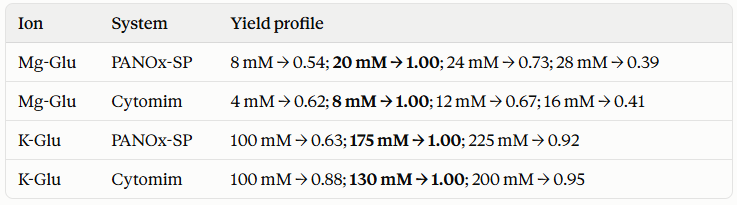
Magnessium drops off sharply on both sides of its optimum, so the useful window is only a few mM wide. Potassium has a broad plateau, and ammonium glutamate barely matters anywhere between 0 and 100 mM. This fits with Mg²⁺ being a cofactor for the ribosome and polymerase and binding to nucleotides and phosphate, so its effective concentration depends on everything else in the mix. (That last point is general background knowledge rather than something the papers spell out.)
Explain how a PEP+NTP reaction formulation is different from a Ribose+NMP reaction formulation.
PEP+NTP (e.g., PANOx-SP) pays for energy and activated nucleotides up front. Ribose+NMP (e.g., RFopt) lets the lysate’s own metabolism build them.
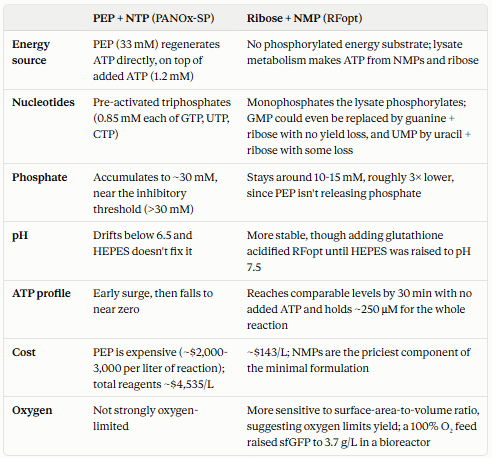 In short, PEP+NTP is expensive and leaves behind phosphate and a falling pH. Ribose+NMP is cheap and more stable, but it relies more heavily on the lysate’s metabolism and on oxygen.
Choose two cell-free reaction compositions from the literature, compare and contrast the choice of reagents and the concentration of reagents.
Compositions chosen
PANOx-SP: Jewett & Swartz (2004), Biotechnol. Bioeng. 86:19-26 (Table I and Methods).
RFopt: Olsen et al. (2026), Nat. Commun. 17:3478 (Table 1 and main text).
These two sit at opposite ends of the field. PANOx-SP is a classic, phosphate-based formulation built to mimic the E. coli cytoplasm. RFopt is a minimal, low-cost formulation found through design of experiments and active learning.
Comparison and contrast
Reagent choices. PANOx-SP pays for energy and activated building blocks directly. PEP regenerates ATP, and the nucleotides are added already as triphosphates. It also includes the full set of cofactors (NAD, CoA, folinic acid) and purified tRNA. RFopt takes the opposite approach: it removes PEP, NAD, CoA and tRNA, supplies nucleotides as cheaper monophosphates, and lets the lysate’s own metabolism build the ATP, using ribose as a substrate.
Concentrations. RFopt runs a much higher potassium glutamate level (362 vs. 175 mM) and more amino acids (5 vs. 2 mM each), and it uses more lysate (30% vs. 24%). Both formulations lean on glutamate salts rather than acetate. PANOx-SP’s magnesium (20 mM) was tuned for a PEP system. Magnesium is the most sensitive ion, so RFopt re-tunes it for every new lysate.
Side effects. In PANOx-SP, PEP breakdown releases about 30 mM phosphate, near the inhibitory range (>30 mM), and the pH drifts down. RFopt keeps phosphate around 10-15 mM and sustains ATP near 250 µM throughout the reaction. The trade-off is that RFopt is more oxygen-sensitive, so reaction geometry matters.
Bottom line. RFopt gives roughly double the yield at about 1/30 of the reagent cost per liter. Most of the savings come from dropping PEP, the triphosphates and the expensive cofactors, which are the most costly parts of the older recipe.
Design note for Reteplase. RFopt is a reducing formulation. Olsen et al. found that adding IAM, GSSG/GSH and DsbC cut sfGFP yield by 75-97%. Using a Δgor lysate and raising the HEPES pH to 7.5 recovered it. That is worth keeping in mind for the oxidizing condition.