Week 3 HW: Cell Free Protocols
Why does the concentration of potassium glutamate and magnesium glutamate differ between compositions? Which is more sensitive?
These components must be readjusted every time other components of the reactions change. They differ because both ions have to be re-tuned whenever something else in the reaction changes, so there is no single “right” value.
Potassium glutamate (K-Glu) is there to mimic the cation balance of the E. coli cytoplasm. Glutamate is the preferred anion because protein-nucleic acid interactions are more favorable in glutamate than in acetate (Jewett & Swartz). The optimum depends on the formulation: In Jewett & Swartz, it is 175 mM for PANOx-SP and 130 mM for Cytomim. In Olsen et al. (Table 1), it ranges from about 80 mM in some published formulations up to 300 mM in their minimal formulation and 362 mM in the optimized one (RFopt).
Magnesium glutamate (Mg-Glu) shifts mainly with the energy system. Jewett & Swartz found the Mg optimum dropped from 20 mM in PANOx-SP (PEP-based) to 8 mM in Cytomim (pyruvate-based). They explain this by PEP’s higher affinity for magnesium compared with pyruvate, and by the fact that Cytomim wasn’t expected to accumulate much phosphate. Counting the 3.3 mM carried over from the extract, Cytomim ends up with 11.3 mM total Mg, less than half of PANOx-SP.
Lysate matters too. Olsen et al. re-optimized magnesium (and phosphate) for every new lysate batch and every new lysate concentration, because the lysate brings its own salts.
The most sensitive is magnessium, table II in Jewett & Swartz shows each ion’s yield as a fraction of the maximum.
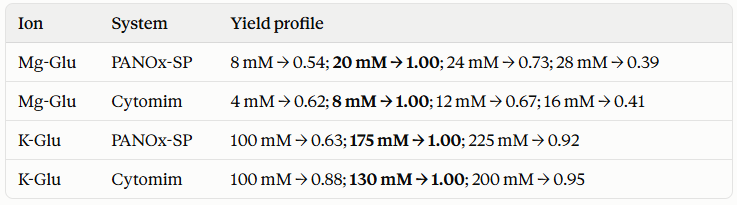
Magnessium drops off sharply on both sides of its optimum, so the useful window is only a few mM wide. Potassium has a broad plateau, and ammonium glutamate barely matters anywhere between 0 and 100 mM. This fits with Mg²⁺ being a cofactor for the ribosome and polymerase and binding to nucleotides and phosphate, so its effective concentration depends on everything else in the mix. (That last point is general background knowledge rather than something the papers spell out.)
Explain how a PEP+NTP reaction formulation is different from a Ribose+NMP reaction formulation.
PEP+NTP (e.g., PANOx-SP) pays for energy and activated nucleotides up front. Ribose+NMP (e.g., RFopt) lets the lysate’s own metabolism build them.
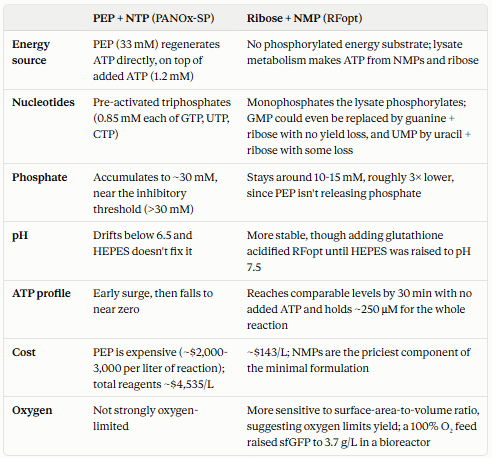 In short, PEP+NTP is expensive and leaves behind phosphate and a falling pH. Ribose+NMP is cheap and more stable, but it relies more heavily on the lysate’s metabolism and on oxygen.
Choose two cell-free reaction compositions from the literature, compare and contrast the choice of reagents and the concentration of reagents.
Compositions chosen PANOx-SP: Jewett & Swartz (2004), Biotechnol. Bioeng. 86:19-26 (Table I and Methods). RFopt: Olsen et al. (2026), Nat. Commun. 17:3478 (Table 1 and main text).
These two sit at opposite ends of the field. PANOx-SP is a classic, phosphate-based formulation built to mimic the E. coli cytoplasm. RFopt is a minimal, low-cost formulation found through design of experiments and active learning.
Comparison and contrast Reagent choices. PANOx-SP pays for energy and activated building blocks directly. PEP regenerates ATP, and the nucleotides are added already as triphosphates. It also includes the full set of cofactors (NAD, CoA, folinic acid) and purified tRNA. RFopt takes the opposite approach: it removes PEP, NAD, CoA and tRNA, supplies nucleotides as cheaper monophosphates, and lets the lysate’s own metabolism build the ATP, using ribose as a substrate.
Concentrations. RFopt runs a much higher potassium glutamate level (362 vs. 175 mM) and more amino acids (5 vs. 2 mM each), and it uses more lysate (30% vs. 24%). Both formulations lean on glutamate salts rather than acetate. PANOx-SP’s magnesium (20 mM) was tuned for a PEP system. Magnesium is the most sensitive ion, so RFopt re-tunes it for every new lysate.
Side effects. In PANOx-SP, PEP breakdown releases about 30 mM phosphate, near the inhibitory range (>30 mM), and the pH drifts down. RFopt keeps phosphate around 10-15 mM and sustains ATP near 250 µM throughout the reaction. The trade-off is that RFopt is more oxygen-sensitive, so reaction geometry matters.
Bottom line. RFopt gives roughly double the yield at about 1/30 of the reagent cost per liter. Most of the savings come from dropping PEP, the triphosphates and the expensive cofactors, which are the most costly parts of the older recipe.
Design note for Reteplase. RFopt is a reducing formulation. Olsen et al. found that adding IAM, GSSG/GSH and DsbC cut sfGFP yield by 75-97%. Using a Δgor lysate and raising the HEPES pH to 7.5 recovered it. That is worth keeping in mind for the oxidizing condition.