Week 4 HW: CFPS reaction design for sfGFP PETASE RETEPLASE
A. DESIGN A BATCH OF CELL-FREE REACTION COMPOSITIONS
sfGFP
First design for sfGFP with Google AI:
{
      "sample_id": "luisa_itzel_olivas_evangelista_2026-10-16_rb41eb_sfGFP",
      "sample_type": "experimental",
      "reagent_list": {
        "amino_acid_mix_17": 1200,
        "amp": 300,
        "base_buffer": 2000,
        "cmp": 200,
        "cysteine": 300,
        "glucose": 150,
        "gmp": 200,
        "hepes_koh": 300,
        "lysate": 5000,
        "magnesium_glutamate": 350,
        "nicotinamide": 500,
        "potassium_glutamate": 3000,
        "ribose": 2000,
        "spermidine": 100,
        "template_sfgfp": 2000,
        "tyrosine": 300,
        "ump": 200,
        "nuclease_free_water": 1900
      },
      "metadata": {
        "ai_model": "Google AI",
        "protein_target": "sfGFP",
        "acknowledgements": "",
        "comments": "Cost-optimized reducing formulation based on the RFopt architecture. It leverages a low-cost metabolic system (Ribose + NMPs combined with Glucose and Nicotinamide) to maximize yield while safely avoiding high-cost pure NTP blocks."
      }
    }

• Batch 1 (Ionic Optimization): • Improvement: Lowered potassium_glutamate from 3000 to 2400 and raised magnesium_glutamate to 400. • Rationale: Too much potassium physically blocks the T7 RNA Polymerase. By balancing the K/Mg ratio, the model should forecast a higher yield than your original 0.245 g/L baseline.

• Batch 2 (Hybrid Energy Kickstart): • Improvement: Introduced a small kickstart of pure, high-quality energy by adding atp (150) and gtp (100). • Rationale: Your NMP metabolic recycling loop is incredibly cheap, but it takes time to ramp up. Giving the ribosomes a bit of premium fuel at second zero triggers immediate translation, boosting yield without blowing up the cost.

• Batch 3 (Aggressive Metabolism): • Improvement: Saturated the NMP pool (AMP, CMP, GMP, UMP) and increased nicotinamide to 600. • Rationale: This forces the model to accelerate the enzymatic recycling pathway via sugars (glucose/ribose) to see if the cell-free system can sustain protein synthesis for a longer duration.

PETase
First design for PETase with Google AI:
{
      "sample_id": "luisa_itzel_olivas_evangelista_2026-10-16_rb41eb_PETase",
      "sample_type": "experimental",
      "reagent_list": {
        "amino_acid_mix_17": 1200,
        "amp": 125,
        "base_buffer": 2000,
        "cmp": 75,
        "cysteine": 300,
        "glucose": 150,
        "gmp": 125,
        "hepes_koh": 350,
        "lysate": 5000,
        "magnesium_glutamate": 200,
        "nicotinamide": 500,
        "potassium_glutamate": 2500,
        "ribose": 2000,
        "template_petase": 2000,
        "tyrosine": 1200,
        "ump": 75,
        "nuclease_free_water": 2200
      },
      "metadata": {
        "ai_model": "Google AI",
        "protein_target": "PETase",
        "acknowledgements": "",
        "comments": "Reaction design focused on the solubility and catalytic activity of TfCut2. Replaced unmeasured free guanine with catalog-approved gmp to prevent collapse risk."
      }
    }

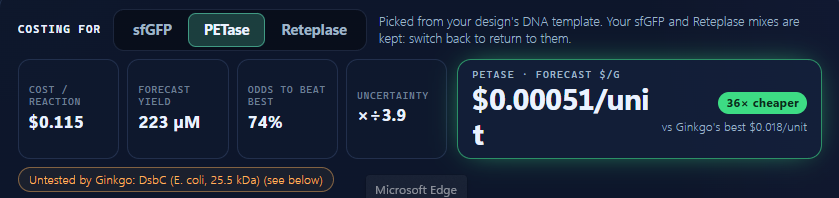
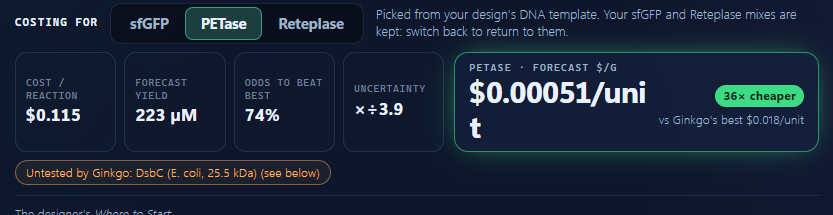
This first design is optimal
• Batch 2 (Amino Acid Optimization): • Improvement: Increased cysteine (400) and slightly lowered potassium (2200). • Rationale: PETase contains 1 disulfide bond. Since DsbC is not being used, increasing the available free cysteine provides extra thiol groups to help the protein find its stable, native conformation naturally in the well.
• Batch 3 (Nucleotide Reserve): • Improvement: Doubled the concentrations of the supporting NMPs (AMP, CMP, GMP, UMP). • Rationale: This prevents the transcription machinery from running out of mRNA building blocks halfway through the reaction, stretching protein accumulation past the initial hours.
Reteplase
First design for Reteplase with Google AI:
{
      "sample_id": "luisa_itzel_olivas_evangelista_2026-10-16_rb41eb_Reteplase",
      "sample_type": "experimental",
      "reagent_list": {
        "amino_acid_mix_17": 1000,
        "atp": 500,
        "base_buffer": 2000,
        "cysteine": 400,
        "hepes_koh": 400,
        "lysate": 5000,
        "magnesium_glutamate": 250,
        "potassium_glutamate": 2200,
        "spermidine": 150,
        "template_reteplase": 2000,
        "tyrosine": 1000,
        "nuclease_free_water": 5100
      },
      "metadata": {
        "ai_model": "Google AI",
        "protein_target": "Reteplase",
        "acknowledgements": "",
        "comments": "Formulation engineered to address Reteplase's 9 disulfide bonds using a DTT-free, IAM-treated lysate infrastructure integrated with high-efficiency energy parameters."
      }
    }
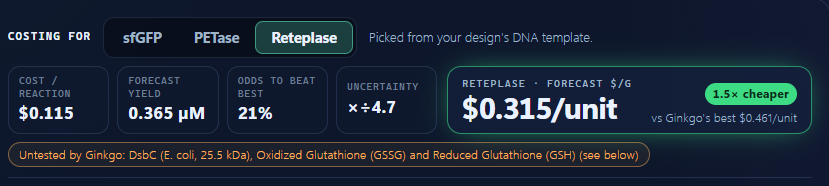
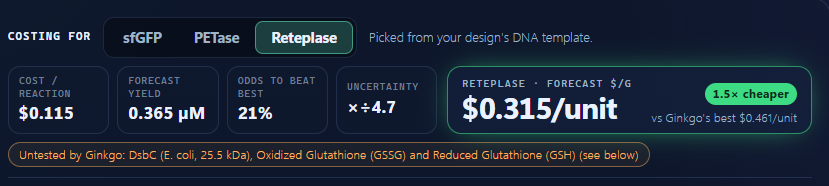
Non viable model, it stripped away the redox and folding factors required for a highly complex protein.
• Batch 1 (Essential Redox Rescue): • Improvement: Restored dsbc (150), gsh (50), and gssg (100) along with direct atp (500). • Rationale: Reteplase has 9 disulfide bonds. The GSSG/GSH pair establishes the essential oxidizing environment for bonds to form, while the DsbC enzyme acts as an isomerase corrector.
• Batch 2 (Power Energy + Max Redox): • Improvement: Raised dsbc to 200, optimized the redox pair to 150/50, and added a heavy energy block with atp (600) and gtp (200). • Rationale: This the most aggressive push for maximum yield. It gives the machinery all the raw energy needed to transcribe and translate a long 399-amino-acid protein while guaranteeing enough chaperones to prevent misfolding and aggregation.
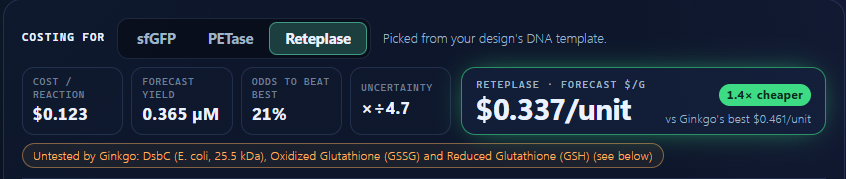
• Batch 3 (Efficient Hybrid Redox):
• Improvement: Combined the oxidizing environment (DsbC and GSSG/GSH) with a cost-efficient low-ATP (200) setup.

Conclusions
Which batch would I keep modifying for each protein to find a winner?
- For sfGFP: Batch 1 (Ionic Optimization)
For sfGFP, Batch 1 is the most promising to keep modifying. Since adding expensive energy (ATP) did not change the computer yield. In the future, I would keep tweaking the Magnesium-to-Potassium ratio. Finding the exact spot for these two salts is the best way to speed up the translation machinery without adding any extra cost.
- For PETase: Batch 2 (Amino Acid Shift)
For PETase, Batch 2 is the best starting point for future changes. The strategy of removing the expensive DsbC chaperone works great, but it puts a lot of stress on the protein to fold by itself. In Batch 2, I added extra Cysteine. For my next step, I would keep experimenting with different combinations of amino acids (like adding more Tyrosine) to see if we can help the protein fold even faster and increase the yield naturally.
- For Reteplase: Batch 3 (Efficient Hybrid)
For Reteplase, Batch 3 is definitely the one to keep modifying. Reteplase is a very complex protein with 9 disulfide bonds. Batch 3 is my smartest design because it combines the necessary folding tools (Redox and Chaperones) with a super-cheap NMP recycling engine. I would keep adjusting the exact balance between GSSG and GSH to find the perfect low-cost environment for complex folding.