Week 2 HW: DNA Design
What molecule are you expressing? A protein, an RNA, or an enzyme (or small set of enzymes) for a pathway. If your HW1 product is a material, food, or chemical, identify the protein(s) that produce it and design for those.
Per homework 1, I want to biomanufacture anti-biofilm phages on a large scale, engineering, testing, evolving, and producing the modified phages on a large scale to identify promising candidates for biofilm mitigation. This would likely involve CRISPR-based editing and/or assembly and rebooting of phages to stitch together modified components. For the purposes of this assignment, I will focus on designing an expression construct that overexpresses the mycobacteriophage SWU’s gp39 protein, which interferes with biofilm formation and increases the permeability of the Mycobacterial cell wall (https://www.nature.com/articles/srep28701). This protein could eventually be useful to engineer into other mycobacteriophages as a means of enhancing their ability to disrupt biofilms / infect in spite of them – but we may also want to test the effectiveness of the overexpressed protein on its own before we attempt phage engineering.
What is the sequence? Give the protein or RNA sequence, or the specific gene, you will encode, and say where it comes from (a database accession such as UniProt or NCBI, a known part, or de novo). Cite it.
DNA sequence for SWU gp39:
Protein sequence for SWU gp39:
From NCBI: https://www.ncbi.nlm.nih.gov/gene/?term=gp39+mycobacteriophage+SWU1
From sequence NC_017973.1 – gene symbol A321_gp39
What host or chassis? The living system from HW1, for example E. coli, S. cerevisiae, CHO or another mammalian line, or a cell-free system. Your host drives almost every part choice that follows.
I will express the protein in Mycobacterium smegmatis.
Where does the product need to go? Cytoplasm, secreted, membrane, or a compartment? This decides whether you need a signal peptide or targeting sequence.
Cytoplasm
Every construct is built from parts. Decide which parts your target needs, then create or import each one in Kernel with the correct part type. At minimum, choose the elements below for your host.
Tx start (Promoter):
- pExTra backbone includes a tetracycline-inducible promoter - pTet
Tx end (Terminator):
- pExTra backbone includes a terminator
Tl start:
- pExTra backbone includes an M. smegmatis RBS
CDS:
- NC_017973.1 gene A321_gp39
Vector context:
- pExTra expression construct for M. smegmatis, obtained through the SEA-GENES manual: https://genesguide.seaphages.org/
Create a new construct in your folder and add your parts in the correct 5’→3’ order for your host (for a basic expression cassette: promoter → RBS or 5’ UTR/Kozak → CDS → terminator, plus any signal peptide or tag, in the vector backbone). Check the assembled sequence: the reading frame is intact, the start and stop codons are where you expect, and there are no accidental internal stops. Look at the construct map Kernel renders and confirm the parts sit in the order and orientation you intended.
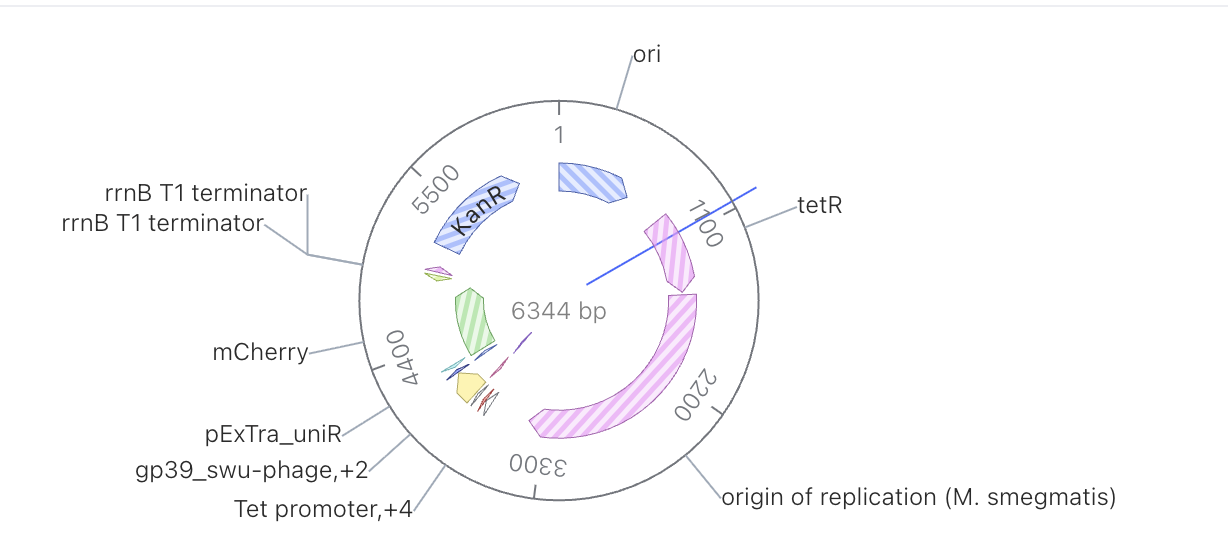
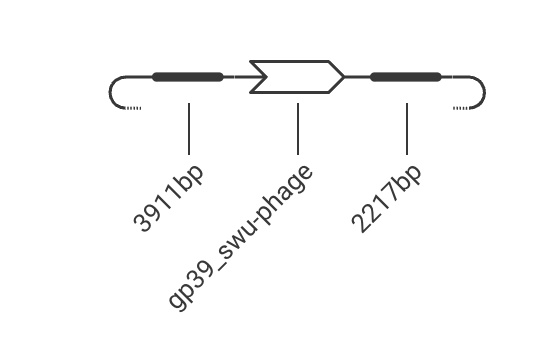
Brief Description: My inducible construct overexpresses gp39, a protein that the SWU mycobacteriophage uses to weaken/inhibit mycobacterial biofilm formation. I’ve selected the pExTra backbone, which the SEA-GENES program recommends for mycobacterial expression constructs.
Codon-optimize your CDS for your chosen host. Compare before and after: what changed, and why does codon usage matter for expression in this organism? Note any constraints you applied (e.g. avoiding certain restriction sites, GC content).
I have access to the IDT tool for codon optimization. IDT does not have an option to optimize for Mycobacterium smegmatis, so I selected M. tuberculosis instead for the purposes of the exercise. (If I were to do this in real life, I would likely leave it as-is and assume that a phage protein from a phage that infects M. smegmatis should be expressable in M. smeg without any special optimization.) The optimized sequence looks relatively similar to the original.
Search your sequence (BLAST / sequence search) against known sequences. Is your CDS what you think it is? Is it identical to a natural gene, or novel? What is the closest match?
I obtained the sequence from NCBI, so its top hit is the phage sequence from which I obtained it.
Run the safety screen on your construct. Summarize what it checks for and what it reports. If it flags something, explain whether it is expected for your design and how you would respond.
Returned “No flagged sequences detected”
How would you build it? Would you order it as synthetic DNA, assemble it from smaller fragments (e.g. Gibson assembly), or build it from a pool of oligos synthesized on a chip? Justify your choice given your construct’s length and complexity.
I would order the pExTra plasmid vector from SEA-GENES, then order the CDS as a gene block and insert it into the vector via either Gibson or Golden Gate Assembly. This approach is standard for assembling simple expression constructs.
What does synthesis constrain? Synthesis has error rates and struggles with certain sequences. Does your design contain anything hard to synthesize? How would error correction or fragment-based assembly change your approach?
Mycobacterial and mycobacteriophage sequences tend to have a high GC content and are harder to sythesize, assemble via Gibson, and sequence. Depending on how long it could take to troubleshoot the Gibson, Golden Gate Assembly might be preferable, as it relies on restriction enzymes – not exonucleases, which are subjected to nucleotide bond strength – to assemble the parts.
Prototype vs. scale. Mirroring HW1: the way you’d build one construct to test your idea may differ from how you’d produce DNA at the scale your product needs. Briefly describe both if they differ.
Above, I’m describing the process I would use to clone SWU gene gp39 – an phage component that intereferes with lipid synthesis and alters the cell wall through this method to prevent biofilm formation.
As in Homework #1, close by naming the edges of your design. Identify the 2–3 biggest unknowns or risks in your construct. For example: Will the promoter give the right expression level? Will the protein fold and be active in this host? Will it be secreted? Is codon optimization enough, or do you need to tune it empirically? For each, state how you would find out: the measurement, experiment, or design variant you would try next. A good answer here shows you know which decisions are still bets.
- The CDS mat be too toxic to express and observe without killing the cells of interest
- The promoter may be too leaky, potentially leading to bacterial cell death