Week 4 HW: Cell-Free Reaction Design 2
Co-designed bulk reaction gradients with Heather Qian (W&M)
Doing reteplase because it’s the hardest to synthesize due to S-S bonds. Therefore, we would want to optimize the redox environment and chaperone concentration to promote its correct synthesis.
Using Heather’s original design (based on Cai et al paper) and modifying key parameters along a gradient (so sending in two different “gradients”):
- DsbC Gradient
- GSSG/GSH Gradient
see below
DsbC: typically 1uM - 15 uM final conc (based on typical reaction concs being in this range)
- Step size: 2 uM
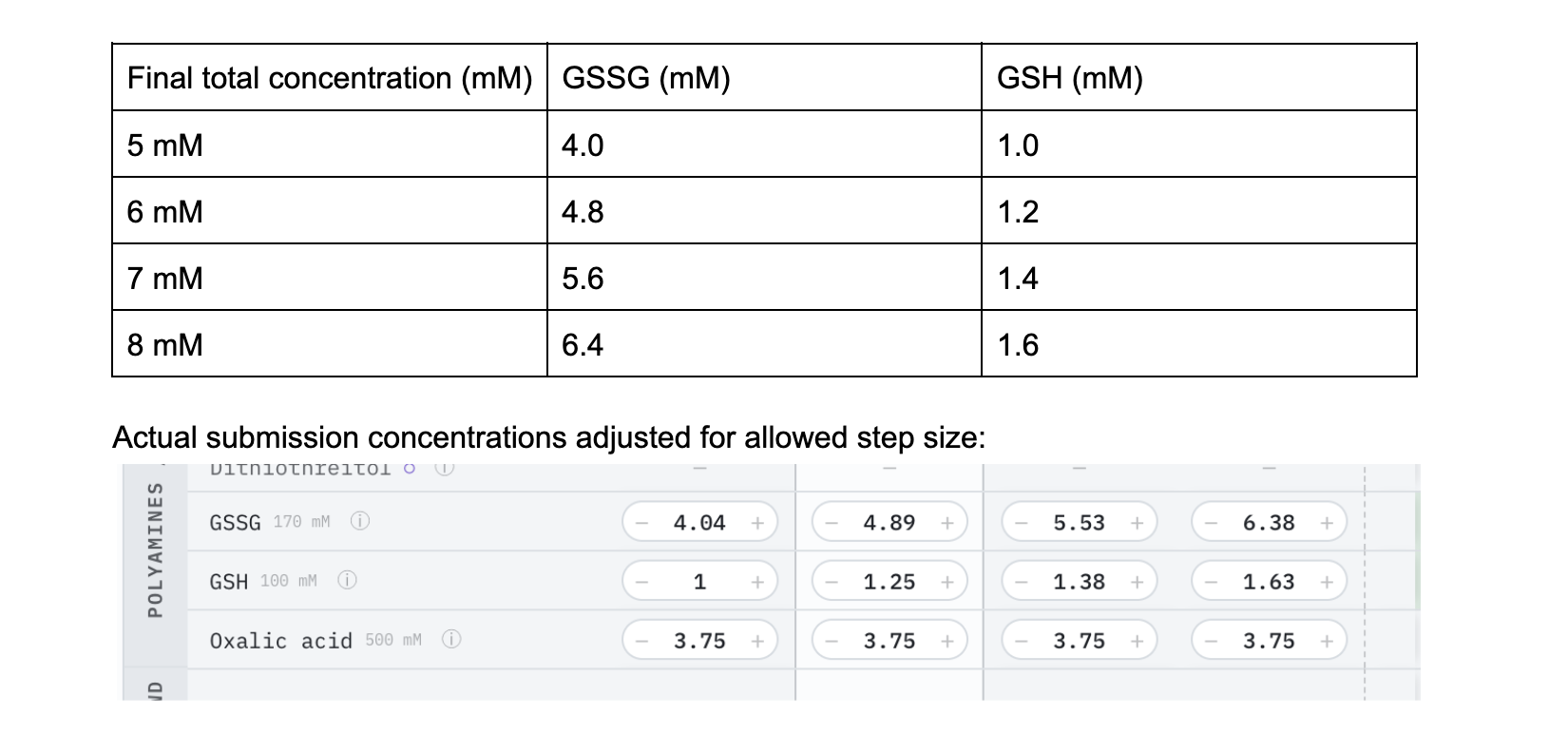
- And we’re now doing 4.04 mM GSSG and 1 mM GSH as a “baseline”
Redox conditions:
- GSSG and GSH both required (dk why Cai et al only uses GSSG) - typically 4:1 GSSG:GSH
- Keep this the same for simplicity
- Final concentrations usually 5-8 mM
- Step size: 1 mM
“ideal/target” concentrations:
- Use 5 uM DsbC as “baseline” because it’s most common in the reference plates and it’s relatively in the middle of the range of common concentrations