Week 1 HW: Final Project Ideas
What I Would Like to Biomanufacture
I propose to biomanufacture a living bioluminescent surface as an art artifact — a material that emits light in response to touch and retains a fading memory of contact patterns over time.
My motivation is artistic and conceptual. My practice centers on the relationship between material behavior and perception — specifically, on systems whose internal logic is real but not immediately recoverable from observation. I am interested in memory as a material property: the idea that a substance can hold a trace of what has touched it, not as data storage but as a physical shift in how it behaves. A bioluminescent surface that responds differently to repeated contact than to first contact — that is brighter, or slower to fade, where a hand has been before — enacts this principle in living matter.
The artifact would take the form of a dark enclosure containing a cultivated dinoflagellate suspension or biofilm. When touched or disturbed, the organisms emit blue-green bioluminescence. In sustained darkness or with long-exposure photography, the cumulative pattern of contact becomes visible — a map of attention, of repeated gesture, of where a hand has been. The material does not reset cleanly. It holds something of what has touched it.
What Living System I Would Use
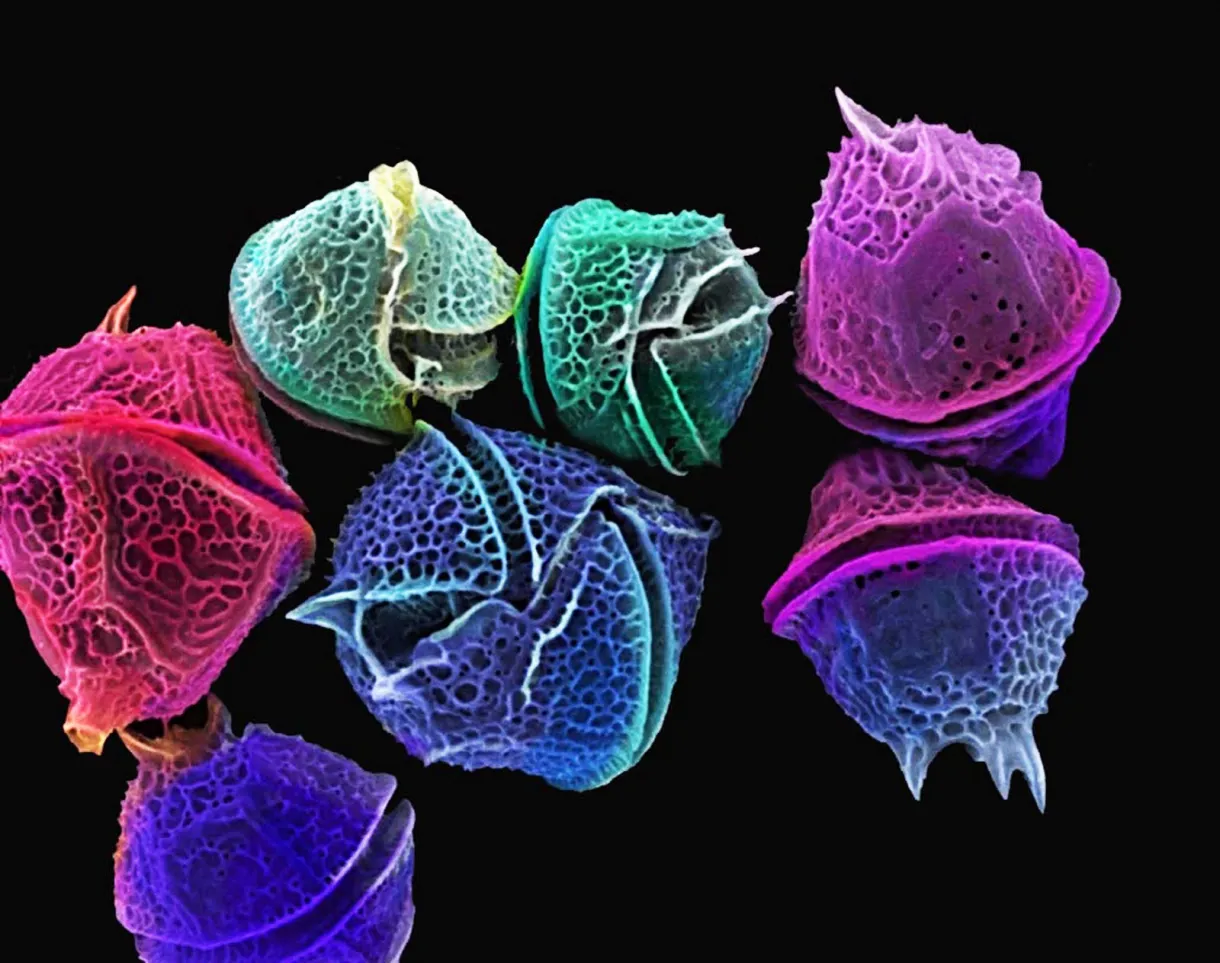
I would use Pyrocystis fusiformis or Noctiluca scintillans, both well-documented bioluminescent dinoflagellates, as the biological chassis. These organisms produce light mechanically — the act of disturbing the cell membrane triggers a calcium-mediated action potential that activates luciferase, producing a flash of blue-green light (peak ~475 nm).
The system inputs: mechanical disturbance (touch, pressure wave, fluid movement). The biological process: mechanosensitive ion channels open → calcium influx → luciferase-luciferin reaction → photon emission. The output: localized bioluminescent flash, duration ~100–500ms per stimulus.
For the memory component, I would explore two approaches: (1) conditioning the culture to produce sustained afterglow through genetic or chemical modification of the recharge cycle, or (2) embedding organisms in a biofilm or hydrogel matrix where physical deformation from contact persists longer than in free suspension, creating a structural memory of touch that correlates with light emission patterns.
Assumption: sustained or patterned bioluminescence can be achieved through matrix embedding or strain selection. This would need experimental validation.
How I Would Use Automation
I would use a desktop liquid-handling robot (e.g., Opentrons OT-2) for culture maintenance, dilution, and transfer — automating the daily feeding, pH monitoring, and passaging required to keep dinoflagellate cultures healthy and consistently bioluminescent.
For the artistic application, I would use programmable microfluidics to control the flow of culture medium across a surface, enabling spatial patterning of organism density. This allows me to design the surface’s luminescent responsiveness — denser regions glow more brightly, creating an intentional material gradient.
At prototype scale, automation handles the biology so I can focus on the spatial and interactive design of the artifact.
How Much and How Long
Scale definition: A single art installation — one panel approximately 60cm × 60cm, 5mm deep, containing a dinoflagellate suspension or biofilm.
Volume estimate:
- Panel volume: 60 × 60 × 0.5 cm = 1,800 cm³ ≈ 1.8L of culture
- Typical dinoflagellate culture density: ~500–1,000 cells/mL
- Required: ~1.8L at working density
Production timeline:
- Pyrocystis fusiformis doubling time: ~3–5 days under 12:12 light/dark cycle
- From 50mL stock to 1.8L: ~3–4 doublings → 12–20 days
- With Opentrons: minimal manual intervention, ~3 weeks total
- At larger scale (10 panels): parallel bioreactors, ~6–8 weeks
What I Don’t Know Yet:
- Sustained memory: Can bioluminescent afterglow be extended beyond ~500ms without genetic modification?
- Biofilm stability: Can dinoflagellates be embedded in a hydrogel while maintaining viability over weeks?
- Spatial control: How uniform is bioluminescent response at the density required for aesthetic legibility?