<Mariana Catalina Pemberthy Mantilla> — HTBAA Fall 2026
About me
Colombian Computer Engineering Graduate with a Computer Science Specialization. I’m a software developer with a foundation in algorithms and problem-solving, and the creator of Mare, a task management app designed to support people with autism spectrum disorder.
Right now I’m exploring the intersection of biology and technology, and that’s why I’m taking this HTGAA 2026 course.
Contact info
Homework, Labs, and Projects
See the nav bar on the left to look through my work for How To
Biomanufacture Almost Anything (Fall 2026)!
Subsections of <Mariana Catalina Pemberthy Mantilla> — HTBAA Fall 2026
Week 1 HW: Final Project Ideas
1) What would you like to biomanufacture and why?
I would like to biomanufacture a new material for menstrual pads where petroleum-derived synthetic superabsorbent polymers (SAPs) and plastic backings are not used; in that way, it would be a zero-waste and biodegradable process using bio-materials. I think it’s important considering the different factors that can affect female health using these menstrual pads and for the environment because these plastic pads take centuries to biodegrade. Additionally, this would be beneficial not only to women but for the whole environment.
2) What living system would you use?
Since I am a beginner, I don’t understand all the concepts very well, so I used a notebook with the class readings to help me answer this question.
Prompt:
“What living system could be used to create a new material for menstrual pads that generates no waste and utilizes biomaterials? Briefly and clearly describe your answer using bullet points.”
AI Response:
To manufacture zero-waste, bio-based materials suitable for products like menstrual pads, two living (or bio-derived) systems highlighted in the sources offer powerful solutions:
1. Halophilic Extremophiles (Halomonas Species)
Biodegradable Polymer Production: Engineered halophiles like Halomonas bluephagenesis naturally accumulate polyhydroxyalkanoates (PHAs)—a family of 100% biodegradable and biocompatible biopolyesters that can be processed into soft absorbent fibers and waterproof backing films.
Unsterilized, Low-Energy Fermentation: Because these extreme microbes thrive in high salt (30–80 g/L NaCl) and high pH (8–10) environments that kill wild contaminants, they can be grown in open, continuous bioreactors using seawater or wastewater without energy-intensive steam sterilization.
Wastewaterless Self-Flocculation: Through morphology engineering (such as altering the cell-division gene ftsZ or cell-surface charge), the microbes elongate or clump together (self-flocculate), allowing them to settle by gravity for easy harvesting without high-energy centrifuges.
Sustainable Waste Feedstocks: They can be cultivated using upcycled waste carbon sources—such as agricultural biomass, industrial starch, or kitchen waste—eliminating reliance on petroleum.
2. Cell-Free Metabolic Engineering (CFME) / In Vitro Systems
Enzymatic Biomaterial Synthesis: Instead of intact living cells, CFME uses crude cell extracts or harvested enzyme cascades to directly synthesize PHA bioplastics and biopolymers.
Near 100% Carbon Yield: Operating outside living cell survival constraints prevents carbon loss to cell growth or unwanted side-products, maximizing yield while generating virtually no biological waste.
Direct Conversion of Crude Waste: Cell-free enzymes can tolerate toxic components present in recycled biomass hydrolysates that would otherwise kill living microbes.
3) How would you use automation?
Prompt:
“For the two living systems, what types of automation would be best, and at what stage of the process would they be used? Create a comparison table with a maximum of four options for the two living systems. It must include three columns: Living System, Automation, and Process Stage”
AI Response:
Automation Comparison Table
Living System
Automation
Process Stage
Halophilic Extremophiles (Halomonas spp.)
Robotic Liquid Handlers & Electrotransformation: High-throughput robotic workstations used for clone library construction, plasmid transformation, and multi-gene CRISPR editing.
Design & Strain Building
Halophilic Extremophiles (Halomonas spp.)
Sensor-Driven Bioreactors & Automated Settling: Continuous unsterilized bioreactors equipped with automated pH/salinity feedback sensors and gravity-driven self-flocculation controls for harvest.
Cultivation & Downstream Harvest
Cell-Free Systems (CFME)
Acoustic Droplet Dispensers: Tipless acoustic dispensers used for precise, low-volume enzyme titration, cofactor mixing, and rapid metabolic pathway assembly.
Reaction Assembly & Prototyping
Cell-Free Systems (CFME)
Microfluidics & Mass Spectrometry: Droplet microfluidic chips and acoustic ejection mass spectrometry for real-time kinetic monitoring and rapid metabolite screening.
Testing & High-Throughput Analytics
4) How much would you need to make, and how long would it take?
Considering that this is a new material for menstrual pads, I researched how much material is currently needed to approximate the requirements for these circumstances. My initial assumption is based on a batch of 500 menstrual pads, so the required materials and production time would be as follows:
Prompt:
“Considering the current manufacturing process for sanitary pads (in terms of quantity and time), what would be required to produce 500 pads using the new material concept, while accounting for the automation proposed for the “living systems” in the comparison table?”
Raw Biopolymer Required: 1.0 to 2.5 kg of purified polyhydroxyalkanoate (PHA) biopolymer or microbial cellulose (~2 to 5 grams per pad for the waterproof backing film, absorbent core, and top sheet).
Calculation:
Halophilic Extremophile System (Halomonas spp.):
Polymer Yield: 60 to 80 grams of PHA per Liter of fermentation broth.
Calculation:
Bioreactor Capacity: A 25 to 50 Liter batch bioreactor (accounting for ~80–90% extraction recovery efficiency).
Material Inputs: 30–80 g/L NaCl in unsterilized seawater or wastewater combined with upcycled carbon waste feedstocks.
Cell-Free System (CFME):
Reaction Vessel Volume: A 15 to 30 Literin vitro reaction vessel (operating with near 100% theoretical carbon efficiency).
Automation Titration: Nanoliter- to microliter-scale automated liquid dispensing for enzyme, cofactor, and extract assembly.
4.2) How long?
Traditional Manufacturing Baseline: High-speed mechanical lines produce 500 to 1,500 pads per minute (20 to 60 seconds for 500 pads once materials are loaded).
Biological Synthesis Phase (Main Bottleneck):
Halophilic Extremophile Fermentation: 24 to 48 hours of cultivation to grow the bacteria and accumulate the 1.0–2.5 kg of PHA biopolymer.
Cell-Free Metabolic Synthesis (CFME): 6 to 12 hours of in vitro reaction time.
Downstream Processing & Final Assembly:
Biopolymer Extrusion: 2 to 4 hours to process and spin the polymer into nonwoven absorbent fibers and flexible backing sheets.
Automated Converting & Cutting: Under 2 minutes to layer, die-cut, and package the 500 finished pads.
5) What don’t you know yet?
I don’t know how to produce a new biomaterial or all the principles and fundamentals required to make this work.
I don’t know how I can experiment with this as a committed listener looking to work with a lab that permits online participation.
I don’t know whether Living System 1 or Living System 2 is more feasible to actually produce.
I don’t understand the full manufacturing process very well, so I don’t know how to apply the different automation options to each system.
I don’t understand very much at the moment, but I’m committed to learning everything necessary and beyond to make this work. Also, I am willingly open to the guidance, feedback, and criticism of the professors, TAs, and nodes.
Week 2 HW: DNA Design
Part 0: Set Up in Kernel
Repository & Folder Location: My project repository and folder in the HTBAA 2026 Workspace is located at: HTBAA26_WilliamandMary / Mariana Catalina Pemberthy Mantilla.
Part 1: Define Your Expression Target
What molecule are you expressing? I am expressing a set of three metabolic enzymes (PhaA, PhaB and PhaC) that form the core biosynthetic pathway to manufacture polyhydroxyalkanoate (PHA) bioplastic for absorbent fibers and waterproof backing films in zero-waste menstrual pads.
What host or chassis?Escherichia coli BL21(DE3). In Cell-Free Metabolic Engineering (CFME), this host chassis is grown in cultures to overexpress the target pathway enzymes; then, cells are lysed to harvest an active enzyme extract for in vitro biomanufacturing.
Where does the product need to go?In Vitro Reaction Solution (Cytoplasmic Extract). The target enzymes accumulate inside the host cell cytoplasm during extract preparation and operate freely in the open cell-free reaction vessel. No secretion signal tag or membrane-targeting sequence is required.
Part 2: Design Your Genetic Parts
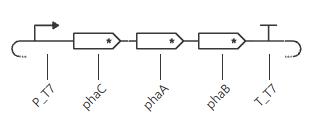
Every genetic construct requires specific control elements assembled around the coding sequences. Below is the parts table corresponding to the five individual parts created in Kernel for high-level expression in E. coli BL21(DE3):
Part Name
Layer / Part Type
Sequence Source / Origin
Justification
P_T7
Promoter (Start Switch)
Bacteriophage T7 promoter (TAATACGACTCACTATAGGG)
A strong promoter recognized specifically by T7 RNA Polymerase in E. coli BL21(DE3) to drive high-level mRNA transcription.
phaC
Coding Sequence (CDS (+start +stop))
UniProt P23608 (C. necator)
DNA coding sequence for PHA Synthase, which polymerizes monomers into solid bioplastic.
phaA
Coding Sequence (CDS (+start +stop))
UniProt P14611 (C. necator)
DNA coding sequence for 3-ketothiolase, which condenses initial acetyl-CoA building blocks.
phaB
Coding Sequence (CDS (+start +stop))
UniProt P14697 (C. necator)
DNA coding sequence for acetoacetyl-CoA reductase, which charges monomers with NADPH energy.
T_T7
Terminator (Stop Switch)
Bacteriophage T7 terminator
A transcription “STOP” signal that halts mRNA transcription cleanly at the end of the operon.
Part 3: Assemble Your Construct
1. Polycistronic Construct Architecture (5’ → 3')
Inside Kernel, the five modular parts were assembled in linear 5’ → 3’ order within the pET-28a(+) construct:
[P_T7] - [phaC] - [phaA] [phaB] - [T_T7]
Part 4: Optimize and quality-check
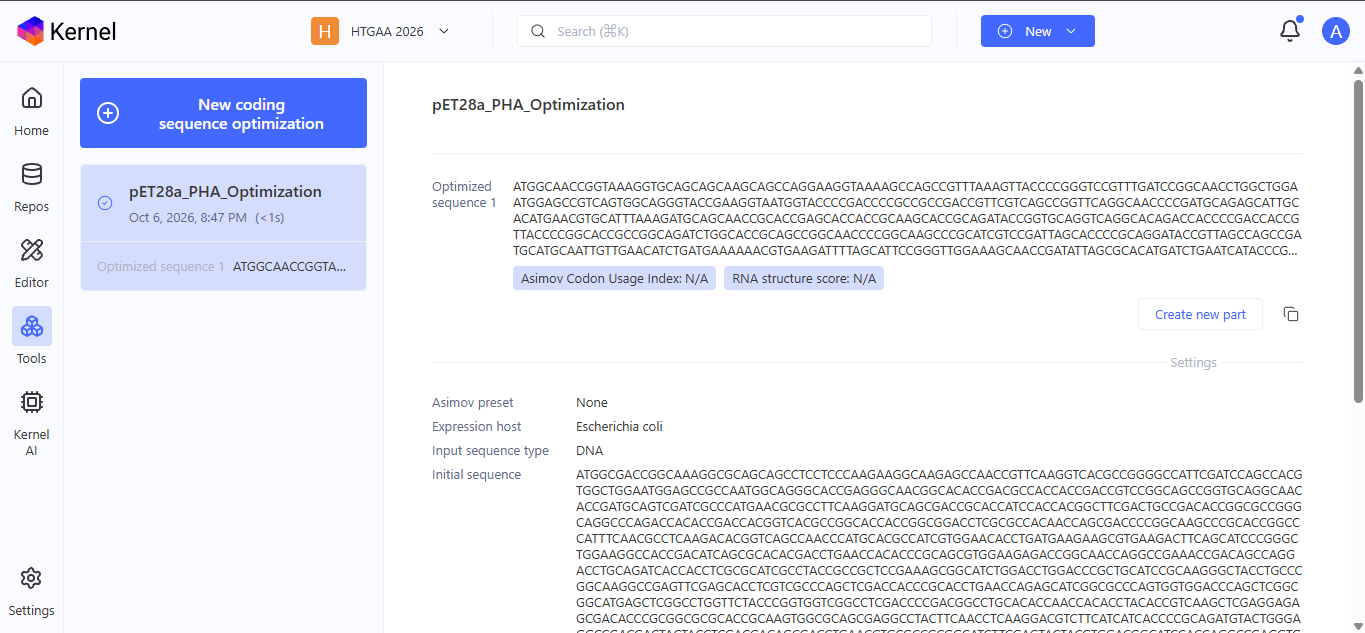
1. Codon Optimization
I used the coding sequence optimization tool in Kernel to optimize the DNA sequence for the phaC that result in:
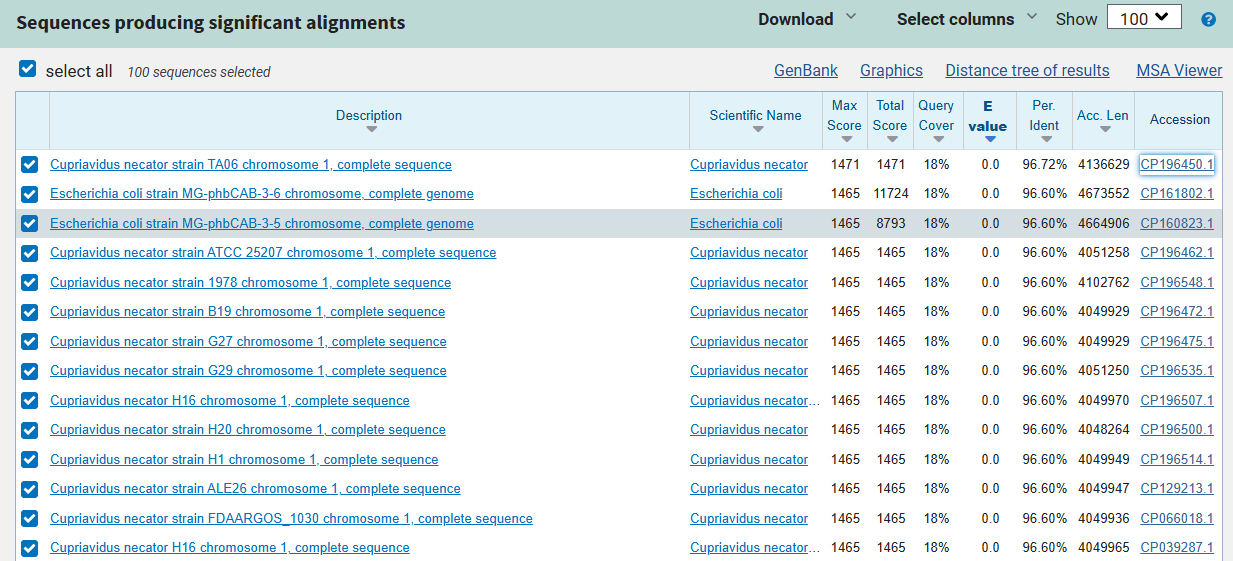
2. BLAST SEARCH
I searched my sequence and the result was identical to known sequences since I used known genes:
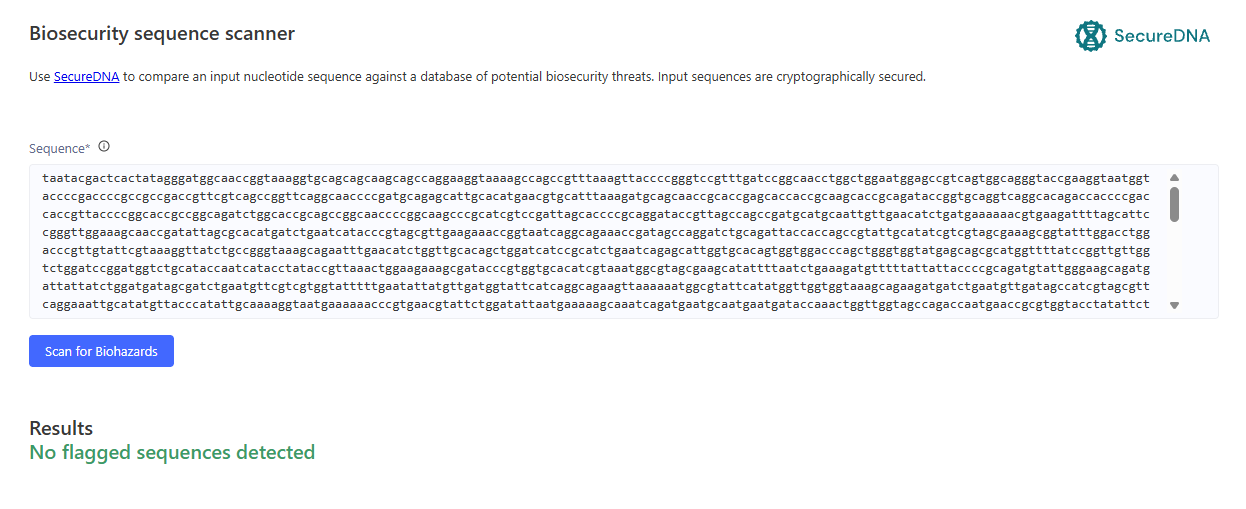
3. Safety screen
Note: I used the same Gemini LLM notebook for the first homework assignment, along with the additional readings, to get better responses. I used it to comprehend and assemble every part, little by little.