I’m a Costa Rican student pursuing a Bsc in Engineering in Industrial Bioprocesses at Universidad Nacional de Costa Rica.
I have given myself a chance to develop skills in different areas within STEM to support my academic endeavours. I have certifications in Good Clinical Practices, Business Analytics and Big Data, AI and STEM applications, Automation and Quality Testing, Web Development and Project Management. My career has allowed me to use tools such as R Studio, Python and Polymath.
I have 10 years of working experience in fields such as customer service, project management and human resources. In the last 6 years I have worked as Analytics Specialist and Systems Administrator and I am eager to transfer those skills to my academic background.
Additionally I have worked with several NGOs in topics such as Climate Change and Climate Justice, Mental Health and Ballet Education in vulnerable communities.
I am open to collaboration opportunities in the case that you find my profile fitting for you projects.
See the nav bar on the left to look through my work for How To
Biomanufacture Almost Anything (Fall 2026)!
Subsections of Mariana Palazuelos Prado — HTBAA Fall 2026
Week 1 HW: Final Project Ideas
(1) What would you like to biomanufacture and why?
I would like to produce second-generation biobutanol from de-oiled citrus waste sourced from CENADA (National Centre for Food Supply and Distribution). This biofuel will be produced via ABE (Acetone-Butanol-Ethanol) fermentation, supported by automated systems. This project aims to generate alternatives to fossil fuels given current geopolitical disruptions in oil distribution, while supporting Costa Rica’s goals under the National Decarbonization Plan.
(2) What living system would you use?
Solventogenic anaerobic bacteria from the genus Clostridium. Alternatively, non-model organisms or genetically modified strains could be evaluated.The process involves the following steps:
Hydrolysis: Breakdown of the citrus substrate to release fermentable sugars and pectin-derived galacturonic acid.Anaerobic Fermentation (Two Phases):
Acidogenesis: Converts input sugars into organic acids (acetic and butyric acids).
Solventogenesis: Reassimilates these acids—counteracting environmental pH drop—and converts them into neutral solvents (acetone, ethanol, and biobutanol).
Product Recovery: Generation of refined biobutanol, coproducts (acetone and ethanol), and biogas (CO2 and H2).
(3) How would you use automation?
Automation for Research: High-throughput microdroplet screening to test strain tolerance to residual d-limonene (ensuring concentrations remain below critical limits) and high butanol concentrations. Automation ensures rapid prototyping, reducing time and capital investment in the initial R&D phase.
Automation for Test Production: Automated pipetting and media preparation using platforms like Opentrons and Cloud Labs. This allows optimization of hydrolysis ratios and nitrogen supplementation. Furthermore, growth kinetics and solvent production can be monitored in real time across multiple parallel micro-reactors.
(4) How much would you need to make, and how long would it take?
(a) Production Quantity:CENADA generates an average of 10,000 kg/day of waste. At ~20% dry matter, this yields approximately 2,000 kg/day of dry substrate. Assuming 50% of this substrate converts to fermentable sugars via hydrolysis, and applying a 30% theoretical yield for ABE fermentation (60% of which is butanol), estimated potential yield is 180 kg of biobutanol per day.
(b) Timeline:
Prototyping: Evaluating 96 to 384 parallel hydrolysis and fermentation conditions takes 24–48 hours post-plate preparation, based on standard bacterial growth kinetics.Batch Fermentation: Each ABE batch requires 60–72 hours due to sequential acidogenic and solventogenic phases.Continuous Operation: Because butanol concentrations above 1.5% inhibit Clostridium, an in-situ continuous extraction system (gas stripping or pervaporation) will be used. This will allow the reactor to run in extended 5 to 7-day operational cycles based on demand.
(5) What don’t you know yet?
The three primary technical bottlenecks and assumptions in this biomanufacturing system are:
Tolerance to Residual Inhibitors: Although d-limonene can be reduced to 0.05%, experimental testing is still required to determine strain sensitivity to residual flavonoids and freed galacturonic acid.
Carbon Catabolite Repression (CCR): Determining whether the selected strain can simultaneously metabolize glucose, fructose, xylose, and galacturonic acid without glucose suppressing the uptake of other sugars.Energy Costs of Continuous Separation: Evaluating the economic viability and energy consumption of in-situ separation systems (pervaporation/gas stripping) scaled to production volumes.
Citation Statement
AI Client Used: Gemini
Prompt:“Can you ensure the following text follows a correct grammatical structure, there are no typos and correctly explains the process with a clear and concise language considering this text has been manually translated: [Insert raw text]
Sources
Aditiya, H. B., Mahlia, T. M. I., Chong, W. T., Nur, H., & Sebayang, A. H. (2016). Second generation bioethanol production: A critical review. Renewable and Sustainable Energy Reviews, 66, 631–653. https://doi.org/10.1016/j.rser.2016.07.015
Bayona, M. (2021). Pretratamientos físico-químicos de residuos agrícolas para la obtención de biocombustibles [Master’s thesis, Universidad de Zaragoza].Boluda Aguilar, M. (2013). Producción de bioetanol mediante fermentación de subproductos cítricos pretratados con steam explosion [Doctoral dissertation, Universidad Politécnica de Cartagena].
Wang, N., Chen, X., Li, B., Shi, J., & Li, X. (2021). Process optimization of acetone-butanol-ethanol fermentation integrated with pervaporation for enhanced butanol production. Biochemical Engineering Journal, 173, 108070. https://doi.org/10.1016/j.bej.2021.108070
Lizano Orozco, K. (2026). Valorización de residuos cítricos del CENADA mediante extracción de aceites esenciales como pretratamiento integrado para la producción de bioetanol: análisis de prefactibilidad bajo condiciones de Costa Rica [Project in development, Universidad Nacional de Costa Rica (UNA)].
● What molecule are you expressing?
A multi-subunit Resistance-Nodulation-Division (RND) family organic solvent efflux pump complex (specifically the TtgABC tripartite efflux system) alongside its transcriptional repressor TtgR. This complex extrudes monoterpenes (residual D-limonene <0.05%) and accumulating short-chain alcohols (biobutanol) directly out of the cell envelope.
● What is the sequence?
TtgABC Operon: Derived from Pseudomonas putida DOT-T1E (GenBank Accession: AF295799; UniProt: Q9RBP9 for TtgA, Q9RBP8 for TtgB, Q9RBP7 for TtgC)
● What host or chassis?
Clostridium acetobutylicum ATCC 824 (solventogenic Gram-positive anaerobic bacterium), with E. coli DH5α used as the intermediate cloning host
● Where does the product need to go?
The cell envelope and cell membrane. TtgB inserts into the inner cell membrane, TtgC spans the outer cell envelope, and TtgA functions as the membrane fusion protein linking the trans-envelope channel.
Part 2: Design your genetic parts
Layer
Part Type and Short Name
Source/ Sequence Origin
Justification for Host & Product
Transcription Control
Inducible Promoter (P_ttgR-hybrid)
P. putida DOT-T1E
Contains TtgR repressor operator sites (O_ttgR), allowing dynamic promoter activation only when D-limonene (>0.01%) or biobutanol (>0.5% w/v) is detected
Repressor
Transcriptional Repressor (TtgR_CDS)
P. putida DOT-T1E (Q9RBP6)
-Binds O_ttgR to keep expression OFF during initial exponential growth, preventing unnecessary metabolic/energetic burden
Translation Start
Tuned RBS Library (RBS_TtgA, RBS_TtgB, RBS_TtgC
Synthetic (Kernel RBS Calculator)
Thermodynamic RBS sequences tuned for Clostridium 16S rRNA to maintain the stoichiometric 1:1:1 subunit ratio needed for functional tripartite pump assembly
Recoded to match the extreme A+T bias (~70%) of Clostridium acetobutylicum, eliminating rare codon translation bottlenecks
Targeting / Signal
N-terminal Signal Peptides (SP_Sec)
Native Clostridium Sec signal peptide
Directs the nascent polypeptide chains to the Sec translocon for proper insertion into the inner membrane and cell envelope
Transcription Stop
Double Terminator (T_L3S2P21)
Synthetic bacterial terminator
Provides >98% efficiency termination to prevent transcriptional read-through into plasmid backbone elements
Vector Context
Vector Backbone (pIMP13-pCB102)
E. coli–Clostridium shuttle plasmid
Contains colE1 ori for E. coli propagation, pCB102/pE194 ori for Gram-positive replication, and ermB (erythromycin resistance)
Part 3: Assemble your construct
Exported Schematic Description:
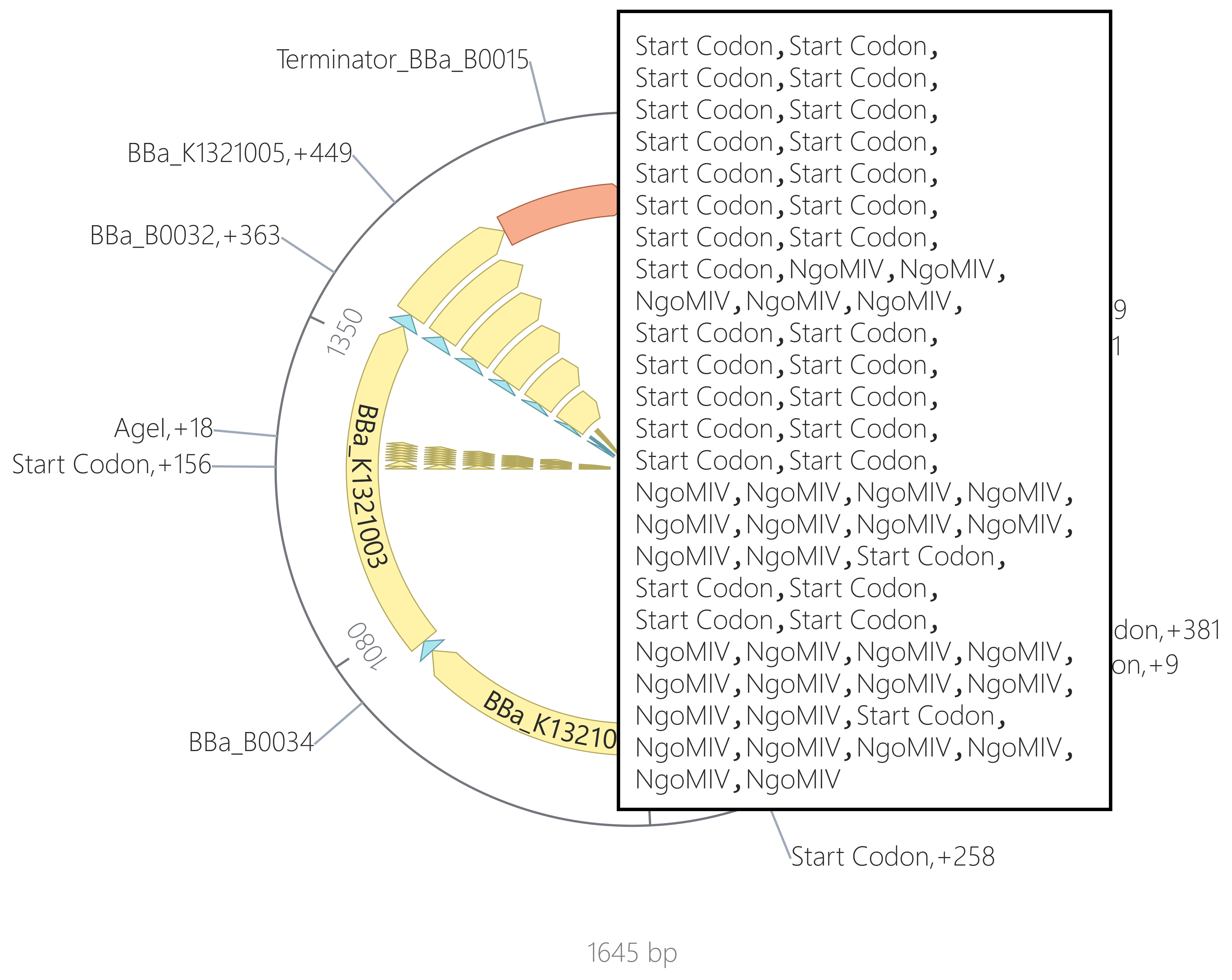
The Kernel construct map displays a single polycistronic operon driven by P_ttgR-hybrid, where a single transcript encodes the periplasmic adapter (TtgA), inner membrane pump (TtgB), and outer envelope channel (TtgC) sequentially before terminating at T_L3S2P21
Part 4: Optimize and quality-check
Codon optimization: Recoded the native P. putida CDS from ~61% G+C down to ~31% G+C to match Clostridium acetobutylicum codon usage
Why: High-level expression of heterologous G+C-rich genes in Clostridium stalls translation due to depletion of rare tRNAs. Internal restriction sites (BsaI, BsmBI) were eliminated during recoding.
Sequence Search (BLAST): Nucleotide BLAST confirmed 100% amino acid sequence alignment to P. putida TtgABC proteins with ~75% nucleotide identity due to host-specific codon adaptation.
Safety Screen: Endogenous RND efflux pumps are benign bacterial transport mechanisms and pose no biosecurity hazards
Part 5: From design to build
How would you build it?
The construct will be built via Golden Gate Assembly (BsaI Type IIS restriction enzymes) using standardized gBlock fragments[14][15]. Standardizing the operon into 4-bp overhang sub-fragments allows one-pot enzymatic assembly into the pIMP13 backbone
What does synthesis constrain?
High A+T content (~70%) and repetitive transmembrane regions tend to produce synthesis errors or homopolymer slippage. To mitigate this, error correction protocols using protein-mediated MutS (Carr et al., 2004) will be applied, and the operon will be divided into smaller <1.5 kb synthetic fragments before assembly
Prototype vs. Scale
Prototype: Synthesize chip-based oligo pools (Tian et al., 2004; Kosuri et al., 2010; Kong et al., 2007) and assemble variants in 96/384-well plates using an Opentrons robot for high-throughput microdroplet tolerance screening
Scale: Chromosomally integrate the optimized efflux operon into C. acetobutylicum via CRISPR-Cas9 or Allele-Coupled Exchange (ACE) to avoid plasmid loss during 50,000 L industrial fermentations without needing antibiotic selection
Part 6: What don’t you know yet?
● Proton Motive Force (PMF) Depletion and Energetic Burden:
Risk: RND efflux pumps consume the cell’s transmembrane proton gradient. Overexpression might starve Clostridium of ATP, reducing biobutanol synthesis yield
Testing Plan: Measure intracellular ATP/ADP ratios and membrane potential during ABE fermentation under different promoter induction levels
● Tripartite Envelope Assembly in Gram-Positive Cell Walls
Risk: TtgC natively spans Gram-negative outer membranes; assembly across the thick peptidoglycan cell wall of Gram-positive Clostridium may be inefficient
Testing Plan: Perform cell-fractionation and Western blotting to verify membrane localization of TtgA, TtgB, and TtgC
● Inhibitor Synergy in Real CENADA Hydrolysate
Risk: De-oiled citrus bagazo contains complex mixtures of residual D-limonene (<0.05%), galacturonic acid, and flavonoids (hesperidin/naringin)
Testing Plan: Run microplate growth assays across serial dilutions of actual CENADA hydrolysates using MIT Cloud Lab automated kinetic reader plates
Part 7: AI Citation Statement
AI Client used: Gemini Notebook (HTBAA 2026 Workbench)
AI Prompt: Elaborate a full work plan to work on Kernel Asimov to develop D-Limonene and Solvent Efflux Pumps
AI Prompt: Based on the outline for the project found in the file named Homework Workbook.docx, please complete the questions asked in the file on HTBAA Homework #2_DNA Design.docx based on the Work Plan: In Silico Design of Solvent Efflux Circuits in Kernel by Asimov."
Annexes
Workplan for Asimov-Kernel repo
PHASE
Description
PHASE 1: Parts Curation & Chassis-Specific Codon Optimization
A. COMPARE CELL-FREE REACTION COMPOSITIONS (20 minutes)
Why does the concentration of potassium glutamate and magnesium glutamate differ between compositions? Which is more sensitive?
Explain how a PEP+NTP reaction formulation is different from a Ribose+NMP reaction formulation.
Choose two cell-free reaction compositions from the literature, compare and contrast the choice of reagents and the concentration of reagents.
B. DESIGN ONE REACTION COMPOSITION FOR EACH OF THE THREE PROTEINS (40 minutes)
For each composition, specify the reagents you would adjust from the relevant categories, including salts, energy sources, building blocks, cofactors, and redox components.