Week 2 HW: DNA Design
Part 0: Set up in Kernel
The construct and associated genetic parts are stored within the repo named palazuelos-biobutanol under HTBAA 2026 workspace URL: https://kernel.asimov.com/htgaa-2026/repositories/repository/c5bb3642-7d18-4fd7-a216-877eec535685
Part 1: Define your expression target
● What molecule are you expressing? A multi-subunit Resistance-Nodulation-Division (RND) family organic solvent efflux pump complex (specifically the TtgABC tripartite efflux system) alongside its transcriptional repressor TtgR. This complex extrudes monoterpenes (residual D-limonene <0.05%) and accumulating short-chain alcohols (biobutanol) directly out of the cell envelope.
● What is the sequence?
TtgABC Operon: Derived from Pseudomonas putida DOT-T1E (GenBank Accession: AF295799; UniProt: Q9RBP9 for TtgA, Q9RBP8 for TtgB, Q9RBP7 for TtgC)
● What host or chassis? Clostridium acetobutylicum ATCC 824 (solventogenic Gram-positive anaerobic bacterium), with E. coli DH5α used as the intermediate cloning host
● Where does the product need to go? The cell envelope and cell membrane. TtgB inserts into the inner cell membrane, TtgC spans the outer cell envelope, and TtgA functions as the membrane fusion protein linking the trans-envelope channel.
Part 2: Design your genetic parts
| Layer | Part Type and Short Name | Source/ Sequence Origin | Justification for Host & Product |
|---|---|---|---|
| Transcription Control | Inducible Promoter (P_ttgR-hybrid) | P. putida DOT-T1E | Contains TtgR repressor operator sites (O_ttgR), allowing dynamic promoter activation only when D-limonene (>0.01%) or biobutanol (>0.5% w/v) is detected |
| Repressor | Transcriptional Repressor (TtgR_CDS) | P. putida DOT-T1E (Q9RBP6) | -Binds O_ttgR to keep expression OFF during initial exponential growth, preventing unnecessary metabolic/energetic burden |
| Translation Start | Tuned RBS Library (RBS_TtgA, RBS_TtgB, RBS_TtgC | Synthetic (Kernel RBS Calculator) | Thermodynamic RBS sequences tuned for Clostridium 16S rRNA to maintain the stoichiometric 1:1:1 subunit ratio needed for functional tripartite pump assembly |
| Coding Sequences | Codon-Optimized CDS (TtgA_CDS, TtgB_CDS, TtgC_CDS) | P. putida DOT-T1E (AF295799) | Recoded to match the extreme A+T bias (~70%) of Clostridium acetobutylicum, eliminating rare codon translation bottlenecks |
| Targeting / Signal | N-terminal Signal Peptides (SP_Sec) | Native Clostridium Sec signal peptide | Directs the nascent polypeptide chains to the Sec translocon for proper insertion into the inner membrane and cell envelope |
| Transcription Stop | Double Terminator (T_L3S2P21) | Synthetic bacterial terminator | Provides >98% efficiency termination to prevent transcriptional read-through into plasmid backbone elements |
| Vector Context | Vector Backbone (pIMP13-pCB102) | E. coli–Clostridium shuttle plasmid | Contains colE1 ori for E. coli propagation, pCB102/pE194 ori for Gram-positive replication, and ermB (erythromycin resistance) |
Part 3: Assemble your construct
Exported Schematic Description:
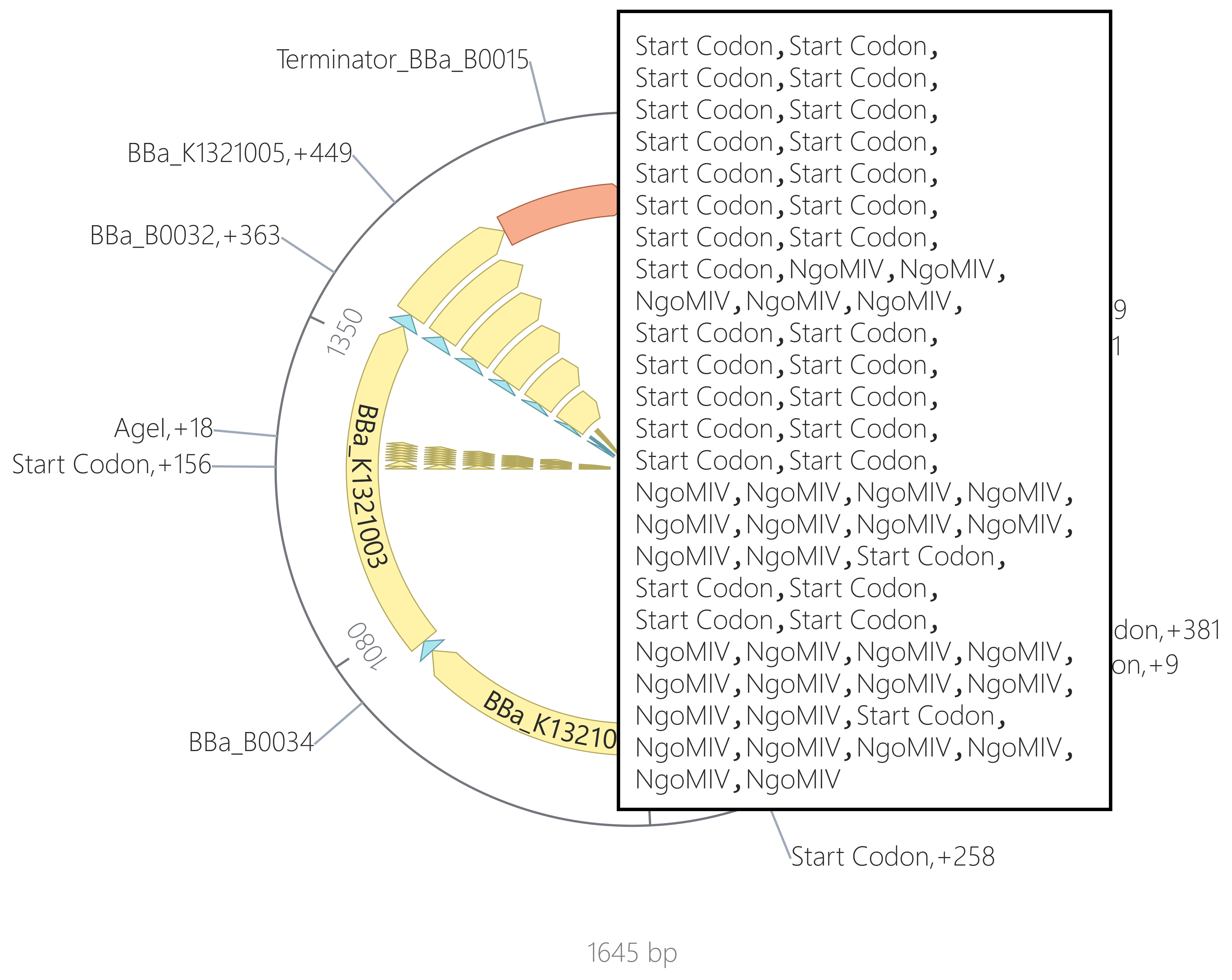
The Kernel construct map displays a single polycistronic operon driven by P_ttgR-hybrid, where a single transcript encodes the periplasmic adapter (TtgA), inner membrane pump (TtgB), and outer envelope channel (TtgC) sequentially before terminating at T_L3S2P21
Part 4: Optimize and quality-check
Codon optimization: Recoded the native P. putida CDS from ~61% G+C down to ~31% G+C to match Clostridium acetobutylicum codon usage Why: High-level expression of heterologous G+C-rich genes in Clostridium stalls translation due to depletion of rare tRNAs. Internal restriction sites (BsaI, BsmBI) were eliminated during recoding.
Sequence Search (BLAST): Nucleotide BLAST confirmed 100% amino acid sequence alignment to P. putida TtgABC proteins with ~75% nucleotide identity due to host-specific codon adaptation.
Safety Screen: Endogenous RND efflux pumps are benign bacterial transport mechanisms and pose no biosecurity hazards
Part 5: From design to build
How would you build it?
The construct will be built via Golden Gate Assembly (BsaI Type IIS restriction enzymes) using standardized gBlock fragments[14][15]. Standardizing the operon into 4-bp overhang sub-fragments allows one-pot enzymatic assembly into the pIMP13 backbone
What does synthesis constrain? High A+T content (~70%) and repetitive transmembrane regions tend to produce synthesis errors or homopolymer slippage. To mitigate this, error correction protocols using protein-mediated MutS (Carr et al., 2004) will be applied, and the operon will be divided into smaller <1.5 kb synthetic fragments before assembly
Prototype vs. Scale
Prototype: Synthesize chip-based oligo pools (Tian et al., 2004; Kosuri et al., 2010; Kong et al., 2007) and assemble variants in 96/384-well plates using an Opentrons robot for high-throughput microdroplet tolerance screening
Scale: Chromosomally integrate the optimized efflux operon into C. acetobutylicum via CRISPR-Cas9 or Allele-Coupled Exchange (ACE) to avoid plasmid loss during 50,000 L industrial fermentations without needing antibiotic selection
Part 6: What don’t you know yet?
● Proton Motive Force (PMF) Depletion and Energetic Burden: Risk: RND efflux pumps consume the cell’s transmembrane proton gradient. Overexpression might starve Clostridium of ATP, reducing biobutanol synthesis yield Testing Plan: Measure intracellular ATP/ADP ratios and membrane potential during ABE fermentation under different promoter induction levels
● Tripartite Envelope Assembly in Gram-Positive Cell Walls Risk: TtgC natively spans Gram-negative outer membranes; assembly across the thick peptidoglycan cell wall of Gram-positive Clostridium may be inefficient Testing Plan: Perform cell-fractionation and Western blotting to verify membrane localization of TtgA, TtgB, and TtgC
● Inhibitor Synergy in Real CENADA Hydrolysate Risk: De-oiled citrus bagazo contains complex mixtures of residual D-limonene (<0.05%), galacturonic acid, and flavonoids (hesperidin/naringin) Testing Plan: Run microplate growth assays across serial dilutions of actual CENADA hydrolysates using MIT Cloud Lab automated kinetic reader plates

Part 7: AI Citation Statement AI Client used: Gemini Notebook (HTBAA 2026 Workbench) AI Prompt: Elaborate a full work plan to work on Kernel Asimov to develop D-Limonene and Solvent Efflux Pumps
AI Prompt: Based on the outline for the project found in the file named Homework Workbook.docx, please complete the questions asked in the file on HTBAA Homework #2_DNA Design.docx based on the Work Plan: In Silico Design of Solvent Efflux Circuits in Kernel by Asimov."
Annexes Workplan for Asimov-Kernel repo
| PHASE | Description |
|---|---|
| PHASE 1: Parts Curation & Chassis-Specific Codon Optimization | Import AcrAB-TolC/TtgABC CDS -> Apply Clostridium A+T Codon Bias -> Map Features |
| PHASE 2: Circuit Architecture & Expression Tuning | Topology A: Constitutive Operon Topology B: Dynamic Solvent-Responsive Switch ~ (P_thl + Tuned RBS Strengths) ~ (TtgR/LimR Repressor + Inducible Promoter) |
| PHASE 3: Circuit Simulation & Energetic Burden Modeling | Simulate Flux, Expression Stoichiometry (1:1:1), & Membrane Transport Burden |
| PHASE 4: Assembly Simulation & Vector Engineering | Design Golden Gate/Gibson Junctions -> Shuttle Vector (pIM13/pCB102) Mapping |
| PHASE 5: Handoff to Automation (Opentrons & MIT Cloud Lab) | Export SBOL/JSON -> Generate Liquid Handling Scripts -> 384-Well Assay Screening |