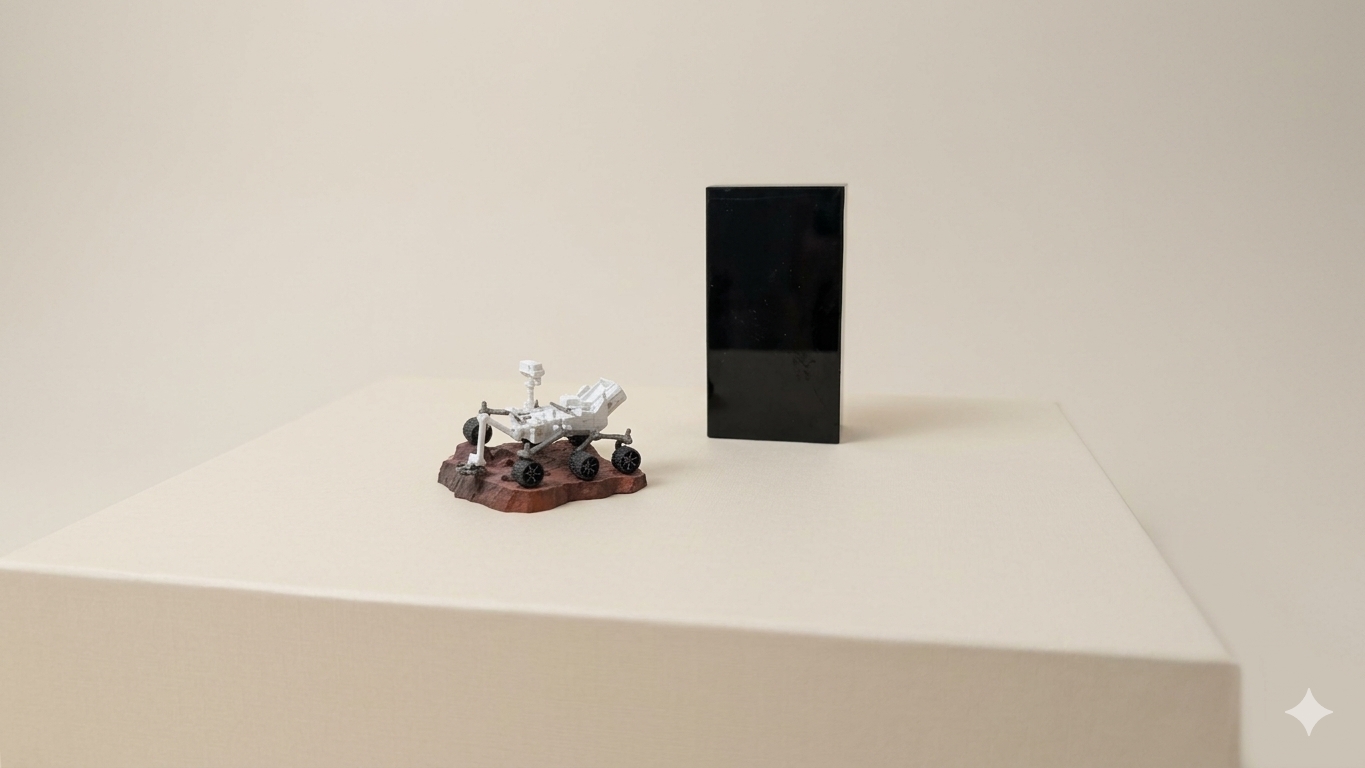
The Reflective Resin Monolith and the Beloved Curiosity
About me
Hello.
I live in Japan, where I specialize in Buddhist studies;
I am an ordained Buddhist practitioner and also work at a publishing company.
I am a biology enthusiast who dreams of living on Mars as the ultimate destination of my life.
I hope to gain insights into making the journey to Mars❤️ a reality while drawing inspiration from participating in MIT courses.
I organize synthetic biology study groups and workshops for the general public.
I also run an organization called OpenPETase.
I(We) will move forward with content and study sessions to ensure the smooth operation of the BioClub Tokyo node.
See the nav bar on the left to look through my work for How To
Biomanufacture Almost Anything (Fall 2026)!
Subsections of Mario Nakahara — HTGAA Spring 2026
Week 1 HW: Final Project Ideas
HTBAA Homework #1
Due: Tuesday September 22, by 2:30p ET
Introduction
Ever since I first heard about the Mars mission 20 years ago and felt incredibly excited, I’ve been following developments in space exploration.
With recent advances in rocket technology making a trip to the Moon a realistic possibility, I’ve come to believe that the idea of colonizing Mars is no longer just a pipe dream.
Since I didn’t major in science as a student and am not a scientist now,
I can only offer ideas and fictional descriptions (nothing concrete), and while I certainly won’t be able to achieve anything specific in my final project a few weeks from now, I’ll write down what I “want to do” at this point.
In a Class 1 lecture, a paper on fabrication on the Moon and Mars was introduced, and since it overlapped with several topics I’d already found interesting, the content on this page may also overlap (though, of course, it’s less specific). I’d like to apologize for that in advance.
I previously received an idea from a space development company to break down plastic on the Moon and use that energy to travel to Mars.
My goal is to make plastic decomposition machines (bioreactors) available to the general public, but could they also be used for space exploration??
Cooperation between Earth, the Moon, and Mars: Fabrication and its automation for human colonization
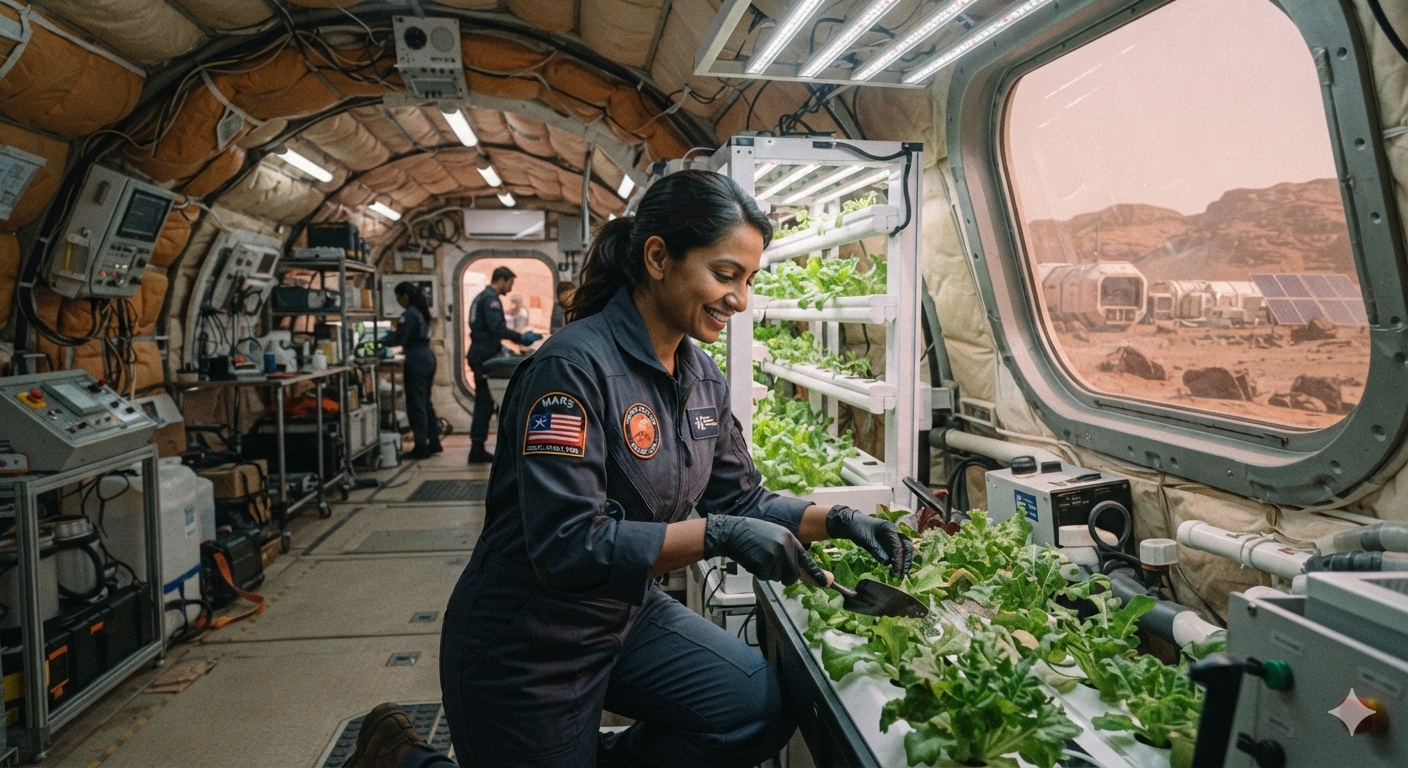
Building an online system connecting Earth, the Moon, and Mars◎ Growing plants on Mars (and the Moon)
(1) Items to be biomanufactured and the reasons why
Why do you want to create it:
There is a possibility that humanity will live in space in the future.
Target product:
It requires the establishment of a two-way online system connecting Earth, the Moon, and Mars (?), as well as the following:
Food (i.e., plants)
Energy
Sustainable materials (for daily use)—specifically, those that are biodegradable and renewable
Who it’s for:
For humanity and for evolution.
Why I’m interested:
Because I believe it connects to the evolution of humanity and the future of plants and animals.
1.Food (specifically, plants)
*Note: It is unclear whether humans, after migrating,
will continue to consume fresh vegetables and protein, or if nutrient-dense supplements will suffice.
4.Circular energy
Large-scale cloud labs (culturing, screening, sampling, measurement, optimization)
(4) What quantity needs to be produced, and how long will it take?
*Focusing on 1.Food (≈ Plants)
Regarding the human population interested in migrating:
According to Google AI…
Global population across all age groups (teens to centenarians):
Current global population: approx. 8.3 billion
Around 2037: Reaches 9 billion
Around 2060: Reaches 10 billion
Around 2084: Peaks at approx. 10.3 billion
*What percentage of this population is likely to migrate to Mars?
It is highly probable that the figure will be around 0.012% (roughly one in 10,000 people) or even lower.
(a) What is the required quantity?
Define the scale of the project and estimate the quantity of the target product to be manufactured.
According to Google AI:
*How much food is needed if 10,000 people relocate?
For 10,000 people, approximately 5,500 to 7,300 tons of food are required annually (about 15 to 20 tons per day).
Production of cultured meat or potatoes.
(b) How long does it take?
“Time required for harvest” by crop
Microalgae (e.g., Spirulina): A few days
Leafy vegetables (e.g., lettuce, komatsuna): Approx. 20–30 days
(5) What remains unknown?
How much plant material can be produced in space, and is it possible without sunlight?
What impact would genetic modification have on the human body?
Durability in space and renewability;
Feasibility of communication;
How the system changes if lunar or Martian resources are used for energy.
What are the effects of cosmic radiation and low gravity?
Generation of water and air; impacts of radiation, etc.
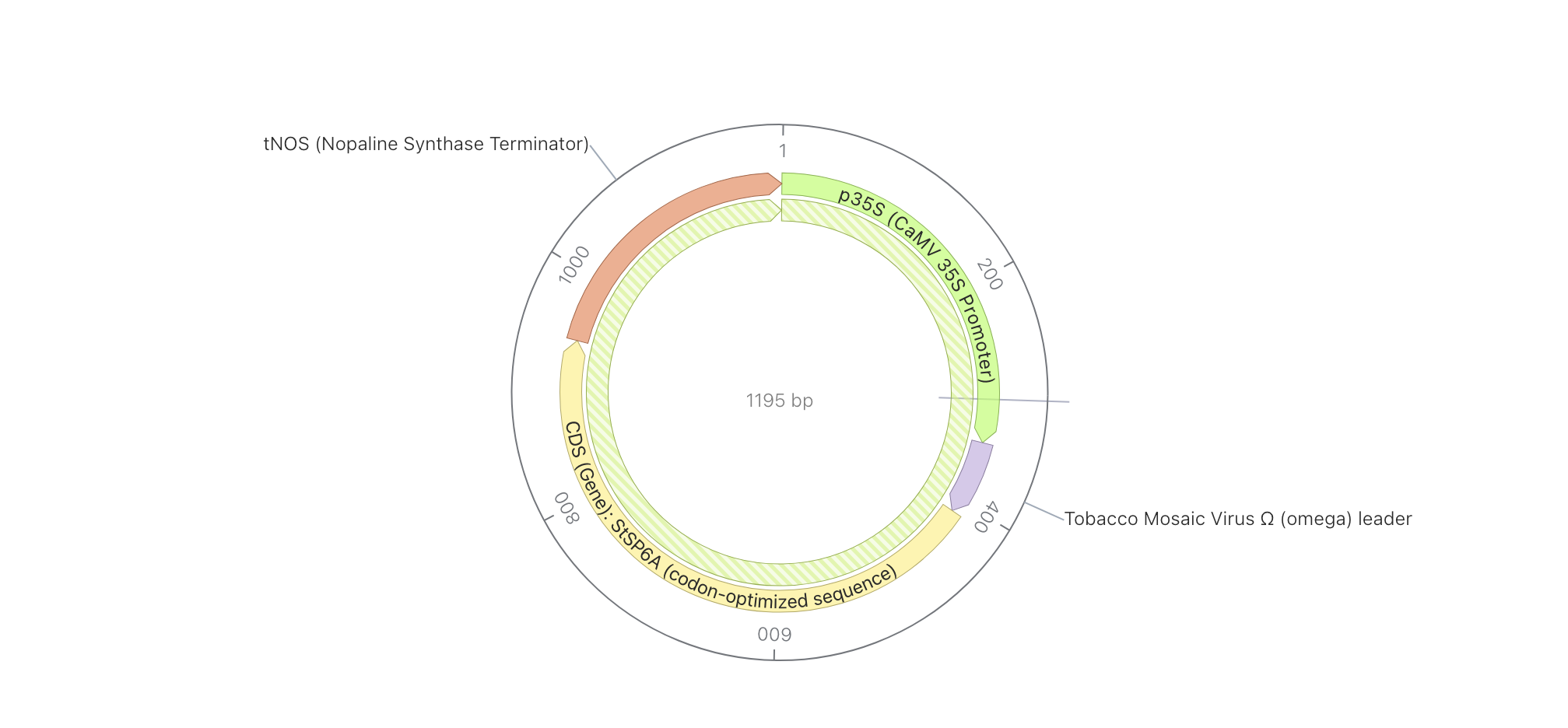
A circuit designed to induce ultra-fast tuber formation regardless of day length, even under continuous 24-hour LED illumination.
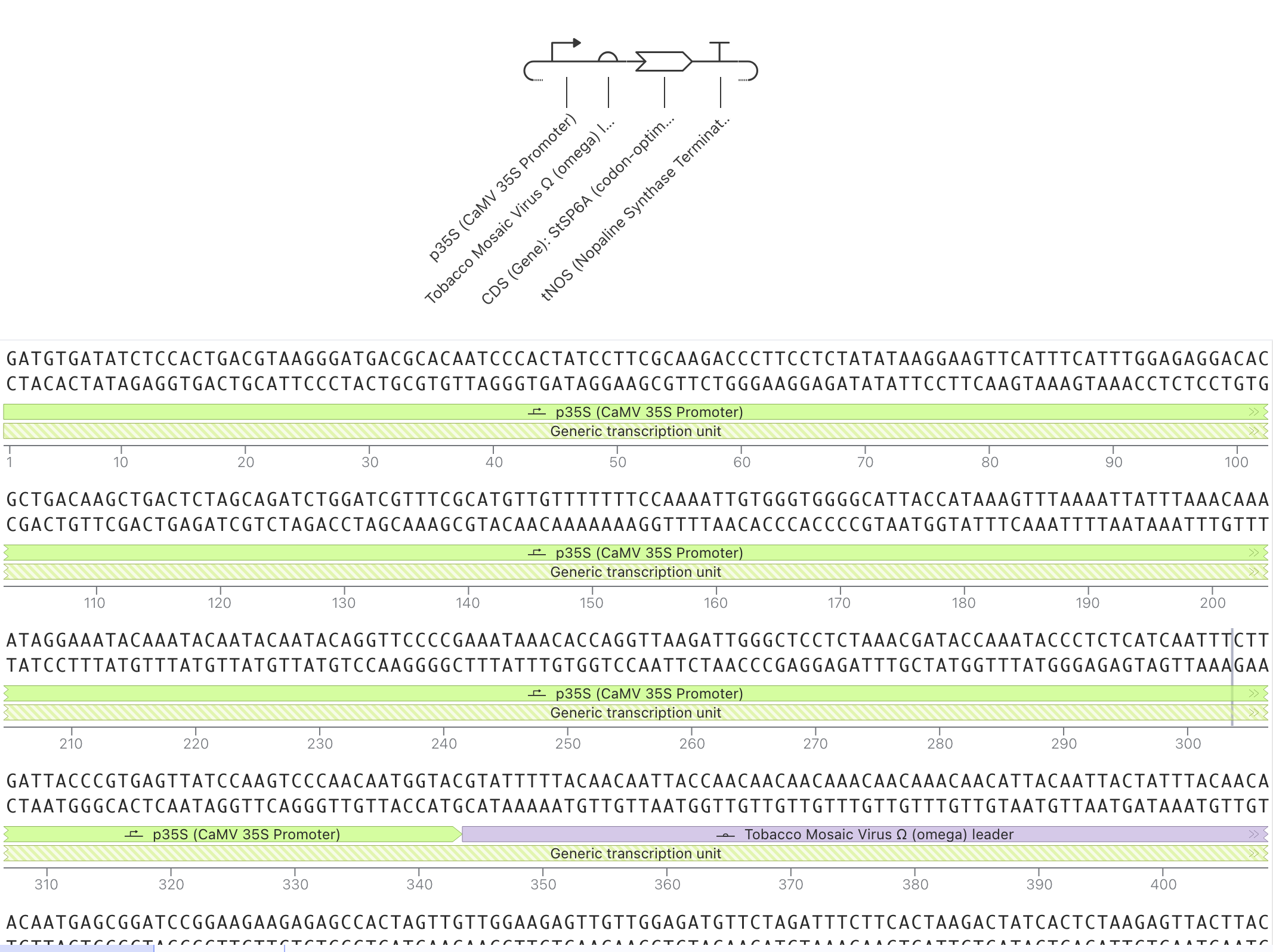
●Promoter: p35S (CaMV 35S Promoter) or pNos
Overview: A strong constitutive promoter derived from the Cauliflower Mosaic Virus; it is the most widely used promoter in the plant kingdom, driving continuous transcription 24 hours a day.
Overview: The Ω sequence (a translational enhancer) from the Tobacco Mosaic Virus. It strongly recruits ribosomes within plant cells, dramatically boosting translation efficiency.
●CDS (Gene): StSP6A (codon-optimized sequence)
Overview: A gene encoding the tuber-formation signal in potato (Solanum tuberosum).
Processing in Kernel: The “Codon Optimization” function is used to optimize the nucleotide sequence based on potato codon usage bias (Target organism: Solanum tuberosum).
●Terminator: tNOS (Nopaline Synthase Terminator)
Overview: A standard plant terminator derived from Agrobacterium. It ensures the reliable termination of transcription and stabilizes the mRNA.
Chassis:Solanum tuberosum (Potato)
Part 1: Define your expression target
Start from the project you proposed in Homework #1 and pin down exactly what your cells need to make. Answer in your write-up:
● What molecule are you expressing? A protein, an RNA, or an enzyme (or small set of enzymes) for a pathway. If your HW1 product is a material, food, or chemical, identify the protein(s) that produce it and design for those.
● What is the sequence? Give the protein or RNA sequence, or the specific gene, you will encode, and say where it comes from (a database accession such as UniProt or NCBI, a known part, or de novo). Cite it.
● What host or chassis? The living system from HW1, for example E. coli, S. cerevisiae, CHO or another mammalian line, or a cell-free system. Your host drives almost every part choice that follows.
● Where does the product need to go? Cytoplasm, secreted, membrane, or a compartment? This decides whether you need a signal peptide or targeting sequence.
Part 2: Design your genetic parts
Every construct is built from parts. Decide which parts your target needs, then create or import each one in Kernel with the correct part type. At minimum, choose the elements below for your host.
For each part you use, record in Kernel (and note in your write-up):
The part type and a short name.
Its sequence and where it came from (a Kernel part, a database, or designed).
One sentence of justification, why this part, for this host, for this product.
You do not need to hand-design a backbone from scratch; you may reuse an existing one and say what it provides.
Part 3: Assemble your construct
Now put the parts together into a single construct in Kernel.
Create a new construct in your folder and add your parts in the correct 5’→3’ order for your host (for a basic expression cassette: promoter → RBS or 5’ UTR/Kozak → CDS → terminator, plus any signal peptide or tag, in the vector backbone).
Check the assembled sequence: the reading frame is intact, the start and stop codons are where you expect, and there are no accidental internal stops.
Look at the construct map Kernel renders and confirm the parts sit in the order and orientation you intended.
Deliverable for this part: your assembled construct in Kernel, plus an exported schematic of it in your write-up, with a brief description of the design.
Part 4: Optimize and quality-check
Use Kernel’s design tools on your coding sequence and construct, and interpret the results rather than just running them.
● Codon-optimize your CDS for your chosen host. Compare before and after: what changed, and why does codon usage matter for expression in this organism? Note any constraints you applied (e.g. avoiding certain restriction sites, GC content).
● Search your sequence (BLAST / sequence search) against known sequences. Is your CDS what you think it is? Is it identical to a natural gene, or novel? What is the closest match?
● Run the safety screen on your construct. Summarize what it checks for and what it reports. If it flags something, explain whether it is expected for your design and how you would respond.
Deliverable for this part: a short paragraph per tool covering what you ran, what it returned, and what you concluded. Screenshots welcome.
Part 5: From design to build
A sequence in software is not yet DNA. Using this week’s readings, reason about how your construct would actually be made. Answer in your write-up:
● How would you build it? Would you order it as synthetic DNA, assemble it from smaller fragments (e.g. Gibson assembly), or build it from a pool of oligos synthesized on a chip? Justify your choice given your construct’s length and complexity.
● What does synthesis constrain? Synthesis has error rates and struggles with certain sequences. Does your design contain anything hard to synthesize? How would error correction or fragment-based assembly change your approach?
● Prototype vs. scale. Mirroring HW1: the way you’d build one construct to test your idea may differ from how you’d produce DNA at the scale your product needs. Briefly describe both if they differ.
Ground this in at least two of the assigned readings and cite them.
Part 6:What don’t you know yet?
As in Homework #1, close by naming the edges of your design. Identify the 2–3 biggest unknowns or risks in your construct. For example: Will the promoter give the right expression level? Will the protein fold and be active in this host? Will it be secreted? Is codon optimization enough, or do you need to tune it empirically?
For each, state how you would find out: the measurement, experiment, or design variant you would try next. A good answer here shows you know which decisions are still bets.
Week 3 HW: Cell-Free Protocols
3. ASSIGNMENT: CFPS REACTION DESIGN FOR SFGFP, PETASE, RETEPLASE
Copy and paste this section (section 3, A-F) into your website! Note, coopetition.htgaa.org is intended to support you as you answer the following questions.
Goal: using the collective intelligence of the HTBAA community and accessible AI systems, design novel CFPS reaction compositions for each of the three target proteins: sfGFP, PETase, and Reteplase to reduce the cost per gram of functional protein. Each design should be compatible with the experimental framework described above and should reflect the distinct expression and folding requirements of that protein. You can learn more about the details of the coopetition here.
A. COMPARE CELL-FREE REACTION COMPOSITIONS (20 minutes)
Why does the concentration of potassium glutamate and magnesium glutamate differ between compositions? Which is more sensitive?
Explain how a PEP+NTP reaction formulation is different from a Ribose+NMP reaction formulation.
Choose two cell-free reaction compositions from the literature, compare and contrast the choice of reagents and the concentration of reagents.
Note: A recommended starting point would be to review a least one published formulation, such as PANOx-SP (Jewett & Swartz 2004), a cost-optimized formulation from Olsen et al. (2026), and/or an AI-designed formulation from Smith et al. (2026).
B. DESIGN ONE REACTION COMPOSITION FOR EACH OF THE THREE PROTEINS (40 minutes)
Sign in to coopetition.htgaa.org and publish your first unique 20 μL CFPS reaction composition for each of the following (don’t worry, you can resubmit later):
sfGFP
PETase
None
None
None
Reteplase
Note: if you’re unable to login with your HTGAA keycloak account, please post in Zulip so that you can participate in the coopetition!
For each composition, specify the reagents you would adjust from the relevant categories, including salts, energy sources, building blocks, cofactors, and redox components.
As a HTBAA research team, we will have the opportunity to suggest new reagents to add to the cell-free reagent inventory. Contribute (or upvote) at least one reagent to the “Community Reagents” section of the website and provide a short rationale. Include in your homework documentation how you decided on that specific reagent and provide links to any relevant research.
Visit the cfps-coopetition forum page to ensure you will be able to take part in the discussion. Bonus: send a note in the channel about a CFPS optimization idea that you have! If you would like clarification on aspects of the project, please message in this dedicated channel.
C. ASIMOV KERNAL (OPTIONAL)
Build T7 compatible plasmids for cell-free expression using the amino acid coding sequences below:
sfGFP
MSKGEELFTGVVPILVELDGDVNGHKFSVRGEGEGDATIGKLTLKFICTTGKLPVPWPTLVTTLTYGVQCFSRYPDHMKRHDFFKSAMPEGYVQERTISFKDDGKYKTRAVVKFEGDTLVNRIELKGTDFKEDGNILGHKLEYNFNSHNVYITADKQKNGIKANFTVRHNVEDGSVQLADHYQQNTPIGDGPVLLPDNHYLSTQTVLSKDPNEKGTRDHMVLHEYVNAAGITWSHPQFEK
PETase
MEKKIWSHPQFEKGGSGENLYFQSGGASPAGGGANPYERGPNPTDALLEASSGPFSVSEENVSRLSASGFGGGTIYYPRENNTYGAVAISPGYTGTEASIAWLGERIASHGFVVITIDTITTLDQPDSRAEQLNAALNHMINRASSTVRSRIDSSRLAVMGHSMGGGGTLRLASQRPDLKAAIPLTPWHLNKNWSSVTVPTLIIGADLDTIAPVATHAKPFYNSLPSSISKAYLELDGATHFAPNIPNKIIGKYSVAWLKRFVDNDTRYTQFLCPGPRDGLFGEVEEYRSTCPFGGSGVSGWRLFKKIS
Reteplase
MEKKIWSHPQFEKGGSGENLYFQSGGASPAGGGNSDCYFGNGSAYRGTHSLTESGASCLPWNSMILIGKVYTAQNPSAQALGLGKHNYCRNPDGDAKPWCHVLKNRRLTWEYCDVPSCSTCGLRQYSQPQFRIKGGLFADIASHPWQAAIFAKHRRSPGERFLCGGILISSCWILSAAHCFQERFPPHHLTVILGRTYRVVPGEEEQKFEVEKYIVHKEFDDDTYDNDIALLQLKSDSSRCAQESSVVRTVCLPPADLQLPDWTECELSGYGKHEALSPFYSERLKEAHVRLYPSSRCTSQHLLNRTVTDNMLCAGDTRSGGPQANLHDACQGDSGGPLVCLNDGRMTLVGIISWGLGCGQKDVPGVYTKVTNYLDWIRDNMRPGGSGVSGWRLFKKIS
Bonus question: design a T7 helper plasmid that you could add to the cell-free reaction to improve the yield of functional reteplase (general chaperones, disulfide-bond machinery, etc).
Use of AI
You are encouraged to use AI and online tools for this assignment to assist your reagent composition development process. As you will present your work during recitation, you must be able to explain and justify the reasoning behind your design.
If you use AI, ensure that you cite the AI client and your prompts used.