Week 1 HW: Final Project Ideas
HTBAA Homework #1 Due: Tuesday September 22, by 2:30p ET
Introduction
Ever since I first heard about the Mars mission 20 years ago and felt incredibly excited, I’ve been following developments in space exploration. With recent advances in rocket technology making a trip to the Moon a realistic possibility, I’ve come to believe that the idea of colonizing Mars is no longer just a pipe dream.
Since I didn’t major in science as a student and am not a scientist now, I can only offer ideas and fictional descriptions (nothing concrete), and while I certainly won’t be able to achieve anything specific in my final project a few weeks from now, I’ll write down what I “want to do” at this point.
In a Class 1 lecture, a paper on fabrication on the Moon and Mars was introduced, and since it overlapped with several topics I’d already found interesting, the content on this page may also overlap (though, of course, it’s less specific). I’d like to apologize for that in advance.
I previously received an idea from a space development company to break down plastic on the Moon and use that energy to travel to Mars. My goal is to make plastic decomposition machines (bioreactors) available to the general public, but could they also be used for space exploration??
Cooperation between Earth, the Moon, and Mars: Fabrication and its automation for human colonization
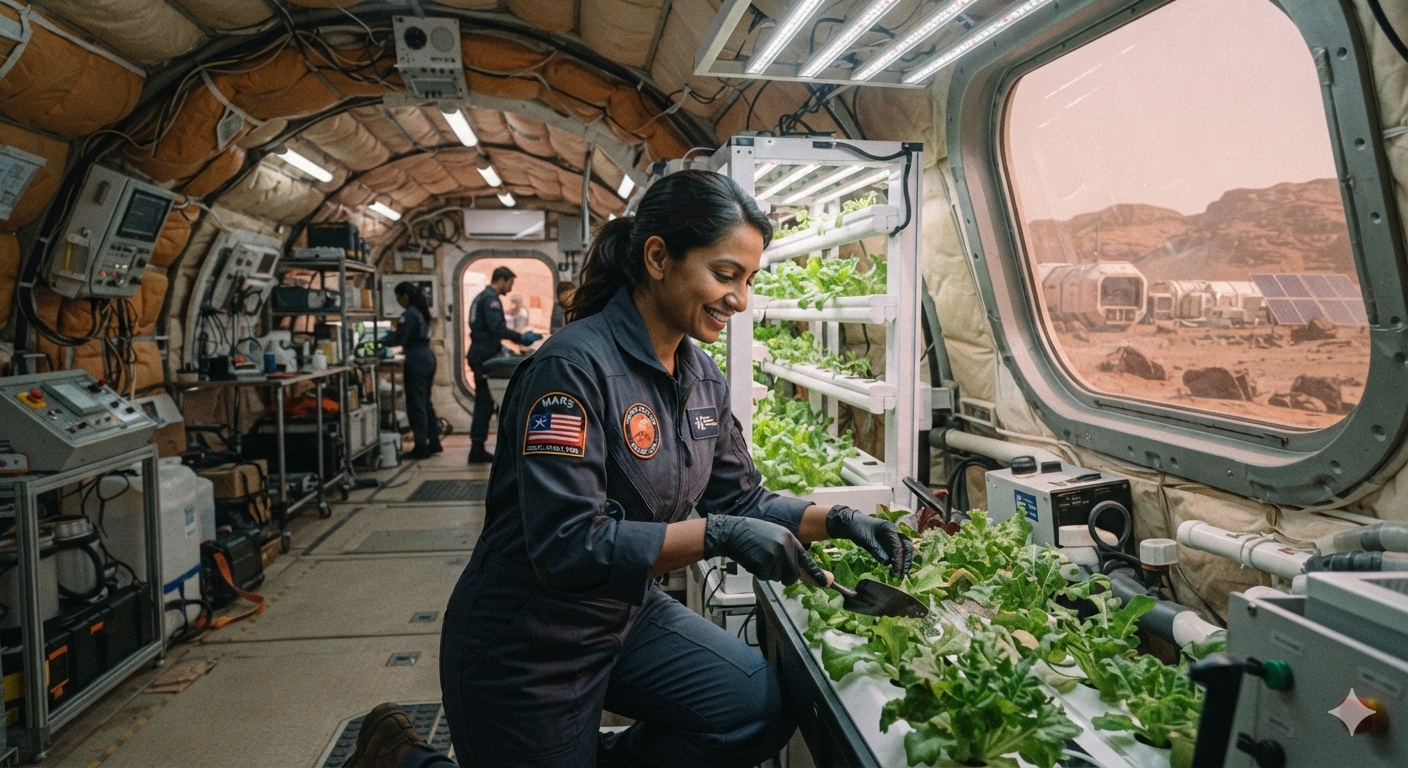
Building an online system connecting Earth, the Moon, and Mars ◎ Growing plants on Mars (and the Moon)
(1) Items to be biomanufactured and the reasons why
Why do you want to create it: There is a possibility that humanity will live in space in the future.
Target product: It requires the establishment of a two-way online system connecting Earth, the Moon, and Mars (?), as well as the following: Food (i.e., plants) Energy Sustainable materials (for daily use)—specifically, those that are biodegradable and renewable
Who it’s for: For humanity and for evolution.
Why I’m interested: Because I believe it connects to the evolution of humanity and the future of plants and animals.
1.Food (specifically, plants)
*Note: It is unclear whether humans, after migrating, will continue to consume fresh vegetables and protein, or if nutrient-dense supplements will suffice.
2.Sustainable materials (for daily necessities) *Features: microbial degradability, renewability
3.Buildings
4.Circular energy systems
(2) What kind of biological systems will be used?
1.Food (≈ plants) → Systems utilizing DNA, microorganisms, DNA manipulation of seeds, or mycelium
2.Sustainable materials (daily goods) *Microbial decomposition, recyclability → Microorganisms (mycelium fabrication), modified plastics
3.Buildings → Microorganisms (mycelium fabrication), modified plastics
4.Circular energy → Cell-free systems (e.g., using water fleas, Euglena, or Spirulina?), energy derived from plastic decomposition
(3) How will you utilize automation? Please identify at least one automation technology to be combined with biological systems.
1.Food (≈ Plants) Large-scale cloud labs; AI-driven automated plant cultivation systems (culturing)
2.Sustainable materials (consumer goods) *Microbial degradation, renewability Large-scale cloud labs
3.Buildings Large-scale cloud labs (culturing, assembly)
4.Circular energy Large-scale cloud labs (culturing, screening, sampling, measurement, optimization)
(4) What quantity needs to be produced, and how long will it take? *Focusing on 1.Food (≈ Plants)
Regarding the human population interested in migrating: According to Google AI…
Global population across all age groups (teens to centenarians): Current global population: approx. 8.3 billion Around 2037: Reaches 9 billion Around 2060: Reaches 10 billion Around 2084: Peaks at approx. 10.3 billion
*What percentage of this population is likely to migrate to Mars? It is highly probable that the figure will be around 0.012% (roughly one in 10,000 people) or even lower.
(a) What is the required quantity? Define the scale of the project and estimate the quantity of the target product to be manufactured.
According to Google AI: *How much food is needed if 10,000 people relocate? For 10,000 people, approximately 5,500 to 7,300 tons of food are required annually (about 15 to 20 tons per day). Production of cultured meat or potatoes.
(b) How long does it take?
“Time required for harvest” by crop Microalgae (e.g., Spirulina): A few days Leafy vegetables (e.g., lettuce, komatsuna): Approx. 20–30 days
Root vegetables/Tubers (e.g., potatoes, sweet potatoes): Approx. 90 days (3 months)
Cultured meat (artificial meat): Approx. 2–4 weeks
(5) What remains unknown? How much plant material can be produced in space, and is it possible without sunlight? What impact would genetic modification have on the human body?
Durability in space and renewability; Feasibility of communication; How the system changes if lunar or Martian resources are used for energy.
What are the effects of cosmic radiation and low gravity? Generation of water and air; impacts of radiation, etc.