Week 1 HW: Final Project Ideas
HTBAA Homework #1
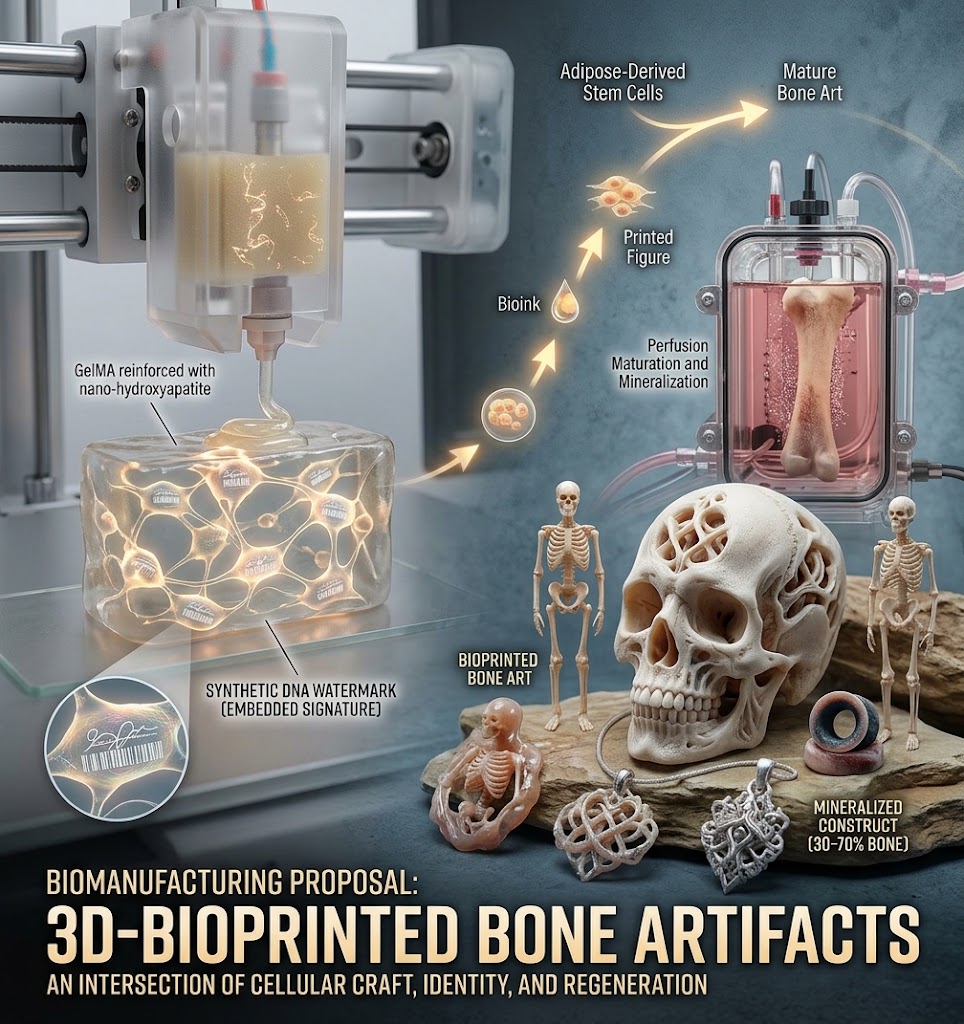
Biomanufacturing Proposal: 3D-Bioprinted Bone Artifacts from Adipose-Derived Stem Cells
Matthew Woslum - September 22, 2026
(1) What I would like to biomanufacture, and why
Target output
3D-bioprinted figurines made from living osteoblasts embedded in a degradable, mineralizing scaffold. The osteoblasts would be derived from adipose-derived stromal/stem cells (ASCs) expanded in serum-free or low-cost alternatively supplemented media, printed into a cell-adherent composite bioink, and matured in a perfusion bioreactor until the construct mineralizes into bone-like tissue.
Motivation: utilitarian and artistic
A streamlined, inexpensive process for bioprinting client-specific osteoblast–scaffold constructs would open tissue culture as an artistic medium. Miniature skeletons, jewelry grown from a client’s own cells, gauged ear plugs made from your own (or your partner’s) bone. The project would give me hands-on experience with low-cost mammalian cell culture, osteogenic differentiation, and CRISPR knock-in editing. Each artwork’s cells would carry a synthetic DNA watermark, a signature embedded in every cell of the piece.
Who is it for? Initially, my own lab skills practice. But with refinement, commissioned art or utilitarian bone objects could replace many plastic household objects. I find it interesting because it sits at the intersection of tissue engineering, craft, and identity: what does it mean to make (and own) an object literally grown from yourself or someone you love?
(2) What living system would I use?
The chassis will be primary human ASCs. Adipose tissue is clinically abundant and easy to harvest, and ASCs are well characterized for expansion and osteogenic differentiation.
Workflow:
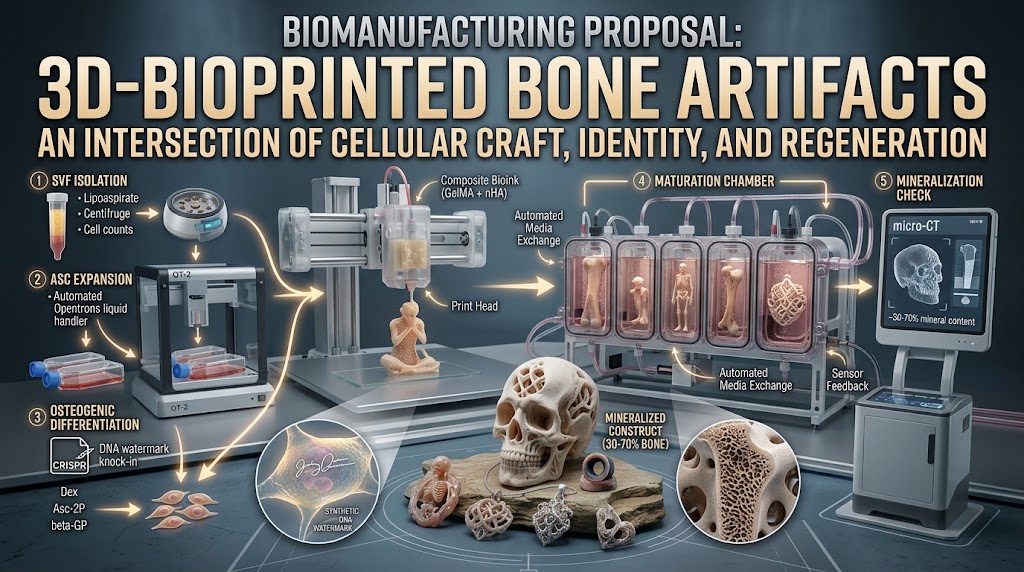
- Harvest lipoaspirate → isolate the stromal vascular fraction (SVF) by collagenase digestion and centrifugation.
- Select adherent ASCs and expand them in serum-free (or dilute human platelet-lysate) media to reduce cost and lot-to-lot variability relative to fetal bovine serum.
- Early in expansion, optionally knock in a synthetic DNA watermark sequence (CRISPR/Cas9) so that every cell in the final piece carries the maker’s signature + reporter/selection marker.
- Drive osteogenic differentiation with dexamethasone, ascorbate-2-phosphate, and β-glycerophosphate, applied during/after printing.
- Print the ASC-laden bioink into the target geometry, crosslink, and mature the construct in a perfusion bioreactor.
Inputs: lipoaspirate, culture media and growth factors, and a composite bioink. Process: ASC expansion, osteogenic differentiation, and extracellular matrix mineralization. Output: a partially mineralized (~30–70%), cell-laden bone-like construct.
(3) How would I use automation?
Expansion: an Opentrons liquid-handling robot would automate feeding, passaging, and plating across parallel flasks on a fixed schedule. Media changes are the largest recurring labor and contamination risk in mammalian culture, so this is the best step to automate.
Fabrication: a desktop extrusion bioprinter deposits the ASC-laden bioink in the figure geometry with reproducible cell density. The resolution would be dependent on the bioprinter.
Maturation: a perfusion bioreactor automates media exchange and flows medium through the printed construct. This is essential rather than optional: static culture would not mineralize a construct this thick (diffusion limits) and would cause a cause a necrotic core, whereas perfusion enables greater scale[6].
If the process were ever scaled up, the same biology would run in multiple, automated perfusion chambers with sensor feedback rather than manually tended flasks. The prototyping stack (Opentrons + bioreactor) differs from the manufacturing stack (parallel reactors) mainly in reactor count and integration.
(4) How much would I need to make, and how long would it take?
(a) How much?
A 15 cm figure-scale object has a bulk volume of roughly 100–150 cm³ as a mostly solid bone construct, that is ~80–100 cm³ of bone/scaffold composite.
Cells: Bone tissue engineering typically seeds scaffolds at 5 × 10⁶ cells/cm³ [1]. 3D-bioprinted bone constructs commonly use 5–10 × 10⁶ cells/mL of bioink [2]. Using 5 × 10⁶ cells/cm³:
80–100 cm³ × 5 × 10⁶ cells/cm³ = 4–5 × 10⁸ cells. Buffering ~2× for cell death and incomplete differentiation gives a production target of ~10⁹ ASCs.
Lipoaspirate: 1 g of lipoaspirate yields ~2–5 × 10⁵ nucleated SVF cells [3]. About 1% are true adherent, colony-forming ASCs, therefore, ~2–5 × 10³ ASCs per gram [3].
Starting with 6 g of fat: 6 g × (2–5 × 10³ ASCs/g) = 1.2–3 × 10⁴ ASCs. Required expansion: 10⁹ / 2 × 10⁴ ≈ 5 × 10⁴-fold ≈ 15–16 doublings (log₂(5 × 10⁴) ≈ 15.6). ASCs can undergo ~15–20 doublings before senescence [4], so this is feasible but near the conservative limit. Hence, starting with 6 g rather than 2 g.
Scaffold: ~80–100 cm³ of degradable, osteoconductive bioink: gelatin methacrylate (GelMA) — which carries native cell-adhesive RGD motifs and is enzymatically degradable — reinforced with nano-hydroxyapatite (~10–20 wt%) for osteoconductivity and printability [2]. I wish to avoid non-degradable PLA so that the finished artifact is as close to living tissue as possible.
Mass: Fully mineralized cortical bone is 1.8–1.9 g/cm³ [5]. Because I expect only ~30–70% mineralization, the finished piece would weigh roughly 45–135 g (80–100 cm³ × 1.8–1.9 g/cm³ × 0.3–0.7). A 100% mineralized upper bound would be ~145–190 g.
(b) How long?
SVF isolation and ASC selection: ~1 week.
Expansion to ~10⁹ cells: ASC doubling time ~2–3 days [4]; 15–16 doublings ≈ 7 weeks of pure growth, or ~8–10 weeks in practice with passaging roughly once per week (~3 doublings per passage, ~5–6 passages). Automated feeding/passaging (OT-2) keeps this schedule unattended and parallelizable.
Bioprinting and onset of differentiation: ~1–2 weeks.
Maturation and mineralization in the perfusion bioreactor: ~8–12 weeks, organized matrix (rather than a brittle mineral crust) is desired.
Total: approximately 4–6 months end-to-end per figure. Automation throughput matters mainly in the expansion phase, where one liquid handler can tend far more parallel culture than a person can; the maturation phase is throughput-limited by perfusion-chamber footprint rather than labor.
(5) What I don’t know yet
Lipoaspirate sourcing and donor variability: access to clinical-grade tissue, how much ASC yield and potency vary between donors, and whether xeno-free media match serum-based performance at acceptable cost.
Scaffold mechanics versus biology: can a fully degradable GelMA/nano-hydroxyapatite ink reach the stiffness and compressive strength to stand as a free-standing 15 cm object while still supporting ASC osteogenesis? Substrate stiffness is itself a key osteogenic cue, so the design is a genuine trade-off.
Differentiation efficiency in 3D: what fraction of printed ASCs actually deposit mineralized matrix inside a thick construct, and how much the DNA-watermark knock-in reduces expansion capacity or osteogenic potential.
References
[1] Holy, C. E., Shoichet, M. S., & Davies, J. E. (2000). Engineering three-dimensional bone tissue in vitro using biodegradable scaffolds: investigating initial seeding density and culture period. Journal of Biomedical Materials Research, 51(3), 376–382.
[2] Gungor-Ozkerim, P. S., Inci, I., Zhang, Y. S., Khademhosseini, A., & Dokmeci, M. R. (2018). Bioinks for 3D bioprinting: an overview. Biomaterials Science, 6(5), 915–946.
[3] Yoshimura, K., et al. (2006). Characterization of freshly isolated and cultured cells derived from the fatty and fluid portions of liposuction aspirates. Journal of Cellular Physiology, 208(1), 64–76.
[4] Pittenger, M. F., et al. (1999). Multilineage potential of adult human mesenchymal stem cells. Science, 284(5411), 143–147; see also Bonab, M. M., et al. (2006). Aging of mesenchymal stem cell in vitro. BMC Cell Biology, 7, 14.
[5] Rho, J.-Y., Kuhn-Spearing, L., & Zioupos, P. (1998). Mechanical properties and the hierarchical structure of bone. Medical Engineering & Physics, 20(2), 92–102.
[6] Grayson, W. L., et al. (2008). Engineering anatomically shaped human bone grafts. Proceedings of the National Academy of Sciences, 105(37), 13454–13459.
AI assistants (Kimi - Moonshot AI, Gemini - Google) were used to sanity-check the arithmetic and units in the back-of-the-envelope estimates and genereate images. Prompts: “Check the math on cell counts for SVF sufficient for enough ADSCs to seed a 15 cm tall figure comprised of bone-like mineralized tissue and scaffold”, “Use this project proposal to generate an introductory image and a workflow image” All biological parameters were verified against the primary literature cited above.
Biosecurity, Biosafety & Risk Assessment Matrix
Evaluated Options:
- Option 1 (Baseline / Manual Culture): Manual primary cell isolation and expansion in standard open flasks, manual media changes, static differentiation, standard laboratory biosafety level (BSL-2).
- Option 2 (Proposed Automated & Closed Pipeline): Automated liquid handling (Opentrons) for expansion, custom 3D-printed positive-pressure HEPA/bio-containment enclosure, and perfusion bioreactor maturation.
| Does the option: | Option 1 (Manual / Open) | Option 2 (Proposed Bio-Printer & Bioreactor) |
|---|---|---|
| Enhance Biosecurity | ||
| • By preventing incidents | No (manual handling risks mix-ups or unmonitored strain/cell line drift) | Yes (DNA-watermark knock-in enables genomic tracking and provenance verification) |
| • By helping respond | Low | Moderate (Opentrons run logs and telemetry trace all liquid-handling steps) |
| Foster Lab Safety | ||
| • By preventing incident | Standard | Yes (positive-pressure HEPA enclosure reduces bioaerosol risk during bioprinting) |
| • By helping respond | Manual spill cleanup protocols | Moderate (automated micro-dispensing minimizes handling) |
| Protect the environment | ||
| • By preventing incidents | Standard risk (biological waste generated from primary human tissue/ASCs) | Yes (contained waste routing in perfusion loops reduces hazardous liquid waste volume) |
| • By helping respond | Standard containment | Yes (enclosed fluidics allow easy neutralization of run media) |
| Other considerations | ||
| • Minimizing costs and burdens | High labor footprint (lipoaspirate collection is labor-intensive) | Same |
| • Feasibility? | High (established protocols) | High (validated open-hardware & frugal chemistry) |
| • Not impede research | Yes | Yes (fully open hardware and accessible wetware) |
| • Promote constructive applications | Yes | Yes (democratizes thick-tissue engineering and accessible bioreactor designs) |