Week 1 HW: Final Project Ideas
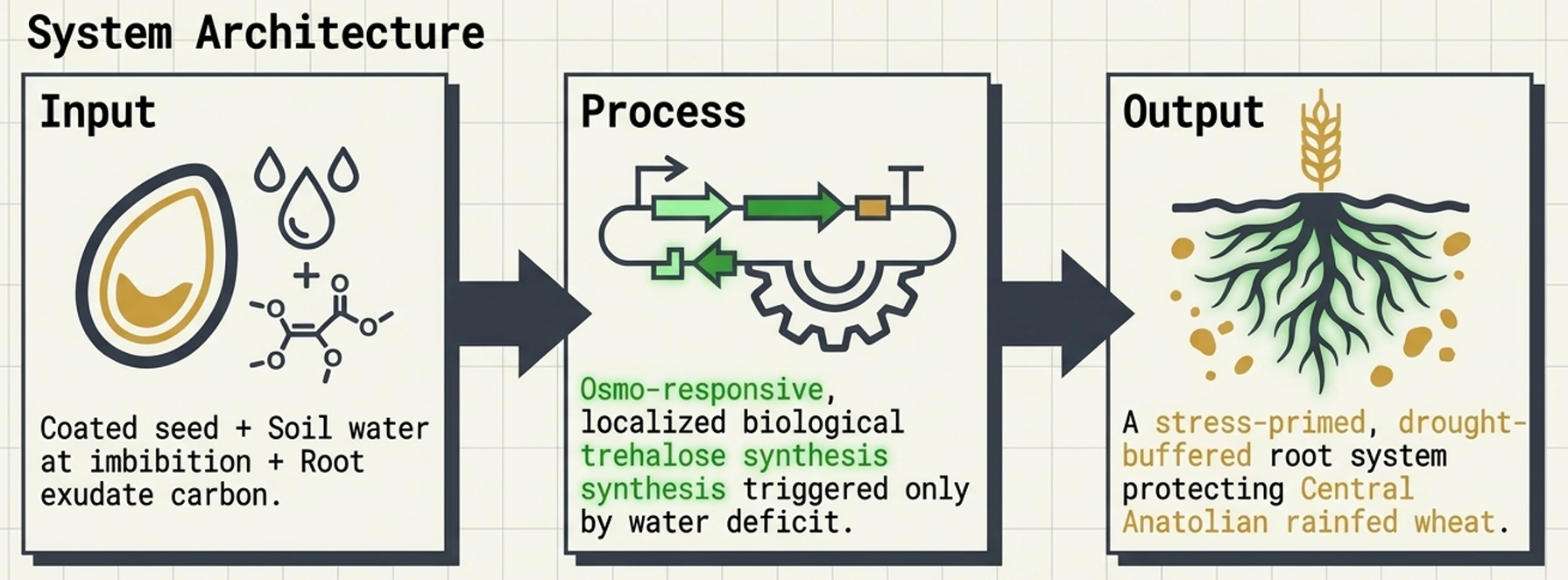
1. What do you want to make? → An engineered trehalose-overproducing rhizobacterium, applied as a dry seed coating on rainfed wheat, that manufactures drought-priming signal continuously at the root instead of delivering it once as a chemical.
2. What living system could make it? → Azospirillum brasilense (or a Bacillus backup for shelf life) carrying a bifunctional yeast TPS–TPP fusion under an osmotically inducible promoter. In: seed, soil water, root exudate carbon. Out: a colonized, stress-primed root system.
3. How could automation help you make it? → Prototyping: an Opentrons OT-2 screening 24 promoters × 8 osmotic potentials × 3 replicates in one afternoon to find the right induction threshold. Manufacturing: automated fed-batch control, continuous centrifugation, drying, and drum seed coating with in-line viability QC.
4. What would it take to make it at a meaningful scale? For 3 Mha of Central Anatolia: 1.5 × 10¹⁹ CFU/year, which is 1,500 m³ of broth at 10¹³ CFU/L — 30 batches in a 50 m³ fermenter, about 45 days. Allow one log of shelf-life loss and it becomes 15,000 m³ and two lines running most of the year. Roughly $1–5/ha, so break-even needs under 1% yield response.
Premise:
Exogenously applied trehalose is a well-supported drought-priming agent for cereals, but it is also a commodity chemical produced industrially since 1995, and it is cleared from plant and soil within days by ubiquitous trehalase activity. Both facts point away from manufacturing the molecule itself. This proposal therefore relocates the biomanufacturing target: instead of producing trehalose and applying it once at imbibition, I propose to manufacture the organism that synthesises it continuously at the root interface — an engineered, trehalose-overproducing plant-growth-promoting rhizobacterium delivered as a dry seed coating on rainfed wheat.
The design rests on a specific mechanistic claim, supported in the evidence section below: the benefit of bacterial trehalose is not bulk osmoprotection of the plant but a signalling effect, in which small quantities reaching the root upregulate stress-response pathways. If that is correct, continuous low-level production at the rhizosphere is the appropriate delivery mode, and a single large dose is the wrong one.
(1) What you would like to biomanufacture and why?
The product. A seed-applied, engineered trehalose-overproducing rhizobacterial inoculant for rainfed bread wheat, manufactured as a spore-based dry seed coating. The manufactured object is living cells, not a chemical: roughly 10⁶ colony-forming units deposited on each seed, which then replicate in the rhizosphere and synthesize trehalose in situ under water deficit.
Who it is for. Rainfed wheat growers on the Central Anatolian plateau. Türkiye plants approximately 7.1 million hectares of wheat at an average yield near 2.61 t/ha, concentrated in Central Anatolia and Southeast Anatolia. These are largely unirrigated fields where yield is set by spring rainfall, and the damaging stress is terminal drought during grain filling. Turkish average wheat yields sit well below those of comparable temperate producers, and the gap is substantially a water gap rather than a genetics gap.
Why this, and why me. My motivation is utilitarian and regional. I am not proposing to eliminate drought loss — no seed treatment can — but to buy a partial physiological buffer at a cost per hectare low enough that a smallholder adopts it without a subsidy. The target is a single-digit dollar cost per hectare against roughly $650/ha of gross wheat revenue, which means even a modest yield response clears break-even by a wide margin. My own background is in microbial bioprocess development and fermentation scale-up, so the manufacturing half of this problem is one I can assess concretely rather than hand-wave.
Why it is interesting as biomanufacturing. Trehalose is already an industrial commodity, produced biologically since 1995 and available at roughly $3.50–6/kg. Manufacturing it myself would be a purchase order dressed up as a project. The interesting engineering problem is not the molecule but the delivery of continuous synthesis — which converts a chemical-supply question into a genuine chassis, construct, and formulation question, and which addresses the central weakness of exogenous trehalose application: persistence.
(2) What living system would you use?
Chassis. Two credible options, with an explicit trade-off I have not yet resolved experimentally.
Azospirillum (e.g. A. brasilense or A. argentinense) carries almost all of the published efficacy evidence for trehalose-mediated drought protection in cereals, and it is an established, commercially deployed cereal root colonizer. Bacillus sporulates, which is decisive for shelf life and dry seed coating — a non-sporulating inoculant loses roughly three log units of viability over six months of storage, which as shown in Section 4 is the single largest driver of required plant size.
I propose Azospirillum as the scientifically justified primary chassis, because efficacy evidence is harder to substitute than formulation engineering, and I flag the shelf-life penalty as a named assumption to be tested rather than assumed away. A Bacillus backup chassis would be carried in parallel.
Construct. A bifunctional yeast TPS–TPP fusion (trehalose-6-phosphate synthase fused to trehalose-6-phosphate phosphatase), rather than otsA alone. This choice follows directly from the maize data: the strain carrying the bifunctional fusion outperformed the strain carrying ReOtsA alone, giving biomass 1.7-fold greater than non-inoculated plants. Fusing the two activities also channels the T6P intermediate, limiting accumulation of a metabolite that is itself a potent regulator of central carbon metabolism.
Regulation — my one deliberate departure from the literature. The published constructs used a constitutive lac promoter. I propose instead a stress-inducible promoter — an osmotically regulated element such as proU, osmY, or the native otsBA promoter. The rationale is metabolic burden: constitutive overproduction taxes the cell throughout the non-stressed majority of the growing season, when trehalose confers no benefit, and burden is a well-documented cause of impaired rhizosphere colonization fitness. The desired transfer function is minimal expression at field capacity and sharp induction below a defined soil water potential. Tuning this is the core prototyping task in Section 3.
Process description.
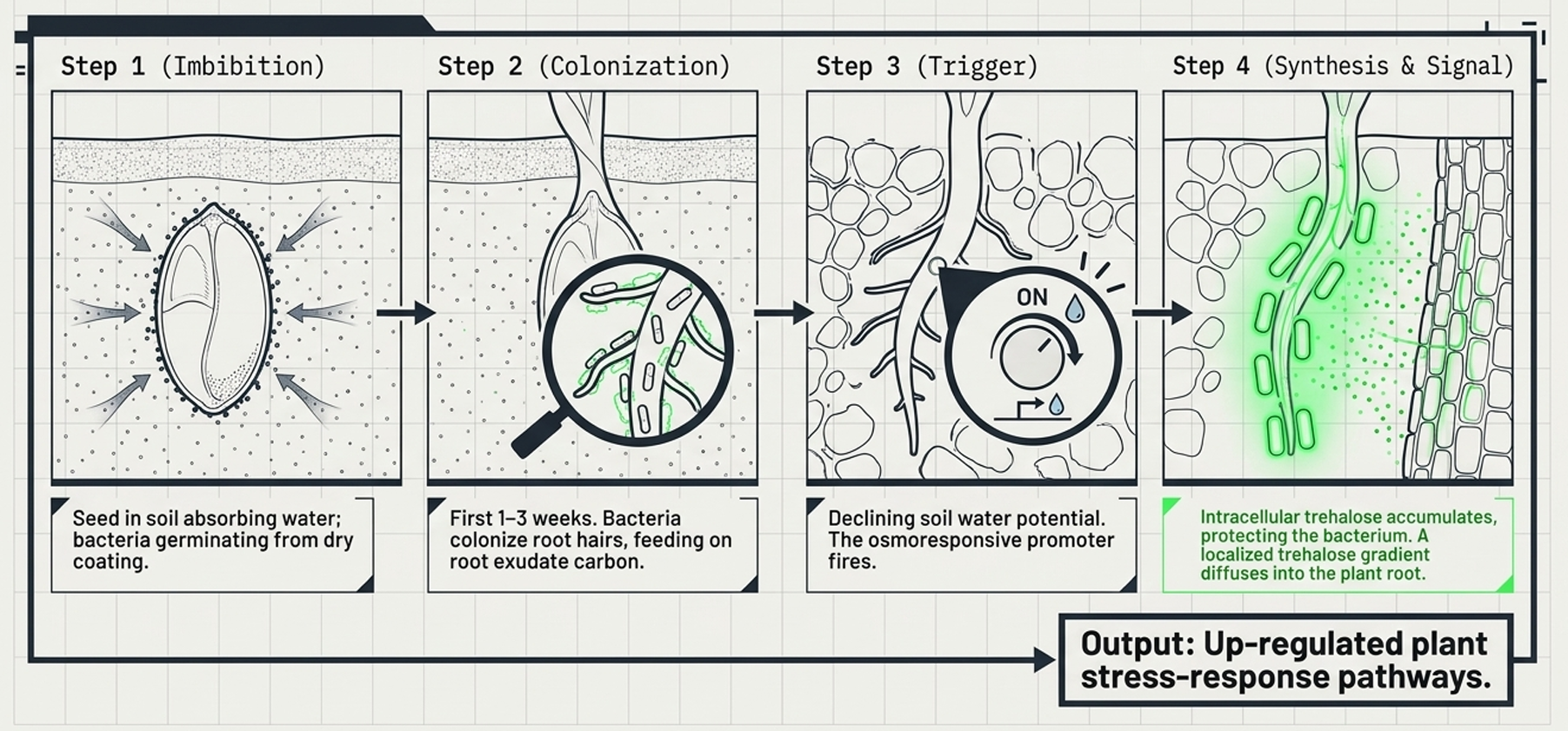
• In: coated seed; soil water at imbibition; root exudate carbon (organic acids, sugars) as the ongoing feedstock once colonization is established.
• Process: seed imbibes → bacteria germinate from spores or resuscitate from dried cells → rhizosphere colonization over the first 1–3 weeks → under declining soil water potential the osmoresponsive promoter fires → TPS–TPP converts UDP-glucose and glucose-6-phosphate to trehalose-6-phosphate and then to trehalose → trehalose accumulates intracellularly, protecting the bacterium, and a small quantity reaches the root.
• Out: a colonized, stress-primed root system; upregulated plant stress-response, carbon and nitrogen metabolism gene expression; measurable outcomes are relative water content, biomass, and ultimately grain yield under water deficit.
Assumptions I am making, stated explicitly.
- That trehalose or T6P crosses from bacterium to root in a physiologically meaningful quantity. This is the field’s working hypothesis, not a measured flux, and it is Unknown #1 in Section 5.
- That results obtained in maize transfer to wheat, despite differences in root architecture and in the timing of the critical stress window.
- That a promoter tuned against PEG or NaCl in liquid culture fires appropriately at real field matric potentials — laboratory osmotic stress and field drying are not the same stimulus.
- That the engineered strain colonizes wheat roots at wild-type efficiency. This is supported by the observation that altering trehalose metabolism in Azospirillum did not impair root colonization under either normal or drought conditions.
(3) How would you use automation?
Prototyping: promoter tuning on a liquid-handling robot
The critical design parameter is the promoter’s transfer function, and finding it is a combinatorial search. I would use an Opentrons OT-2 to build and screen a library of candidate stress-responsive promoters driving a fluorescent reporter in the chosen chassis.
• 24 candidate promoters (native otsBA, proU, osmY, synthetic variants with mutated operator spacing)
• × 8 osmotic potentials (a PEG-6000 or NaCl ladder spanning field capacity to severe deficit)
• × 3 biological replicates
• = 576 wells, or two 384-well plates, read on a plate reader in a single afternoon
The selection criterion is not maximum expression but the right shape: low basal output at high water potential, sharp induction below a defined threshold, and no runaway expression at extreme stress. Screening this by hand is the difference between a week and a semester, and manual pipetting introduces exactly the well-to-well variance that would obscure a transfer-function shape.
A second automation target is the production fermentation itself: a parallel micro-bioreactor array under automated design-of-experiments to optimize carbon source, dissolved oxygen, feed rate, and (for a Bacillus backup) the sporulation trigger. This is where fed-batch process development compresses from months of sequential runs to weeks of parallel ones.
Manufacturing: entirely different equipment
At production scale the automation is conventional bioprocess and seed-treatment machinery, not laboratory robotics: automated fed-batch feed control on a 50 m³ fermenter, continuous-flow centrifugation for harvest, spray or freeze drying with in-line moisture control, and automated seed coating. Commercial seed treatment uses fluidized-bed equipment, augers, roller mills, rotostatic seed treaters and drum coaters — and the automation that matters most is in-line viability QC, because the product’s specification is live cells per seed and that number decays continuously from the moment of harvest.
(4) How much would you need to make, and how long would it take?
(a) How much?
Scale definition: the rainfed wheat area of Central Anatolia, taken as 3 million hectares (a conservative subset of Türkiye’s ~7.1 Mha total wheat area).
| Quantity | Value | Basis |
|---|---|---|
| Seeding rate | 200 kg/ha | Turkish practice; ~1.8 Mt seed sown nationally per year |
| Thousand-kernel weight | 40 g | typical bread wheat → 25,000 seeds/kg |
| Seeds per hectare | 5 × 10⁶ | 200 kg/ha × 25,000 seeds/kg |
| Dose per seed | 1 × 10⁶ CFU | standard commercial seed-treatment loading |
| CFU per hectare | 5 × 10¹² | 5 × 10⁶ seeds × 10⁶ CFU |
| Total CFU per year | 1.5 × 10¹⁹ | 5 × 10¹² × 3 × 10⁶ ha |
(b) How long?
Assume high-cell-density fed-batch fermentation reaching 1 × 10¹⁰ CFU/mL = 1 × 10¹³ CFU/L. This is deliberately conservative; optimised low-cost media for bioinoculants have been reported substantially higher.
Base case (no viability loss):
• Broth required: 1.5 × 10¹⁹ CFU ÷ 10¹³ CFU/L = 1.5 × 10⁶ L = 1,500 m³/year
• In a 50 m³ fermenter: 1,500 ÷ 50 = 30 batches
• At 24 h fermentation + 12 h turnaround = 1.5 days/batch: 45 days of fermentation per year
So a single 50 m³ line, running roughly six weeks a year, supplies an area the size of Central Anatolia.
Realistic case (1-log loss through drying, formulation and storage):
Regulatory frameworks typically require 10⁷–10⁹ CFU per gram or millilitre at time of manufacture, and liquid inoculants have been documented losing on the order of three log units over six months of storage. Allowing a single log of overage:
• Broth required: 15,000 m³/year → 300 batches → ~450 days, i.e. two lines running nearly continuously.
This tenfold swing is the dominant result of the whole calculation, and it is not a titer problem. Plant size here is set by whether the organism survives the shelf, not by how well it grows in the fermenter. That is the engineering argument for carrying a sporulating Bacillus chassis in parallel: spores would collapse the overage factor and with it the capital requirement.
Cost sanity check
At 1,500 m³ for 3 Mha, broth consumption is 0.5 L per hectare. At a fully loaded fermentation cost of $2–10/L, the active ingredient costs $1–5/ha — essentially identical to the purchased-trehalose route (0.27 kg/ha × ~$4/kg ≈ $1.10/ha), but delivering continuous rather than single-dose synthesis. Against roughly $650/ha of gross wheat revenue at 2.6 t/ha, break-even requires a yield response below 1%. The economics are not the risk in this project. The biology is.
5. What don’t you know yet?
Unknown 1 — Does anything actually cross from bacterium to root?
The entire design rests on bacterial trehalose reaching the plant as a signal, and this flux has never been directly measured. The literature’s own statement of the mechanism is explicitly hypothetical: that very small amounts of trehalose are translocated to the roots and signal stress-tolerance pathways in the plant. It remains possible that the observed benefit is mediated entirely by bacterial survival — a trehalose-protected bacterium simply persists better under drought and continues delivering unrelated plant-growth-promoting functions such as auxin secretion.
What I would measure: ¹³C- or ¹⁴C-labelled trehalose feeding with root-tissue tracing; quantification of T6P and trehalose in root tissue by LC-MS/MS comparing engineered, wild-type and trehalase-expressing strains; and transcriptomic confirmation that plant stress-response genes are induced in a trehalose-dependent manner. If the flux is negligible, the whole delivery rationale collapses and the project should revert to direct trehalose application.
Unknown 2 — Does the maize result transfer to wheat under terminal drought?
Every supporting study is a pot experiment scoring seedling survival and biomass, not a multi-site field trial scoring grain yield. The proximate endpoints reported — survival percentage, shoot and root fresh weight, relative water content, leaf and root length — are not yield. Wheat and maize differ in root architecture, in C3 versus C4 physiology, and critically in the timing of the stress window that determines yield: wheat’s vulnerability is terminal drought during grain filling, which no seedling-stage assay captures.
What I would measure: multi-site, multi-year replicated field trials in Central Anatolia with grain yield as the primary endpoint and managed terminal-drought treatments, plus rhizosphere colonization persistence through to anthesis.
Unknown 3 — Is the regulatory path longer than the technical one?
This is a deliberate environmental release of a genetically modified organism across millions of hectares. Turkey’s biosafety framework is restrictive, and no engineered PGPR of this type is approved for release there. It is entirely possible that the science works and the product never reaches a field. The fallback, and it is a serious one: screen for naturally high-trehalose-accumulating wild isolates rather than engineering them. A. argentinense Az19 is itself a wild osmotolerant strain, and the loss-of-function work demonstrates that its native trehalose accumulation is already functionally significant under drought. A selection-based rather than engineering-based product would likely show a smaller effect size but faces a dramatically shorter route to the field. I would run both tracks in parallel and let the regulatory timeline, not the effect size, decide which ships.
Supporting evidence
The proposal has a direct published precedent, and the evidence chain is unusually strong because it includes gain-of-function, extension to a cereal, and loss-of-function control.
Gain of function — Suárez et al. 2008
Overexpression of trehalose-6-phosphate synthase in the symbiotic bacterium Rhizobium etli, inoculated onto common bean:
• Plants given the overexpressing strain had more nodules, higher nitrogenase activity and greater biomass than plants given wild-type R. etli
• Plants given a trehalose-6-phosphate synthase mutant strain had fewer nodules, less nitrogenase activity and less biomass — a dose-response in both directions
• Under drought, plants inoculated with the overexpressing strain fully recovered, while those inoculated with wild-type or mutant strains wilted and died
• Yield under constant irrigation increased by more than 50%
• Macroarray analysis of 7,200 ESTs from nodules revealed upregulation of genes in stress tolerance and in carbon and nitrogen metabolism, suggesting a signalling mechanism for trehalose
That final point is the mechanistic basis for preferring continuous in-situ synthesis over a single applied dose.
Extension to a cereal — Rodríguez-Salazar et al. 2009
Azospirillum brasilense transformed with a trehalose-biosynthesis gene fusion from S. cerevisiae, inoculated onto maize:
• Transformed bacteria grew at up to 0.5 M NaCl and accumulated trehalose; wild type tolerated neither osmotic stress nor accumulated significant disaccharide
• 85% of inoculated maize plants survived drought stress versus 55% with the wild-type strain
• 73% increase in biomass relative to wild-type inoculation, with significant increases in leaf and root length
• The bifunctional yeast fusion construct outperformed ReOtsA alone, giving biomass 1.7× that of non-inoculated plants — the basis for the construct choice in Section 2
Loss of function — Azospirillum argentinense Az19
The strongest single piece of evidence, because it isolates the variable. The trehalase gene treF was constitutively expressed in Az19 to abolish trehalose accumulation:
• The resulting strain Az19F did not accumulate trehalose and was impaired in coping with salt, osmotic and UV stress
• Root colonization was unaffected under both normal and drought conditions — removing the obvious confound
• Both strains promoted maize growth equally under normal irrigation
• Under drought, Az19F was defective: reduced capacity to improve plant height and fresh weight, and it failed to raise relative water content as Az19 did Colonization held constant, trehalose removed, benefit disappears only under drought. This rules out the alternative explanation that the bacteria help through unrelated plant-growth-promoting mechanisms.
References
Suárez, R., Wong, A., Ramírez, M., Barraza, A., Orozco, M. del C., Cevallos, M. A., Lara, M., Hernández, G., & Iturriaga, G. (2008). Improvement of drought tolerance and grain yield in common bean by overexpressing trehalose-6-phosphate synthase in rhizobia. Molecular Plant-Microbe Interactions, 21(7), 958–966. https://doi.org/10.1094/MPMI-21-7-0958
Rodríguez-Salazar, J., Suárez, R., Caballero-Mellado, J., & Iturriaga, G. (2009). Trehalose accumulation in Azospirillum brasilense improves drought tolerance and biomass in maize plants. FEMS Microbiology Letters, 296(1), 52–59. https://doi.org/10.1111/j.1574-6968.2009.01614.x
Maize drought protection by Azospirillum argentinense Az19 requires bacterial trehalose accumulation. (2024). Applied and Environmental Microbiology. PMC11680609.
Al Hinai, M. S., Rehman, A., Siddique, K. H. M., & Farooq, M. (2025). The role of trehalose in improving drought tolerance in wheat. Journal of Agronomy and Crop Science, 211, e70053. https://doi.org/10.1111/jac.70053
USDA Foreign Agricultural Service. (2020). Turkey MY2020/2021 near-record wheat yield. International Production Assessment Division.
Republic of Türkiye Ministry of Agriculture and Forestry. Seed Production. (National wheat area and seed volume figures.)
Course readings drawn on: Petzold & Mukhopadhyay (2025) on high-throughput technologies and automated workflows in biomanufacturing; Asin-Garcia et al. (2025) on enabling research infrastructure.
Declaration of AI use
Client: Claude Opus 5 and Undermind.ai
Prompt: I want to find primary research on exogenous trehalose application in wheat, barley, and maize—as seed priming, seed soaking, seed coating, or foliar treatment—to improve drought tolerance under agronomic-scale water-deficit conditions beyond seedling or PEG-based screening, including field, semi-field, or other production-relevant studies that report quantitative grain yield and/or yield-component outcomes. I want studies that specify trehalose concentration/dose and application method, ideally include dose–response relationships, and provide evidence relevant to whether the observed effects are due to osmoprotection versus trehalose-6-phosphate–related signaling, including data on the persistence or turnover of exogenously applied trehalose in planta given trehalase activity. Reviews are useful for orientation, but the priority is primary research with quantitative agronomic outcomes, excluding studies focused solely on transgenic TPS/TPP manipulation unless they also include an exogenous trehalose application comparison.