Week 2 HW: DNA Design
Part 0: Setup in Benchling
Repository Name: Project/MIT HTBAA 2026
Project Name: Engineered trehalose-overproducing rhizobacterial seed inoculant for rainfed wheat
Part 1: Expression Target
What molecule am I expressing?
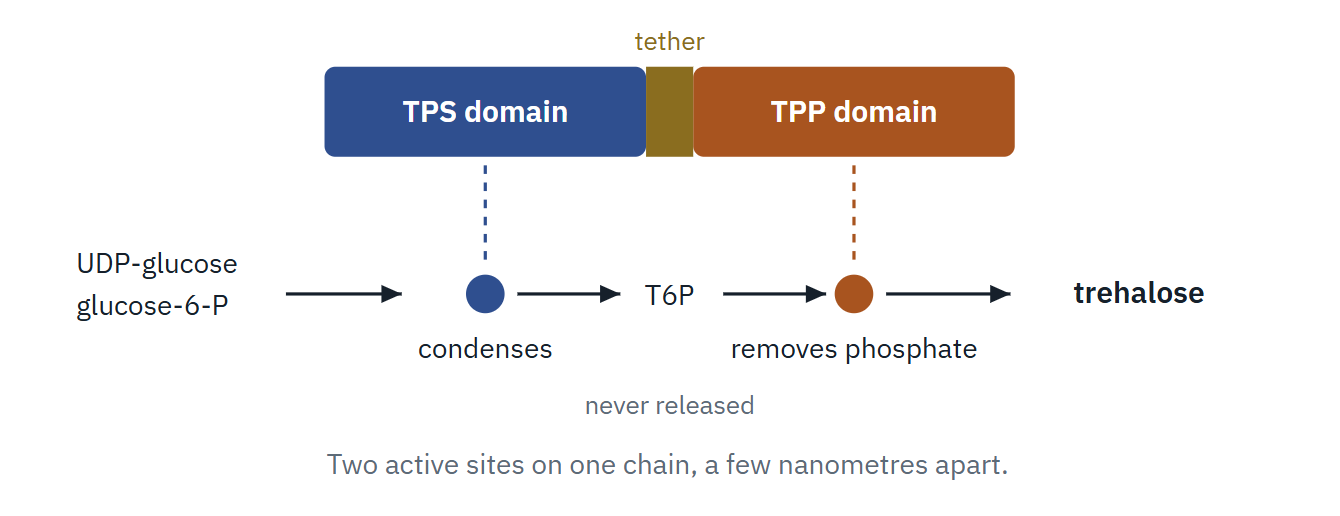
A single bifunctional trehalose-6-phosphate synthase / trehalose-6-phosphate phosphatase (TPS–TPP) fusion enzyme of 892 amino acids: one polypeptide carrying two sequential catalytic activities. TPS (EC 2.4.1.15) condenses UDP-glucose and glucose-6-phosphate to trehalose-6-phosphate (T6P); TPP (EC 3.1.3.12) then dephosphorylates T6P to trehalose. Expressing this as one fusion rather than two genes is a deliberate design choice with three justifications, two of them drawn directly from the source literature:
It avoids T6P accumulation. Rodríguez-Salazar et al. state that the bifunctional construct was selected because it has strong TPP activity, thereby avoiding accumulation of free trehalose-6-phosphate in the cytosol, which is known to provoke pleiotropic effects (De Virgilio et al. 1994; Schluepmann et al. 2004). T6P is a regulator of central carbon metabolism, not an inert intermediate.
It is empirically the better performer. In the same study the BIF strain outperformed the single-enzyme ReOtsA strain at 0.5 M NaCl, accumulated 2× basal trehalose under salt stress versus 1.5× for ReOtsA, and produced the only statistically significant gains in plant survival (85%) and biomass (1.7× uninoculated).
It simplifies the genetic design. One promoter, one ribosome binding site, one coding sequence, and no stoichiometric balancing between separately expressed enzymes.
What is the sequence, and where does it come from?
The construct reproduces the chimeric BIF gene of Miranda et al. (2007), as deployed in A. brasilense by Rodríguez-Salazar et al. (2009).
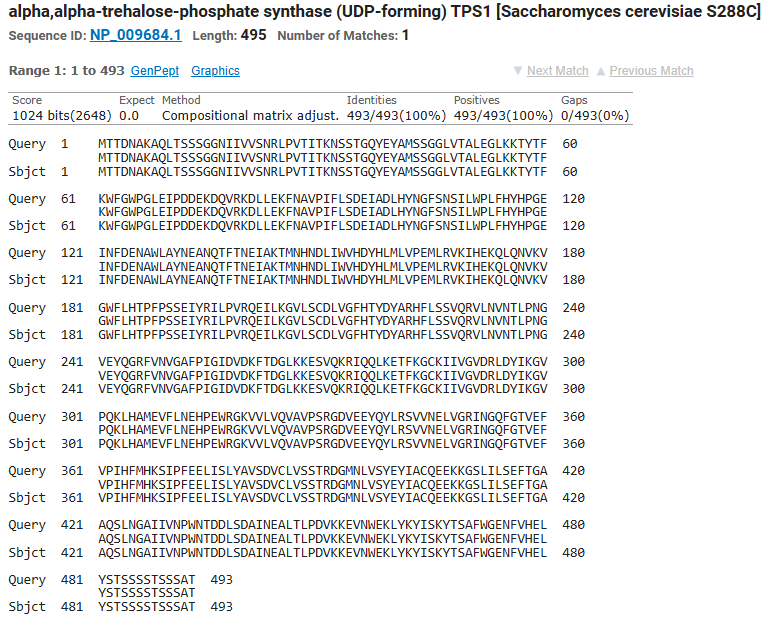
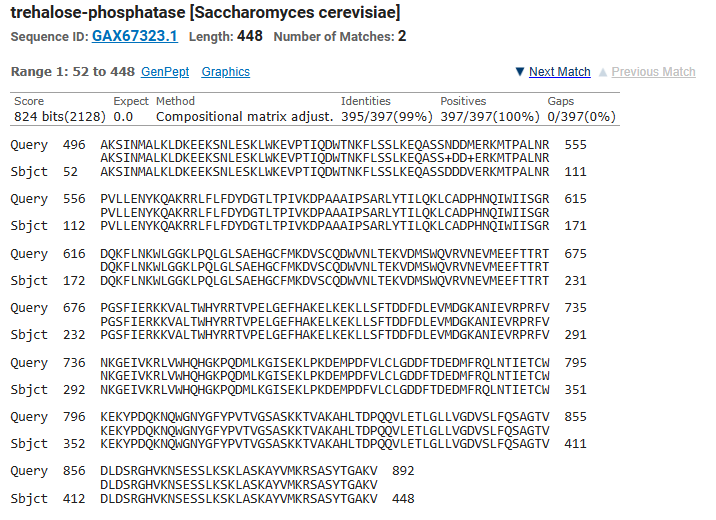
Domain Accession Region used Notes Sequence TPS (synthase) Q00764 TPS1_YEAST residues 1–493 of 495 Full-length CDS minus the C-terminal Lys-Asn and the stop codon, removed by the cloning primer MTTDNAKAQL…
MTTDNAKAQLTSSSGGNIIVVSNRLPVTITKNSSTGQYEYAMSSGGLVTALEGLKKTYTFKWFGWPGLEIPDDEKDQVRKDLLEKFNAVPIFLSDEIADLHYNGFSNSILWPLFHYHPGEINFDENAWLAYNEANQTFTNEIAKTMNHNDLIWVHDYHLMLVPEMLRVKIHEKQLQNVKVGWFLHTPFPSSEIYRILPVRQEILKGVLSCDLVGFHTYDYARHFLSSVQRVLNVNTLPNGVEYQGRFVNVGAFPIGIDVDKFTDGLKKESVQKRIQQLKETFKGCKIIVGVDRLDYIKGVPQKLHAMEVFLNEHPEWRGKVVLVQVAVPSRGDVEEYQYLRSVVNELVGRINGQFGTVEFVPIHFMHKSIPFEELISLYAVSDVCLVSSTRDGMNLVSYEYIACQEEKKGSLILSEFTGAAQSLNGAIIVNPWNTDDLSDAINEALTLPDVKKEVNWEKLYKYISKYTSAFWGENFVHELYSTSSSSTSSSATLinker — BamHI site GGATCC Encodes Gly-Ser; contributes 2 residues, counted once in the fusion GS TPP (phosphatase) P31688 TPS2_YEAST residues 500–896 of 896 C-terminal 397 aa. Removing the first 504 residues of TPS2 leaves a 392-aa C-terminus that is still fully active, since it encompasses the homology blocks present in all TPP enzymes (Vogel et al. 1998); this construct retains slightly more than that minimum AKSINMALKL…
AKSINMALKLDKEEKSNLESKLWKEVPTIQDWTNKFLSSLKEQASSNDDMERKMTPALNRPVLLENYKQAKRRLFLFDYDGTLTPIVKDPAAAIPSARLYTILQKLCADPHNQIWIISGRDQKFLNKWLGGKLPQLGLSAEHGCFMKDVSCQDWVNLTEKVDMSWQVRVNEVMEEFTTRTPGSFIERKKVALTWHYRRTVPELGEFHAKELKEKLLSFTDDFDLEVMDGKANIEVRPRFVNKGEIVKRLVWHQHGKPQDMLKGISEKLPKDEMPDFVLCLGDDFTDEDMFRQLNTIETCWKEKYPDQKNQWGNYGFYPVTVGSASKKTVAKAHLTDPQQVLETLGLLVGDVSLFQSAGTVDLDSRGHVKNSESSLKSKLASKAYVMKRSASYTGAKVTPS-TPP Fusion Protein
MTTDNAKAQLTSSSGGNIIVVSNRLPVTITKNSSTGQYEYAMSSGGLVTALEGLKKTYTFKWFGWPGLEIPDDEKDQVRKDLLEKFNAVPIFLSDEIADLHYNGFSNSILWPLFHYHPGEINFDENAWLAYNEANQTFTNEIAKTMNHNDLIWVHDYHLMLVPEMLRVKIHEKQLQNVKVGWFLHTPFPSSEIYRILPVRQEILKGVLSCDLVGFHTYDYARHFLSSVQRVLNVNTLPNGVEYQGRFVNVGAFPIGIDVDKFTDGLKKESVQKRIQQLKETFKGCKIIVGVDRLDYIKGVPQKLHAMEVFLNEHPEWRGKVVLVQVAVPSRGDVEEYQYLRSVVNELVGRINGQFGTVEFVPIHFMHKSIPFEELISLYAVSDVCLVSSTRDGMNLVSYEYIACQEEKKGSLILSEFTGAAQSLNGAIIVNPWNTDDLSDAINEALTLPDVKKEVNWEKLYKYISKYTSAFWGENFVHELYSTSSSSTSSSATGSAKSINMALKLDKEEKSNLESKLWKEVPTIQDWTNKFLSSLKEQASSNDDMERKMTPALNRPVLLENYKQAKRRLFLFDYDGTLTPIVKDPAAAIPSARLYTILQKLCADPHNQIWIISGRDQKFLNKWLGGKLPQLGLSAEHGCFMKDVSCQDWVNLTEKVDMSWQVRVNEVMEEFTTRTPGSFIERKKVALTWHYRRTVPELGEFHAKELKEKLLSFTDDFDLEVMDGKANIEVRPRFVNKGEIVKRLVWHQHGKPQDMLKGISEKLPKDEMPDFVLCLGDDFTDEDMFRQLNTIETCWKEKYPDQKNQWGNYGFYPVTVGSASKKTVAKAHLTDPQQVLETLGLLVGDVSLFQSAGTVDLDSRGHVKNSESSLKSKLASKAYVMKRSASYTGAKV
Protein: 493 (TPS1) + 2 (Gly-Ser linker) + 397 (TPS2 C-terminus) = 892 aa, matching the ORF reported after sequencing of the published fusion.
DNA: the published chimeric fragment is 2,873 bp, comprising a 1,526-bp TPS1 fragment (including 41 bp of 5′ leader) and a 1,353-bp TPS2 fragment (including 153 bp of untranslated 3′ end), with the shared BamHI site counted once: 1,526 + 1,353 − 6 = 2,873 bp. Subtracting the untranslated flanks gives 2,873 − 41 − 153 = 2,679 bp of coding sequence = 892 codons + stop. The protein and DNA arithmetic agree independently.
What host or chassis?
Azospirillum brasilense strain Cd, the plant-growth-promoting rhizobacterium proposed in Homework #1. Two organisms appear in the workflow: the plasmid is constructed in E. coli DH5α, mobilized by conjugation using E. coli S17-1, and expressed in A. brasilense. Conjugation rather than electroporation is the published route.
One fact about this host drives much of the design: A. brasilense has no native trehalose biosynthesis genes — Rodríguez-Salazar et al. note that no homologous genes are available in databases from A. brasilense or closely related species, and that wild-type cells neither tolerate osmotic stress nor accumulate significant trehalose. The trehalose pathway here is genuinely introduced, not amplified, and there is no native ots promoter in this organism to borrow.
Where does the product need to go?
Cytoplasm. No signal peptide, no targeting sequence. Both substrates are cytoplasmic metabolites and the enzyme has no reason to leave the cell. Whether the trehalose product reaches the wheat root is a transport question, not a targeting question — and as Part 6 sets out, the published attempt to detect it in plant tissue failed. Adding a secretion signal to an 892-aa cytoplasmic enzyme would be a design error.
Part 2: Genetic Parts
The expression context is taken from Rodríguez-Salazar et al., who used the broad-host-range vector pBBR1MCS-5 (Kovach et al. 1995) with expression under the lac promoter, gentamicin selection at 30 µg/mL, and conjugal transfer from E. coli S17-1. Their construct is designated pBBR1M::BIF, where :: is the standard genetic notation for “carrying” — i.e. pBBR1MCS-5 carrying the BIF gene. The constructs described below are distinct from theirs and are named accordingly.
| Part type | Name | BioBrick | Source | Justification |
|---|---|---|---|---|
| Backbone | pBBR1MCS-5 | user-defined | Kovach et al. 1995 | Broad-host-range; demonstrated to express this exact insert in A. brasilense. No Registry equivalent — standard BioBrick backbones (pSB1C3 and relatives) are ColE1-based and will not replicate in this host. |
| Origin | pBBR1 rep / oriV | user-defined | Within backbone | Replicates across α-, β- and γ-proteobacteria at moderate copy number. |
| Selection marker | aacC1 (GmR) | user-defined | Within backbone | Gentamicin 30 µg/mL. Registry markers are typically CmR, AmpR or KanR. Ampicillin is unusable here — wild-type A. brasilense is intrinsically resistant. |
| Promoter — control arm | Plac | BBa_R0010 | Within backbone | LacI- and CAP-regulated, 199 bp. Reproduces the published construct. Note the authors’ own caveat that lac may itself be stress-induced in this host, so this arm may not be truly constitutive. |
| Promoter — test arm | PkatC / PotsA (S. meliloti) | user-defined | Alphaproteobacterial genome | RpoE2/EcfG-dependent osmo-inducible promoter. Must be heterologous — this host has no native trehalose regulon. Alphaproteobacterial stress promoters are essentially absent from the Registry. See Appendix A. |
| Promoter — reference ladder | Anderson series | BBa_J23100–J23119 | iGEM Registry | Constitutive promoters of graded strength, used as the strong and weak anchor rungs of the induction screen. |
| Ribosome binding site | AAGGAAAACCCC | user-defined (cf. BBa_B0034) | Rodríguez-Salazar et al. 2009 | The synthetic Shine–Dalgarno added by the published forward primer. Retained in preference to BBa_B0034 (AAAGAGGAGAAA, the Registry reference RBS) because it is the only RBS empirically shown to drive this insert in this host. |
| Coding sequence | BIF = TPS1(1–493) + GS + TPS2(500–896) | new part | Q00764 / P31688 | 892 aa, 2,679 bp. Novel by construction — this would be submitted as a new Registry part, not cited as an existing one. |
| Linker | Gly-Ser | n/a | BamHI site | Two residues encoded by the in-frame GGATCC junction; too small to warrant a part number. |
| Terminator | rrnB T1 + T7 TE | BBa_B0015 | iGEM Registry | Double terminator = BBa_B0010 (rrnB T1) + BBa_B0012 (T7 TE). Prevents readthrough into the backbone and the plasmid instability that follows. Use BBa_B0010 alone if a single terminator is preferred. |
| Reporter (screen only) | GFPmut3b | BBa_E0040 | iGEM Registry | Fused to each candidate promoter for the induction screen in Appendices A and B; absent from the production construct. |
| Cloning sites | XhoI / KpnI | n/a | Rodríguez-Salazar et al. 2009 | The published flanking sites: XhoI 5′ of the SD, KpnI 3′ of the stop codon. BamHI is internal, at the fusion junction. |
| Tag (prototype only) | N-terminal 6×His | user-defined | Designed | For Western and activity QC. N-terminal so the C-terminal TPP domain stays unobstructed. The deployment version is untagged. |
What is novel here, and what is deliberately reused The backbone is reused, and intentionally so. An origin of replication, a mobilization region and a resistance cassette are solved engineering problems; re-deriving a broad-host-range replicon that functions in an alphaproteobacterium would be a multi-year project rather than a design exercise. pBBR1MCS-5 is treated here as a chassis for the cassette, and what it provides is stated explicitly in the table above.
The novelty is in the cassette, and it is threefold:
(i) the coding sequence is codon-optimized for ~68% GC and is therefore a different molecule from the published BIF gene — roughly 75–80% nucleotide identity while encoding an identical protein;
(ii) the regulatory architecture replaces Plac with an RpoE2-dependent osmo-inducible promoter, which is the design contribution carried forward from Homework #1; and
(iii) an explicit terminator is added, where the published construct relied on vector context. The deployment construct is different again — a markerless mini-Tn7 chromosomal integrant rather than a plasmid at all.
Three plasmids are specified rather than one, so that each experimental arm changes exactly one variable. Without pAzT-1 and pAzT-2 it would be impossible to attribute any change in activity to codon optimization as opposed to the promoter swap.
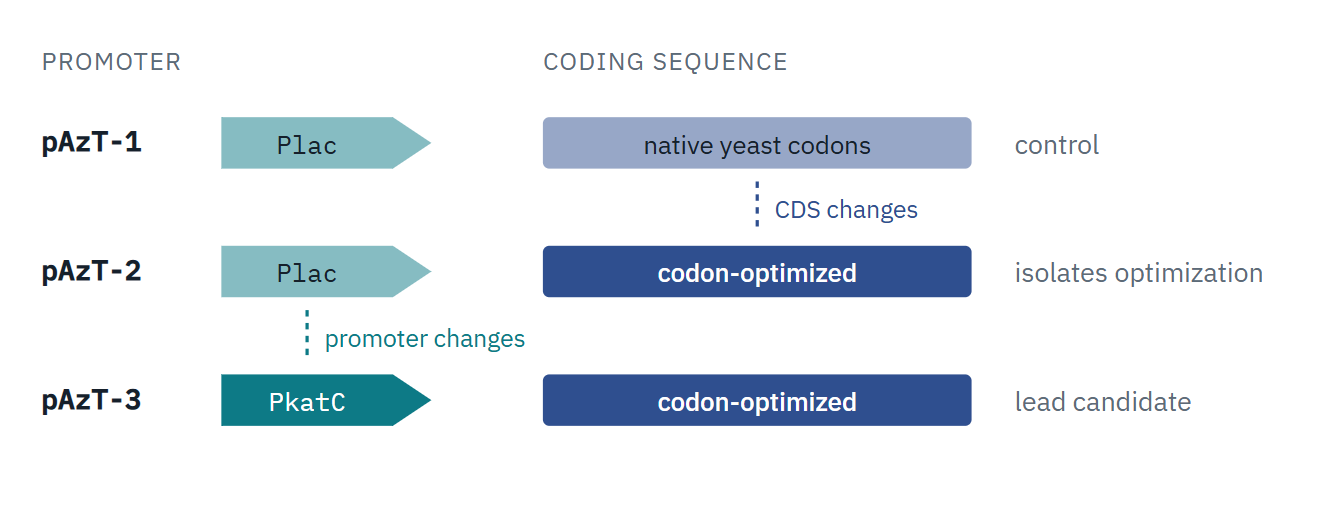
| Name | Promoter | Coding sequence | Role |
|---|---|---|---|
| pAzT-1 | Plac | Native yeast codons | Reproduces the published construct; the positive control, and the only arm with published performance data to compare against |
| pAzT-2 | Plac | Codon-optimized | Isolates the effect of codon optimization alone — the reference arm for Unknown #2 in Part 6 |
| pAzT-3 | PkatC (or the Appendix A winner) | Codon-optimized | The lead candidate: inducible expression of the optimized cassette |
Containment — named, and deliberately not built into this plasmid Homework #1 identified regulatory approval, not biology, as the likely binding constraint on this product. Plasmid-borne gentamicin resistance distributed across three million hectares is not a defensible release. The deployment strain should therefore be a markerless chromosomal integrant delivered by mini-Tn7, which also removes the plasmid-retention risk discussed in Part 6. The plasmid described here is a research tool for the promoter screen and the activity assays, not the product.
Part 3: Construct Assembly
Order of parts in pAzT-3, 5′→3′, in the pBBR1MCS-5 multiple cloning site. pAzT-1 and pAzT-2 differ only in the promoter and the codon usage of the CDS:
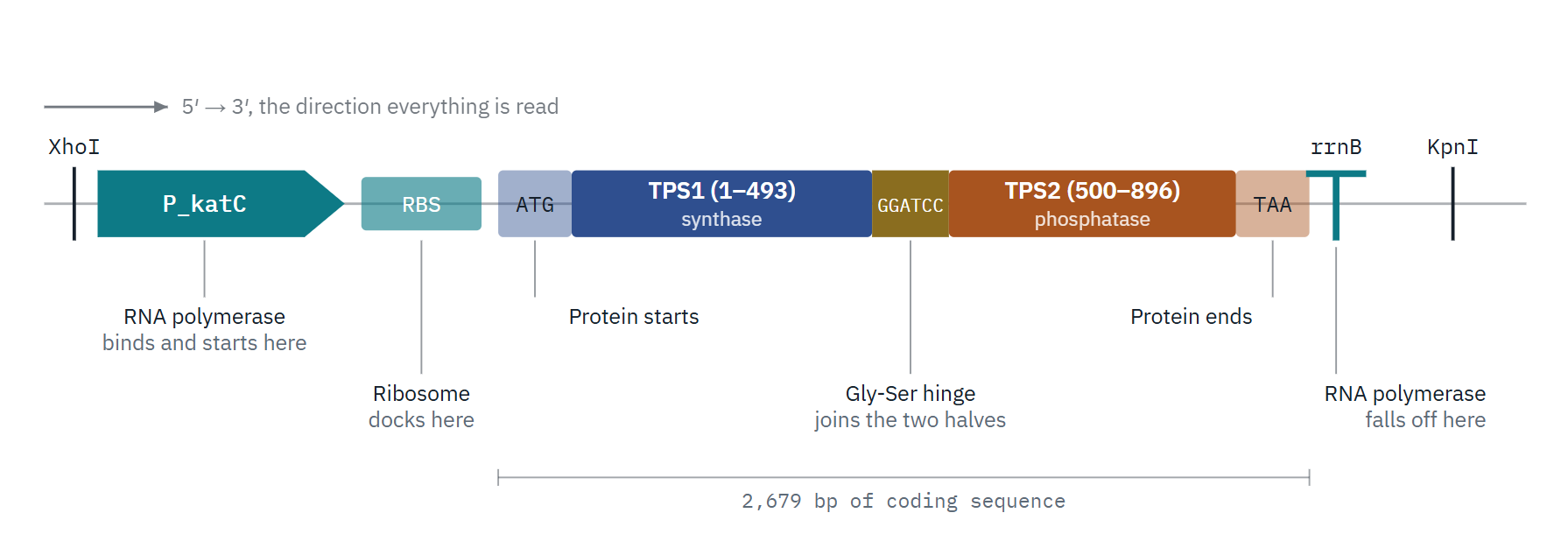
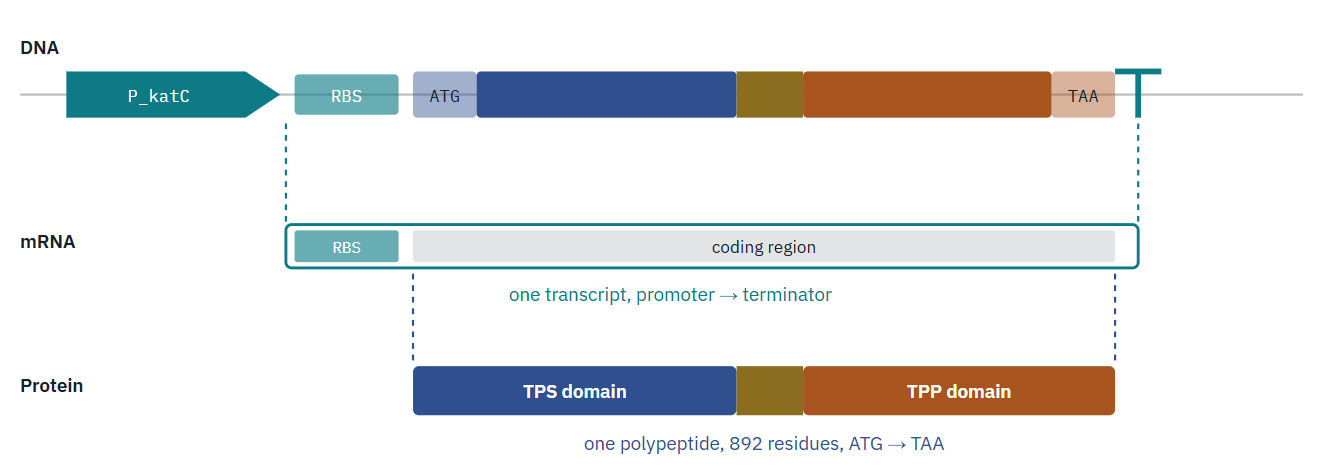
RNA polymerase copies DNA into mRNA. It starts at the promoter and runs until the terminator. Then the ribosome reads that mRNA into protein — but it does not start at the beginning of the mRNA. It docks at the RBS, slides to the ATG, and stops at TAA, well before the mRNA ends.
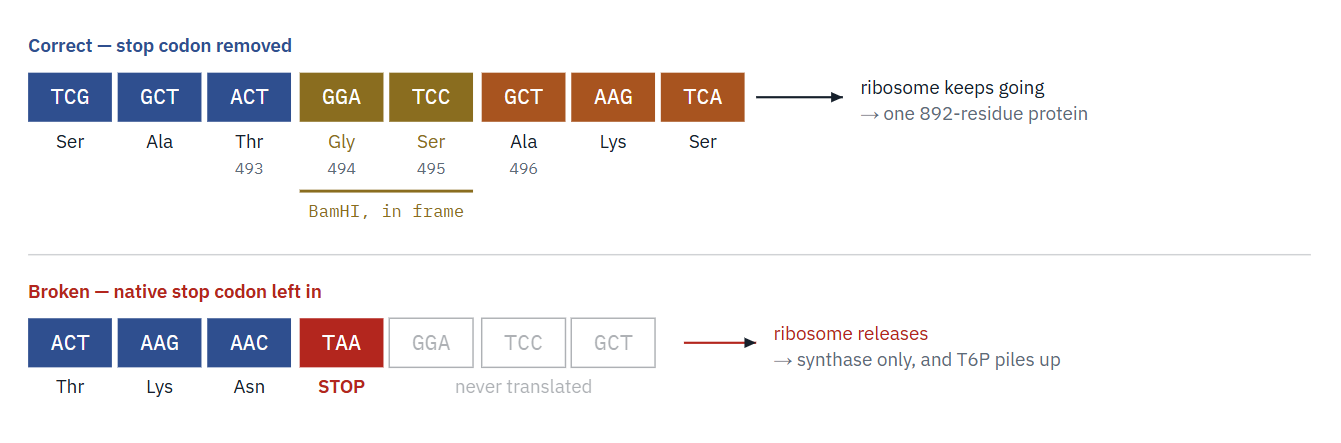
Native TPS1 ends with …AAG AAC TAA — Lys, Asn, then stop. Leave that stop in place and the ribosome falls off the mRNA before it ever reaches TPS2.
What the finished protein actually does T6P is not an inert intermediate — it is a potent regulator of central carbon metabolism, so letting it accumulate causes trouble of its own. Tethering the phosphatase to the synthase means the intermediate is handed straight from one active site to the next.
Part 4: Optimization and quality control
(a) Codon optimization
What I ran. The 892-residue fusion was back-translated against the Azospirillum brasilense codon usage table from the Kazusa database (species 192; 233 CDSs, 86,126 codons). The table’s published GC figures were recomputed independently and matched to within 0.02%, confirming the table was read correctly.
Constraints applied: exclude XhoI, KpnI, EcoRI, XbaI, SpeI and PstI entirely; permit exactly one BamHI site, at the fusion junction; cap GC at 75% in any 60 bp window; cap homopolymer runs at 6; cap repeated k-mers at 12 bp; and forbid internal Shine–Dalgarno-like motifs, which cause ribosomal pausing.
| Metric | Before | After | Comment |
|---|---|---|---|
| GC content | ~38–40% | 63.0% | Before figure is the typical range for S. cerevisiae genes |
| GC at third position (GC3) | low | 98.8% | Almost every codon now ends in G or C — this is where optimization does its work |
| Codon adaptation index (CAI) | measure it | 0.968 | 1.0 would be every codon the organism’s favourite |
| Length | 2,679 bp | 2,679 bp | Unchanged, as it must be |
| Protein sequence | 892 aa | 892 aa | Verified identical residue by residue |
What I concluded. The most important result is a limit rather than a gain: this protein cannot reach the 68.2% GC of the host genome. Its ceiling is 63.5%, and the constrained build reaches 63.0% of that. The reason is the second codon position, which is fixed by the amino acid for 825 of the 892 codons — serine is the only residue in the whole fusion offering any choice there. 582 of the residues force an A or T at that position, lysine and asparagine worst of all with AA and no GC at all in the first two bases. Optimization can therefore only act on the third position, which it drives to 98.8%. Quoting a 68% target would misstate what is achievable for this sequence.
(b) Sequence search
Blastp result for TPS
Blastp result for TPP
(c) Biosecurity screen
Benchling has no native biosecurity screen. Rather than skip the step, run the Common Mechanism, the free open-source screening tool published by IBBIS (the International Biosecurity and Biosafety Initiative for Science) and available on GitHub.
The coding sequence itself should screen clean. Trehalose biosynthesis enzymes are metabolically innocuous, the donor is a food-grade yeast, and the product is a common disaccharide sold as a food ingredient. Two flags are plausible on the full plasmid rather than the insert: the aacC1 gentamicin resistance marker, because antimicrobial resistance determinants are routinely flagged, and the mob/oriT mobilization functions, because conjugative transfer is a horizontal-gene-transfer consideration.
Both flags are expected, and the response to both is the same: each is legitimate in a laboratory research plasmid and not defensible in an environmental release across three million hectares. That is precisely why Part 2 specifies the deployment strain as a markerless mini-Tn7 chromosomal integrant rather than this plasmid. The screen does not change the design; it confirms the reasoning already built into it.
Part 5: From design to build
How would I build it?
The CDS is 2,679 bp; the cassette with promoter, RBS and terminator is roughly 3 kb; the finished plasmid is approximately 7.5–8 kb. That size favours fragment-based assembly: order the codon-optimized CDS as two or three synthetic fragments of about 1 kb and join them into PCR-linearized pBBR1MCS-5 in one Gibson assembly reaction. Gibson et al. (2009) demonstrated one-pot isothermal assembly of overlapping fragments scaling to hundreds of kilobases, so a three- or four-piece join is well within the method, and it removes any dependence on unique restriction sites in a sequence that has just been rewritten.
This is a deliberate departure from the published route, which used restriction cloning via XhoI and KpnI into pBBR1MCS-5 with an internal BamHI junction. Restriction cloning was appropriate for the unoptimized yeast sequence; after codon optimization at ~68% GC the risk of introducing new internal sites makes a sequence-independent method the safer choice. A single 2.7 kb synthetic block was considered and rejected: a GC-rich block of that length is exactly what commercial synthesis struggles with, and splitting it means a failed synthesis costs one fragment rather than the whole gene.
What does synthesis constrain?
There is a genuine tension in this design: optimizing toward 68% GC pushes the sequence into hard-to-synthesize territory. GC-rich windows reduce oligonucleotide coupling efficiency and promote hairpins that stall assembly, so the same change intended to improve expression degrades manufacturability. The 75% windowed-GC cap in Part 4 is the compromise between those two pressures.
Chip-synthesized oligonucleotides carry error rates high enough that across a 2.7 kb assembly most clones will contain at least one error. Carr et al. (2004) demonstrated protein-mediated error correction using MutS to remove heteroduplex-containing molecules from synthesis pools; Kosuri et al. (2010) showed scalable gene synthesis by selectively amplifying subpools from high-fidelity microchips, building on the accurate multiplex synthesis from programmable microchips of Tian et al. (2004). For a single construct the practical choice is to buy error-corrected fragments or to sequence-verify several clones; at library scale, error correction stops being optional.
Prototype versus scale
For this product, DNA is not the thing that scales. The construct is built and sequence-verified once; from then on the process manufactures cells. The Homework #1 production figures — 1,500 m³ of fermentation broth per year in the base case, 15,000 m³ allowing one log of shelf-life loss — involve no further DNA synthesis at all.
Chip-based pooled synthesis earns its place at the prototyping stage instead. The promoter screen in Appendix A — 24 promoters × 8 osmotic potentials × 3 replicates — is exactly the case for ordering one multiplexed oligo pool rather than 24 separately synthesized constructs, which is the economic argument Kosuri et al. and Tian et al. make. The difference between prototype and scale here is not DNA volume but kind: pooled combinatorial synthesis for the design search, then a single sequence-verified chromosomal integrant for manufacturing.
Part 6: What don’t I know yet
1. Does trehalose actually reach the plant? The published attempt to detect it failed.
Rodríguez-Salazar et al. measured trehalose in maize roots and leaves of inoculated plants and reported that no significant levels of the disaccharide could be detected in any analysed tissue. In the discussion they state plainly that they could not detect the disaccharide in plant tissues and hypothesise that very small amounts translocate and signal stress-tolerance pathways, adding that there is no clear evidence as to how bacterial trehalose could regulate plant genes.
Three explanations remain open, and they are not equivalent for the product:
(i) trehalose does transfer, below the HPLC detection limit, and acts as a signal;
(ii) trehalose never leaves the bacterium, and the benefit comes from a better-surviving, better-colonizing bacterium delivering unrelated plant-growth promotion such as auxin;
(iii) T6P or another metabolite, not trehalose, is the transferred species. Under (ii), optimizing trehalose output is optimizing the wrong variable.
How I would find out: isotope tracing rather than bulk quantification — feed ¹³C-labelled glucose to the bacteria and look for labelled trehalose or T6P in root tissue by LC-MS/MS, which is orders of magnitude more sensitive than the HPLC method used. In parallel, discriminate hypothesis (ii) directly by inoculating with a trehalose-null strain that is otherwise identical, the design used in the A. argentinense Az19F work, where colonization was unaffected but the drought benefit disappeared.
2. Will a codon-optimized 892-aa yeast fusion still fold and stay active?
The published fusion works in A. brasilense — but with native yeast codon usage, not a GC-optimized version. Codon optimization alters co-translational folding kinetics even when the protein sequence is unchanged, so optimizing for expression level can reduce active yield. This construct therefore departs from the one datum that proves the design functions.
How I would find out: assay TPS and TPP activities separately in lysates (coupled-enzyme assay for TPS, phosphate release for TPP), quantify intracellular trehalose by HPLC against a purified standard, and inspect the insoluble fraction for inclusion bodies — with the unoptimized published sequence built in parallel as the reference arm, which is the only way to attribute any loss to optimization. Design variants if it fails: revert to native codons; co-express GroESL; weaken the RBS to slow translation; or substitute the bacterial otsA–otsB fusion of Seo et al. (2000), which preserves bifunctionality with a prokaryotic protein.
3. Will the inducible promoter behave, in a host with no trehalose regulon?
Because A. brasilense has no native trehalose genes, the osmo-inducible promoter must be heterologous — most plausibly an RpoE2/EcfG-dependent promoter from S. meliloti or R. etli. Whether the corresponding sigma factor and activation cascade are present and similarly tuned in Azospirillum is untested. There is also a subtler problem: the authors suspect their lac promoter may itself be stress-induced in these hosts, which would mean the published “constitutive” baseline was already partly inducible — and that my control arm is not the control I think it is.
How I would find out: the reporter screen in Appendices A and B — promoter–GFP or luxAB fusions across an eight-point osmotic ladder, selecting on the shape of induction rather than its maximum. Include Plac in that screen explicitly to test whether it is stress-responsive in this host.
Appendix A — Promoter panel for the induction screen
| # | Promoter | Source | Stratum and rationale |
|---|---|---|---|
| 1 | PkatC | S. meliloti | A. Confirmed RpoE2 targets. Catalase C; among the best-characterized RpoE2-dependent promoters |
| 2 | PrpoH2 | S. meliloti | Heat-shock sigma factor, RpoE2 target |
| 3 | PrpoE2 | S. meliloti | Autoregulated — reports RpoE2 activity directly |
| 4 | PndiA1 | S. meliloti | Nutrient-deprivation-induced, RpoE2 target |
| 5 | PndiB | S. meliloti | Second ndi family member, independent readout |
| 6 | PglgA2 | S. meliloti | Glycogen synthesis — carbon-storage arm of the same regulon |
| 7 | PotsA | R. etli | B. Trehalose-pathway promoters. Native context for the ReOtsA gene used in the source study |
| 8 | PotsA | S. meliloti | RpoE2-dependent trehalose synthesis — closest published match to this use case |
| 9 | PtreY | S. meliloti | Alternative trehalose route; tests whether all routes share regulation |
| 10 | PtreS | B. japonicum | Third trehalose route; transcription correlates with trehalose levels |
| 11 | PrpoE2 | R. etli | EcfG homolog from the ReOtsA donor organism |
| 12–15 | PAb-1 … -4 | A. brasilense genome | C. Native candidates, mined not cited. Best matches to the RpoE2 consensus GGAACNaN13–14gcgTTt upstream of annotated ORFs — the only promoters already tuned to this host |
| 16 | PproU | E. coli | D. Portability controls, predicted to underperform. Classic osmotic induction, but σ⁷⁰/H-NS-dependent |
| 17 | PosmY | E. coli | RpoS-dependent — predicted failure, and that prediction is the experiment |
| 18 | PotsAB | E. coli | RpoS-dependent; same prediction |
| 19 | PkdpFABC | E. coli | Turgor-responsive via the KdpDE two-component system — more broadly conserved, best odds in this stratum |
| 20 | PkatC-s13 | Designed | E. Synthetic variants of the best stratum-A hit: −35/−10 spacer fixed at 13 nt |
| 21 | PkatC-s14 | Designed | Spacer fixed at 14 nt — the consensus permits both; resolves which this host prefers |
| 22 | PkatC-con | Designed | Perfect GGAAC −35; raises both basal and induced output |
| 23 | Plac | pBBR1MCS-5 | F. Anchors. The published promoter — positive control, and a direct test of the authors’ suspicion that it is itself stress-induced in this host |
| 24 | promoterless | Designed | Background floor; without it fold-induction cannot be computed |
Appendix B — Osmotic ladder for the induction screen
| # | NaCl (M) | NaCl (g/L) | Ψ (MPa) | Why this point |
|---|---|---|---|---|
| 1 | 0 | 0 | 0 | Uninduced baseline — defines basal expression |
| 2 | 0.05 | 2.9 | −0.23 | Just below field capacity; promoter should still be off |
| 3 | 0.10 | 5.8 | −0.45 | Lowest concentration tested in the source study; all strains grow |
| 4 | 0.15 | 8.8 | −0.68 | Moderate deficit |
| 5 | 0.20 | 11.7 | −0.91 | Approaching the documented induction point |
| 6 | 0.25 | 14.6 | −1.13 | Anchor: the documented RpoE2 activation condition |
| 7 | 0.30 | 17.5 | −1.36 | Anchor: wild type cannot grow here; BIF and ReOtsA grow equally well |
| 8 | 0.50 | 29.2 | −2.27 | Anchor: BIF outperforms ReOtsA; trehalose 2× basal |
References
Miranda, J. A., Avonce, N., Suárez, R., Thevelein, J. M., Van Dijck, P., & Iturriaga, G. (2007). A bifunctional TPS–TPP enzyme from yeast confers tolerance to multiple and extreme abiotic-stress conditions in transgenic Arabidopsis. Planta, 226, 1411–1421.
Rodríguez-Salazar, J., Suárez, R., Caballero-Mellado, J., & Iturriaga, G. (2009). Trehalose accumulation in Azospirillum brasilense improves drought tolerance and biomass in maize plants. FEMS Microbiology Letters, 296(1), 52–59.
Suárez, R., Wong, A., Ramírez, M., Barraza, A., Orozco, M. del C., Cevallos, M. A., Lara, M., Hernández, G., & Iturriaga, G. (2008). Improvement of drought tolerance and grain yield in common bean by overexpressing trehalose-6-phosphate synthase in rhizobia. Molecular Plant-Microbe Interactions, 21(7), 958–966.
Kovach, M. E., et al. (1995). Four new derivatives of the broad-host-range cloning vector pBBR1MCS, carrying different antibiotic-resistance cassettes. Gene, 166, 175–176.
Vogel, G., Aeschbacher, R. A., Müller, J., Boller, T., & Wiemken, A. (1998). Trehalose-6-phosphate phosphatases from Arabidopsis thaliana: identification by functional complementation in the yeast tps2 mutant. Plant Journal, 13, 673–683.
Seo, H.-S., et al. (2000). Characterization of a bifunctional enzyme fusion of trehalose-6-phosphate synthetase and trehalose-6-phosphate phosphatase of Escherichia coli. Applied and Environmental Microbiology, 66(6), 2484–2490.
Sauviac, L., Philippe, H., Phok, K., & Bruand, C. (2007). An extracytoplasmic function sigma factor acts as a general stress response regulator in Sinorhizobium meliloti. Journal of Bacteriology, 189(11), 4204–4216.
Gibson, D. G., Young, L., Chuang, R.-Y., Venter, J. C., Hutchison, C. A., & Smith, H. O. (2009). Enzymatic assembly of DNA molecules up to several hundred kilobases. Nature Methods, 6, 343–345. [assigned reading]
Kosuri, S., Eroshenko, N., LeProust, E. M., Super, M., Way, J., Li, J. B., & Church, G. M. (2010). Scalable gene synthesis by selective amplification of DNA pools from high-fidelity microchips. Nature Biotechnology, 28, 1295–1299. [assigned reading]
Carr, P. A., Park, J. S., Lee, Y.-J., Yu, T., Zhang, S., & Jacobson, J. M. (2004). Protein-mediated error correction for de novo DNA synthesis. Nucleic Acids Research, 32, e162. [assigned reading]
Tian, J., Gong, H., Sheng, N., Zhou, X., Gulari, E., Gao, X., & Church, G. (2004). Accurate multiplex gene synthesis from programmable DNA microchips. Nature, 432, 1050–1054. [assigned reading]
iGEM Registry of Standard Biological Parts. BBa_B0034 (RBS), BBa_B0015 / BBa_B0010 / BBa_B0012 (terminators), BBa_R0010 (lac promoter), BBa_J23100–J23119 (Anderson constitutive series), BBa_E0040 (GFPmut3b). https://parts.igem.org
UniProt Consortium. TPS1_YEAST (Q00764), Saccharomyces cerevisiae alpha,alpha-trehalose-phosphate synthase, 495 aa, EC 2.4.1.15; TPS2_YEAST (P31688), trehalose-phosphatase, 896 aa, EC 3.1.3.12.
Declaration of AI use
Client: Claude, Opus 5.5