Week 3 HW: Cell-Free Protocols
Section A
A1. Why K-glutamate and Mg-glutamate concentrations differ — and which is more sensitive
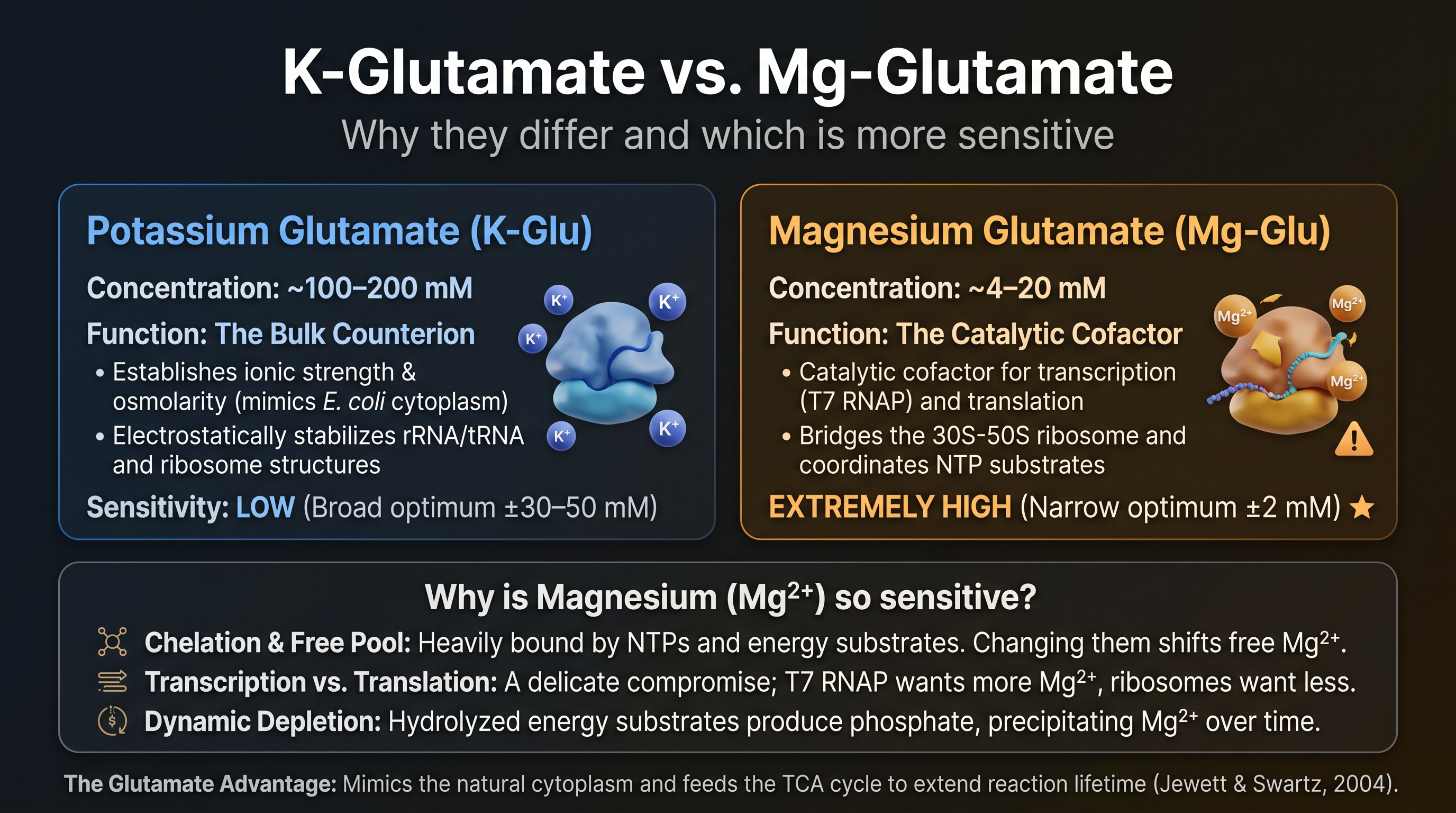
Potassium Glutamate (K-Glu, ~100–200 mM) — Bulk Counterion: Serves as the primary salt to set the ionic strength and osmolarity to mimic the cellular environment (E. coli cytoplasm) and stabilize ribosome/tRNA structures. It has low sensitivity because its optimal range is broad and forgiving (typically ±30–50 mM).
Magnesium Glutamate (Mg-Glu, ~4–20 mM) — Catalytic Cofactor: Acts as a vital, highly active catalytic cofactor needed to coordinate NTPs, bridge the ribosomal subunits, and drive transcription and translation. It has extremely high sensitivity with a very narrow and sharp optimal range (typically ±2 mM).
Why Magnesium is More Sensitive
1. The Free vs. Bound Balance: Because almost everything in the reaction (NTPs, energy sources like PEP, nucleic acids) tightly binds (chelates) Mg2+, the actual available (“free”) magnesium is highly dynamic. Changing these inputs shifts the free Mg2+ without touching the magnesium level itself.
2. The Molecular Compromise: Coupled reactions must balance transcription (which thrives on higher Mg2+) and translation (which requires lower Mg2+ to avoid misfolding and miscoding).
3. Dynamic Depletion: As energy is consumed, accumulating inorganic phosphate binds and precipitates Mg2+, causing the active pool to drop over the course of the reaction.
The Role of Glutamate Used as the natural dominant cytoplasmic anion (Jewett & Swartz, 2004), glutamate doesn’t just provide osmotic support—it actively fuels the lysate’s metabolism (specifically the TCA cycle) to extend reaction lifetime and boost yields.
A2. PEP + NTP vs. Ribose (or maltodextrin) + NMP
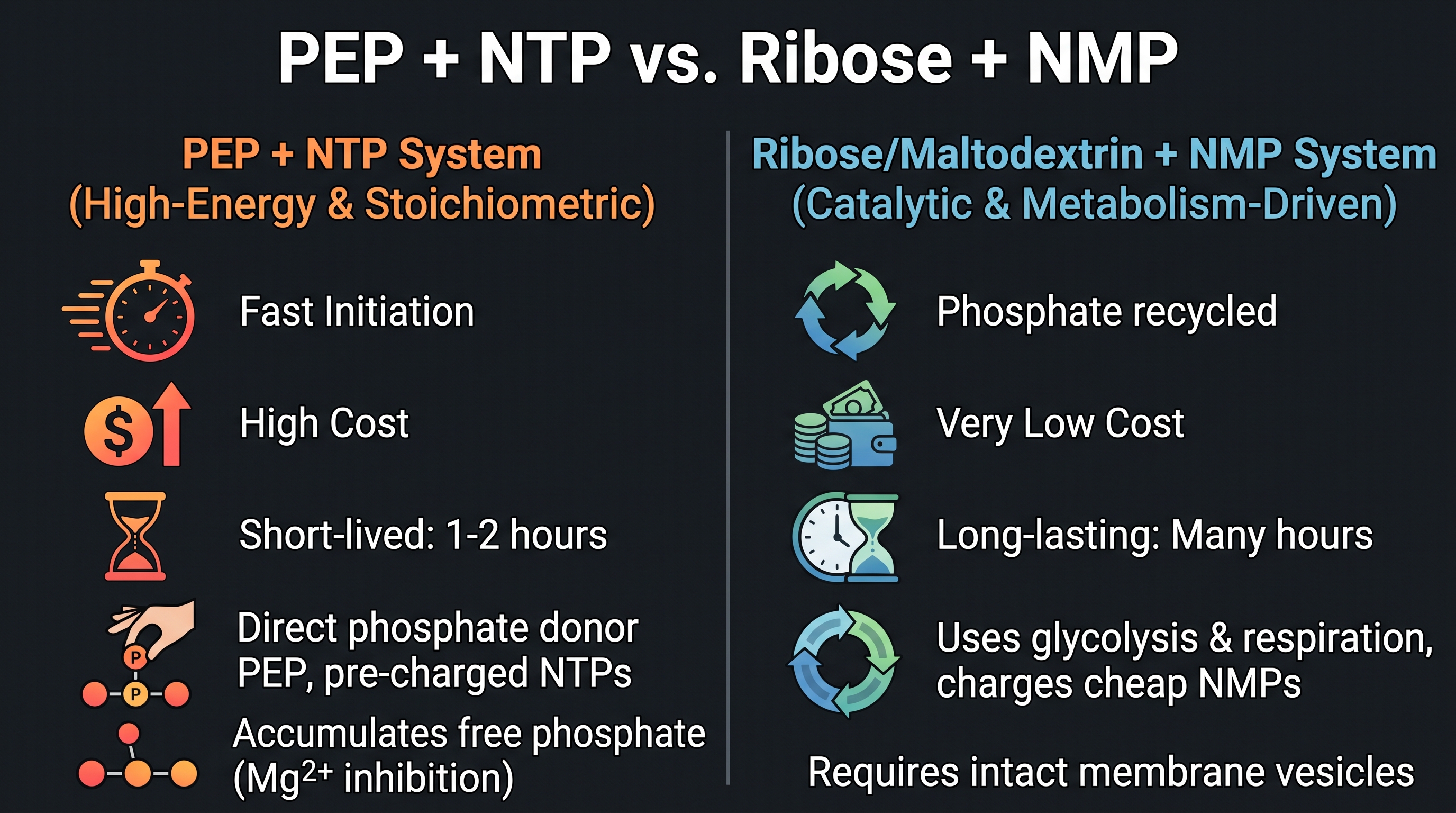
PEP + NTP (Phosphoenolpyruvate + Nucleoside Triphosphates)
This formulation acts as a stoichiometric, high-energy system that supplies nucleotides pre-charged and uses PEP as a direct phosphate donor.
Mechanism: Relies on direct substrate-level phosphorylation (e.g., via endogenous pyruvate kinase transferring phosphate from PEP to ADP).
Kinetics: Initiates rapidly with zero lag time, yielding a very high initial rate of protein synthesis.
Longevity: Reactions are short-lived (typically 1–2 hours). Each PEP molecule donates one phosphate and is consumed, leading to a rapid accumulation of inorganic phosphate. This phosphate tightly chelates free Mg2+, inhibiting the ribosome and halting translation.
pH Stability: Prone to rapid acidic pH drift as PEP is converted into pyruvate and subsequently into lactate or acetate.
Lysate Dependency: Highly robust and protein-agnostic. It functions even in highly clarified or structurally depleted lysates because it does not rely on complex membrane-bound metabolic pathways.
Cost: Prohibitively expensive at scale due to the high cost of both the PEP energy substrate and the purified triphosphates.
Ribose (or Maltodextrin) + NMP (Nucleoside Monophosphates)
This formulation acts as a catalytic system, feeding a cheap carbon source into the lysate’s surviving metabolic network to build and charge nucleotides dynamically.
Mechanism: Feeds a carbon substrate into endogenous glycolysis, the TCA cycle, and oxidative phosphorylation. Endogenous kinases phosphorylate the cheap NMPs into functional NTPs in situ.
Kinetics: Exhibits a distinct initiation lag phase while the enzymatic pathways spin up and the nucleotide pool charges.
Longevity: Reactions can run for many hours. Because the system recycles phosphate rather than dumping it, free Mg2+ levels remain stable and active for much longer.
pH Stability: Maintains pH much better over time, especially if a complex polymer like maltodextrin is used to throttle the glycolytic flux and prevent the rapid accumulation of organic acids.
Lysate Dependency: Highly sensitive to the lysate preparation method. Because it relies heavily on oxidative phosphorylation, the lysate must retain intact, inverted inner membrane vesicles (IMVs). Aggressive centrifugation (e.g., S120 extracts) will strip these out and break the system.
Cost: Drastically reduces cost per gram of protein. NMPs cost an order of magnitude less than NTPs, and sugars cost pennies, making this the standard approach for volumetric scale-up.
A3. Comparing Two Cell-Free Reaction Compositions
Compositions selected: PANOx-SP (Jewett & Swartz, 2004) and RF_opt (Olsen et al., 2026).
These two represent the endpoints of a 22-year arc in CFPS formulation design: a high-performance, chemically-supplied system versus a cost-optimized system that offloads work onto the lysate’s endogenous metabolism. Critically, Olsen et al. re-measured PANOx-SP in their own laboratory (Table 1), so the comparison below is head-to-head under a single lysate batch and a single assay, rather than a cross-paper comparison of reported yields.
Side-by-side composition
All values in mM unless noted; folinic acid and tRNA in mg/mL. Source: Olsen et al. (2026), Table 1.
| Component | PANOx-SP | RF_opt | Change |
|---|---|---|---|
| Yield (measured, same lab) | 1.11 ± 0.13 g/L | 2.39 ± 0.28 g/L | 2.2x up |
| Reagent cost | $4,535 /L | $143 /L | 32x cheaper |
| Cost per gram protein | $4,083 /g | $60 /g | 68x cheaper |
| Mg-glutamate | 8 | 8 | unchanged |
| K-glutamate | 130 | 362 | 2.8x up |
| NH4-glutamate | 10 | – | removed |
| Amino acids | 2 | 5 | 2.5x up |
| HEPES | 57 | 75 | 1.3x up |
| PEP | 30 | – | removed |
| Ribose | – | 50 | added |
| Glucose | – | 10 | added |
| Phosphate | – | 15 | added |
| ATP / CTP / GTP / UTP | 1.2 / 0.85 / 0.85 / 0.85 | – | all removed |
| AMP / CMP / GMP / UMP | – | 3 / 2.15 / 2.15 / 2.15 | all NMP |
| NAD | 0.4 | – | removed |
| CoA | 0.27 | – | removed |
| Nicotinamide | – | 4 | NAD precursor |
| tRNA | 0.17 | – | removed |
| Folinic acid | 0.03 | – | removed |
| Spermidine | 1.5 | – | removed |
| Putrescine | 1 | – | removed |
| Oxalic acid | 4 | – | removed |
PANOx-SP contains more than 20 components. RF_opt contains exactly 12.
Contrast 1: Energy system – stoichiometric vs. catalytic
PANOx-SP uses 30 mM PEP, a high-energy phosphate donor consumed stoichiometrically: each molecule donates one phosphate to ADP via endogenous pyruvate kinase and is spent. RF_opt replaces it with 50 mM ribose + 10 mM glucose + 15 mM inorganic phosphate, feeding central metabolism so that ATP is regenerated catalytically with phosphate recycled rather than accumulated.
Olsen et al. measured the consequence directly (Fig. 2a,b):
- PANOx-SP produces an ATP surge within 30 min, followed by a collapse to near zero by the end of the reaction, with phosphate rising steeply as PEP is consumed.
- RF_opt reaches comparable ATP within 30 min despite containing no exogenous ATP at all, then sustains ~250 uM for the full 20 h – well above the ATP affinity threshold for cell-free gene expression.
- RF_opt phosphate holds at 10–15 mM, three times lower than PANOx-SP, explicitly “because free phosphate is not liberated from PEP.”
This is the mechanistic basis for the longer productive lifetime: phosphate accumulation chelates free Mg2+ and eventually precipitates as magnesium-phosphate, which is a principal reason PEP-based batch reactions stall.
Contrast 2: Nucleotides – triphosphate vs. monophosphate
PANOx-SP supplies all four nucleotides pre-charged as triphosphates (3.75 mM total). RF_opt supplies only monophosphates (9.45 mM total), relying on endogenous NMP and NDP kinases to phosphorylate them in situ.
Note the direction of travel: total nucleotide concentration increases 2.5x while cost falls. Olsen et al. cap NMPs at 5 mM each to prevent formation of insoluble precipitates, and still identify NMPs as the single most expensive reagent group remaining in the minimal system ($62/g protein).
Contrast 3: Cofactors – supplying the product vs. supplying the precursor
PANOx-SP supplies NAD (0.4 mM) and CoA (0.27 mM) directly; both are among the most expensive reagents by volume. RF_opt eliminates both and instead supplies 4 mM nicotinamide, the cheap biosynthetic precursor, allowing the lysate’s own salvage pathway to generate NAD. This is the most economically elegant substitution in the formulation: pay for the precursor, let the extract do the chemistry.
Contrast 4: Deletion of legacy additives
RF_opt removes tRNA, folinic acid, spermidine, putrescine, oxalic acid, and ammonium glutamate with no yield penalty. Two of these deletions are mechanistically forced rather than empirical:
- Oxalate exists solely to inhibit PEP synthetase and prevent a futile ATP-consuming cycle. With no PEP in the formulation, it has no function.
- The polyamines (spermidine, putrescine) were originally introduced in PANOx-SP to replace PEG-8000 as a macromolecular crowding/stabilizing agent.
The remainder were identified empirically across a campaign of 1,231 formulations tested in triplicate.
The central finding: cheaper is not the same as less
RF_opt increases four concentrations and still costs 68x less per gram. Amino acids 2.5x up, potassium 2.8x up, total nucleotide 2.5x up, buffer 1.3x up. The savings derive entirely from substituting inexpensive molecules for expensive ones, not from reducing concentrations.
The 68x improvement also decomposes cleanly:
Because cost per gram is a ratio, both the numerator and the denominator are legitimate optimization targets – and Olsen et al. attacked both. Any formulation design that reduces reagent cost without modelling the yield consequence is optimizing only half of the objective function.
Limitations reported by the authors
RF_opt is not uniformly superior, and the paper is explicit about where it is not:
- Magnesium and phosphate had to be re-optimized for every new lysate batch (Supplementary Fig. 9) – consistent with free Mg2+, not total Mg2+, being the controlled variable.
- RF_opt is more sensitive to lysate loading than PANOx-SP (Fig. 3b), which the authors attribute to the fine metabolic balance of a system that depends on endogenous metabolism rather than supplied high-energy phosphate.
- RF_opt is more sensitive to surface-area-to-volume ratio, because oxidative phosphorylation requires oxygen. Supplying a 100% O2 feed in a 4-mL membrane bioreactor increased yield by 45% to 3.7 +/- 0.2 g/L ($39/g protein).
- RF_opt underperformed PANOx-SP on complex therapeutic proteins – protein D, CRM197, and trastuzumab – and neither formulation produced the trastuzumab Fc dimer, because disulfide bond formation requires an oxidizing system (iodoacetamide-pretreated lysate plus a glutathione redox buffer).
Limitation 4 is directly relevant to formulation design for Reteplase: a composition optimized against sfGFP does not transfer to a multi-disulfide therapeutic protein, and the authors demonstrate this on a protein class far closer to Reteplase than to sfGFP.
A note on formulation drift
The composition circulating today as “PANOx-SP” is not the one published in 2004. Jewett & Swartz (2004), Table I, specifies PANOx-SP as 175 mM K-glutamate, 20 mM Mg-glutamate (plus 3.3 mM Mg-acetate carried over from the extract), 10 mM NH4-glutamate, 33 mM PEP, 1.5 mM spermidine, 1 mM putrescine, 2.7 mM sodium oxalate – with no HEPES and no PEG, both of which were present in PANOx and deliberately removed.
The modern “PANOx-SP” tabulated by Olsen et al. uses 130 mM K-glutamate, 8 mM Mg-glutamate, 57 mM HEPES, 30 mM PEP, and 4 mM oxalate. The 130/8 ionic condition is in fact inherited from the 2004 Cytomim column, not from the 2004 PANOx-SP column.
This drift is itself informative: the two ions most frequently re-tuned between publications are exactly potassium and magnesium, which is what one expects if free Mg2+ depends on the rest of the formulation and must be re-titrated whenever that formulation changes. When citing PANOx-SP, state which version is being used.
References
- Jewett, M. C. & Swartz, J. R. (2004). Mimicking the Escherichia coli cytoplasmic environment activates long-lived and efficient cell-free protein synthesis. Biotechnology and Bioengineering, 86(1), 19–26. DOI: 10.1002/bit.20026. [Table I, p. 20]
- Olsen, M. L., Copeland, C. E., Sundberg, C. A., Aw, R., Shaver, Z. M., Rao, G., Swartz, J. R., Karim, A. S. & Jewett, M. C. (2026). Design-driven optimization of low-cost reagent formulations for reproducible and high-yielding cell-free gene expression. Nature Communications, 17:3478. DOI: 10.1038/s41467-026-69605-8. [Table 1, p. 2; Figs. 2–4]
- Silverman, A. D., Karim, A. S. & Jewett, M. C. (2020). Cell-free gene expression: an expanded repertoire of applications. Nature Reviews Genetics, 21, 151–170. DOI: 10.1038/s41576-019-0186-3. [Context for the energy-system landscape; contains no composition table.]
Section B
Reaction Designs & Community Reagent
Design philosophy
The objective is $ per gram of functional protein. That is a ratio, so it has two levers: reagent cost (numerator) and functional yield (denominator). Olsen et al. (2026) improved it 68-fold over PANOx-SP, and that decomposes as 32x cheaper reagents x 2.2x higher yield — both halves were attacked.
Critically, the correct balance between those levers is different for each of the three proteins, because a formulation that yields zero active protein has infinite cost per gram regardless of reagent price. My three designs therefore differ substantially from one another rather than being one mixture with minor variations:
| Protein | Strategy | Rationale |
|---|---|---|
| sfGFP | Cost-floor | Folds robustly; use it to find the minimum |
| PETase | Cost-led, folding-aware | One disulfide, reducing-compatible |
| Reteplase | Yield-first | Nine disulfides; secure activity, then cut cost |
1. sfGFP — Cost-floor design
https://coopetition.htgaa.org/cfps?design=50cv839371xn9p5
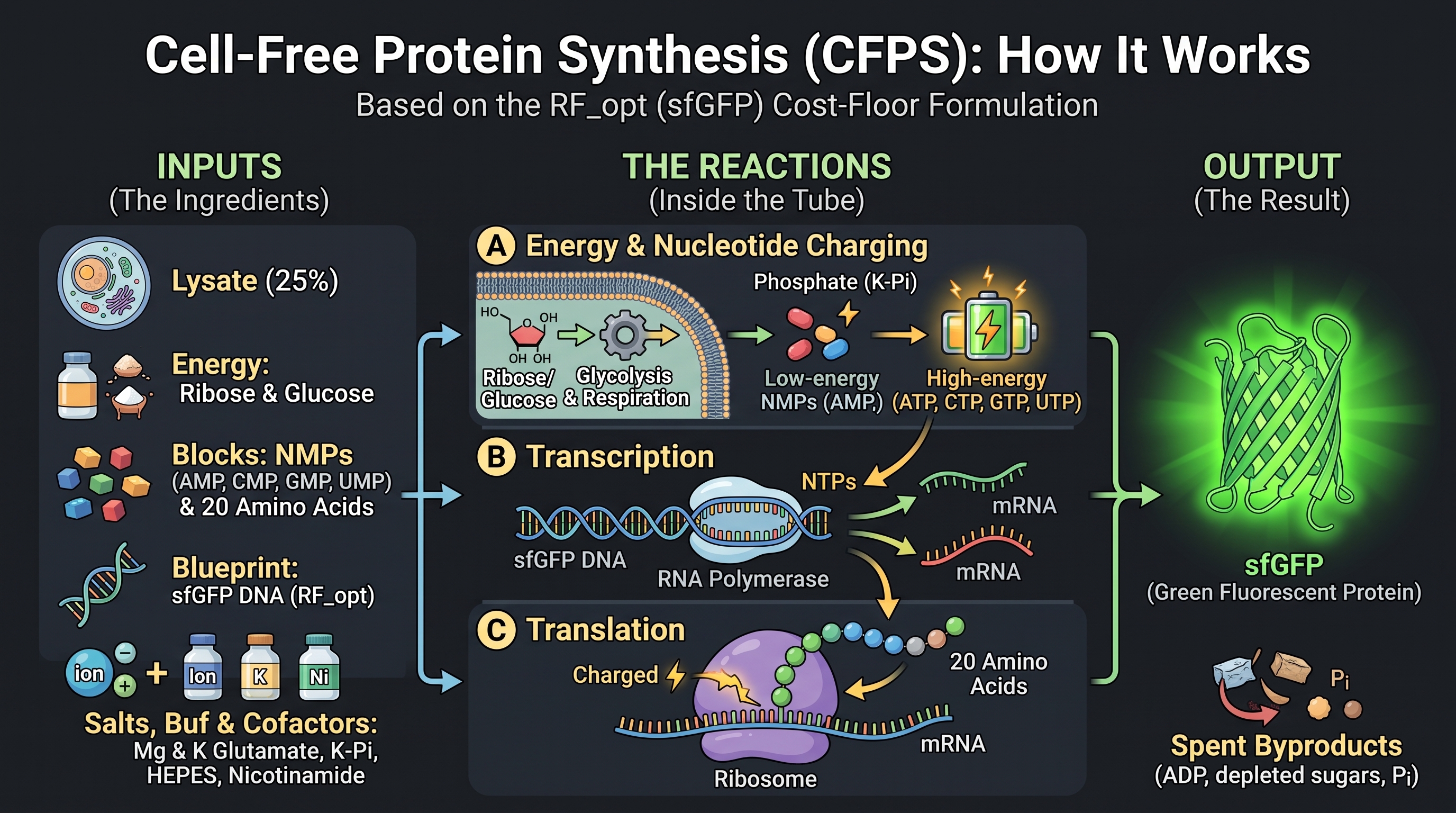
Backbone: RF_opt (Olsen et al. 2026), measured at 2.39 +/- 0.28 g/L, $60/g protein in BL21 Star (DE3) at 30 degC — the same strain and temperature used in this project.
| Category | Reagent | 20 uL final |
|---|---|---|
| Lysate | Standard (reducing) lysate | 25% v/v |
| Salts | Mg-glutamate | 8 mM |
| K-glutamate | 362 mM | |
| Phosphate (K-Pi) | 15 mM | |
| Energy source | Ribose | 50 mM |
| Glucose | 10 mM | |
| Building blocks | Amino acids (20) | 5 mM each |
| AMP | 3 mM | |
| CMP / GMP / UMP | 2.15 mM each | |
| Cofactors | Nicotinamide | 4 mM |
| Buffer | HEPES, pH 7.5 | 75 mM |
| Redox | none | – |
Adjustments from the PANOx-SP baseline, and why:
- Energy: PEP removed, ribose + glucose + phosphate added. PEP is a stoichiometric donor; each molecule gives one phosphate and is spent, while liberated P_i accumulates, chelates free Mg2+ and eventually precipitates. Olsen measured the difference: PANOx-SP ATP surges then collapses to near zero, whereas RF_opt holds ~250 uM ATP for 20 h with phosphate steady at 10-15 mM — three-fold lower — “because free phosphate is not liberated from PEP.”
- Nucleotides: all four NTPs replaced by NMPs. Total nucleotide rises from 3.75 to 9.45 mM while cost falls, because monophosphates are far cheaper and the lysate’s NMP/NDP kinases charge them in situ. Ribose is the mechanistic partner here: it feeds the pentose phosphate pathway, which supplies the ribose moiety for nucleotide salvage.
- Cofactors: NAD and CoA both removed; 4 mM nicotinamide added. Buying the biosynthetic precursor rather than the product, and letting the lysate’s salvage pathway do the chemistry.
- K-glutamate raised 130 -> 362 mM. Potassium glutamate is among the cheapest reagents available and this was simply free yield left on the table in classical formulations.
- Amino acids raised 2 -> 5 mM. Deliberately against the instinct to cut. Amino acids set the yield ceiling; starving them lowers the denominator of $/g and therefore raises cost per gram.
- Deleted with no yield penalty (per Olsen’s 1,231-formulation campaign): tRNA, folinic acid, spermidine, putrescine, NH4-glutamate, cAMP. Oxalate’s deletion is mechanistically forced — it exists only to inhibit PEP synthetase, and there is no PEP.
Screening priorities for round 1: (i) Mg x K grid, not a 1-D Mg scan — the two ions compete for the same condensed-counterion sites on RNA, so the optimum runs on a diagonal and a 1-D scan finds the best point on its own line rather than the peak; (ii) lysate fraction, the largest single cost line; (iii) total NMP, which Olsen identifies as the most expensive group remaining at $62/g.
2. PETase (TfCut2) — Cost-led, folding-aware
https://coopetition.htgaa.org/cfps?design=91m7bo8mt3h3247
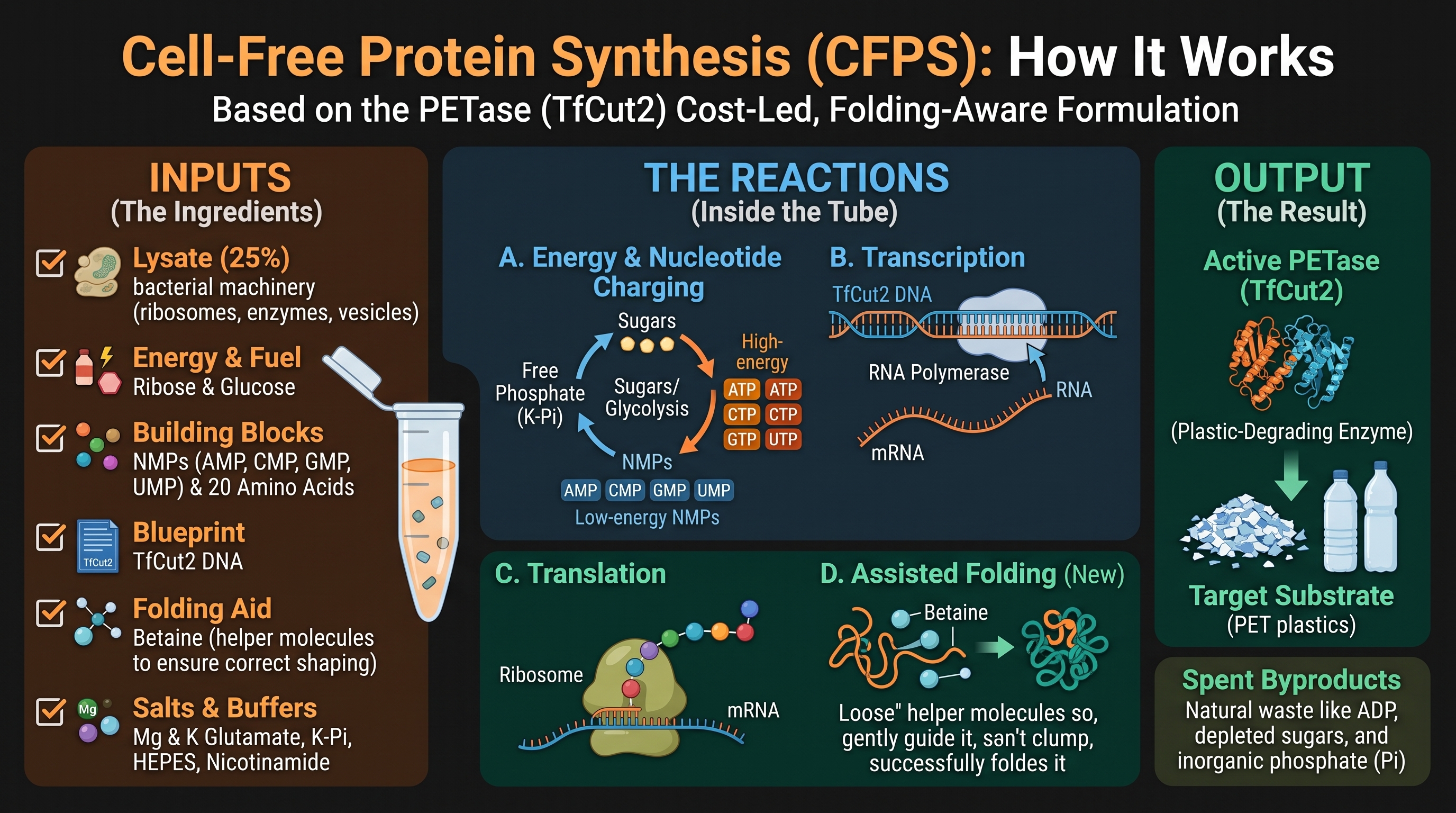
| Category | Reagent | 20 uL final |
|---|---|---|
| Lysate | Standard (reducing) lysate | 25% v/v |
| Salts | Mg-glutamate | 8 mM |
| K-glutamate | 300 mM | |
| Phosphate (K-Pi) | 15 mM | |
| Energy source | Ribose | 50 mM |
| Glucose | 10 mM | |
| Building blocks | Amino acids (20) | 5 mM each |
| AMP | 3 mM | |
| CMP / GMP / UMP | 2.15 mM each | |
| Cofactors | Nicotinamide | 4 mM |
| Buffer | HEPES, pH 7.5 | 75 mM |
| Redox | none | – |
| Folding aid | Betaine | 100 mM |
Key decision: standard lysate, no redox buffer, no DsbC.
This is a deliberate commitment rather than a hedge. The assignment brief states that the reducing environment “is appropriate for sfGFP and remains compatible with TfCut2,” and TfCut2’s single disulfide is structurally stabilizing rather than catalytically essential (the catalytic triad is Ser170-Asp216-His248). Adding a glutathione redox buffer to an untreated lysate is worse than useless: the endogenous thioredoxin and glutaredoxin systems, plus glutathione reductase, collapse the GSSG pool within minutes, so the buffer is paid for and does nothing. Either commit to the IAM-treated, delta-gor DSB lysate or commit to reducing conditions. For a one-disulfide enzyme, reducing is the right and cheaper bet.
Adjustments relative to the sfGFP design:
- K-glutamate lowered 362 -> 300 mM. 362 mM was optimized against sfGFP; a hydrolase with a folding requirement is given slightly more conservative ionic strength pending its own titration.
- Amino acids held at 5 mM, not reduced. PETase is more sensitive to amino acid starvation than sfGFP.
- Betaine 100 mM added as a cheap chemical chaperone / compatible solute, suppressing aggregation without the cost of DsbC (~$5,000/mL). Flagged as a hypothesis: betaine and the already-high K-glutamate may be redundant rather than additive, which the screen will reveal.
3. Reteplase — Yield-first design
https://coopetition.htgaa.org/cfps?design=v0u9hlu89fn21b8
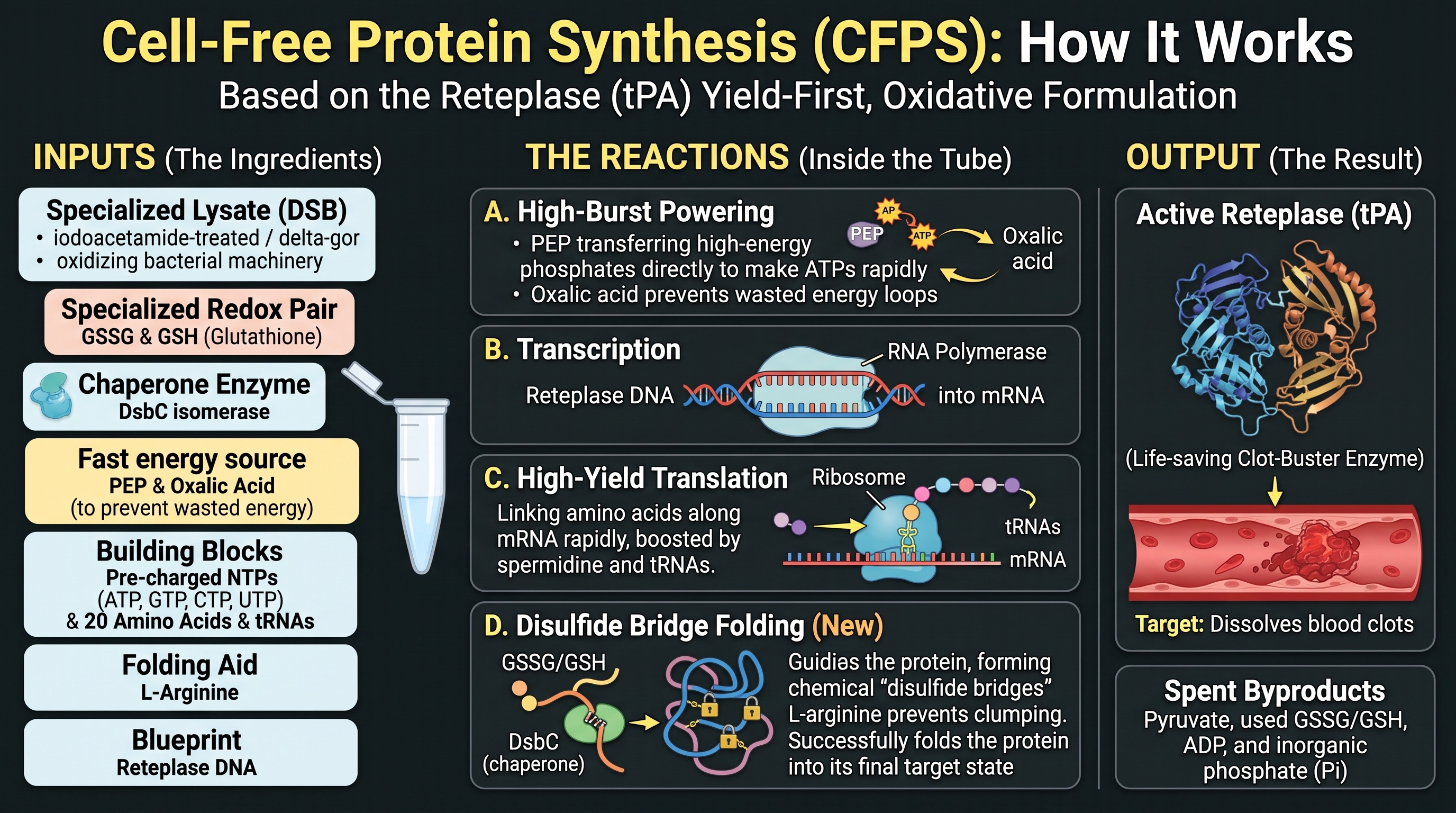
| Category | Reagent | 20 uL final |
|---|---|---|
| Lysate | DSB lysate (iodoacetamide-treated, delta-gor) | 25% v/v |
| Redox | GSSG (oxidized glutathione) | 4 mM |
| GSH (reduced glutathione) | 1 mM | |
| DsbC isomerase | 2 uM | |
| Salts | Mg-glutamate | 8 mM |
| K-glutamate | 180 mM | |
| NH4-glutamate | 10 mM | |
| Energy source | PEP | 30 mM |
| Building blocks | Amino acids (20) | 2 mM each |
| ATP | 1.2 mM | |
| GTP / CTP / UTP | 0.85 mM each | |
| Cofactors | NAD | 0.33 mM |
| CoA | 0.26 mM | |
| Folinic acid | 0.034 mg/mL | |
| tRNA | 0.17 mg/mL | |
| Buffer | HEPES, pH 7.5 | 75 mM |
| Support | Spermidine / putrescine | 1.5 / 1 mM |
| Oxalic acid | 4 mM | |
| Folding aid | L-arginine | 100 mM |
This design deliberately does not minimize reagent cost, for two reasons.
(a) The denominator dominates. Reteplase requires nine disulfide bonds in correct pairings. If the formulation yields no active protein, cost per gram is infinite and no reagent saving can recover it. Olsen et al. report that RF_opt underperformed PANOx-SP on complex therapeutic proteins (protein D, CRM197, trastuzumab), and that neither produced the trastuzumab Fc dimer because oxidizing conditions are required. A formulation optimized against sfGFP does not transfer to a multi-disulfide therapeutic — demonstrated on a protein class far closer to Reteplase than to sfGFP. Cost reduction is deferred to round 2, after an activity signal is secured.
(b) Mechanistic conflict between IAM treatment and glycolytic energy. This is the central design argument. The DSB lysate is pretreated with iodoacetamide to irreversibly cap free thiols and deactivate reductases. But IAM is not selective for reductases — it alkylates accessible cysteines generally, and GAPDH is a catalytic-cysteine enzyme at the centre of glycolysis. A low-cost formulation such as RF_opt depends entirely on endogenous glycolytic and pentose-phosphate flux to regenerate ATP from ribose and glucose. Pairing an IAM-treated lysate with a metabolism-dependent energy system therefore risks disabling the exact pathway the energy system relies on. PEP bypasses this: ATP regeneration proceeds by direct phosphate transfer via pyruvate kinase, independent of the glycolytic steps IAM may have compromised.
I have not found this interaction addressed in the formulations surveyed, and I would propose it as a specific, testable hypothesis for the screen: run the DSB lysate against PEP, against ribose/glucose, and against a 50:50 blend. If the glycolytic arm underperforms specifically in DSB lysate and not in standard lysate, the interaction is real — and it constrains how cheap any oxidizing CFPS formulation can become.
Other adjustments:
- GSSG:GSH = 4:1 oxidized-to-reduced, matching the Zawada et al. formulation as tabulated in Olsen et al. (2026), Table 1. A 4:1 ratio in the reduced direction would poise the reaction reducing and prevent the disulfide formation the design exists to achieve.
- DsbC retained at 2 uM despite cost. With nine bonds, the limiting problem is mis-pairing, not failure to oxidize — an isomerase, not just an oxidant, is required. 2 uM in 20 uL = 40 pmol = 400 nL of a 100 uM stock, which is 16 Echo droplets at 25 nL resolution.
- L-arginine 100 mM as an aggregation suppressant. Reteplase is produced industrially as inclusion bodies and refolded in a separate chemical step; arginine is the standard additive in that refolding chemistry and is inexpensive. Applying refolding-buffer chemistry inside the synthesis reaction is, as far as I can find, not standard practice in CFPS.
- K-glutamate at 180 mM, not 362. The high-potassium optimum was found against sfGFP in a PEP-free system; with PEP restored, the chelation balance and therefore the free Mg2+ / K+ optimum are different and must be re-found.
Section 3B(ii) — Community Reagent contribution
Primary proposal: D-pantothenate (vitamin B5). Secondary proposal: riboflavin (vitamin B2).
How I arrived at these
The single most economically elegant move in Olsen et al. (2026) is the replacement of NAD (~$33/mL) with 4 mM nicotinamide, its cheap biosynthetic precursor, with no yield penalty — the lysate’s own salvage enzymes perform the conversion. That logic was applied exactly once and then abandoned.
Pantothenate extends it to the most expensive small molecule in the inventory. Coenzyme A costs ~$104/mL — roughly three times NAD. E. coli retains the complete five-step CoA biosynthesis pathway (CoaA, CoaBC, CoaD, CoaE) from pantothenate, consuming ATP, CTP and cysteine, all of which are present in the reaction. The pathway is slower than simply adding CoA, but cell-free reactions run 20 h. I searched for prior application of this substitution in CFPS and found none.
Two distinct claims, which should be tested separately:
- Versus a CoA-containing formulation (e.g. PANOx-SP, 0.26 mM CoA), pantothenate is a direct ~$104/mL saving.
- Versus RF_opt, which contains no CoA at all, the question is different: can cheap restoration of CoA capacity push yield above 2.39 g/L? Also worth knowing, but it is an addition, not a substitution.
Riboflavin addresses a limitation the authors identified but did not act on. Olsen et al. show that RF_opt’s yield is oxygen-limited: a 100% O2 feed in a 4-mL bioreactor raised sfGFP by 45%, to 3.7 +/- 0.2 g/L ($39/g), and they attribute this to oxidative phosphorylation being active and required in crude lysates. Oxidative phosphorylation runs on the respiratory chain retained in inverted membrane vesicles, and that chain is built from flavins (FMN/FAD), quinones and heme. Reviewing the eleven formulations in Olsen’s Table 1, none supplies any respiratory-chain cofactor. Every published formulation optimizes the translation reaction and treats the lysate’s energy metabolism as a black box, while the authors’ own oxygen data shows that black box is rate-limiting.
Riboflavin is converted to FMN and then FAD by RibF, which is retained in lysate, and costs essentially nothing. Thiamine (-> TPP, required by transketolase at the centre of the pentose phosphate pathway that RF_opt’s 50 mM ribose enters, and by pyruvate dehydrogenase) and 5-aminolevulinic acid (-> heme, for the cytochrome bo3 / bd terminal oxidases) follow the same logic and would be my next two proposals if slots allow.
Supporting research
- Olsen, M. L. et al. (2026). Design-driven optimization of low-cost reagent formulations for reproducible and high-yielding cell-free gene expression. Nature Communications 17:3478. https://doi.org/10.1038/s41467-026-69605-8 — Table 1 (eleven formulations, costs, yields); Fig. 2d,e (oxygen dependence); the nicotinamide-for-NAD substitution that motivates the precursor logic.
- Jewett, M. C. & Swartz, J. R. (2004). Mimicking the E. coli cytoplasmic environment activates long-lived and efficient cell-free protein synthesis. Biotechnology and Bioengineering 86(1), 19-26. https://doi.org/10.1002/bit.20026
- Silverman, A. D., Karim, A. S. & Jewett, M. C. (2020). Cell-free gene expression: an expanded repertoire of applications. Nature Reviews Genetics 21, 151-170. https://doi.org/10.1038/s41576-019-0186-3