Week 1 HW: Final Project Ideas
Author: Dr. Michellie Hernandez, MD
Assisted by Chat-GPT for content clarity and Gemini for estimated feasibility calculations. Content draft and conception was all done by Dr. Michellie Hernandez, MD
Released September 20, 2026
(1) What you would like to biomanufacture and why?
I would love to help build a monoclonal antibody and mRNA biomanufacturing factory that I would like to call the “HOPE” Factory.
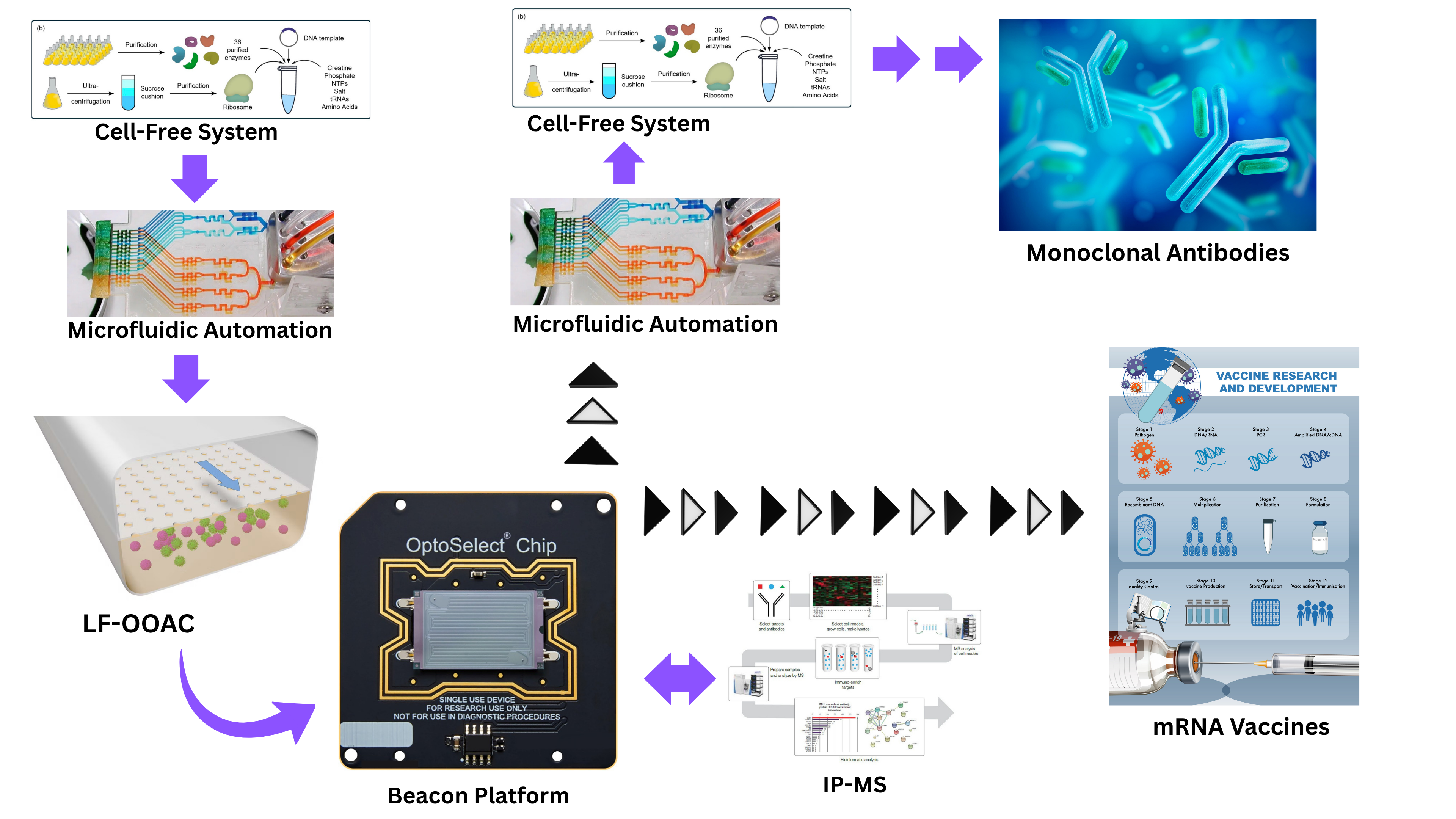
(a) Lymphoid follicles organ-on-a-chip (LF-OOAC) to recreate 3D germinal-center microenvironments in microfluidics can be introduced to the antibody discovery, diagnostic and therapeutic monoclonal antibody development and vaccine development.
(b) A cell-free system to help produce the substrates for the LF-OOAC and automation to help regulate the substrates.
(c) Microfluidic automation to regulate and transfer content from LF-OOAC into Beacon Opto plasma B cell discovery and another microfluidic platform that helps extract the antibodies for analysis in Immunoprecipitation Mass spectroscopy scaling antibody affinity to target antigen of interest (preferably a constant domain for viral pathogens).
(d) Cell-free system and automation to help produce regulate the needed substrates respectively, for monoclonal antibody production.
(e) De novo protein synthesis of the epitope selected antibodies bind to, to predict the epitope’s mRNA for the development of mRNA vaccines.
Current monoclonal antibody production utilizing the Opto Plasma B Discovery Beacon platform enables the isolation and selection of plasma cells that produce antibodies specific to a pathogen or antigen of interest. Using opto-electro positioning (OEP) technology, individual plasma cells can be directed into nano-pen chambers, where they are clonally isolated and their secreted antibodies are analyzed. During the selection process, immunofluorescence-based assays are used to determine whether the antibodies produced by the sampled B cells recognize the antigen of interest. However, the current selection workflow evaluates antibody specificity rather than directly measuring antibody affinity. Plasma B cells are difficult to sample from human blood samples as they tend to be located mainly in the bone marrow. Memory B cells on the contrary can be found in human blood samples.
This distinction becomes particularly important when applying the platform to memory B cells. Memory B cells generally do not constitutively secrete antibodies; therefore, they must first be differentiated into antibody-secreting cells before their antigen specificity can be evaluated using the Beacon platform. Vogt et al. (2020), for example, addressed this requirement by differentiating memory B cells into memory B cell–derived lymphoblastoid cell lines (LCLs). Following Epstein–Barr virus exposure in vitro, these cells were capable of secreting antibodies, allowing individual clones to be evaluated within the Beacon platform using immunofluorescence assays to identify antibodies specific to the antigen of interest.
I propose modifying this approach by differentiating antigen-specific memory B cells into long-lived plasma cells (LLPCs) rather than LCLs and incorporating an antibody-affinity assessment into the selection workflow before mRNA extraction. The objective would be to identify individual B-cell clones that not only recognize the target antigen but also produce high-affinity antibodies. I propose developing a lymphoid follicles organ-on-a-chip (LF-OOAC) in vitro 3D germinal-center microenvironment that facilitates the differentiation of memory B cells to LLPCs, which will be attached to a cell-free system for LF-OOAC maintenance. The human blood samples containing memory B cells will be placed into these LF-OOAC and the differentiation of LLPCs are confirmed which can last up to 3 days in culture for differentiation to occur. Afterwards, the sample can be placed onto the Beacon platform for further isolation and selection analysis.
This proposal is based on several biological questions. During a natural immune response, germinal-center reactions promote the selection and maturation of B-cell clones with progressively increased affinity for their cognate antigen. As B cells mature, high-affinity clones are selected to continue differentiation while low-affinity clones are eliminated, thus differentiating to LLPCs mostly with high-affinity antibody production. Therefore, an important question is whether an in vitro system could reproduce sufficient aspects of this natural differentiation and selection process to generate LLPCs that secrete high-affinity antibodies. A second question concerns the relationship between the cell type used for antibody discovery and the properties of the resulting antibody. Specifically, do memory B cell–derived LCLs generate antibodies with affinity characteristics comparable to those produced by LLPCs derived from the same antigen-specific B-cell population? Which of the two; LCLs or LLPCs produce more high-affinity antibodies?
I therefore propose investigating whether memory B cells can be differentiated into LLPCs before the isolation and the selection process to assure that all specific memory B cells are evaluated during the process. This could potentially be explored through two complementary approaches: (1) specialized in vitro culture conditions designed to promote plasma-cell differentiation and maturation, and (2) bioengineered or bioprinted tissue models that reproduce key structural and signaling features of germinal-center microenvironments. A LF-OOAC 3D germinal-center-like microenvironment could be particularly interesting because antibody affinity maturation is not determined solely by soluble factors; it also depends on the spatial and cellular organization of the germinal-center reaction, including interactions among B cells, T follicular helper cells, follicular dendritic cells, antigen, and associated signaling molecules. Recreating selected aspects of this microenvironment could therefore provide a platform for studying whether memory B cells can be driven toward highly functional plasma-cell states in vitro.
The proposed workflow would consequently extend the current Beacon strategy from simple identification of antigen-specific antibody-producing cells toward the identification of clones with both antigen specificity and high functional affinity: Memory B cell → plasma-cell differentiation → individual-cell isolation in Beacon nano-pens → antibody specificity screening → affinity assessment → selection of high-affinity clone → mRNA extraction → cell-free system antibody production → de novo protein synthesis of the epitope that binds to the selected antibody → mRNA vaccine production. The overarching hypothesis is that combining controlled plasma-cell differentiation, affinity-based selection, and single-cell antibody recovery could improve the ability to identify naturally occurring high-affinity antibodies. Incorporating a LF-OOAC with a germinal-center-inspired bioengineered microenvironment could further provide a means of investigating whether aspects of the natural affinity-maturation process can be reproduced outside the human body.
(2) What living system would you use?
- Cell-free system producing the favorable substrates for B cell differentiation
- Microfluidics automation sampling and measuring to regulate substrates
- Lymphoid follicle Organ-on-a-Chip (LF-OOAC) to differentiate memory B cells to long-lived plasma cells
- Immunoprecipitation-mass spectrometry (IP-MS) to assess antibody affinity
- Microfluidics automation for sampling and measuring to regulate substrates necessary for monoclonal antibodies production
- Cell-free system to produce monoclonal antibodies from the selected plasma cell DNA or mRNA
- Isolation of the Epitope of the selected antibody and de novo synthesis of its mRNA for mRNA vaccine production.
The LF-OOAC 3D germinal center extracellular matrix microenvironment can be maintained by cell-free systems that supply a rich in favorable cytokines (IL-2, IL-4 and IL-21), antigen of interest, and other media to favor differentiation of memory B cells to long lived plasma B cells. For this research proposal I would also like to develop a cell-free system that biomanufactures the monoclonal antibodies consisting of ribosomes, golgi apparatus, and programmed plasmid replicating the mRNA genome that is extracted from the plasma cells isolated from the Beacon platform.
(3) How would you use automation? The LF-OOAC, a 3D germinal center microenvironment in microfluidics can utilize automation to maintain and regulate the favorable conditions in which the microenvironment stimulates the memory B cells of the human blood samples to initiate memory B cell differentiation to LLPCs. The cell-free system maintaining the LF-OOAC can utilize automation to provide a continuous source of substrates, such as CD40 ligands, glucose and cytokines for the differentiation of memory B cell system. While the cell-free system for the development of monoclonal antibodies can utilize automation to provide a continuous source of substrates for monoclonal antibodies production such as mRNA, amino acids and glucose. Regulation of the substrates provided to both cell-free systems will require screening, sampling and measurement of the substrates to determine the quantity of the substrates that need to be added to the cell-free system for its maintenance.
(4) How much would you need to make, and how long would it take? Ideally the LF-OOAC will allow for complete removal of the human sample and sterilization of the biological sample without destroying LF-OOAC, thus allowing it to be reused multiple times with multiple different samples. The need for additional cells not from the human blood sample, like follicular T helper cells or dendritic cells will be determined if the cell-free system connected to the LF-OOAC and providing the substrates for memory B cell differentiation is insufficient to enhance the maturation of LLPCs. A continuous source of antigens of interest, cytokines and CD-40 would be needed for the cell-free system differentiation of memory B cells to LLPCs. A continuous source of amino acids, organelles and glucose will be needed for the cell-free system making monoclonal antibodies. The complete manufacturing process of monoclonal antibody production with prior memory B cell differentiation will add roughly 3 to 5 days for differentiation, 1 day for immunoprecipitation mass spectrometry affinity test, 1 day for Beacon platform selection, and 1-2 weeks downstream processing and verification which can be reduced pending the development of cell-free system for monoclonal antibodies production as isolation and purification cost and duration will be reduced as a result of the cell-free system The average cost of monoclonal antibody production estimation will roughly be $30,000 to $100,000 with this research proposal may increase production cost, but should assure high-affinity monoclonal antibodies potentially assuring good quality immune responses and provide mutation-resistant monoclonal antibodies and vaccines if constant domain antigens are presented during differentiation phase to assure memory B cells specific against constant domain antigens move forward along the development of monoclonal antibodies.
(5.) What don’t you know yet?
Goyal et. al 2019 provided proof of concept that high-affinity antibodies production is obtainable within in vitro in a LF-OOAC from samples and exposure to antigen and favorable conditions. I believe the major bottlenecks on the research proposal would be obtaining the continuous sources of substrates needed for the maintenance of cell-free systems and LF-OOAC, as well as the knowledge gap in the germinal center’s microenvironment that enhances the development of LLPCs. Experimental trials would determine whether or not exposing the memory B cells to favorable conditions will be sufficient to enhance differentiation.
AI used for this homework:
ChatGPT v.5.6 prompt:
- Rephrase to explain the following more clearly: The Opto plasma B discovery Beacon platform can isolate and select plasma cells specific to a pathogen of interest, with its opto-electro positioning (OEP) technology guiding plasma cells into nano-pen chambers where plasma cloning and antibody production takes place. Immunofluorescent assays are done during the selection process and tests the antibodies specificity to an antigen of interest, but the current model does not test for antibody affinity as of yet. However, because the selection process tests antibody specificity to an antigen of interest, memory B cells must first be differentiated into plasma cells, as memory B cells do not produce antibodies and require differentiation to do so. Vogt et al. (2020) differentiated the memory B cells into memory B cell–derived lymphoblastoid cell lines (LCLs) that secrete antibodies upon Epstein-Barr virus exposure in vitro to facilitate their selection with immunofluorescent assays within the Beacon platform (2) to confirm specificity against the antigen of interest. I propose differentiation to long-lived plasma cells instead of LCLs, as well as an affinity evaluation to be done prior to the mRNA extraction within the Beacon B cell discovery platform. Behind my reasoning are these daunting questions: Can we emulate the antibodies of long-lived plasma cells that naturally produce high-affinity antibodies towards the antigen and produce a potent immune response? In the same way, can high-affinity monoclonal antibodies more efficiently produce a potent immune response? Do LCLs have the same affinity for the antigen of interest than long-lived plasmatic B cells or do they produce low affinity antibodies? Can in vitro differentiation of memory B cells to long-lived plasma cells with high-affinity be accomplished in bioimprinted tissue emulating germinal centers or within in vitro specialized media?
Gemini prompt:
- How long does it take to develop a monoclonal antibody with a Beacon platform and what is its cost?
References:
Hernandez M, Bose D (2023) The HOPE Method: Reverse engineering antibodies of recovered patients and bioproteins. J Appl Microb Res. Vol: 6 Issu: 1 (09-20). https://www.innovationinfo.org/articles/JAMBR/JAMBR-164.pdf ARPHA Preprints doi: 10.3897/arphapreprints.e95037
Vogt MR, Fu J, Kose N, Williamson LE, Bombardi R, Setliff I, Georgiev IS, Klose T, Rossmann MG, Bochkov YA, Gern JE, Kuhn RJ, Crowe JE Jr. Human antibodies neutralize enterovirus D68 and protect against infection and paralytic disease. Sci Immunol. 2020 Jul 3;5(49):eaba4902. doi: 10.1126/sciimmunol.aba4902. Erratum in: Sci Immunol. 2020 Sep 18;5(51):eabe5512. doi: 10.1126/sciimmunol.abe5512. PMID: 32620559; PMCID: PMC7418079.
Goyal, G., Prabhala, P., Mahajan, G., Bausk, B., Gilboa, T., Xie, L., Zhai, Y., Lazarovits, R., Mansour, A., Kim, M. S., Curran, D., Long, J. M., Sharma, S., Cohen, L., Levy, O., Prantil-Baun, R., Walt, D. R., & Ingber, D. E. (2019). Lymphoid follicle formation and human vaccination responses recapitulated in an organ-on-a-chip. https://doi.org/10.1101/806505
Brownell, L. (2022, March 15). The immune system is very complicated, but now, it’s on a chip. Wyss Institute. https://wyss.harvard.edu/news/the-immune-system-is-very-complicated-but-now-its-on-a-chip/
Park, H., Jin, H., Kim, D., & Lee, J. (2024). Cell-free systems: Ideal platforms for accelerating the discovery and production of peptide-based antibiotics. International Journal of Molecular Sciences, 25(16), 9109. https://doi.org/10.3390/ijms25169109
Tran, L. (2024, February 26). Microfluidics: Biology’s liquid revolution. The Scientist Magazine®. https://www.the-scientist.com/microfluidics-biology-s-liquid-revolution-71667
The beacon® OPTOFLUIDIC system. (n.d.). Bruker Cellular Analysis. Retrieved 20 September 2026, from https://brukercellularanalysis.com/products/instruments/the-beacon-optofluidic-system/
Bhavin Patel, M.D, Greg Potts, Ph.D, Leigh Foster, B.S, Alex Behling, M.S, John Bucci, M.S, & John Rogers, Ph.D. (2016). Characterization of antibody specificity using immunoprecipitation and mass spectrometry | thermo fisher scientific - US. Thermofisher.Com. https://www.thermofisher.com/us/en/home/life-science/antibodies/antibodies-learning-center/antibodies-resource-library/antibody-application-notes/characterization-antibody-specificity-using-ip-ms.html
Image was done on Canva based on images from the references listed above as well as from Freepik website Designed by Freepik