Week 8 LAB: Bacterial Cell Manufacturing
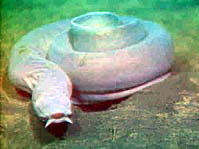
Hagfish (Myxini)
Hagfish (Myxini) produce one of the most unusual defensive biomaterials in nature. Their slime is a rapidly expanding, highly hydrated, fiber-reinforced mucus network that forms when concentrated glandular secretions contact seawater.
Hagfish can produce a bucket of slime almost instantly. Hagfish slime originates from two specialized cell types: Gland mucous cells (GMCs): Produce mucin-containing vesicles. Gland thread cells (GTCs): Produce long protein threads organized into compact coils called skeins.
Ionic strength affects the expansion of mucin and the unfolding of protein threads. At high ionic strength: Threads unravel but form a more compact fiber network. Appropriate divalent cation concentrations: Ca²⁺ and Mg²⁺ help produce an expanded network capable of retaining water.
The hagfish does not actively extract ions from seawater to transform it into slime. Instead, it produces a prepackaged secretion with a distinct ionic composition inside specialized slime glands. When released into seawater, the secretion mixes with the surrounding water, and the resulting ionic environment triggers the physical and biochemical processes that produce slime.
IDEA: Mimic the Hagfish Glandular exudate Composition: Na+ 41.2 mM, K+ 143 mM, Cl- 191.5 mM, Ca²⁺ 0.00045 mM, Mg²⁺ 2.15 mM within the extracellular media with the same ionic composition to enhance slime production in vitro. The host mammalian or bacterial cells with plasmids containing the Hagfish mucin and skeins DNA templates. The host cells will produce the same mucin and skeins produced by the Hagfish. Upon secretion of the mucin and skeins from the cells, they will be exposed to a media rich in Hagfish glandular exudate. Sea water will then be added to enhance biofilm production as the mucin and skeins absorb water and expand.
COMPARISON OF HAGFISH EXUDATE AND SEAWATER COMPOSITION
| Ion | Glandular exudate (mM) | Seawater (mM, approximate) |
|---|---|---|
| Na⁺ | 41.2 | 470–480 |
| K⁺ | 143 | 10 |
| Cl⁻ | 191.5 | 550 |
| Ca²⁺ | 0.00045 | 10 |
| Mg²⁺ | 2.15 | 50 |
Mucin component Mucin is responsible for the mucus-like component and contributes to water retention and viscosity.
| Variable | Description | Functional contribution |
|---|---|---|
| Protein content | Approximately 77% of dry mucus mass | Structural and biochemical component |
| Carbohydrates | Approximately 12%, primarily sulfated mucopolysaccharides | Hydrophilicity and negative charge |
| Lipids | Approximately 5% | Part of the mucus composition |
| Sulfate | Approximately 6% | Contributes to polyanionic character |
| Mucin concentration | Approximately 0.02 mg/mL in deployed slime | Controls mucus contribution to the network |
Protein thread component The Hagfish Gland Thread Cell: A Fiber-Producing Cell Involved in Predator Defense The threads are primarily composed of keratin intermediate filament proteins.
| Variable | Description |
|---|---|
| Protein type | Intermediate filament proteins |
| Thread length | Approximately 10–17 cm at rest |
| Thread diameter | Approximately 1–3 μm |
| Organization | A single long filament arranged into a compact skein |
| Deployment | Unravels when released into seawater |
| Mechanical function | Provides tensile strength, elasticity and a fibrous network |
The threads can extend substantially before breaking, making them important to the mechanical integrity of the slime. PubMed Central (PMC)+1
References:
– Borzouyan Dastjerdi, M., Amini, A., Nazari, M., Cheng, C., Benson, V., Gholami, A., & Ghasemi, Y. (2020). Novel versatile 3D bio-scaffold made of natural biocompatible hagfish exudate for tissue growth and organoid modeling. International Journal of Biological Macromolecules, 158, 894–902. https://doi.org/10.1016/j.ijbiomac.2020.05.024
– Chaudhary G, Ewoldt RH, Thiffeault JL. Unravelling hagfish slime. J R Soc Interface. 2019 Jan 31;16(150):20180710. doi: 10.1098/rsif.2018.0710. PMID: 30958163; PMCID: PMC6364663. https://doi.org/10.1098/rsif.2018.0710
– Fudge DS, Schorno S, Ferraro S. Physiology, biomechanics, and biomimetics of hagfish slime. Annu Rev Biochem. 2015;84:947-67. doi: 10.1146/annurev-biochem-060614-034048. Epub 2014 Dec 12. PMID: 25534639. DOI: 10.1146/annurev-biochem-060614-034048 https://doi.org/10.1146/annurev-biochem-060614-034048
– https://www.instagram.com/reel/DfVzUKDzPM2/?knvt=eHphbmpldjdiM2Nx