Week 3 HW: Cell-Free Reaction Design
ASSIGNMENT: CFPS REACTION DESIGN FOR SFGFP, PETASE, RETEPLASE
Goal: using the collective intelligence of the HTBAA community and accessible AI systems, design novel CFPS reaction compositions for each of the three target proteins: sfGFP, PETase, and Reteplase to reduce the cost per gram of functional protein. Each design should be compatible with the experimental framework described above and should reflect the distinct expression and folding requirements of that protein.
A. COMPARE CELL-FREE REACTION COMPOSITIONS
- Why does the concentration of potassium glutamate and magnesium glutamate differ between compositions? Which is more sensitive?
The concentrations differ because each formulation establishes a different overall ionic and metabolic environment, and K⁺ and Mg²⁺ are therefore co-optimized rather than fixed at one universal concentration. Magnesium glutamate is more sensitive as its concentration has a much narrower optimum, while potassium glutamate tolerates a broader range around its optimum.
In Jewett & Swartz (2004), the original PANOx system used 200 mM potassium glutamate but no magnesium glutamate, instead using 19.3 mM magnesium acetate. PANOx-SP changed this to 175 mM potassium glutamate and 20 mM magnesium glutamate, while Cytomim used 130 mM potassium glutamate and 8 mM magnesium glutamate. Cytomim also replaced PEP with pyruvate and removed HEPES and PEG. In other words, the salt concentrations were optimized as part of a larger change in the reaction environment, rather than independently fixed values.
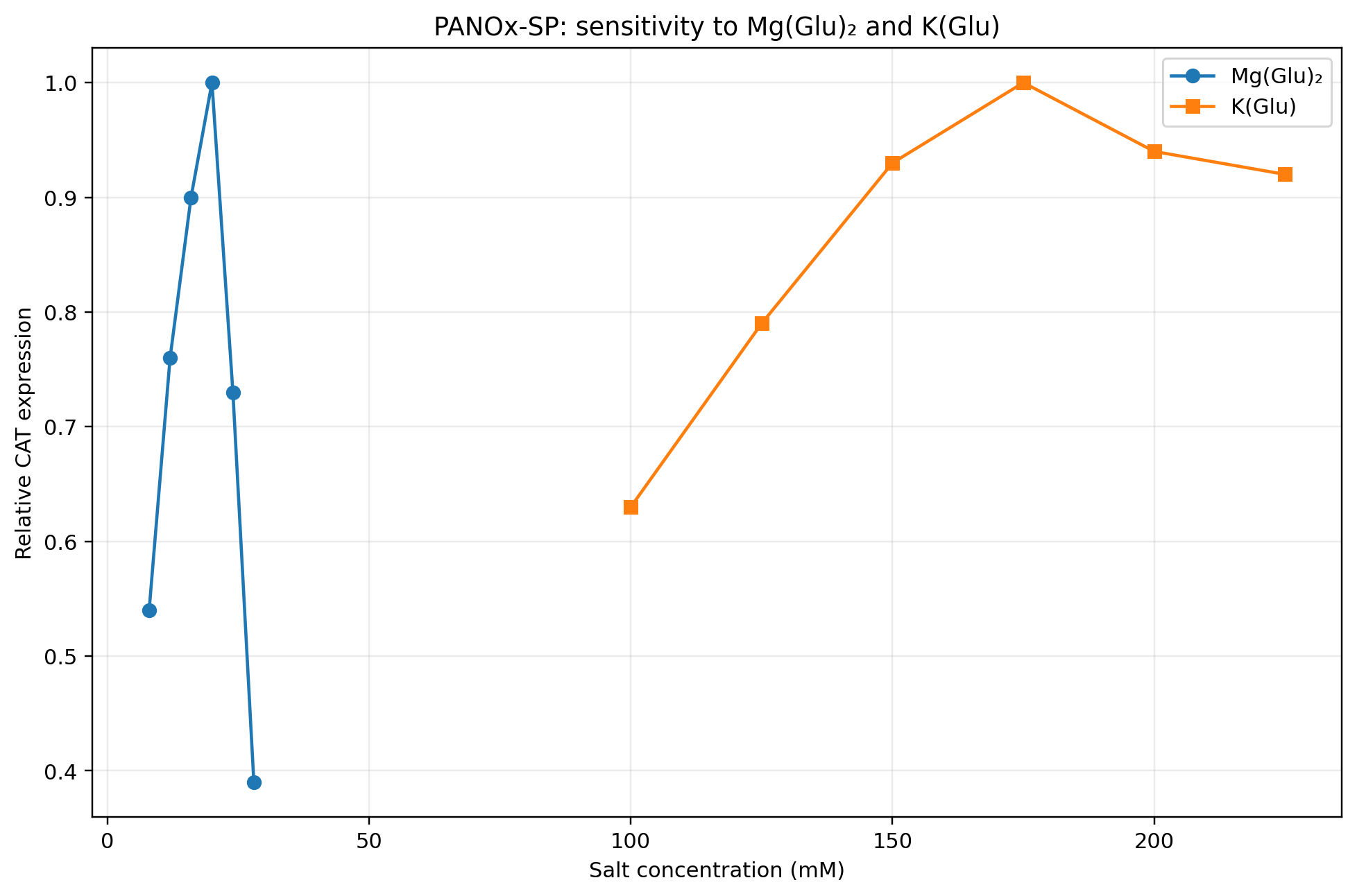 Figure 1. Magnesium and potassium concentration in relation to relative expression from Jewett & Swartz (2004).
Magnesium glutamate is clearly more sensitive than potassium glutamate in the optimization data provided.
- Explain how a PEP+NTP reaction formulation is different from a Ribose+NMP reaction formulation.
The main difference between PEP+NTP and Ribose+NMP is that these formulations approach nucleotide supply and energy generation in different ways.
In a PANOx-SP PEP+NTP formulation from Jewett & Swartz (2004), PEP is supplied at approximately 30–33 mM, while ATP, CTP, GTP and UTP are also supplied directly. PEP provides energy for ATP generation, but phosphate accumulates as PEP is consumed.
In a RFopt Ribose+NMP formulation from Olsen et al. (2026), RFopt contains 50 mM ribose and AMP, CMP, GMP and UMP, but no externally supplied NTP set or PEP. Optimized formulation could generate NTPs from ribose and nitrogenous bases and that it could maintain ATP production without starting with exogenous ATP.
- Choose two cell-free reaction compositions from the literature, compare and contrast the choice of reagents and the concentration of reagents.
I chose PANOx-SP from Jewett and Swartz and RFopt from Olsen et al. as two contrasting cell-free reaction formulations. PANOx-SP represents a conventional phosphorylated-energy-substrate approach, whereas RFopt replaces the conventional PEP+NTP strategy with a lower-cost system based on ribose and nucleotide monophosphates. PANOx-SP contains approximately 30–33 mM PEP and directly supplied ATP, CTP, GTP, and UTP, while RFopt contains 50 mM ribose and AMP, CMP, GMP, and UMP but no exogenous PEP or NTP set. RFopt also uses substantially higher potassium glutamate and amino-acid concentrations than PANOx-SP in the Olsen formulation comparison.
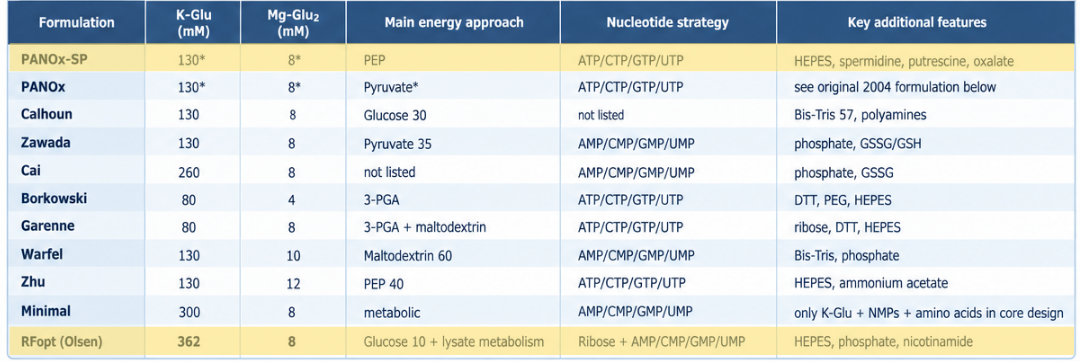 Figure 2. Comparison between PANOx-SP (Jewett & Swartz, 2004) and RFopt formulations (Olsen et al., 2026)
The difference is especially striking in cost and yield. Under the standardized testing performed by Olsen et al., PANOx-SP produced 1.11 ± 0.13 g/L sfGFP at a reagent cost of $4,083/g protein, whereas RFopt produced 2.39 ± 0.28 g/L at only $60/g protein. Therefore, RFopt simultaneously increased yield and reduced reagent cost by approximately two orders of magnitude. The tradeoff is that RFopt depends more heavily on the lysate’s endogenous metabolism, whereas PANOx-SP directly supplies PEP and NTPs.
B. DESIGN ONE REACTION COMPOSITION FOR EACH OF THE THREE PROTEINS
- Sign in to coopetition.htgaa.org and publish your first unique 20 µL CFPS reaction composition for each of the following (don’t worry, you can resubmit later):
| Element | sfGFP | PETase | Reteplase |
|---|---|---|---|
| Potassium glutamate | 353.13 mM | 274.38 mM | 273.28 mM |
| Magnesium glutamate | 8.22 mM | 8.85 mM | 8.85 mM |
| Amino acids | 5.00 mM | 4.81 mM | 4.81 mM |
| Tyrosine | 1.19 mM | 2.81 mM | |
| Cysteine | 5.00 mM | 5.00 mM | |
| HEPES-KOH pH 7.5 | 75.00 mM | 67.50 mM | 67.50 mM |
| Phosphate (di:mono) | 7.50 mM | 7.50 mM | |
| Phosphate (mono:di) | 15.00 mM | 7.50 mM | 7.50 mM |
| Catalase | 62.50 U/mL | ||
| Sodium pyruvate | 9.09 mM | 9.09 mM | |
| Ribose | 49.96 mM | 39.97 mM | 39.97 mM |
| Nicotinamide | 4.00 mM | 4.00 mM | 4.00 mM |
| Spermidine | 1.25 mM | 1.25 mM | |
| Glucose | 8.33 mM | ||
| GSSG | 4.04 mM | ||
| GSH | 1.00 mM | ||
| Adenosine | 406.25 uM | 406.25 uM | |
| DsbC | 5.00 uM | ||
| AMP | 3.00 mM | 500.00 uM | 1.13 mM |
| CMP | 2.13 mM | 1.00 mM | 875.00 uM |
| GMP | 2.13 mM | 1.00 mM | 1.00 mM |
| UMP | 2.13 mM | 1.00 mM | 1.00 mM |
| Water | 2.23 uL |
- sfGFP
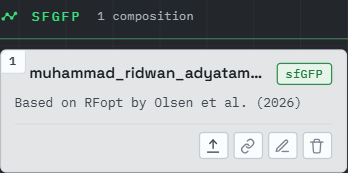
{
  "sample_id": "muhammad_ridwan_adyatama_2026-10-06_3mhdqu",
  "sample_type": "experimental",
  "reagent_list": {
    "amino_acid_mix_17": 1600,
    "amp": 600,
    "base_buffer": 2000,
    "cmp": 425,
    "gmp": 425,
    "hepes_koh": 900,
    "kpo_monobasic_mix": 600,
    "lysate": 5000,
    "magnesium_glutamate": 225,
    "nicotinamide": 800,
    "potassium_glutamate": 3500,
    "ribose": 1500,
    "template_sfgfp": 2000,
    "ump": 425
  },
  "metadata": {
    "ai_model": "",
    "protein_target": "sfGFP",
    "acknowledgements": "",
    "comments": "Based on RFopt by Olsen et al. (2026)"
  }
}
- PETase
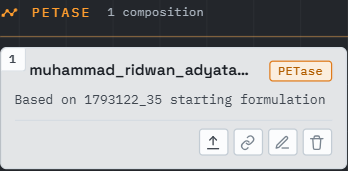
{
  "sample_id": "muhammad_ridwan_adyatama_2026-10-07_xka23b",
  "sample_type": "experimental",
  "reagent_list": {
    "adenosine": 325,
    "amino_acid_mix_17": 1525,
    "amp": 100,
    "base_buffer": 2000,
    "cmp": 200,
    "cysteine": 400,
    "dsbc_ecoli": 1000,
    "glucose": 150,
    "gmp": 200,
    "hepes_koh": 750,
    "kpo_dibasic_mix": 300,
    "kpo_monobasic_mix": 300,
    "lysate": 5000,
    "magnesium_glutamate": 250,
    "nicotinamide": 800,
    "nuclease_free_water": 1225,
    "potassium_glutamate": 1700,
    "ribose": 1200,
    "sodium_pyruvate": 200,
    "spermidine": 100,
    "template_petase": 2000,
    "tyrosine": 75,
    "ump": 200
  },
  "metadata": {
    "ai_model": "",
    "protein_target": "PETase",
    "acknowledgements": "",
    "comments": "Based on 1793122_35"
  }
}
- Reteplase
{
  "sample_id": "muhammad_ridwan_adyatama_2026-10-07_0myflp",
  "sample_type": "experimental",
  "reagent_list": {
    "adenosine": 325,
    "amino_acid_mix_17": 1525,
    "amp": 225,
    "base_buffer": 2000,
    "catalase": 25,
    "cmp": 175,
    "cysteine": 400,
    "dsbc_ecoli": 1000,
    "gmp": 175,
    "hepes_koh": 750,
    "kpo_dibasic_mix": 300,
    "kpo_monobasic_mix": 300,
    "lysate": 5000,
    "magnesium_glutamate": 250,
    "nicotinamide": 800,
    "oxidized_glutathione": 475,
    "potassium_glutamate": 1675,
    "reduced_glutathione": 200,
    "ribose": 1200,
    "sodium_pyruvate": 200,
    "spermidine": 100,
    "template_reteplase": 2000,
    "tyrosine": 725,
    "ump": 175
  },
  "metadata": {
    "ai_model": "",
    "protein_target": "Reteplase",
    "acknowledgements": "",
    "comments": "Based on RFopt by Olsen et al. (2026)"
  }
}
- As a HTBAA research team, we will have the opportunity to suggest new reagents to add to the cell-free reagent inventory. Contribute (or upvote) at least one reagent to the “Community Reagents” section of the website and provide a short rationale. Include in your homework documentation how you decided on that specific reagent and provide links to any relevant research.
 Figure 3. Community reagents contribution of mine is upvote for polyphosphate and FkpA
I upvoted polyphosphate because the Smith et al. study identified NTP/ATP regeneration as an important design consideration and specifically listed polyphosphate among potential additional reagents. Unlike simply increasing the concentration of an existing nucleotide substrate, polyphosphate could provide another route for phosphate transfer during energy regeneration. The current formulation work demonstrates that changing the energy and nucleotide-generation strategy can substantially reduce CFPS cost, so polyphosphate would be a useful reagent to test in the same optimization framework.
I also upvoted FkpA since the Reteplase formulation already includes DsbC and FkpA reduce aggregation and works with DsbC to improve antibody folding and assembly in a cell-free system
- Visit the cfps-coopetition forum page to ensure you will be able to take part in the discussion. Bonus: send a note in the channel about a CFPS optimization idea that you have! If you would like clarification on aspects of the project, please message in this dedicated channel.
Done!
C. ASIMOV KERNEL
- Build T7 compatible plasmids for cell-free expression using the amino acid coding sequences below:
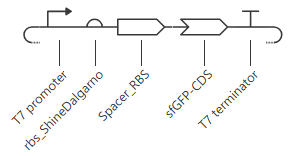
sfGFP
MSKGEELFTGVVPILVELDGDVNGHKFSVRGEGEGDATIGKLTLKFICTTGKLPVPWPTLVTTLTYGVQCFSRYPDHMKRHDFFKSAMPEGYVQER
TISFKDDGKYKTRAVVKFEGDTLVNRIELKGTDFKEDGNILGHKLEYNFNSHNVYITADKQKNGIKANFTVRHNVEDGSVQLADHYQQNTPIGDGP
VLLPDNHYLSTQTVLSKDPNEKGTRDHMVLHEYVNAAGITWSHPQFEK
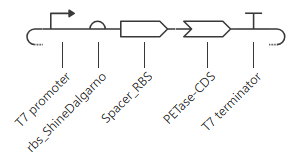
PETase
MEKKIWSHPQFEKGGSGENLYFQSGGASPAGGGANPYERGPNPTDALLEASSGPFSVSEENVSRLSASGFGGGTIYYPRENNTYGAVAISPGYTGT
EASIAWLGERIASHGFVVITIDTITTLDQPDSRAEQLNAALNHMINRASSTVRSRIDSSRLAVMGHSMGGGGTLRLASQRPDLKAAIPLTPWHLNK
NWSSVTVPTLIIGADLDTIAPVATHAKPFYNSLPSSISKAYLELDGATHFAPNIPNKIIGKYSVAWLKRFVDNDTRYTQFLCPGPRDGLFGEVEEY
RSTCPFGGSGVSGWRLFKKIS
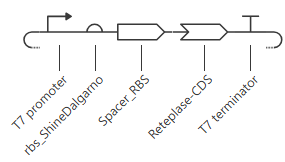
Reteplase
MEKKIWSHPQFEKGGSGENLYFQSGGASPAGGGNSDCYFGNGSAYRGTHSLTESGASCLPWNSMILIGKVYTAQNPSAQALGLGKHNYCRNPDGDA
KPWCHVLKNRRLTWEYCDVPSCSTCGLRQYSQPQFRIKGGLFADIASHPWQAAIFAKHRRSPGERFLCGGILISSCWILSAAHCFQERFPPHHLTV
ILGRTYRVVPGEEEQKFEVEKYIVHKEFDDDTYDNDIALLQLKSDSSRCAQESSVVRTVCLPPADLQLPDWTECELSGYGKHEALSPFYSERLKEA
HVRLYPSSRCTSQHLLNRTVTDNMLCAGDTRSGGPQANLHDACQGDSGGPLVCLNDGRMTLVGIISWGLGCGQKDVPGVYTKVTNYLDWIRDNMRP
GGSGVSGWRLFKKIS
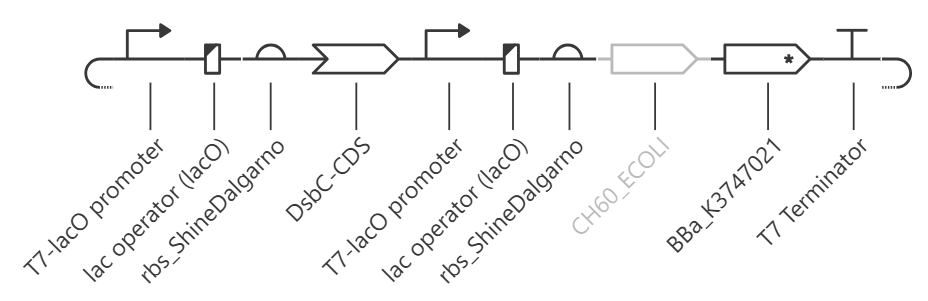
- Bonus question: design a T7 helper plasmid that you could add to the cell-free reaction to improve the yield of functional reteplase (general chaperones, disulfide-bond machinery, etc).
I tried to design a pACYCDuet-1 based helper plasmid with two separate T7 cassettes (MCS1 and MCS2), each with its own promoter and RBS. A clean design is:
MCS1: DsbC (cytosolic) MCS2: GroEL and GroES as a single operon-like insert under one promoter.
Together with its co-chaperonin GroES, chaperonin GroEL plays an essential role in assisting protein folding (PubMed:2897629, PubMed:2573517, PubMed:10532860, PubMed:1676490, PubMed:8104102, PubMed:9285593, PubMed:16751100, PubMed:18418386, PubMed:18987317, PubMed:20603018, PubMed:24816391). The GroEL-GroES system forms a nano-cage that allows encapsulation of the non-native substrate proteins and provides a physical environment optimized to promote and accelerate protein folding, probably by preventing aggregation and by entropically destabilizing folding intermediates (PubMed:16751100, PubMed:18418386, PubMed:18987317, PubMed:20603018, PubMed:24816391). Rapid binding of ATP, followed by slower binding of the non-native substrate protein and GroES to the cis open ring of GroEL initiates productive folding of the non-native protein inside a highly stable GroEL-ATP-GroES complex (PubMed:9285593, PubMed:9285585, PubMed:19915138, PubMed:22445172). Binding of ATP and GroES induces conformational changes that result in the release of the substrate protein into a nano-cage compartment, within the GroEL central cavity, for folding in isolation (PubMed:8861908, PubMed:9285585, PubMed:16684774, PubMed:22445172).
Reference
Jewett, M.C. & Swartz, J.R. (2004). Mimicking the Escherichia coli cytoplasmic environment activates long-lived and efficient cell-free protein synthesis. Biotechnol. Bioeng., 86: 19-26. https://doi.org/10.1002/bit.20026
Olsen, M.L., Copeland, C.E., Sundberg, C.A. et al. (2026). Design-driven optimization of low-cost reagent formulations for reproducible and high-yielding cell-free gene expression. Nat. Commun., 17: 3478. https://doi.org/10.1038/s41467-026-69605-8
Smith, A. A., Wong, E. L., Donovan, R. C., Chapman, B. A., Harry, R., Tirandazi, P., … & Reuel, N. F. (2026). Using a GPT-5-driven autonomous lab to optimize the cost and titer of cell-free protein synthesis. bioRxiv. https://doi.org/10.64898/2026.02.05.703998