Week 4 LAB: Cell-Free Manufacturing
WEEK 4 ASSIGNMENT: CFPS REACTION DESIGN FOR SFGFP, PETASE, RETEPLASE
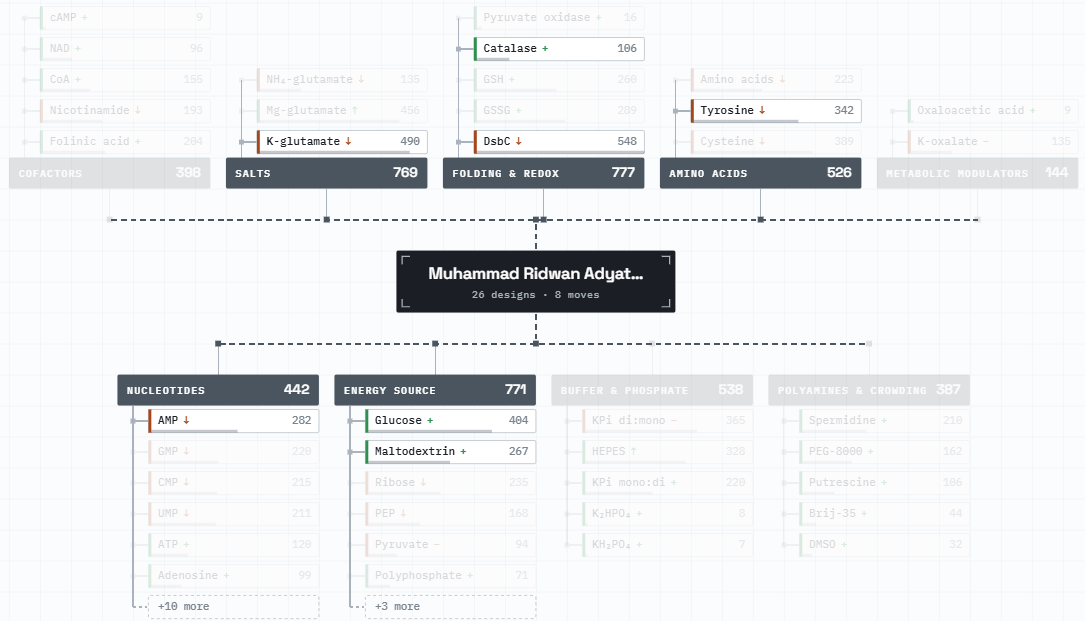
A. DESIGN A BATCH OF CELL-FREE REACTION COMPOSITIONS
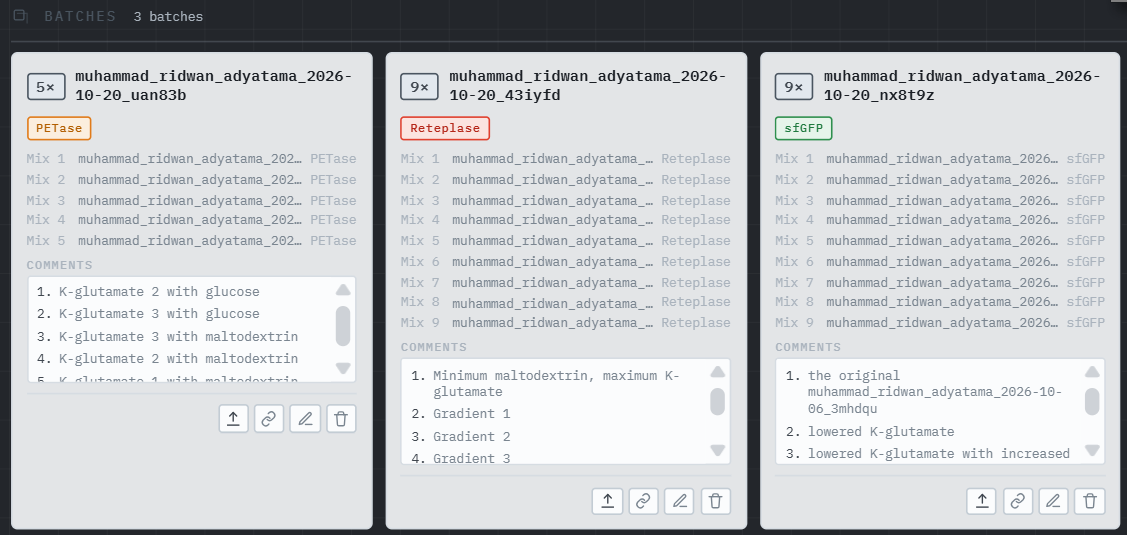
When designing experiments, you’ll often want to compare several conditions that differ only slightly, such as one reagent at a few different concentrations, and batches let you submit those together. To make a batch, click “+ add mix” in the designer to copy your current composition into additional columns, change reagent(s) to a different concentration in each column, add an overall hypothesis plus a short rationale for each mix when submitting.
You should batch experimental conditions that are intended to be directly compared with each other. When we pick the final experimental conditions, we’ll try to include whole batches rather than splitting them up.
A batch is a JSON object with an overall experiment_hypothesis and a samples list. Each item in the list is a dictionary for one composition: a unique sample_id and reagent_list of reagent volumes in nL that sum to exactly 20,000, and metadata with that composition’s protein_target and comments.
| Batch | Main Variable | Specific Rationale | Predicted Result |
|---|---|---|---|
| sfGFP | Decreasing K-glutamate, with selected Mg-glutamate changes | Investigates the ionic environment and its interaction with magnesium-dependent transcription and translation | Potential nonlinear response, with an intermediate condition producing the highest fluorescence |
| PETase | Glucose versus maltodextrin, with selected Mg-glutamate changes | Investigates how energy-substrate choice affects energy regeneration and protein synthesis | Maltodextrin may maintain or improve yield, depending on the formulation and Mg level |
| Reteplase | Increasing maltodextrin while decreasing K-glutamate | Investigates the combined influence of energy supply and ionic conditions while keeping the folding-support components constant | The combined changes may improve or impair production; the individual effects cannot be separated in this design |
sfGFP
This batch investigates how decreasing potassium glutamate affects sfGFP production in a cell-free reaction based on RFopt by Olsen et al. (2026). Potassium glutamate contributes to the ionic environment required for efficient transcription and translation. Because both insufficient and excessive ionic concentrations may be unfavorable to the reaction, a gradient of decreasing potassium glutamate is used to investigate whether a lower concentration improves sfGFP yield or whether the original formulation is closer to the optimal condition.
Magnesium glutamate is varied between selected formulations to investigate its interaction with potassium glutamate. Magnesium supports essential processes involved in transcription and translation, but its optimal level depends on the overall reaction composition. The hypothesis is that decreasing potassium glutamate will produce a nonlinear response in sfGFP yield, with an intermediate concentration potentially outperforming the original formulation. The magnesium comparisons will help determine whether the effect of potassium glutamate depends on the magnesium level.
{
  "experiment_hypothesis": "Investigate K-glutamate concentration change on sfGFP yield on formulation based on RFopt by Olsen et al. (2026)",
  "samples": [
    {
      "sample_id": "muhammad_ridwan_adyatama_2026-10-21_fey8rr",
      "sample_type": "experimental",
      "reagent_list": {
        "amino_acid_mix_17": 1600,
        "amp": 600,
        "base_buffer": 2000,
        "cmp": 425,
        "gmp": 425,
        "hepes_koh": 900,
        "kpo_monobasic_mix": 600,
        "lysate": 5000,
        "magnesium_glutamate": 225,
        "nicotinamide": 800,
        "potassium_glutamate": 3500,
        "ribose": 1500,
        "template_sfgfp": 2000,
        "ump": 425
      },
      "metadata": {
        "ai_model": "",
        "ai_conversation_link": "",
        "protein_target": "sfGFP",
        "acknowledgements": "",
        "comments": "the original muhammad_ridwan_adyatama_2026-10-06_3mhdqu"
      }
    },
    {
      "sample_id": "muhammad_ridwan_adyatama_2026-10-21_fey8rr",
      "sample_type": "experimental",
      "reagent_list": {
        "amino_acid_mix_17": 1600,
        "amp": 600,
        "base_buffer": 2000,
        "cmp": 425,
        "gmp": 425,
        "hepes_koh": 900,
        "kpo_monobasic_mix": 600,
        "lysate": 5000,
        "magnesium_glutamate": 225,
        "nicotinamide": 800,
        "nuclease_free_water": 450,
        "potassium_glutamate": 3050,
        "ribose": 1500,
        "template_sfgfp": 2000,
        "ump": 425
      },
      "metadata": {
        "ai_model": "",
        "ai_conversation_link": "",
        "protein_target": "sfGFP",
        "acknowledgements": "",
        "comments": "lowered K-glutamate"
      }
    },
    {
      "sample_id": "muhammad_ridwan_adyatama_2026-10-21_fey8rr",
      "sample_type": "experimental",
      "reagent_list": {
        "amino_acid_mix_17": 1600,
        "amp": 600,
        "base_buffer": 2000,
        "cmp": 425,
        "gmp": 425,
        "hepes_koh": 900,
        "kpo_monobasic_mix": 600,
        "lysate": 5000,
        "magnesium_glutamate": 250,
        "nicotinamide": 800,
        "nuclease_free_water": 425,
        "potassium_glutamate": 3050,
        "ribose": 1500,
        "template_sfgfp": 2000,
        "ump": 425
      },
      "metadata": {
        "ai_model": "",
        "ai_conversation_link": "",
        "protein_target": "sfGFP",
        "acknowledgements": "",
        "comments": "lowered K-glutamate with increased Mg-glutamate"
      }
    },
    {
      "sample_id": "muhammad_ridwan_adyatama_2026-10-21_fey8rr",
      "sample_type": "experimental",
      "reagent_list": {
        "amino_acid_mix_17": 1600,
        "amp": 600,
        "base_buffer": 2000,
        "cmp": 425,
        "gmp": 425,
        "hepes_koh": 900,
        "kpo_monobasic_mix": 600,
        "lysate": 5000,
        "magnesium_glutamate": 250,
        "nicotinamide": 800,
        "nuclease_free_water": 1125,
        "potassium_glutamate": 2350,
        "ribose": 1500,
        "template_sfgfp": 2000,
        "ump": 425
      },
      "metadata": {
        "ai_model": "",
        "ai_conversation_link": "",
        "protein_target": "sfGFP",
        "acknowledgements": "",
        "comments": "Gradient 1"
      }
    },
    {
      "sample_id": "muhammad_ridwan_adyatama_2026-10-21_fey8rr",
      "sample_type": "experimental",
      "reagent_list": {
        "amino_acid_mix_17": 1600,
        "amp": 600,
        "base_buffer": 2000,
        "cmp": 425,
        "gmp": 425,
        "hepes_koh": 900,
        "kpo_monobasic_mix": 600,
        "lysate": 5000,
        "magnesium_glutamate": 250,
        "nicotinamide": 800,
        "nuclease_free_water": 1575,
        "potassium_glutamate": 1900,
        "ribose": 1500,
        "template_sfgfp": 2000,
        "ump": 425
      },
      "metadata": {
        "ai_model": "",
        "ai_conversation_link": "",
        "protein_target": "sfGFP",
        "acknowledgements": "",
        "comments": "Gradient 2"
      }
    },
    {
      "sample_id": "muhammad_ridwan_adyatama_2026-10-21_fey8rr",
      "sample_type": "experimental",
      "reagent_list": {
        "amino_acid_mix_17": 1600,
        "amp": 600,
        "base_buffer": 2000,
        "cmp": 425,
        "gmp": 425,
        "hepes_koh": 900,
        "kpo_monobasic_mix": 600,
        "lysate": 5000,
        "magnesium_glutamate": 250,
        "nicotinamide": 800,
        "nuclease_free_water": 2275,
        "potassium_glutamate": 1200,
        "ribose": 1500,
        "template_sfgfp": 2000,
        "ump": 425
      },
      "metadata": {
        "ai_model": "",
        "ai_conversation_link": "",
        "protein_target": "sfGFP",
        "acknowledgements": "",
        "comments": "Gradient 3"
      }
    },
    {
      "sample_id": "muhammad_ridwan_adyatama_2026-10-21_fey8rr",
      "sample_type": "experimental",
      "reagent_list": {
        "amino_acid_mix_17": 1600,
        "amp": 600,
        "base_buffer": 2000,
        "cmp": 425,
        "gmp": 425,
        "hepes_koh": 900,
        "kpo_monobasic_mix": 600,
        "lysate": 5000,
        "magnesium_glutamate": 250,
        "nicotinamide": 800,
        "nuclease_free_water": 2725,
        "potassium_glutamate": 750,
        "ribose": 1500,
        "template_sfgfp": 2000,
        "ump": 425
      },
      "metadata": {
        "ai_model": "",
        "ai_conversation_link": "",
        "protein_target": "sfGFP",
        "acknowledgements": "",
        "comments": "Gradient 4"
      }
    },
    {
      "sample_id": "muhammad_ridwan_adyatama_2026-10-21_fey8rr",
      "sample_type": "experimental",
      "reagent_list": {
        "amino_acid_mix_17": 1600,
        "amp": 600,
        "base_buffer": 2000,
        "cmp": 425,
        "gmp": 425,
        "hepes_koh": 900,
        "kpo_monobasic_mix": 600,
        "lysate": 5000,
        "magnesium_glutamate": 225,
        "nicotinamide": 800,
        "nuclease_free_water": 3500,
        "ribose": 1500,
        "template_sfgfp": 2000,
        "ump": 425
      },
      "metadata": {
        "ai_model": "",
        "ai_conversation_link": "",
        "protein_target": "sfGFP",
        "acknowledgements": "",
        "comments": "Gradient 5"
      }
    },
    {
      "sample_id": "muhammad_ridwan_adyatama_2026-10-21_fey8rr",
      "sample_type": "experimental",
      "reagent_list": {
        "amino_acid_mix_17": 1600,
        "amp": 600,
        "base_buffer": 2000,
        "cmp": 425,
        "gmp": 425,
        "hepes_koh": 900,
        "kpo_monobasic_mix": 600,
        "lysate": 5000,
        "magnesium_glutamate": 250,
        "nicotinamide": 800,
        "nuclease_free_water": 3475,
        "ribose": 1500,
        "template_sfgfp": 2000,
        "ump": 425
      },
      "metadata": {
        "ai_model": "",
        "ai_conversation_link": "",
        "protein_target": "sfGFP",
        "acknowledgements": "",
        "comments": "Gradient 5 with previous Mg-glutamate value"
      }
    }
  ]
}
PETase
This batch investigates the effect of using maltodextrin instead of glucose as an energy substrate in a cell-free reaction for PETase production. Glucose and maltodextrin can support energy regeneration, but maltodextrin is metabolized more gradually and may provide a more sustained supply of energy for protein synthesis. It may also help regulate phosphate accumulation and maintain a more favorable reaction environment.
The formulations compare glucose-containing and maltodextrin-containing reactions at selected magnesium glutamate levels. Magnesium is required for essential processes involved in transcription and translation, and its availability may influence the performance of each energy-substrate formulation. The hypothesis is that maltodextrin may maintain or improve PETase yield relative to glucose, with the outcome depending partly on the magnesium level. The experiment will help determine which substrate formulation is more favorable for PETase production under the tested conditions.
{
  "experiment_hypothesis": "Investigating substitution of glucose with maltodextrin on PETase with 3 different K-glutamate levels",
  "samples": [
    {
      "sample_id": "muhammad_ridwan_adyatama_2026-10-21_fey8rr",
      "sample_type": "experimental",
      "reagent_list": {
        "amino_acid_mix_17": 1600,
        "amp": 600,
        "base_buffer": 2000,
        "cmp": 425,
        "glucose": 175,
        "gmp": 425,
        "hepes_koh": 900,
        "kpo_monobasic_mix": 600,
        "lysate": 5000,
        "magnesium_glutamate": 250,
        "nicotinamide": 800,
        "nuclease_free_water": 1025,
        "potassium_glutamate": 2275,
        "ribose": 1500,
        "template_petase": 2000,
        "ump": 425
      },
      "metadata": {
        "ai_model": "",
        "ai_conversation_link": "",
        "protein_target": "PETase",
        "acknowledgements": "",
        "comments": "K-glutamate 2 with glucose"
      }
    },
    {
      "sample_id": "muhammad_ridwan_adyatama_2026-10-21_fey8rr",
      "sample_type": "experimental",
      "reagent_list": {
        "amino_acid_mix_17": 1600,
        "amp": 600,
        "base_buffer": 2000,
        "cmp": 425,
        "glucose": 175,
        "gmp": 425,
        "hepes_koh": 900,
        "kpo_monobasic_mix": 600,
        "lysate": 5000,
        "magnesium_glutamate": 200,
        "nicotinamide": 800,
        "nuclease_free_water": 1075,
        "potassium_glutamate": 2275,
        "ribose": 1500,
        "template_petase": 2000,
        "ump": 425
      },
      "metadata": {
        "ai_model": "",
        "ai_conversation_link": "",
        "protein_target": "PETase",
        "acknowledgements": "",
        "comments": "K-glutamate 3 with glucose"
      }
    },
    {
      "sample_id": "muhammad_ridwan_adyatama_2026-10-21_fey8rr",
      "sample_type": "experimental",
      "reagent_list": {
        "amino_acid_mix_17": 1600,
        "amp": 600,
        "base_buffer": 2000,
        "cmp": 425,
        "gmp": 425,
        "hepes_koh": 900,
        "kpo_monobasic_mix": 600,
        "lysate": 5000,
        "magnesium_glutamate": 200,
        "maltodextrin_17": 650,
        "nicotinamide": 800,
        "nuclease_free_water": 600,
        "potassium_glutamate": 2275,
        "ribose": 1500,
        "template_petase": 2000,
        "ump": 425
      },
      "metadata": {
        "ai_model": "",
        "ai_conversation_link": "",
        "protein_target": "PETase",
        "acknowledgements": "",
        "comments": "K-glutamate 3 with maltodextrin"
      }
    },
    {
      "sample_id": "muhammad_ridwan_adyatama_2026-10-21_fey8rr",
      "sample_type": "experimental",
      "reagent_list": {
        "amino_acid_mix_17": 1600,
        "amp": 600,
        "base_buffer": 2000,
        "cmp": 425,
        "gmp": 425,
        "hepes_koh": 900,
        "kpo_monobasic_mix": 600,
        "lysate": 5000,
        "magnesium_glutamate": 250,
        "maltodextrin_17": 650,
        "nicotinamide": 800,
        "nuclease_free_water": 550,
        "potassium_glutamate": 2275,
        "ribose": 1500,
        "template_petase": 2000,
        "ump": 425
      },
      "metadata": {
        "ai_model": "",
        "ai_conversation_link": "",
        "protein_target": "PETase",
        "acknowledgements": "",
        "comments": "K-glutamate 2 with maltodextrin"
      }
    },
    {
      "sample_id": "muhammad_ridwan_adyatama_2026-10-21_fey8rr",
      "sample_type": "experimental",
      "reagent_list": {
        "amino_acid_mix_17": 1600,
        "amp": 600,
        "base_buffer": 2000,
        "cmp": 425,
        "gmp": 425,
        "hepes_koh": 900,
        "kpo_monobasic_mix": 600,
        "lysate": 5000,
        "magnesium_glutamate": 225,
        "maltodextrin_17": 650,
        "nicotinamide": 800,
        "nuclease_free_water": 575,
        "potassium_glutamate": 2275,
        "ribose": 1500,
        "template_petase": 2000,
        "ump": 425
      },
      "metadata": {
        "ai_model": "",
        "ai_conversation_link": "",
        "protein_target": "PETase",
        "acknowledgements": "",
        "comments": "K-glutamate 1 with maltodextrin"
      }
    }
  ]
}
Reteplase
This batch investigates the combined effects of increasing maltodextrin and decreasing potassium glutamate in an RFopt-based cell-free formulation (Olsen et al., 2026) for reteplase production. Maltodextrin acts as an energy substrate that may support sustained ATP regeneration and help maintain a favorable reaction environment. Potassium glutamate contributes to the ionic conditions required for transcription and translation, meaning that its concentration can affect protein synthesis in a concentration-dependent manner.
The formulations progressively increase maltodextrin while reducing potassium glutamate, with magnesium glutamate and the other listed components held constant. The reaction also contains DsbC, oxidized and reduced glutathione, and cysteine to support the formation and rearrangement of disulfide bonds required for correct reteplase folding.
The hypothesis is that increasing maltodextrin while decreasing potassium glutamate will alter reteplase production, potentially improving the balance between energy regeneration and ionic conditions. An intermediate combination may provide a more favorable reaction environment than either extreme. However, because both variables change together, any observed difference cannot be attributed independently to maltodextrin or potassium glutamate. Follow-up experiments separating their effects would be needed to identify the contribution of each reagent.
{
  "experiment_hypothesis": "Investigate increase of maltodextrin and decrease of K-glutamate for reteplase formulation based on RFopt by Olsen et al. (2026)",
  "samples": [
    {
      "sample_id": "muhammad_ridwan_adyatama_2026-10-21_fey8rr",
      "sample_type": "experimental",
      "reagent_list": {
        "adenosine": 325,
        "amino_acid_mix_17": 1525,
        "amp": 225,
        "base_buffer": 2000,
        "catalase": 25,
        "cmp": 175,
        "cysteine": 400,
        "dsbc_ecoli": 1000,
        "gmp": 175,
        "hepes_koh": 750,
        "kpo_dibasic_mix": 300,
        "kpo_monobasic_mix": 300,
        "lysate": 5000,
        "magnesium_glutamate": 250,
        "maltodextrin_17": 25,
        "nicotinamide": 800,
        "oxidized_glutathione": 475,
        "potassium_glutamate": 1650,
        "reduced_glutathione": 200,
        "ribose": 1200,
        "sodium_pyruvate": 200,
        "spermidine": 100,
        "template_reteplase": 2000,
        "tyrosine": 725,
        "ump": 175
      },
      "metadata": {
        "ai_model": "",
        "ai_conversation_link": "",
        "protein_target": "Reteplase",
        "acknowledgements": "",
        "comments": "Minimum maltodextrin, maximum K-glutamate"
      }
    },
    {
      "sample_id": "muhammad_ridwan_adyatama_2026-10-21_fey8rr",
      "sample_type": "experimental",
      "reagent_list": {
        "adenosine": 325,
        "amino_acid_mix_17": 1525,
        "amp": 225,
        "base_buffer": 2000,
        "catalase": 25,
        "cmp": 175,
        "cysteine": 400,
        "dsbc_ecoli": 1000,
        "gmp": 175,
        "hepes_koh": 750,
        "kpo_dibasic_mix": 300,
        "kpo_monobasic_mix": 300,
        "lysate": 5000,
        "magnesium_glutamate": 250,
        "maltodextrin_17": 175,
        "nicotinamide": 800,
        "oxidized_glutathione": 475,
        "potassium_glutamate": 1500,
        "reduced_glutathione": 200,
        "ribose": 1200,
        "sodium_pyruvate": 200,
        "spermidine": 100,
        "template_reteplase": 2000,
        "tyrosine": 725,
        "ump": 175
      },
      "metadata": {
        "ai_model": "",
        "ai_conversation_link": "",
        "protein_target": "Reteplase",
        "acknowledgements": "",
        "comments": "Gradient 1"
      }
    },
    {
      "sample_id": "muhammad_ridwan_adyatama_2026-10-21_fey8rr",
      "sample_type": "experimental",
      "reagent_list": {
        "adenosine": 325,
        "amino_acid_mix_17": 1525,
        "amp": 225,
        "base_buffer": 2000,
        "catalase": 25,
        "cmp": 175,
        "cysteine": 400,
        "dsbc_ecoli": 1000,
        "gmp": 175,
        "hepes_koh": 750,
        "kpo_dibasic_mix": 300,
        "kpo_monobasic_mix": 300,
        "lysate": 5000,
        "magnesium_glutamate": 250,
        "maltodextrin_17": 325,
        "nicotinamide": 800,
        "oxidized_glutathione": 475,
        "potassium_glutamate": 1350,
        "reduced_glutathione": 200,
        "ribose": 1200,
        "sodium_pyruvate": 200,
        "spermidine": 100,
        "template_reteplase": 2000,
        "tyrosine": 725,
        "ump": 175
      },
      "metadata": {
        "ai_model": "",
        "ai_conversation_link": "",
        "protein_target": "Reteplase",
        "acknowledgements": "",
        "comments": "Gradient 2"
      }
    },
    {
      "sample_id": "muhammad_ridwan_adyatama_2026-10-21_fey8rr",
      "sample_type": "experimental",
      "reagent_list": {
        "adenosine": 325,
        "amino_acid_mix_17": 1525,
        "amp": 225,
        "base_buffer": 2000,
        "catalase": 25,
        "cmp": 175,
        "cysteine": 400,
        "dsbc_ecoli": 1000,
        "gmp": 175,
        "hepes_koh": 750,
        "kpo_dibasic_mix": 300,
        "kpo_monobasic_mix": 300,
        "lysate": 5000,
        "magnesium_glutamate": 250,
        "maltodextrin_17": 475,
        "nicotinamide": 800,
        "oxidized_glutathione": 475,
        "potassium_glutamate": 1200,
        "reduced_glutathione": 200,
        "ribose": 1200,
        "sodium_pyruvate": 200,
        "spermidine": 100,
        "template_reteplase": 2000,
        "tyrosine": 725,
        "ump": 175
      },
      "metadata": {
        "ai_model": "",
        "ai_conversation_link": "",
        "protein_target": "Reteplase",
        "acknowledgements": "",
        "comments": "Gradient 3"
      }
    },
    {
      "sample_id": "muhammad_ridwan_adyatama_2026-10-21_fey8rr",
      "sample_type": "experimental",
      "reagent_list": {
        "adenosine": 325,
        "amino_acid_mix_17": 1525,
        "amp": 225,
        "base_buffer": 2000,
        "catalase": 25,
        "cmp": 175,
        "cysteine": 400,
        "dsbc_ecoli": 1000,
        "gmp": 175,
        "hepes_koh": 750,
        "kpo_dibasic_mix": 300,
        "kpo_monobasic_mix": 300,
        "lysate": 5000,
        "magnesium_glutamate": 250,
        "maltodextrin_17": 575,
        "nicotinamide": 800,
        "oxidized_glutathione": 475,
        "potassium_glutamate": 1100,
        "reduced_glutathione": 200,
        "ribose": 1200,
        "sodium_pyruvate": 200,
        "spermidine": 100,
        "template_reteplase": 2000,
        "tyrosine": 725,
        "ump": 175
      },
      "metadata": {
        "ai_model": "",
        "ai_conversation_link": "",
        "protein_target": "Reteplase",
        "acknowledgements": "",
        "comments": "Gradient 4"
      }
    },
    {
      "sample_id": "muhammad_ridwan_adyatama_2026-10-21_fey8rr",
      "sample_type": "experimental",
      "reagent_list": {
        "adenosine": 325,
        "amino_acid_mix_17": 1525,
        "amp": 225,
        "base_buffer": 2000,
        "catalase": 25,
        "cmp": 175,
        "cysteine": 400,
        "dsbc_ecoli": 1000,
        "gmp": 175,
        "hepes_koh": 750,
        "kpo_dibasic_mix": 300,
        "kpo_monobasic_mix": 300,
        "lysate": 5000,
        "magnesium_glutamate": 250,
        "maltodextrin_17": 675,
        "nicotinamide": 800,
        "oxidized_glutathione": 475,
        "potassium_glutamate": 1000,
        "reduced_glutathione": 200,
        "ribose": 1200,
        "sodium_pyruvate": 200,
        "spermidine": 100,
        "template_reteplase": 2000,
        "tyrosine": 725,
        "ump": 175
      },
      "metadata": {
        "ai_model": "",
        "ai_conversation_link": "",
        "protein_target": "Reteplase",
        "acknowledgements": "",
        "comments": "Gradient 5"
      }
    },
    {
      "sample_id": "muhammad_ridwan_adyatama_2026-10-21_fey8rr",
      "sample_type": "experimental",
      "reagent_list": {
        "adenosine": 325,
        "amino_acid_mix_17": 1525,
        "amp": 225,
        "base_buffer": 2000,
        "catalase": 25,
        "cmp": 175,
        "cysteine": 400,
        "dsbc_ecoli": 1000,
        "gmp": 175,
        "hepes_koh": 750,
        "kpo_dibasic_mix": 300,
        "kpo_monobasic_mix": 300,
        "lysate": 5000,
        "magnesium_glutamate": 250,
        "maltodextrin_17": 1000,
        "nicotinamide": 800,
        "oxidized_glutathione": 475,
        "potassium_glutamate": 675,
        "reduced_glutathione": 200,
        "ribose": 1200,
        "sodium_pyruvate": 200,
        "spermidine": 100,
        "template_reteplase": 2000,
        "tyrosine": 725,
        "ump": 175
      },
      "metadata": {
        "ai_model": "",
        "ai_conversation_link": "",
        "protein_target": "Reteplase",
        "acknowledgements": "",
        "comments": "Gradient 6"
      }
    },
    {
      "sample_id": "muhammad_ridwan_adyatama_2026-10-21_fey8rr",
      "sample_type": "experimental",
      "reagent_list": {
        "adenosine": 325,
        "amino_acid_mix_17": 1525,
        "amp": 225,
        "base_buffer": 2000,
        "catalase": 25,
        "cmp": 175,
        "cysteine": 400,
        "dsbc_ecoli": 1000,
        "gmp": 175,
        "hepes_koh": 750,
        "kpo_dibasic_mix": 300,
        "kpo_monobasic_mix": 300,
        "lysate": 5000,
        "magnesium_glutamate": 250,
        "maltodextrin_17": 1350,
        "nicotinamide": 800,
        "oxidized_glutathione": 475,
        "potassium_glutamate": 325,
        "reduced_glutathione": 200,
        "ribose": 1200,
        "sodium_pyruvate": 200,
        "spermidine": 100,
        "template_reteplase": 2000,
        "tyrosine": 725,
        "ump": 175
      },
      "metadata": {
        "ai_model": "",
        "ai_conversation_link": "",
        "protein_target": "Reteplase",
        "acknowledgements": "",
        "comments": "Gradient 7"
      }
    },
    {
      "sample_id": "muhammad_ridwan_adyatama_2026-10-21_fey8rr",
      "sample_type": "experimental",
      "reagent_list": {
        "adenosine": 325,
        "amino_acid_mix_17": 1525,
        "amp": 225,
        "base_buffer": 2000,
        "catalase": 25,
        "cmp": 175,
        "cysteine": 400,
        "dsbc_ecoli": 1000,
        "gmp": 175,
        "hepes_koh": 750,
        "kpo_dibasic_mix": 300,
        "kpo_monobasic_mix": 300,
        "lysate": 5000,
        "magnesium_glutamate": 250,
        "maltodextrin_17": 1675,
        "nicotinamide": 800,
        "oxidized_glutathione": 475,
        "reduced_glutathione": 200,
        "ribose": 1200,
        "sodium_pyruvate": 200,
        "spermidine": 100,
        "template_reteplase": 2000,
        "tyrosine": 725,
        "ump": 175
      },
      "metadata": {
        "ai_model": "",
        "ai_conversation_link": "",
        "protein_target": "Reteplase",
        "acknowledgements": "",
        "comments": "Maximum maltodextrin, minimum K-glutamate"
      }
    }
  ]
}
B. RESEARCH TEAM DISCUSSION, DATA ANALYSIS, METASCIENCE
Research Team Discussion: We’d like a few HTBAA members to share their approach to experimental design during the recitation meeting on Thursday (5-6:30 PM ET) with the Adamala, Borkowski, and Styczynski labs. If you are willing to share a short 2–3 minute synopsis (no slides required), please sign up by Thursday (Oct 15).
Note: ideas at any stage are encouraged: a single hypothesis, an experimental batch you’re planning, broader topics you are investigating, or computational methods you are trying. The goal is to facilitate a rich discussion with these leading cell-free research labs and to welcome them to our community!
Even if you do not wish to sign up to share publicly, please document on your homework page the current status of your CFPS optimization ideas!
My current CFPS optimization strategy focuses on testing how changes in the ionic environment, energy supply, and protein-folding conditions affect cell-free protein synthesis across three targets (sfGFP, PETase, and reteplase). My Coopetition designs explore different reagent changes across multiple formulations. The listed moves on my coopetition’s HTBAA summary represent the overall set of changes across my designs. Individual formulations use different subsets, rather than combining every change into a single reaction.
- sfGFP: Lowering potassium glutamate
For sfGFP, my main move is to decrease potassium glutamate (K-glutamate). Potassium contributes to the ionic environment required for transcription and translation, but its optimal concentration depends on the overall reaction composition. I hypothesize that lowering K-glutamate may improve sfGFP production if the original formulation has a potassium concentration above the optimum. However, excessive reduction could impair the reaction, so I am interested in identifying how protein output responds across decreasing concentrations rather than assuming that less potassium is always better.
- PETase: Modifying folding support and energy supply
For PETase, my moves are to increase catalase, decrease DsbC, and increase glucose and maltodextrin in selected formulations.Catalase breaks down hydrogen peroxide into water and oxygen, potentially helping manage peroxide accumulation in the reaction. DsbC supports protein folding by helping rearrange incorrectly formed disulfide bonds. Since PETase contains one disulfide bond, I want to investigate whether changing the balance between catalase and DsbC affects the production of functional enzyme. Increasing catalase while decreasing DsbC does not necessarily improve folding; the experiment tests whether the existing levels are appropriate for this formulation.
I am also investigating increased glucose and maltodextrin as potential ways to improve energy supply for protein synthesis. These energy substrates may support ATP regeneration, although their effects depend on how efficiently the cell-free system metabolizes them. My hypothesis is that optimizing the energy supply and folding environment may improve PETase activity, rather than simply increasing the amount of protein produced. PETase activity will therefore be important when interpreting the results.
- Reteplase: Modifying ionic conditions, amino acid availability, and energy supply
For reteplase, my moves are to decrease K-glutamate and tyrosine, while increasing AMP, maltodextrin, and catalase across selected formulations.Decreasing K-glutamate tests whether a different ionic environment improves the reaction. Decreasing tyrosine tests whether a lower concentration of this amino acid is more favorable than the original formulation. Although amino acids are essential building blocks for protein synthesis, their optimal concentrations depend on the reaction environment.
Increasing AMP tests whether changing the adenylate nucleotide pool improves the biochemical conditions supporting protein synthesis and energy metabolism. Increasing maltodextrin tests whether a greater amount of this energy substrate supports the reaction, while increasing catalase investigates whether greater peroxide removal is beneficial.
These changes are particularly interesting for reteplase because it contains nine disulfide bonds, making correct protein folding an important consideration. My hypothesis is that optimizing the ionic environment, energy supply, nucleotide availability, and peroxide management may improve reteplase production. However, these changes may not all have beneficial effects, and increased protein output alone would not establish that the resulting reteplase is correctly folded and functional.
Data Analysis: Familiarize yourself with the autonomous-cfps repository. Experimental results are stored in autonomous_cfps/data/reference_set and data analysis files are in the reference_results folder. Review the sfGFP_control_20260722-39-L_96w_report.pdf. What does it show about how the same 20 µL sfGFP reaction performs in a 384-well plate versus a 96-well deep-well plate? Can you suggest what might explain some of the differences (for example: oxygen access, evaporation).
The reported median design-well titer was approximately 7.3 times higher in the 96-well format. The calibration curves also differed: the same fluorescence corresponded to approximately 1.3 times more sfGFP on the quad 96-well calibration curve than on the 384-well curve. That calibration difference alone does not explain the full 7.3-fold difference.
The formulation rankings also changed considerably between formats. A detailed course-page cross-check reports a Spearman correlation of −0.12 between matched design rankings and no overlap between the two formats’ top-ten lists. This suggests that the best-performing formulation in one plate format may not be the best-performing formulation in another.
Different plate geometries and liquid depths may change gas–liquid oxygen transfer. Oxygen availability can influence energy regeneration in the lysate and the maturation of fluorescent sfGFP. However, the observed result does not establish oxygen access as the cause. The well shape, reaction depth, surface-area-to-volume ratio, and mixing conditions may also change the biochemical environment even when nominal reagent compositions are identical.
Metascience: With hundreds of proposed reactions and a limited number of experimental wells during round 1 of the coopetition, deciding which experiments to run is itself a scientific question. A shared rubric, a set of criteria we score every proposal against, can make that choice transparent and fair. Propose one rubric criterion you think we should use to decide which experiments make it onto the plate, and explain in a sentence or two why it matters. Examples include novelty relative to what’s already been tested, the strength of the hypothesis, or the expected information gain.
I would prioritize experiments that help distinguish between competing hypotheses about important CFPS parameters, even if they do not produce the highest protein yield. With limited experimental wells and a very large formulation space, the best experiments are those that provide interpretable results that can guide the next design round, including results that show a proposed change does not improve the reaction.
C. AGENTIC CONTRIBUTION
coopetition.htgaa.org has been updated to allow for AI agents to programmatically create and submit CFPS compositions based on your guidance. Visit the Agent tab to generate an agent token which can be used for interacting with the website. (optional) try making a CFPS design using your agent and document the experience on your webpage!
I tried using AI agent (ChatGPT) to create and submit a sfGFP composition based on my previous sfGFP submissions, however the AI agent failed to submit it. It repeatedly asked for my permission to submit the formulation but failed to continue after being given one.