Week 6 HW: Non-Model Organism - Cultivarium
WEEK 6 ASSIGNMENT: NON-MODEL ORGANISM EXPLROATION
Part 1- Explore non model organisms
What non-model organism did you choose, and why? Justify their relevance in your write-up. Describe the method you used to identify this organism.
I selected Sphingomonas elodea (CVM083) as a non-model organism relevant to my biomanufacturing project. My actual target product is synthetic coral mucus, specifically a mucin-like glycoprotein containing a protein scaffold decorated with coral-inspired glycans. However, coral mucus is naturally produced by coral tissue, and none of the microorganisms in the available Cultivarium strain collection directly produces this material. Therefore, I broadened my search to microorganisms that naturally produce structurally complex extracellular carbohydrates and have an established biomanufacturing application.
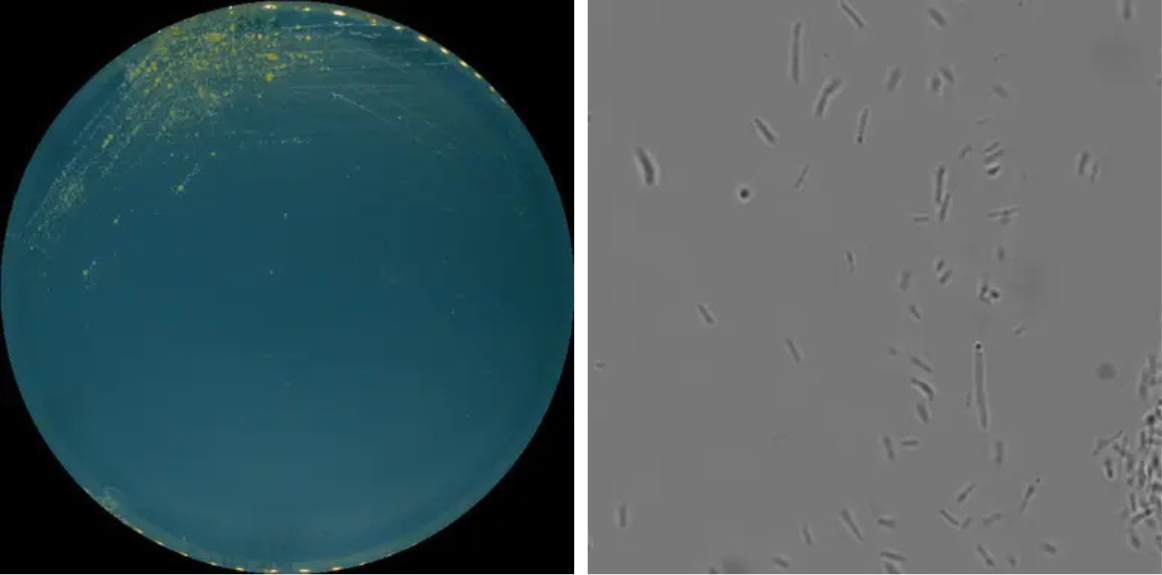 Figure 1. Sphingomonas elodea colony (left) and microscopic (right) morphology, taken from Cultivarium Portal. Both were grown on Nutrient Broth (NB) and microscopic morphology was taken at 72 hours post-inoculation (Cultivarium, n.d.a)
I selected S. elodea because it naturally produces gellan gum, an extracellular heteropolysaccharide with an established industrial application. Although gellan gum is chemically different from coral mucin, its biosynthesis involves glycosyltransferases and carbohydrate precursors to assemble a complex extracellular polymer. This makes S. elodea a relevant reference organism for the glycan-production aspect of my project, particularly my second manufacturing stage, where I intend to use a cell-free enzymatic system to decorate a recombinant mucin-like protein scaffold with different coral-inspired glycans.
I do not intend to replace E. coli with S. elodea as my main protein-production chassis. Instead, I want to use the available genetic and metabolic information from S. elodea to better understand microbial glycan biosynthesis, identify potentially relevant enzymatic functions, and explore strategies for producing complex carbohydrate-containing materials. The glycosyltransferases involved in gellan biosynthesis would not necessarily be compatible with my protein scaffold, so their potential relevance would need to be investigated separately.
Copy and fill out the table below. Where information is unavailable, leave blank. In a separate paragraph, describe what you are able to do with this information. What information is missing, and why might you need that information?
| Category | Data |
|---|---|
| Species Name | Sphingomonas elodea |
| Strain Name | CVM083 (ATCC 31461) |
| Link | https://portal.cultivarium.org/species/179878?strain_id=ATCC31461&view=strain |
| Growth Media and Temperature | NB pH 8 with TE and V at 30°C |
| Susceptible antibiotics, and MIC90 | apramycin (1), chloramphenicol (16), erythromycin (16), gentamicin (2), kanamycin (0.5), rifampicin (2), spectinomycin (8), streptomycin (128), tetracycline (8), thiostreptone (16), trimethoprim (32) |
| Functional ORIs | pSa (medium confidence) |
| Genome Size | 4,135,552 bp |
| Number of Publications Listed | 336 |
List all genetic methods available for that species. How many methods are available, and what’s the range of years (oldest-newest) for genetic research on this organism? If none are available, say so. What is the suggested next closest organism, and what genetic methods are available there?
A method for homologous recombination of S. elodea has been described in 2019 by Li et al.. Other uncategorized genetic methods have also been reported before. A study in 2014 summarized genetic and mutational engineering approaches toward modified sphingan variants of S. elodea, while a paper published in 2011 described Vitreoscilla haemoglobin (VHb) gene expression in S. elodea under the control of constitutive bla promoter to improve gellan production.
Past Publications
- Homologous recombination
Li, A., Hu, T., Luo, H., Alam, N.-U., Xin, J., Li, H., Lin, Y., Huang, J., Huang, K., Meng, Y., Meng, F., Hu, X., & Li, O. (2019). A Carotenoid- and Poly-β-Hydroxybutyrate-Free Mutant Strain of Sphingomonas elodea ATCC 31461 for the Commercial Production of Gellan. mSphere, 4(5): 00668. DOI: 10.1128/msphere.00668-19
- Others
Schmid, J., Sperl, N., & Sieber, V. A. (2014). Comparison of genes involved in sphingan biosynthesis brought up to date. Applied Microbiology and Biotechnology, 98(2014): 7719-7733. DOI: 10.1007/s00253-014-5940-z
Wu, X. C., Chen, Y. M., Li, Y. D., Li, O., Zhu, L., Qian, C. D., Tao, X. L., & Teng, Y. (2011). Constitutive expression of Vitreoscilla haemoglobin in Sphingomonas elodea to improve gellan gum production. Journal of Applied Microbiology, 110(2): 422-430. DOI: 10.1111/j.1365-2672.2010.04896.x
In broader sense, there are 17 publications reporting genetic methods for Sphingomonas sp., ranging from transformation methods (chemical competence, conjugation) to genetic engineering (homologous recombination, gene expression, Tn mutagenesis, and others). Newest publication for each genetic method can be seen below.
Past Publications
- Chemical Competence
Xu, J. H., Wu, J., Hong, Q., Zhang, Z. L., & Li, S. P. (2006). [Construction of double-labelled carbofuran-degrading bacterium Sphingomonas sp. CDS-1). Wei sheng wu xue bao = Acta microbiologica Sinica, 46(4), 613–617. PMID: 17037065
- Conjugation
Han, X., Hui, L., Mengqi, C., Zaimei, Z., Zhongrui, G., Hu, Z., Jiqian, W., & Yawei, S. (2022). Construction of the LB cloning system and its application in gene fusion expression in Sphingosine monocytogenes. Chinese Journal of Biotechnology, 38(4): 1576-1588. DOI: 10.13345/j.cjb.210440
- Homologous Recombination
Li, H., Chen, M., Zhang, Z., Li, B., Liu, J., Xue, H., Ji, S., Guo, Z., Wang, J., & Zhu, H. (2022) Hybrid Histidine Kinase WelA of Sphingomonas sp. WG Contributes to WL Gum Biosynthesis and Motility. Frontiers in Microbiology, 13: 792315. DOI: 10.3389/fmicb.2022.792315
- Gene Expression
Wouters, K., Maes, E., Spitz, J.-A., Roeffaers, M. B. J., Wattiau, P., Hofkens, J., & Springael, D. (2010). A non-invasive fluorescent staining procedure allows Confocal Laser Scanning Microscopy based imaging of Mycobacterium in multispecies biofilms colonizing and degrading polycyclic aromatic hydrocarbons. Journal of Microbiological Methods, 83(3): 317-325. DOI: 10.1016/j.mimet.2010.09.014
- Tn Mutagenesis
Czieborowski, M., Hübenthal1, A., Poehlein, A., Vogt, I., & Philipp, B. (2020). Genetic and physiological analysis of biofilm formation on different plastic surfaces by Sphingomonas sp. strain S2M10 reveals an essential function of sphingan biosynthesis. Microbiology Society, 166(10): 918-935. DOI: 10.1099/mic.0.000961
- Others
Wei, L., Moo, Y., Liu, H., Ke, C., Liu, X., & Li, S. (2022). Effect of an inorganic nitrogen source (NH4)2SO4 on the production of welan gum from Sphingomonas sp. mutant obtained through UV-ARTP compound mutagenesis. International Journal of Biological Macromolecules, 210(2022): 630-638. DOI: 10.1016/j.ijbiomac.2022.04.219
Part 2- Explore neighbor strains
Copy and fill out the table below. For each category with missing information in Part 1, fill out information from a neighbor strain.
| Neighbor Species | Related Level | Category | Data |
|---|---|---|---|
| Sphingomonas sp. | genus | genetic methods | chemical competence, conjugation, homologous recombination, gene expression, Tn mutagenesis, and others |
Part 3: From Information to Delivery- What don’t you know yet?
Review the data you gathered above. What do you know about your target strain, and what information is still missing? How confident do you feel about your ability to design an experiment with this strain? Identify the 2-3 biggest unknowns or risks. For example: Will the growth conditions from a nearest neighbor translate directly? What about the functional plasmid ORIs?
The first major unknown is whether the reported growth conditions are also suitable for producing gellan gum. The Portal lists NB medium at pH 8 with TE and V at 30°C, but this information does not necessarily mean that these are optimal conditions for extracellular polysaccharide production. Growth and product formation are two different outcomes, and I need to establish whether the strain produces a measurable and reproducible amount of extracellular polymer under these conditions.
The second major uncertainty is whether the available genetic information can be translated into a working genetic system for CVM083. Although pSa is listed as a potentially functional origin of replication, its medium confidence level means that I should not assume it will support stable plasmid replication in this particular strain. Similarly, the antibiotic susceptibility data provide a starting point for selecting possible markers, but they do not independently establish the conditions needed for reliable selection.
The third and most project-specific unknown is whether the carbohydrate biosynthesis machinery of S. elodea can provide enzymes that are useful for my synthetic coral mucus platform. Gellan gum is an extracellular polysaccharide, whereas my target is a glycosylated protein in which sugars must be attached to specific sites on a Ser/Thr-rich protein scaffold. Therefore, the glycosyltransferases involved in gellan biosynthesis cannot automatically be assumed to recognize or modify my recombinant mucin-like protein. Their natural substrate and sugar-donor requirements may be entirely different from those needed for protein glycosylation.
For each, state how you would find out: the experiment you would try next. What are your readouts, and what would they tell you?
My first experiment would therefore be a small-scale cultivation study using the conditions listed in the Portal as a starting point. I would monitor bacterial growth over time through optical density and observe changes in culture pH, while also collecting the culture supernatant to recover and quantify extracellular polysaccharides. The main readouts would include biomass, recovered polymer yield, and the polymer’s viscosity or rheological properties. If the strain grows well but produces little extracellular polymer, I would know that the listed conditions are suitable for cultivation but may require further optimization for gellan production. Conversely, reproducible polymer production would establish a useful baseline for studying S. elodea as an extracellular carbohydrate-producing reference organism.
I would first investigate DNA delivery and plasmid maintenance using a simple reporter construct containing the pSa origin and an appropriate selectable marker. I would also consider adapting a genetic method already reported for S. elodea, particularly the homologous recombination approach described by Li et al. (2019), while treating methods reported in other Sphingomonas species as additional possibilities rather than confirmed protocols. The readouts would include successful recovery of cells carrying the construct, reporter expression, confirmation of the plasmid or intended genetic modification, and plasmid stability after subsequent cultivation. These results would tell me whether CVM083 can be genetically manipulated reliably enough to investigate its carbohydrate biosynthesis genes. If DNA delivery or plasmid maintenance proves unsuccessful, I could still study its extracellular polysaccharide production without genetic modification, which is sufficient for its initial role as a reference organism.
To investigate this, I would first examine the available genomic and literature information on the gellan biosynthesis pathway and identify candidate enzymes based on their reported functions. I would then prioritize enzymes for a small cell-free compatibility test using my synthetic mucin-like scaffold and suitable activated sugar donors. LC-MS or LC-MS/MS would be used to identify changes in molecular mass, detect glycan attachment, and assess whether any modification occurs at the intended protein sites. Controls without the enzyme or sugar donor would help distinguish genuine enzymatic modification from background signals. If a candidate enzyme successfully modifies the scaffold, it could become a starting point for further development of the second manufacturing stage. However, if it only functions in gellan polymer assembly, I would still retain S. elodea as a useful reference for extracellular glycan production, without claiming that its enzymes can directly reproduce coral mucin glycosylation.
Part 4: Final Project
Reflect on your final project proposal. How might the resources shared with you (Cultivarium Portal, Vault, PRISM) help with your living system design? Identify a specific tool and its relevance, and how you intend to use it for your project.
The Cultivarium resources could support different stages of my project, particularly because I am working with a non-model organism as a reference for understanding extracellular carbohydrate production. The Cultivarium Portal has already been useful for identifying S. elodea CVM083 and collecting its growth conditions, antibiotic susceptibility profile, genome information, and reported genetic methods. I would continue using its Reported Methods section to trace the original publications behind each genetic method and distinguish approaches demonstrated in S. elodea from those only reported in related Sphingomonas species. I would also use the available organism information and community contributions to identify practical cultivation considerations that might not be fully described in published papers. This would help me plan experiments more efficiently and avoid treating information from a related organism as a confirmed condition for CVM083. The Portal is particularly relevant at the early development stage, when I need to determine what is already known about an organism and which experimental gaps I need to address.
Assuming the Vault provided in this course is the repository for organizing research materials and experimental data, I would use it as a centralized place to maintain the information generated throughout the project. For example, I could organize the genome and candidate enzyme sequences from S. elodea, the DNA sequence and plasmid map of my recombinant mucin-like scaffold, and the records of different glycosylation enzyme combinations. I would also keep the corresponding experimental outputs, including LC-MS results, polymer yield, viscosity measurements, and microfluidic co-culture observations, together with their experimental conditions and protocol versions. This would be particularly important because my project involves several modules that need to be connected: protein scaffold production, enzymatic glycosylation, and downstream testing of the synthetic mucus in a coral–microbe cultivation system. Keeping these records organized would allow me to trace a particular synthetic mucus sample back to its scaffold batch, enzyme combination, and production conditions. It would also make it easier to compare different glycoforms and identify which formulation produces the most consistent results.
PRISM would be particularly useful for documenting the experimental procedures themselves. Unlike a conventional written protocol, PRISM can use audio and video recordings of laboratory work to generate a structured, step-by-step protocol synchronized with the recorded experiment. This is useful because some experimental details, such as how a researcher handles a culture, mixes a viscous sample, or recognizes a particular change during an extraction, may not be adequately described in a written method (Lee, 2025). I would use it to document the cultivation and polymer recovery procedures for S. elodea, followed by the purification of the recombinant mucin-like scaffold and the cell-free glycosylation process. Later, it could also help document the preparation and operation of the microfluidic system used to investigate interactions between coral tissue and associated microorganisms. Recording these procedures would help preserve small but important experimental adjustments, make the work easier to reproduce, and allow other team members to follow the same procedures. The protocols generated by PRISM would still need to be reviewed and corrected against the actual experimental records before being treated as validated methods.
REFERENCES
Cultivarium (n.d.a). Species 179878: ATCC 31461. Retrieved October 27th, 2026, from https://portal.cultivarium.org/species/179878?strain_id=ATCC31461&view=strain
Cultivarium. (n.d.b). Species 28214. Retrieved October 27th, 2026, from https://portal.cultivarium.org/species/28214
Lee, H. (2025, July 22). PRISM: Capturing the invisible art of scientific practice. Cultivarium. Retrieved October 27th, 2026, from https://blog.cultivarium.org/p/prism-capturing-the-invisible-art