Week 1 HW: Final Project Ideas
1. WHAT and WHY?
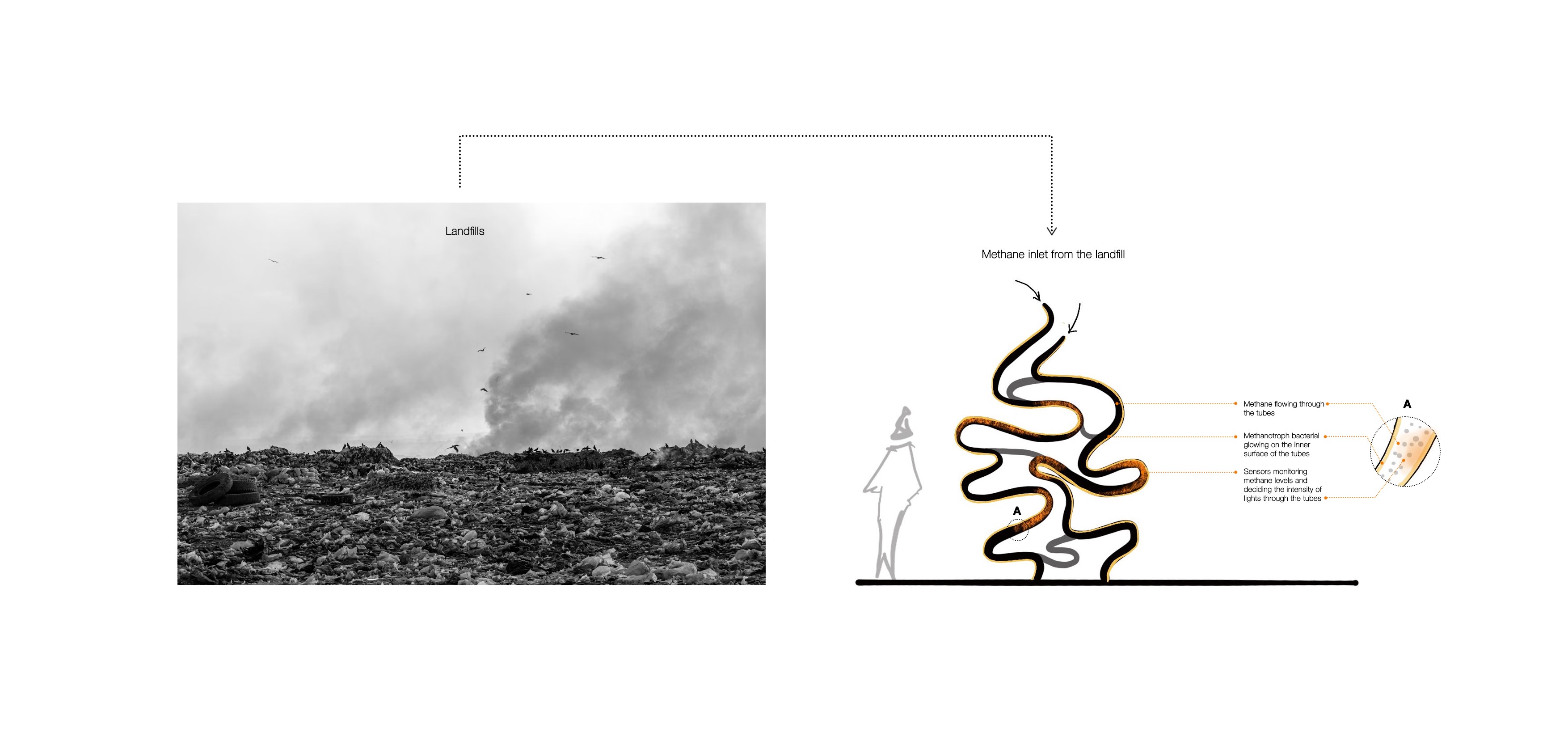
The idea is to create a site-specific tubular artifact/installation that captures methane from the landfills and biomanufactures Polyhydroxybutyrate (PHB), a bio-degradable polymer.
The project explores how waste sites can also act as sites for biomanufacturing. Landfills generate methane through decomposition of organic waste. This locally available carbon source can be continuously used as the feedstock for biological processes.
The proposed artefact would have a dual role, a bio-reactor and visual interface for people to interact with. Methanotrophic bacteria would consume methane to accumulate PHB in their cells, under specific conditions. In a given cycle, a fixed amount of methane enters the system, less methane present in the tubes would signal more PHB production. The proposed site-specific installation would sense the methane concentrations in the tubes and create different intensities of light.
Less Methane consumed (less PHB production), less intense lights
More Methane consumed (High PHB production), more intense lights
The lighting system will provide visibility to the bio-manufacturing process allowing people to interact with the installation.
2. LIVING SYSTEMS
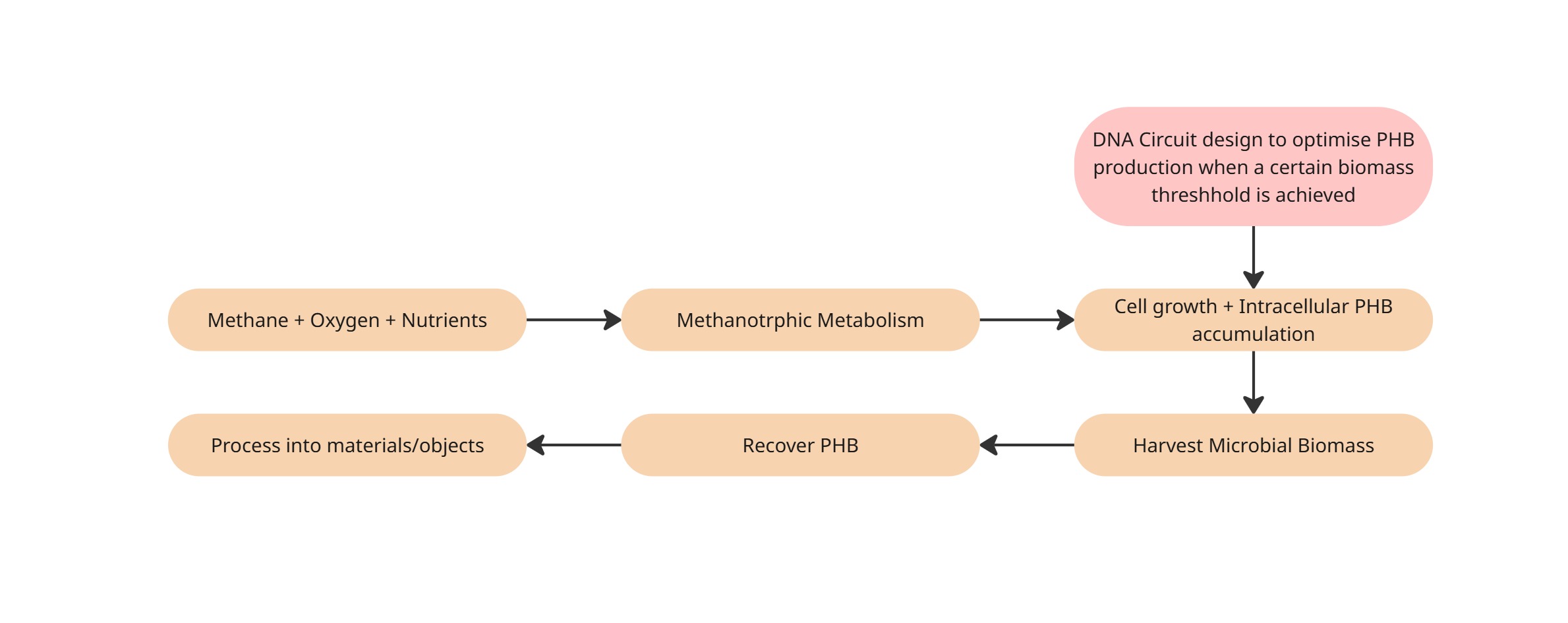
The proposed chassis is a PHB-producing Methanotrophic Bacteria (Methylocystis sp.).
The project aims to use DNA circuit design to optimise PHB production when a certain Biomass threshold is achieved. The internal surface area of the tubular system would determine the microbial growth and define the biomass threshold at which the system goes from growth to production mode. This programmable system would create a balance between microbial growth and material production.
3. AUTOMATION
The project presents a two-fold automation strategy.
A.DNA circuit design to provide a growth vs production switch (environmental control and sensing, sampling)
B.Lighting control through Methane sensing to make biomanufacturing interactive
For these strategies, an automated bioreactor with a sensor + actuator system is proposed.
The automated sensing technology would handle methane sensing and biomass monitoring. The inlet valves will be programmed based on this data. The environmental control within the bioreactor would also be monitored to keep track of nutrient levels, oxygen, pH and temperature. Periodic samples would be removed and assessed for PHB production.
The methane sensing system would control the light intensity in different parts of the tubes.
4. SCALE
For the initial prototype, the target is to biomanufacture around 500g of PHB. This would provide proof of concept for scaling up the idea.
A recent study by Hong et al. (2025) achieved 34.5 g/L of PHB content after 162 hours of cultivation. Using this as a starting point,
Volume of culture: 500g / 34.5 g/L = 14.49 L of culture
A 20 L bioreactor is proposed as a demonstrator.
Estimated time: 34.5 g/L / 160 h * 20L = 4.26 g/h
500 g / 4.26 g/H = 117.4 h
5. UNKNOWNS
A. Can engineered Methylocystis bacteria switch from growth to production mode? B. Can methane from landfills be a reliable source? C. Can this system be scaled-up to achieve high PBH productivity?
References
Hong, H. J., Hyung, J. S., Lee, J., & Na, J.-G. (2024). Effects of methane to oxygen ratio on cell growth and polyhydroxybutyrate synthesis in high cell density cultivation of Methylocystis sp. MJC1. Environmental Science and Pollution Research, 32(28), 16715–16724. https://doi.org/10.1007/s11356-024-33524-2
Naizabekov, S., Hyun, S. W., Na, J.-G., Yoon, S., Lee, O. K., & Lee, E. Y. (2023). Comparative genomic analysis of Methylocystis sp. MJC1 as a platform strain for polyhydroxybutyrate biosynthesis. PLOS ONE, 18(5), e0284846. https://doi.org/10.1371/journal.pone.0284846
Safaeian, P., Yazdian, F., Khosravi-Darani, K., Rashedi, H., & Lackner, M. (2023). P3HB from CH4 using methanotrophs: Aspects of bioreactor, fermentation process and modelling for cost-effective biopolymer production. Frontiers in Bioengineering and Biotechnology, 11. https://doi.org/10.3389/fbioe.2023.1137749
Taskan, B., Taskan, E., Lai, Y. S., Eustance, E., Mahmood, M., Luo, Y., & Rittmann, B. E. (2025). Polyhydroxybutyrate (Phb) production and methane uptake by methanotrophic bacteria in a membrane-based reactor. Chemosphere, 385, 144590. https://doi.org/10.1016/j.chemosphere.2025.144590
AI use statement: ChatGPT (OpenAI, GPT-5.6 Luna) was used during the development of this proposal to support language editing, and back-of-the-envelope calculations. Scientific claims and cited sources were independently reviewed and verified by the author.