<NANA AGYEI AFRANE-ASARE> — HTBAA Fall 2026
About me
I love Science
Contact info
Homework, Labs, and Projects
See the nav bar on the left to look through my work for How To Biomanufacture Almost Anything (Fall 2026)!
Answer
Well, have a few ideas I would have to flesh out, but first I would like to build on my final project idea from How to Grow Almost Anything in the Spring (HTGAA). The idea is based around a low-cost paper-based biosensor kit for detecting mining pollutants, with lead(Pb), mercury (Hg), arsenic (As), and cadmium (Cd) being the target metals. The biosensor strip will have four spatially separated zones. Each zone would contain a freeze-dried reaction that responds to one of the target metals and produces a visible colour change when a drop of water rehydrates it.
| Target Metal | Color Output |
|---|---|
| Lead (Pb) | Magenta |
| Mercury (Hg) | Red |
| Arsenic (As) | Yellow |
| Cadmium (Cd) | Purple |
The " why " has to do with the increased activities of small-scale illegal gold mining, also known as “galamsey”. This has heavily contaminated major Ghanaian river systems such as the Pra, Ankobra, and Birim river systems. These river systems supply drinking water, irrigation, and fish for millions of people in rural communities. The biosensor would serve as a cheap tool for screening tool for these communities.
Answer
I would use a cell-free transcription-translation (TX-TL) system derived from an E.coli lysate. E. coli will be cultured, lysed, and clarified to produce a crude extract containing the ribosomal and metabolic machinery for transcription and translation. An energy mix of NTPs (nucleotide triphosphates), amino acids, cofactors, and plasmid DNA encoding the four metal-sensing circuits. Each circuit consists of two cassettes: Cassette 1, the reporter driven by the metal-responsive promoter.
Answer
I would use an Opentrons OT-2 Liquid-handling robot to automate the reaction assembly and strip production process. This is because each biosensor strip requires precise, reproducible dispensing of microliter volumes of cell lysate and DNA reagent mix onto the paper substrate. The Opentrons OT-2 will ensure batch consistency and quality control, as it can run standardized dispensing programs across 96-well adjacent paper arrays with a plate reader to screen each batch for correct colorimetric responses across known metal standards before they are approved for lyophilization and distribution.
Answer
For a first meaningful demonstration in a rural community near one of the polluted rivers, I would choose a target of 10,000 biosensor strips. This amount would be large enough to move beyond laboratory prototypes but small enough to represent a community-level pilot.
Each strip would have four sensing zones,
10,000 strips × 4 zones per strip = 40,000 sensing reatcion
If each sensing zone requires about 20 µL of cell-free reaction mixture
40,000 × 20 µL = 800,000 µL = 800 mL = 0.8 L
That would be 0.8 L of final cell-free reaction mixture required to manufacture 10,000 strips.
However, to account for any loss during the manufacturing process, I will add a 20% allowance for loss.
0.8 L × 1.2 = 0.96 L
Therefore, appoximately 1L of the formulated cell-free reaction would be needed.
For the duration, I would assume a complete cell-free sensing reaction would require 4 hours of incubation.
My initial manufacturing calculations would be: 4 hours biological reaction time 1 hour for automated setup and dispensing 12 hours of overnight freeze-drying 1 hour for assembly and packaging
Thus:
1 + 4 + 12 + 1 = 18 hours
It would take approximately 18 hours from reaction preparation to the packaging of a biosensor strip.
I think some major unknowns I would need to investigate are
References
https://pages.htgaa.org/2026a/nana-agyei-afrane-asare/projects/individual-final-project/index.html
Gräwe, A., Dreyer, A., Vornholt, T., Barteczko, U., Buchholz, L., Drews, G., Ho, U. L., Jackowski, M. E., Kracht, M., Lüders, J., Bleckwehl, T., Rositzka, L., Ruwe, M., Wittchen, M., Lutter, P., Müller, K., & Kalinowski, J. (2019). A paper-based, cell-free biosensor system for the detection of heavy metals and date rape drugs. PloS one, 14(3), e0210940. https://doi.org/10.1371/journal.pone.0210940

I logged into Kernel and created a repository named “HTBAA-2026 Nana Agyei William & Mary Node”.

Answer
The molecule I aim to express is the AppA phytase, a phosphate-mobilizing enzyme that releases phosphate from phytate.
Phytase AppA Protein Sequence:
MKAILIPFLSLLIPLTPQSAFAQSEPELKLESVVIVSRHGVRAPTKATQLMQDVTPDAWPTWPVKLGWLTPRGGELIAYLGHYQRQRLVADGLLAKKGCPQSGQVAIIADVDERTRKTGEAFAAGLAPDCAITVHTQADTSSPDPLFNPLKTGVCQLDNANVTDAILSRAGGSIADFTGHRQTAFRELERVLNFPQSNLCLKREKQDESCSLTQALPSELKVSADNVSLTGAVSLASMLTEIFLLQQAQGMPEPGWGRITDSHQWNTLLSLHNAQFYLLQRTPEVARSRATPLLDLIKTALTPHPPQKQAYGVTLPTSVLFIAGHDTNLANLGGALELNWTLPGQPDNTPPGGELVFERWRRLSDNSQWIQVSLVFQTLQQMRDKTPLSLNTPPGEVKLTLAGCEERNAQGMCSLAGFTQIVNEARIPACSL
Phytase AppA DNA Sequence:
ATGAAAGCGATCTTAATCCCATTTTTATCTCTTCTGATTCCGTTAACCCCGCAATCTGCAT TCGCTCAGAGTGAGCCGGAGCTGAAGCTGGAAAGTGTGGTGATTGTCAGTCGTCATGGTGTGCGTGCTCC AACCAAGGCCACGCAACTGATGCAGGATGTCACCCCAGACGCATGGCCAACCTGGCCGGTAAAACTGGGT TGGCTGACACCGCGCGGTGGTGAGCTAATCGCCTATCTCGGACATTACCAACGCCAGCGTCTGGTAGCCG ACGGATTGCTGGCGAAAAAGGGCTGCCCGCAGTCTGGTCAGGTCGCGATTATTGCTGATGTCGACGAGCG TACCCGTAAAACAGGCGAAGCCTTCGCCGCCGGGCTGGCACCTGACTGTGCAATAACCGTACATACCCAG GCAGATACGTCCAGTCCCGATCCGTTATTTAATCCTCTAAAAACTGGCGTTTGCCAACTGGATAACGCGA ACGTGACTGACGCGATCCTCAGCAGGGCAGGAGGGTCAATTGCTGACTTTACCGGGCATCGGCAAACGGC GTTTCGCGAACTGGAACGGGTGCTTAATTTTCCGCAATCAAACTTGTGCCTTAAACGTGAGAAACAGGAC GAAAGCTGTTCATTAACGCAGGCATTACCATCGGAACTCAAGGTGAGCGCCGACAATGTCTCATTAACCG GTGCGGTAAGCCTCGCATCAATGCTGACGAAGATATTTCTCCTGCAACAAGCACAGGGAATGCCGGAGCC GGGGTGGGGAAGGATCACCGATTCACACCAGTGGAACACCTTGCTAAGTTTGCATAACGCGCAATTTTAT TTGTTACAACGCACGCCAGAGGTTGCCCGCAGCCGCGCCACCCCGTTATTAGATTTGATCAAGACAGCGT TGACGCCCCATCCACCGCAAAAACAGGCGTATGGTGTGACATTACCCACTTCAGTGCTGTTTATCGCCGG ACACGATACTAATCTGGCAAATCTCGGCGGCGCACTGGAGCTCAACTGGACGCTTCCCGGTCAGCCGGAT AACACGCCGCCAGGTGGTGAACTGGTGTTTGAACGCTGGCGTCGGCTAAGCGATAACAGCCAGTGGATTC AGGTTTCGCTGGTCTTCCAGACTTTACAGCAGATGCGTGATAAAACGCCGCTGTCATTAAATACGCCGCC CGGAGAGGTGAAACTGACCCTGGCAGGATGTGAAGAGCGAAATGCGCAGGGCATGTGTTCGTTGGCAGGT TTTACGCAAATCGTGAATGAAGCACGCATACCGGCGTGCAGTTTGTAA
I obtained this sequence from NCBI : https://www.ncbi.nlm.nih.gov/nuccore/AF537219.1
10..1308 /gene=“appA” /note=“phytase; phosphatase” /codon_start=1 /transl_table=11 /product=“AppA” /protein_id=“AAN28334.1
The host would be an E.coli K-12 cell-free expression system. This is because the Pho phosphate-response system is well characterized in E.coli. and it has a native phosphate regulatory system that would serve as a sensing mechanism.
I think periplasmic targeting would be a good choice, since AppA is naturally associated with the periplasmic space in E.coli.
For parts, I would use:
A Pho-responsive promoter such as the phoA promoter, which is a characterized E. coli phosphate-starvation-responsive promoter. (BBa_K912001)
BBa_B0034 as the ribosome binding site.
AppA phytase coding strand serving as the phosphate-mobilizing enzyme
BBa_B0015 as the Terminator
BBa_K4201013 as the backbone; this is an ampicillin backbone that confers ampicillin resistance. It uses the pUC191 vector, which is commonly used as an E.coli cloning vector.
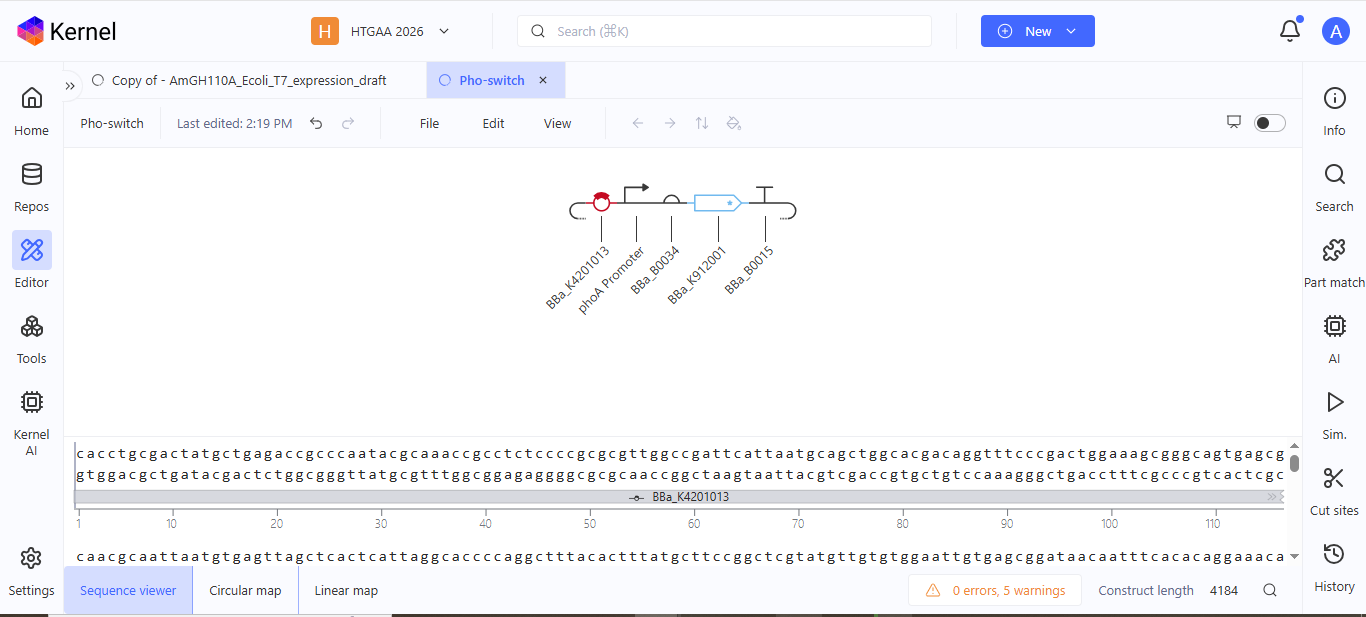
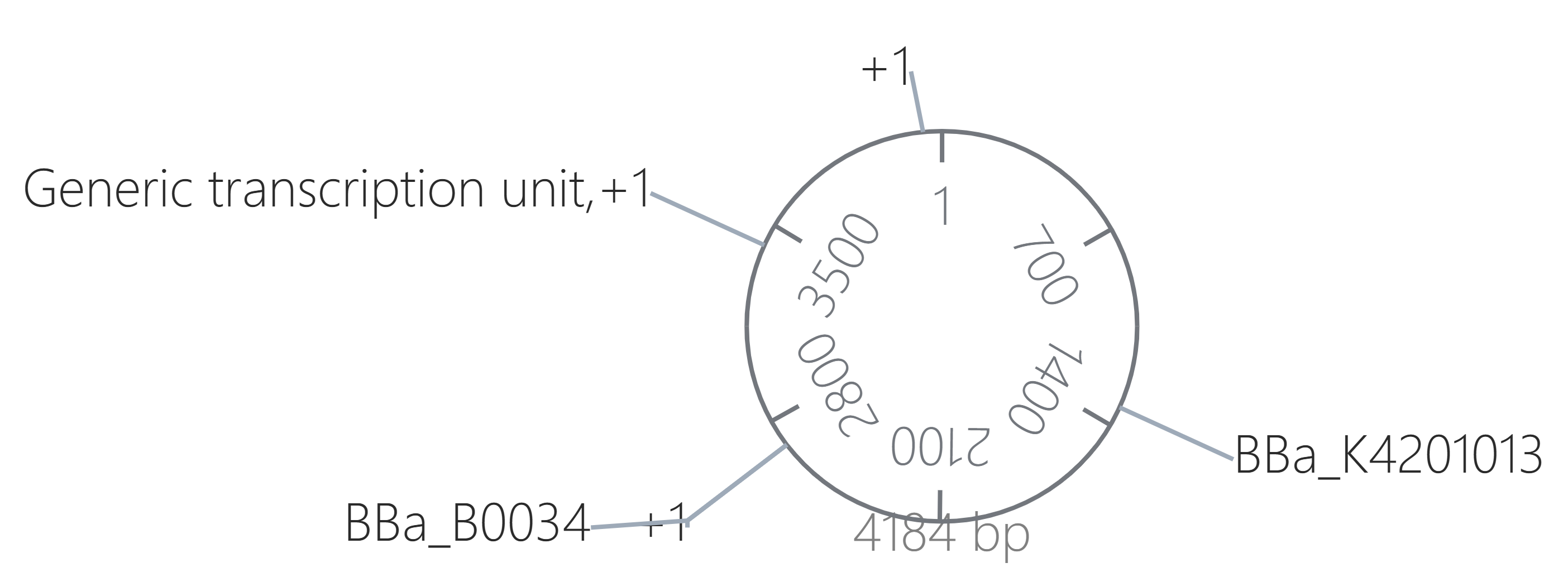
My genetic construct is designed to express AppA phytase/acid phosphatase, a phosphate-modifying enzyme that helps release phosphate from organic phosphorus compounds, potentially making phosphorus available for plant uptake when availability is low.
I used the coding sequence optimization tool in Kernel to optimize the DNA sequence for AppA phytase for an E.Coli host.
ATGAAAGCAATTCTGATTCCGTTTCTGAGCCTGCTGATTCCGCTGACCCCGCAGAGCGCATTTGCACAGAGCGAACCGGAACTGAAACTGGAAAGCGTTGTTATTGTTAGCCGTCATGGTGTTCGTGCACCGACCAAAGCAACCCAGCTGATGCAGGATGTTACCCCGGATGCATGGCCGACCTGGCCGGTTAAACTGGGTTGGCTGACCCCGCGTGGTGGTGAACTGATTGCATATCTGGGTCATTATCAGCGTCAGCGTCTGGTTGCAGATGGTCTGCTGGCAAAAAAAGGTTGTCCGCAGAGCGGTCAGGTTGCAATTATTGCAGATGTTGATGAACGTACCCGTAAAACCGGTGAAGCATTTGCAGCAGGTCTGGCACCGGATTGTGCAATTACCGTTCATACCCAGGCAGATACCAGCAGCCCGGATCCGCTGTTTAATCCGCTGAAAACCGGTGTTTGTCAGCTGGATAATGCAAATGTTACCGATGCAATTCTGAGCCGTGCAGGTGGTAGCATTGCAGATTTTACCGGTCATCGTCAGACCGCATTTCGTGAACTGGAACGTGTTCTGAATTTTCCGCAGAGCAATCTGTGTCTGAAACGTGAAAAACAGGATGAAAGCTGTAGCCTGACCCAGGCACTGCCGAGCGAACTGAAAGTTAGCGCAGATAATGTTAGCCTGACCGGTGCAGTTAGCCTGGCAAGCATGCTGACCAAAATTTTTCTGCTGCAGCAGGCACAGGGTATGCCGGAACCGGGTTGGGGTCGTATTACCGATAGCCATCAGTGGAATACCCTGCTGAGCCTGCATAATGCACAGTTTTATCTGCTGCAGCGTACCCCGGAAGTTGCACGTAGCCGTGCAACCCCGCTGCTGGATCTGATTAAAACCGCACTGACCCCGCATCCGCCGCAGAAACAGGCATATGGTGTTACCCTGCCGACCAGCGTTCTGTTTATTGCAGGTCATGATACCAATCTGGCAAATCTGGGTGGTGCACTGGAACTGAATTGGACCCTGCCGGGTCAGCCGGATAATACCCCGCCGGGTGGTGAACTGGTTTTTGAACGTTGGCGTCGTCTGAGCGATAATAGCCAGTGGATTCAGGTTAGCCTGGTTTTTCAGACCCTGCAGCAGATGCGTGATAAAACCCCGCTGAGCCTGAATACCCCGCCGGGTGAAGTTAAACTGACCCTGGCAGGTTGTGAAGAACGTAATGCACAGGGTATGTGTAGCCTGGCAGGTTTTACCCAGATTGTTAATGAAGCACGTATTCCGGCATGTAGCCTGTGATAA
-Searched Sequence (BLAST)
I ran a BLAST search of the AppA phytase DNA coding sequence, and it ended up being a 100% match since I obtained the sequence from NCBI.
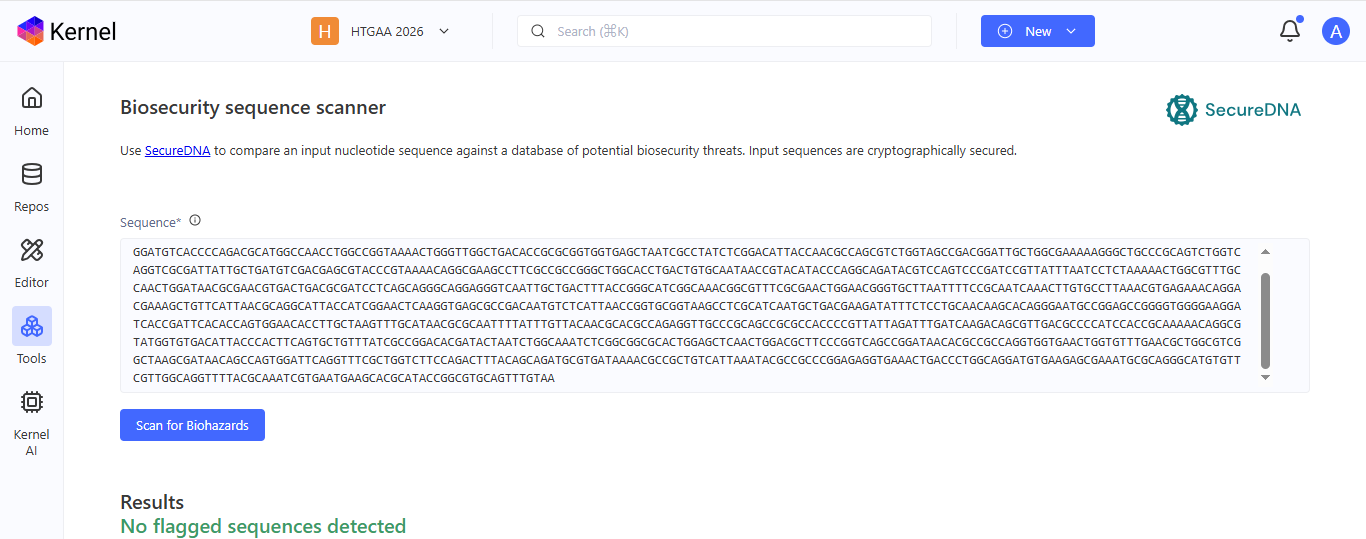
I ran the AppA phytase sequence through Kernel’s biosecurity sequence scanner, and it detected no flagged sequences.
To build the construct, I would order a synthetic DNA construct from Twist. The order would include the phoA promoter, a characterized E. coli phosphate-starvation-responsive promoter. (BBa_K912001), BBa_B0034 as the ribosome-binding site, AppA phytase coding strand serving as the phosphate-mobilizing enzyme, BBa_B0015 as the terminator, and BBa_K4201013 as the backbone. Most of these parts can be found on iGEM E.Coli would be a good vector.
Upon inspection, the parts of my DNA construct do not seem like they would be hard to synthesize, as most of the parts are from iGEM. The AppA phytase coding sequence seems to have its reading frame intact as well.
For the prototype, I would prioritize verifying that the genetic construct behaves as intended. I would test whether low phosphate levels activate the phoA promoter and whether AppA is produced, remains enzymatically active, and causes the release of phosphate from suitable organic phosphorus substrates. The objective would be to use the prototype to establish the proof of concept.
For turning it into an agricultural enzyme product, the manufacturing strategy would need to address reproducibility, production cost, enzyme activity, and the amount of functional AppA obtained per unit of production resources. Scaling would also involve developing and validating appropriate fermentation, recovery, recovry and quality control processes.
A major uncertainty is whether AppA phytase would fold correctly and reach the intended cellular location and retain sufficient phytase activity. I could possibly determine this by assessing protein localization and measuring enzyme activity against suitable organic phosphorus substrates.
Another unknown is whether the phosA promoter would regulate AppA expression effectively under limited phosphate conditions.
Crater, J. S., & Lievense, J. C. (2018). Scale-up of industrial microbial processes. FEMS microbiology letters, 365(13), fny138.
Sun, M., Gao, A.X., Liu, X. et al. High-throughput process development from gene cloning to protein production. Microb Cell Fact 22, 182 (2023). https://doi.org/10.1186/s12934-023-02184-1
Question 1. Why does the concentration of potassium glutamate and magnesium glutamate differ between compositions? Which is more sensitive?
Answer
The concentrations of potassium glutamate and magnesium glutamate differ between compositions because they depend heavily on specific energy regeneration systems and buffer components. Potassium glutamate is mainly used to establish the ionic strength and support ribosome function and translation fidelity. Magnesium glutamate, on the other hand, supplies magnesium ions, which are essential cofactors for nucleic acid enzymes, ribosomes, translation factors, and ATP-dependent systems.
Magnesium glutamate is more sensitive to concentration changes, as too little magnesium can impair ribosome function and enzyme activity, while too much can inhibit protein synthesis.
Question 2. Explain how a PEP+NTP reaction formulation is different from a Ribose+NMP reaction formulation.
Answer
PEP + NTP reaction formulations supply a phosphorylated energy substrate and ready to use nucleotide triphosphate, making it a direct, fast, but expensive formulation. However, Ribose + NMP reaction formulations rely more on the cell extract’s metabolism to generate energy and convert nucleotide precursors into the forms required for transcription.
Question 3. Choose two cell-free reaction compositions from the literature, compare and contrast the choice of reagents and the concentration of reagents.
Answer
I am comparing the PANOx-SP composition described by Jewett & Swartz 2004 with the RFopt formulation by Olsen et al.,(2026). Both formulations use the same foundational machinery, such as E.coli cell lysate, amino acids, potassium glutamate, and magnesium glutamate. PANOx-SP was engineered for maximum initial productivity using high-grade, expensive reagents (PEP + NTP), while RFopt focused on economic scalability, using ribose and glucose with NMPs.
Note: A recommended starting point would be to review at least one published formulation, such as PANOx-SP (Jewett & Swartz 2004), a cost-optimized formulation from Olsen et al. (2026), and/or an AI-designed formulation from Smith et al. (2026).
Question 1. Sign in to coopetition.htgaa.org and publish your first unique 20 µL CFPS reaction composition for each of the following (don’t worry, you can resubmit later): sfGFP PETase Reteplase
Note: if you’re unable to login with your HTGAA keycloak account, please post in Zulip so that you can participate in the coopetition!
For each composition, specify the reagents you would adjust from the relevant categories, including salts, energy sources, building blocks, cofactors, and redox components.
Answer
I signed in to coopetition.htgaa.org and submitted CFPS reaction compositions for each of the three proteins. On the page, you will find the composition and reagents for each submission.
Question 2. As a HTBAA research team, we will have the opportunity to suggest new reagents to add to the cell-free reagent inventory. Contribute (or upvote) at least one reagent to the “Community Reagents” section of the website and provide a short rationale. Include in your homework documentation how you decided on that specific reagent and provide links to any relevant research.
Answer
I suggest adding creatine phosphate because it provides an alternative energy-regeneration strategy for cell-free protein synthesis. It can help regenerate ATP in combination with creatine kinase. It could also be useful when comparing energy systems, optimizing protein yield, and reagent costs.
Colant N, Melinek B, Teneb J, et al. A rational approach to improving titer in Escherichia coli-based cell-free protein synthesis reactions. Biotechnol Progress. 2021; 37:e3062. https://doi.org/10.1002/btpr.3062
Question 3. Visit the cfps-coopetition forum page to ensure you will be able to take part in the discussion. Bonus: send a note in the channel about a CFPS optimization idea that you have! If you would like clarification on aspects of the project, please message in this dedicated channel.
When designing experiments, you’ll often want to compare several conditions that differ only slightly, such as one reagent at a few different concentrations, and batches let you submit those together. To make a batch, click “+ add mix” in the designer to copy your current composition into additional columns, change reagent(s) to a different concentration in each column, add an overall hypothesis plus a short rationale for each mix when submitting.
You should batch experimental conditions that are intended to be directly compared with each other. When we pick the final experimental conditions, we’ll try to include whole batches rather than splitting them up.
A batch is a JSON object with an overall experiment_hypothesis and a samples list. Each item in the list is a dictionary for one composition: a unique sample_id and reagent_list of reagent volumes in nL that sum to exactly 20,000, and metadata with that composition’s protein_target and comments.
For example, to specify a parameter sweep, you keep every sample identical except the reagent you’re varying, and adjust water to keep the total at 20,000 nL:
Answer
I designed a couple of batches comparing several conditions for each of the three proteins.
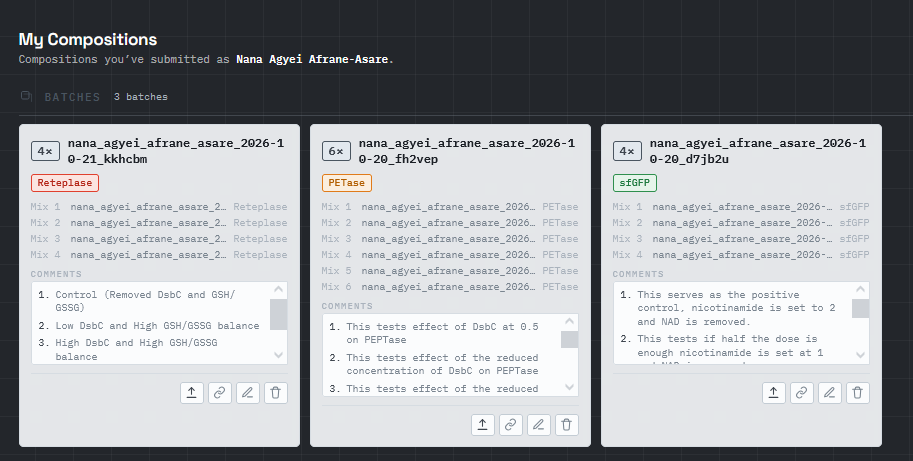
sfGFP
My hypothesis is that removing NAD while increasing nicotinamide may reduce the cost, since it is an expensive helper molecule and can be built from nicotinamide, which is cheaper. This is based on Olsen et al.(2026), which identified NAD as a potentially unnecessary and costly supplement.
| Reagent | Unit | Mix 1 (sfGFP) | Mix 2 (sfGFP) | Mix 3 (sfGFP) | Mix 4 (sfGFP) | sfGFP PEP (2026) | sfGFP Ribose (2026) | PETase PEP (2026) | PETase Ribose (2026) | Reteplase PEP (2026) | Reteplase Ribose (2026) |
|---|---|---|---|---|---|---|---|---|---|---|---|
| K(Glu) | mM | 279.844 | 279.844 | 279.844 | 279.844 | 200 | 200 | 200 | 200 | 200 | 200 |
| Mg(Glu)2 | mM | 8.225 | 8.225 | 8.225 | 8.225 | 8.85 | 8.85 | 8.85 | 8.85 | 8.85 | 8.85 |
| NH4(Glu) | mM | 10 | 10 | 10 | 10 | 10 | 10 | 10 | |||
| Amino acids | mM | 2 | 2 | 2 | 2 | 2 | 5 | 2 | 5 | 2 | 4.8125 |
| Tyrosine | mM | 1 | 1 | 1 | 1 | 1 | 1 | 1 | 1 | 1 | 1.1875 |
| Cysteine | mM | 1 | 1 | 1 | 1 | 1 | 1 | 1 | 1 | 1 | 5 |
| HEPES pH 7.5 | mM | 57.5 | 57.5 | 57.5 | 57.5 | 57.5 | 75 | 57.5 | 75 | 57.5 | 67.5 |
| Phosphate (di:mono) | mM | 7.5 | |||||||||
| Phosphate (mono:di) | mM | 15 | 15 | 7.5 | |||||||
| K₂HPO₄ (dibasic) | mM | ||||||||||
| KH₂PO₄ (monobasic) | mM | ||||||||||
| Glucose | mM | ||||||||||
| Sodium pyruvate | mM | 9.0876 | |||||||||
| Maltose | mM | ||||||||||
| Maltodextrin | mg/mL | ||||||||||
| Ribose | mM | 49.9567 | 49.9567 | 39.9654 | |||||||
| PEP | mM | 30 | 30 | 30 | 30 | 30 | 30 | 30 | |||
| Dilithium acetyl phosphate | mM | ||||||||||
| Sodium hexametaphosphate | mM | ||||||||||
| Potassium formate | mM | ||||||||||
| Folinic acid | mg/mL | 0.025 | 0.025 | 0.025 | 0.025 | 0.025 | 0.025 | 0.025 | |||
| CoA | mM | 0.25 | 0.25 | 0.25 | 0.25 | 0.25 | 0.25 | 0.25 | |||
| NAD | mM | 0.375 | 0.375 | 0.375 | 0.375 | ||||||
| cAMP | mM | ||||||||||
| Nicotinamide | mM | 2 | 1 | 4 | 4 | 4 | |||||
| Putrescine | mM | 1.25 | 1.25 | 1.25 | 1.25 | 1.25 | 1.25 | 1.25 | |||
| Spermidine | mM | 1.5625 | 1.5625 | 1.5625 | 1.5625 | 1.5625 | 1.5625 | 1.5625 | 1.25 | ||
| GSSG | mM | 4.0375 | 4.0375 | ||||||||
| GSH | mM | 1 | 1 | ||||||||
| Oxalic acid | mM | 3.75 | 3.75 | 3.75 | 3.75 | 3.75 | 3.75 | 3.75 | |||
| PEG-8000 | % w/v | ||||||||||
| Brij-35 | % v/v | ||||||||||
| DMSO | % v/v | ||||||||||
| Oxaloacetic acid | mM | ||||||||||
| Succinic acid | mM | ||||||||||
| Adenosine | mM | 0.4062 | |||||||||
| Cytidine | mM | ||||||||||
| Guanosine | mM | ||||||||||
| Uridine | mM | ||||||||||
| Thymidine | mM | ||||||||||
| Adenine | mM | ||||||||||
| Guanine | mM | ||||||||||
| Cytosine | mM | ||||||||||
| Uracil | mM | ||||||||||
| Thymine | mM | ||||||||||
| Catalase | U/mL | 187.5 | |||||||||
| DsbC | µM | 5 | 5 | 5 | 5 | ||||||
| Pyruvate oxidase | mg/mL | ||||||||||
| ATP | mM | 1.25 | 1.25 | 1.25 | 1.25 | 1.25 | 1.25 | 1.25 | |||
| CTP | mM | 0.875 | 0.875 | 0.875 | 0.875 | 0.875 | 0.875 | 0.875 | |||
| GTP | mM | 0.875 | 0.875 | 0.875 | 0.875 | 0.875 | 0.875 | 0.875 | |||
| UTP | mM | 0.875 | 0.875 | 0.875 | 0.875 | 0.875 | 0.875 | 0.875 | |||
| AMP | mM | 3 | 3 | 0.5 | |||||||
| CMP | mM | 2.125 | 2.125 | 1 | |||||||
| GMP | mM | 2.125 | 2.125 | 1 | |||||||
| UMP | mM | 2.125 | 2.125 | 1 |
PETase
My hypothesis is that decreasing the concentration of DsbC can aid in optimizing the dose of DsbC and reduce reagent cost since it is a very expensive enzyme. Additionally, PEPTase is a protein with a single bond, which is less likely to rearrange than one with nine, so it may require less DsbC. This hypothesis was not really based on any particular literature, just my curiosity.
| Reagent | Unit | Mix 1 (PETase) | Mix 2 (PETase) | Mix 3 (PETase) | Mix 4 (PETase) | Mix 5 (PETase) | Mix 6 (PETase) | sfGFP PEP (2026) | sfGFP Ribose (2026) | PETase PEP (2026) | PETase Ribose (2026) | Reteplase PEP (2026) | Reteplase Ribose (2026) |
|---|---|---|---|---|---|---|---|---|---|---|---|---|---|
| K(Glu) | mM | 299.531 | 299.531 | 299.531 | 299.531 | 299.531 | 299.531 | 200 | 200 | 200 | 200 | 200 | 200 |
| Mg(Glu)2 | mM | 8.225 | 8.225 | 8.225 | 8.225 | 8.225 | 8.225 | 8.85 | 8.85 | 8.85 | 8.85 | 8.85 | 8.85 |
| NH4(Glu) | mM | 10 | 10 | 10 | |||||||||
| Amino acids | mM | 5 | 5 | 5 | 5 | 5 | 5 | 2 | 5 | 2 | 5 | 2 | 4.8125 |
| Tyrosine | mM | 1 | 1 | 1 | 1 | 1 | 1 | 1 | 1 | 1 | 1 | 1 | 1.1875 |
| Cysteine | mM | 1 | 1 | 1 | 1 | 1 | 1 | 1 | 1 | 1 | 1 | 1 | 5 |
| HEPES pH 7.5 | mM | 75 | 75 | 75 | 75 | 75 | 75 | 57.5 | 75 | 57.5 | 75 | 57.5 | 67.5 |
| Phosphate (di:mono) | mM | 7.5 | |||||||||||
| Phosphate (mono:di) | mM | 15 | 15 | 15 | 15 | 15 | 15 | 15 | 15 | 7.5 | |||
| K₂HPO₄ (dibasic) | mM | ||||||||||||
| KH₂PO₄ (monobasic) | mM | ||||||||||||
| Glucose | mM | ||||||||||||
| Sodium pyruvate | mM | 9.0876 | |||||||||||
| Maltose | mM | ||||||||||||
| Maltodextrin | mg/mL | ||||||||||||
| Ribose | mM | 49.9567 | 49.9567 | 49.9567 | 49.9567 | 49.9567 | 49.9567 | 49.9567 | 49.9567 | 39.9654 | |||
| PEP | mM | 30 | 30 | 30 | |||||||||
| Dilithium acetyl phosphate | mM | ||||||||||||
| Sodium hexametaphosphate | mM | ||||||||||||
| Potassium formate | mM | ||||||||||||
| Folinic acid | mg/mL | 0.025 | 0.025 | 0.025 | |||||||||
| CoA | mM | 0.25 | 0.25 | 0.25 | |||||||||
| NAD | mM | 0.375 | 0.375 | 0.375 | |||||||||
| cAMP | mM | ||||||||||||
| Nicotinamide | mM | 4 | 4 | 4 | 4 | 4 | 4 | 4 | 4 | 4 | |||
| Putrescine | mM | 1.25 | 1.25 | 1.25 | |||||||||
| Spermidine | mM | 1.5625 | 1.5625 | 1.5625 | 1.25 | ||||||||
| GSSG | mM | 4.0375 | 4.0375 | ||||||||||
| GSH | mM | 1 | 1 | ||||||||||
| Oxalic acid | mM | 3.75 | 3.75 | 3.75 | |||||||||
| PEG-8000 | % w/v | ||||||||||||
| Brij-35 | % v/v | ||||||||||||
| DMSO | % v/v | ||||||||||||
| Oxaloacetic acid | mM | ||||||||||||
| Succinic acid | mM | ||||||||||||
| Adenosine | mM | 0.4062 | |||||||||||
| Cytidine | mM | ||||||||||||
| Guanosine | mM | ||||||||||||
| Uridine | mM | ||||||||||||
| Thymidine | mM | ||||||||||||
| Adenine | mM | ||||||||||||
| Guanine | mM | ||||||||||||
| Cytosine | mM | ||||||||||||
| Uracil | mM | ||||||||||||
| Thymine | mM | ||||||||||||
| Catalase | U/mL | 187.5 | |||||||||||
| DsbC | µM | 0.5 | 0.25 | 1.75 | 4 | 5 | 5 | 5 | 5 | 5 | |||
| Pyruvate oxidase | mg/mL | ||||||||||||
| ATP | mM | 1.25 | 1.25 | 1.25 | |||||||||
| CTP | mM | 0.875 | 0.875 | 0.875 | |||||||||
| GTP | mM | 0.875 | 0.875 | 0.875 | |||||||||
| UTP | mM | 0.875 | 0.875 | 0.875 | |||||||||
| AMP | mM | 3 | 3 | 3 | 3 | 3 | 3 | 3 | 3 | 0.5 | |||
| CMP | mM | 2.125 | 2.125 | 2.125 | 2.125 | 2.125 | 2.125 | 2.125 | 2.125 | 1 | |||
| GMP | mM | 2.125 | 2.125 | 2.125 | 2.125 | 2.125 | 2.125 | 2.125 | 2.125 | 1 | |||
| UMP | mM | 2.125 | 2.125 | 2.125 | 2.125 | 2.125 | 2.125 | 2.125 | 2.125 | 1 |
Reteplase
My hypothesis is that varying the GSH/GSSG balance together with DsbC will enable us to the GSH/GSSG balance together with DsbC will enable us to determine the optimum reaction conditions that would maximize protein folding. This hypothesis is supported by work on plasminogen activators in CFPS, where extract treatment, a GSH/GSSG redox buffer, and DsbC improved the yield of active protein. This hypothesis was influenced by Yin and Swartz (2004).
| Reagent | Unit | Mix 1 (Reteplase) | Mix 2 (Reteplase) | Mix 3 (Reteplase) | Mix 4 (Reteplase) | sfGFP PEP (2026) | sfGFP Ribose (2026) | PETase PEP (2026) | PETase Ribose (2026) | Reteplase PEP (2026) | Reteplase Ribose (2026) |
|---|---|---|---|---|---|---|---|---|---|---|---|
| K(Glu) | mM | 299.531 | 299.531 | 299.531 | 299.531 | 200 | 200 | 200 | 200 | 200 | 200 |
| Mg(Glu)2 | mM | 8.225 | 8.225 | 8.225 | 8.225 | 8.225 | 8.225 | 8.225 | 8.225 | 8.225 | 8.225 |
| NH4(Glu) | mM | 10 | 10 | 10 | |||||||
| Amino acids | mM | 5 | 5 | 5 | 5 | 2 | 5 | 2 | 5 | 2 | 4.8125 |
| Tyrosine | mM | 1 | 1 | 1 | 1 | 1 | 1 | 1 | 1 | 1 | 1.1875 |
| Cysteine | mM | 1 | 1 | 1 | 1 | 1 | 1 | 1 | 1 | 1 | 5 |
| HEPES pH 7.5 | mM | 75 | 75 | 75 | 75 | 57.5 | 75 | 57.5 | 75 | 57.5 | 67.5 |
| Phosphate (di:mono) | mM | 7.5 | |||||||||
| Phosphate (mono:di) | mM | 15 | 15 | 15 | 15 | 15 | 15 | 7.5 | |||
| K₂HPO₄ (dibasic) | mM | ||||||||||
| KH₂PO₄ (monobasic) | mM | ||||||||||
| Glucose | mM | ||||||||||
| Sodium pyruvate | mM | 9.0876 | |||||||||
| Maltose | mM | ||||||||||
| Maltodextrin | mg/mL | ||||||||||
| Ribose | mM | 49.9567 | 49.9567 | 49.9567 | 49.9567 | 49.9567 | 49.9567 | 39.9654 | |||
| PEP | mM | 30 | 30 | 30 | |||||||
| Dilithium acetyl phosphate | mM | ||||||||||
| Sodium hexametaphosphate | mM | ||||||||||
| Potassium formate | mM | ||||||||||
| Folinic acid | mg/mL | 0.025 | 0.025 | 0.025 | |||||||
| CoA | mM | 0.25 | 0.25 | 0.25 | |||||||
| NAD | mM | 0.375 | 0.375 | 0.375 | |||||||
| cAMP | mM | ||||||||||
| Nicotinamide | mM | 4 | 4 | 4 | 4 | 4 | 4 | 4 | |||
| Putrescine | mM | 1.25 | 1.25 | 1.25 | |||||||
| Spermidine | mM | 1.5625 | 1.5625 | 1.5625 | 1.25 | ||||||
| GSSG | mM | 0.425 | 4.25 | 4.25 | 2.55 | 4.0375 | 4.0375 | ||||
| GSH | mM | 0.25 | 1 | 1 | 0.5 | 1 | 1 | ||||
| Oxalic acid | mM | 3.75 | 3.75 | 3.75 | |||||||
| PEG-8000 | % w/v | ||||||||||
| Brij-35 | % v/v | ||||||||||
| DMSO | % v/v | ||||||||||
| Oxaloacetic acid | mM | ||||||||||
| Succinic acid | mM | ||||||||||
| Adenosine | mM | 0.4062 | |||||||||
| Cytidine | mM | ||||||||||
| Guanosine | mM | ||||||||||
| Uridine | mM | ||||||||||
| Thymidine | mM | ||||||||||
| Adenine | mM | ||||||||||
| Guanine | mM | ||||||||||
| Cytosine | mM | ||||||||||
| Uracil | mM | ||||||||||
| Thymine | mM | ||||||||||
| Catalase | U/mL | 187.5 | |||||||||
| DsbC | µM | 0.25 | 0.25 | 0.75 | 0.5 | 5 | 5 | 5 | 5 | ||
| Pyruvate oxidase | mg/mL | ||||||||||
| ATP | mM | 1.25 | 1.25 | 1.25 | |||||||
| CTP | mM | 0.875 | 0.875 | 0.875 | |||||||
| GTP | mM | 0.875 | 0.875 | 0.875 | |||||||
| UTP | mM | 0.875 | 0.875 | 0.875 | |||||||
| AMP | mM | 3 | 3 | 3 | 3 | 3 | 3 | 0.5 | |||
| CMP | mM | 2.125 | 2.125 | 2.125 | 2.125 | 2.125 | 2.125 | 1 | |||
| GMP | mM | 2.125 | 2.125 | 2.125 | 2.125 | 2.125 | 2.125 | 1 | |||
| UMP | mM | 2.125 | 2.125 | 2.125 | 2.125 | 2.125 | 2.125 | 1 |
C. AGENTIC CONTRIBUTION (OPTIONAL)
coopetition.htgaa.org has been updated to allow for AI agents to programmatically create and submit CFPS compositions based on your guidance. Visit the Agent tab to generate an agent token which can be used for interacting with the website.
Your AI agent can design and submit reagent compositions (singly or in batches), edit, reorder or delete your contributions, star and comment on other compositions, suggest, upvote and comment on community reagents, add, edit and upvote papers in the literature list, and read the approved reagent list.
Answer
Unfortunately, I did not use AI agents to submit any CFPS compositions.
I used Claude Sonnet 5.5 to help brainstorm ideas for CFPS composition for the three proteins.
Olsen, M. L., Copeland, C. E., Sundberg, C. A., Aw, R., Shaver, Z. M., Rao, G., Swartz, J. R., Karim, A. S., & Jewett, M. C. (2026). Design-driven optimization of low-cost reagent formulations for reproducible and high-yielding cell-free gene expression. Nature communications, 17(1), 3478. https://doi.org/10.1038/s41467-026-69605-8
Jewett, M. C., & Swartz, J. R. (2004). Mimicking the Escherichia coli cytoplasmic environment activates long-lived and efficient cell-free protein synthesis. Biotechnology and Bioengineering, 86(1), 19–26. DOI: 10.1002/bit.20026.
Silverman, A. D., Karim, A. S., & Jewett, M. C. (2020). Cell-free gene expression: an expanded repertoire of applications. Nature Reviews Genetics, 21, 151–170. DOI: 10.1038/s41576-019-0186-3.
Rasor, B. J., Vögeli, B., Landwehr, G. M., Bogart, J. W., Karim, A. S., & Jewett, M. C. (2021). Toward sustainable, cell-free biomanufacturing. Current Opinion in Biotechnology, 69, 136–144. DOI: 10.1016/j.copbio.2020.12.012.
Yin, G., & Swartz, J. R. (2004). Enhancing multiple disulfide bonded protein folding in a cell-free system. Biotechnology and Bioengineering, 86(2), 188–195. https://doi.org/10.1002/bit.10827
Your email address has been pre-approved for Portal access.
Question 1. Create your account through the link in the Welcome email, or using this link.
Question 2. Click around and explore- Data, Taxonomy Browser, and the search bar are good places to start. Notice-what species have you heard of? What types of data are available?
Answer
Question 1.
I created my account through the link in the welcome email.

Question 2.
I explored the portal, and I discovered that cultivarium holds data on 175,488 species and 159,700 strains of organisms. I had heard of some of the species, but the 1# ranked species, which was Vibrio natriegens, caught my eye because it wasn’t something I was familiar with. Vibrio natriegens is a fast-growing, non-pathogenic marine bacterium known for its rapid doubling time of less than 10 minutes and high substrate uptake rates.
Question 1. Identify a non-model organism that naturally produces your target product. You can use the Portal AI, MicroScopus, or another tool to conduct this search. If not directly available, search for microorganisms that carry related genes or have a similar industry application.
Question 2. Navigate to that organism’s page on the Cultivarium Portal. Select a specific strain (“strain information” tab). Examine what types of information are readily available for that strain?
| Category | Data |
|---|---|
| Species Name | Vibrio natriegens |
| Strain Name | Vibrio natriegens 111 |
| Link | Cultivarium – Vibrio natriegens |
| Growth Media and Temperature | LB3% NaCl, 37°C |
| Susceptible Antibiotics and MIC90 | |
| Functional ORIs | |
| Genome Size | |
| Number of Publications Listed |
Answer
Question 1.
A non-model organism that can produce phytase, which is my target product, is Komagataella phaffii (Pichia pastoris). I discovered it using MicroScopus.
Question 2.
| Category | Data |
|---|---|
| Species Name | Komagataella pastoris |
| Strain Name | Komagataella pastoris CBS 704 |
| Link | Cultivarium – Komagataella pastoris |
| Growth Media and Temperature | 24-26°C |
| Susceptible Antibiotics and MIC90 | |
| Functional ORIs | |
| Genome Size | |
| Number of Publications Listed | 14 |
The information provides a basic profile of Komagataella pastoris, including its species, strain identity, growth temperature, and the number of publications associated with it. I can use these details to evaluate the suitability of Komagataella pastoris as a biological chassis for synthetic biology, genetic engineering, and biomanufacturing applications. The publication count also serves as an indication of the available research literature.
Regarding the missing information: growth media, susceptible antibiotics, MIC90, functional origins of replication, and genome size. These missing details are important because species identification alone is insufficient for selecting a chassis. They can help determine whether Komagataella pastoris can support the intended genetic modifications and maintain engineered constructs while performing reliably under the desired biomanufacturing conditions.
One strategy for when organism information is limited is to use available information from phylogenetically related species or strains. We call these strains “neighbors”.
For your species identified in Part 1, identify the nearest neighbor strain with available information to fill out the missing details. (HINT: traverse up the Taxonomy Browser and search for CVM strains) Deliverable: Copy and fill out the table below. For each category with missing information in Part 1, fill out information from a neighbor strain.
| Neighbor Species | Related Level (e.g., genus, family) | Category | Data |
|---|---|---|---|
| Vibrio gazogenes | Genus | Genome Size | 4,892,895 bp |
Answer
| Neighbor Species | Related Level (e.g., genus, family) | Category | Data |
|---|---|---|---|
| Komagataella pastoris | Genus | Genome Size | |
| Komagataella kurtzmanii | Genus | Genome Size | |
| Komagataella mondaviorum | Genus | Genome Size | |
| Komagataella phaffii NRRL Y-11430 Stain | Genus | Genome Size | 9,141,832 bp |
| Komagataella populi | Genus | Genome Size | |
| Komagataella pseudopastoris | Genus | Genome Size | |
| Komagataella ulmi | Genus | Genome Size |
While using the Taxonomy Browser on the Cultivarium platform I noticed that most of the relatives of Komagataella pastoris my non-model species expect Komagataella phaffii did not have the information needed to complete the table.
Review the data you gathered above. What do you know about your target strain, and what information is still missing? How confident do you feel about your ability to design an experiment with this strain? Identify the 2-3 biggest unknowns or risks. For example: Will the growth conditions from a nearest neighbor translate directly? What about the functional plasmid ORIs? For each, state how you would find out: the experiment you would try next. What are your readouts, and what would they tell you?
Answer
My target strain is Komagataella pastoris CBS 704, a methylotrophic yeast belonging to the genus Komagataella. From the information avaliable on the Cultivarium platform I identifiied several closely related species including K. phaffii, K. kurtzmanii, K. mondaviorum and K. ulmi.
In regards to the information missing, I have not determined the specific growth media that this strains trives in. I have yet to establish wether the strain can efficienctly take up foreign DNA and intergate the introduced genetic material into its genome as well as the in the traget product can be retrived effiectively. Inspite of this I have moderate confidence in my ability to use this strain in an experiment.
For the three major risks and Unkowns they are smiliar to what I stated above.
To determine this I would Conduct a small-scale growth experiment using different temperatures, pH values and carbon sources, including glucose, glycerol and methanol. Use published Komagataella growth conditions as starting points. I would measure optical density (OD600) at regular intervals and construct growth curves. This will help identify suitable growth conditions, growth rates and preferred carbon sources.
I would introduce a test genetic construct containing a reporter gene, such as GFP, under a promoter known to work in K. phaffii. Test an appropriate yeast-compatible selectable marker and evaluate whether autonomous replication or genomic integration is achieved. Ultimately I would measure GFP fluorescence, the number of transformants and the stability of the introduced DNA. These results will indicate whether the genetic components are functional in the target strain.
I would perform a small-scale transformation experiment using an established yeast transformation method, such as electroporation or lithium acetate-based transformation. Include an appropriate positive control where possible. I would then measure the number of viable transformants on selective media, confirm DNA introduction using colony PCR, and assess genetic stability through subsequent growth without selection.
Reflect on your final project proposal. How might the resources shared with you (Cultivarium Portal, Vault, PRISM) help with your living system design? Identify a specific tool and its relevance, and how you intend to use it for your project.
Answer
For my final project, I plan to develop a biological system that can detect low phosphate levels and respond by activating the production of Phytase to make otherwise unavailable phosphate accessible to plants.
Using the Cultivarium portal, I would investigate strains of E.coli and their genomic information, growth conditions, nutrient requirements, and information about related organisms that might offer alternative chassis options.
For the Vault, I would use it to document the biological information and materials I gather throughout the project design process. This would include information such as genetic sequences, plasmid designs, relevant literature, experimental records, and other supporting resources available through the platform
PRISM would be useful during experimental testing, optimisation, and enzyme production stages of developing the phosphate-responsive system. I would use it to record laboratory procedures that involve the preparation and cultivation of the selected host organism, testing the phosphate-responsive genetic circuit, and monitoring reporter expression under different phosphate conditions.
Carneiro, C. V. G. C., Serra, L. A., Pacheco, T. F., Ferreira, L. M. M., Brandão, L. T. D., Freitas, M. N. d. M., Trichez, D., & Almeida, J. R. M. d. (2022). Advances in Komagataella phaffii Engineering for the Production of Renewable Chemicals and Proteins. Fermentation, 8(11), 575. https://doi.org/10.3390/fermentation8110575
Heistinger, L., Dohm, J. C., Paes, B. G., Koizar, D., Troyer, C., Ata, Ö., Steininger-Mairinger, T., & Mattanovich, D. (2022). Genotypic and phenotypic diversity among Komagataella species reveals a hidden pathway for xylose utilization. Microbial cell factories, 21(1), 70. https://doi.org/10.1186/s12934-022-01796-3