Week 4 LAB: Cell-Free Manufacturing
WEEK 4 ASSIGNMENT: CFPS REACTION DESIGN FOR SFGFP, PETASE, RETEPLASE
A. DESIGN A BATCH OF CELL-FREE REACTION COMPOSITIONS
When designing experiments, you’ll often want to compare several conditions that differ only slightly, such as one reagent at a few different concentrations, and batches let you submit those together. To make a batch, click “+ add mix” in the designer to copy your current composition into additional columns, change reagent(s) to a different concentration in each column, add an overall hypothesis plus a short rationale for each mix when submitting.
You should batch experimental conditions that are intended to be directly compared with each other. When we pick the final experimental conditions, we’ll try to include whole batches rather than splitting them up.
A batch is a JSON object with an overall experiment_hypothesis and a samples list. Each item in the list is a dictionary for one composition: a unique sample_id and reagent_list of reagent volumes in nL that sum to exactly 20,000, and metadata with that composition’s protein_target and comments.
For example, to specify a parameter sweep, you keep every sample identical except the reagent you’re varying, and adjust water to keep the total at 20,000 nL:
Answer
I designed a couple of batches comparing several conditions for each of the three proteins.
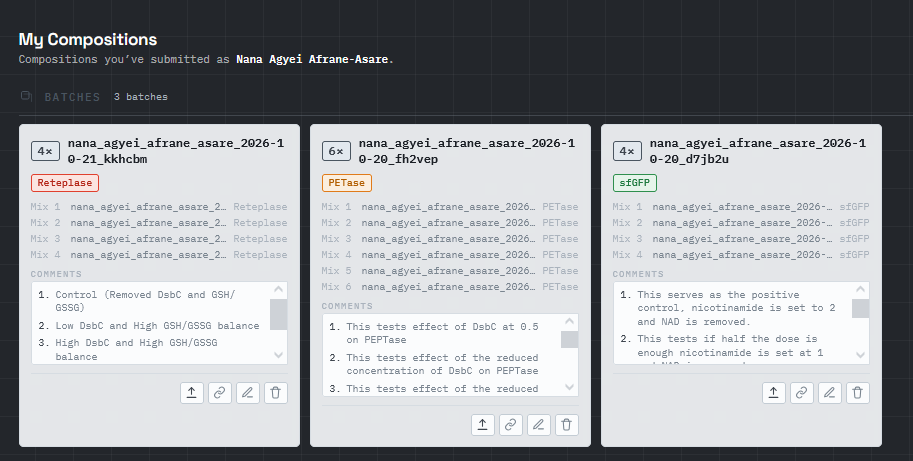
sfGFP
My hypothesis is that removing NAD while increasing nicotinamide may reduce the cost, since it is an expensive helper molecule and can be built from nicotinamide, which is cheaper. This is based on Olsen et al.(2026), which identified NAD as a potentially unnecessary and costly supplement.
| Reagent | Unit | Mix 1 (sfGFP) | Mix 2 (sfGFP) | Mix 3 (sfGFP) | Mix 4 (sfGFP) | sfGFP PEP (2026) | sfGFP Ribose (2026) | PETase PEP (2026) | PETase Ribose (2026) | Reteplase PEP (2026) | Reteplase Ribose (2026) |
|---|---|---|---|---|---|---|---|---|---|---|---|
| K(Glu) | mM | 279.844 | 279.844 | 279.844 | 279.844 | 200 | 200 | 200 | 200 | 200 | 200 |
| Mg(Glu)2 | mM | 8.225 | 8.225 | 8.225 | 8.225 | 8.85 | 8.85 | 8.85 | 8.85 | 8.85 | 8.85 |
| NH4(Glu) | mM | 10 | 10 | 10 | 10 | 10 | 10 | 10 | |||
| Amino acids | mM | 2 | 2 | 2 | 2 | 2 | 5 | 2 | 5 | 2 | 4.8125 |
| Tyrosine | mM | 1 | 1 | 1 | 1 | 1 | 1 | 1 | 1 | 1 | 1.1875 |
| Cysteine | mM | 1 | 1 | 1 | 1 | 1 | 1 | 1 | 1 | 1 | 5 |
| HEPES pH 7.5 | mM | 57.5 | 57.5 | 57.5 | 57.5 | 57.5 | 75 | 57.5 | 75 | 57.5 | 67.5 |
| Phosphate (di:mono) | mM | 7.5 | |||||||||
| Phosphate (mono:di) | mM | 15 | 15 | 7.5 | |||||||
| K₂HPO₄ (dibasic) | mM | ||||||||||
| KH₂PO₄ (monobasic) | mM | ||||||||||
| Glucose | mM | ||||||||||
| Sodium pyruvate | mM | 9.0876 | |||||||||
| Maltose | mM | ||||||||||
| Maltodextrin | mg/mL | ||||||||||
| Ribose | mM | 49.9567 | 49.9567 | 39.9654 | |||||||
| PEP | mM | 30 | 30 | 30 | 30 | 30 | 30 | 30 | |||
| Dilithium acetyl phosphate | mM | ||||||||||
| Sodium hexametaphosphate | mM | ||||||||||
| Potassium formate | mM | ||||||||||
| Folinic acid | mg/mL | 0.025 | 0.025 | 0.025 | 0.025 | 0.025 | 0.025 | 0.025 | |||
| CoA | mM | 0.25 | 0.25 | 0.25 | 0.25 | 0.25 | 0.25 | 0.25 | |||
| NAD | mM | 0.375 | 0.375 | 0.375 | 0.375 | ||||||
| cAMP | mM | ||||||||||
| Nicotinamide | mM | 2 | 1 | 4 | 4 | 4 | |||||
| Putrescine | mM | 1.25 | 1.25 | 1.25 | 1.25 | 1.25 | 1.25 | 1.25 | |||
| Spermidine | mM | 1.5625 | 1.5625 | 1.5625 | 1.5625 | 1.5625 | 1.5625 | 1.5625 | 1.25 | ||
| GSSG | mM | 4.0375 | 4.0375 | ||||||||
| GSH | mM | 1 | 1 | ||||||||
| Oxalic acid | mM | 3.75 | 3.75 | 3.75 | 3.75 | 3.75 | 3.75 | 3.75 | |||
| PEG-8000 | % w/v | ||||||||||
| Brij-35 | % v/v | ||||||||||
| DMSO | % v/v | ||||||||||
| Oxaloacetic acid | mM | ||||||||||
| Succinic acid | mM | ||||||||||
| Adenosine | mM | 0.4062 | |||||||||
| Cytidine | mM | ||||||||||
| Guanosine | mM | ||||||||||
| Uridine | mM | ||||||||||
| Thymidine | mM | ||||||||||
| Adenine | mM | ||||||||||
| Guanine | mM | ||||||||||
| Cytosine | mM | ||||||||||
| Uracil | mM | ||||||||||
| Thymine | mM | ||||||||||
| Catalase | U/mL | 187.5 | |||||||||
| DsbC | µM | 5 | 5 | 5 | 5 | ||||||
| Pyruvate oxidase | mg/mL | ||||||||||
| ATP | mM | 1.25 | 1.25 | 1.25 | 1.25 | 1.25 | 1.25 | 1.25 | |||
| CTP | mM | 0.875 | 0.875 | 0.875 | 0.875 | 0.875 | 0.875 | 0.875 | |||
| GTP | mM | 0.875 | 0.875 | 0.875 | 0.875 | 0.875 | 0.875 | 0.875 | |||
| UTP | mM | 0.875 | 0.875 | 0.875 | 0.875 | 0.875 | 0.875 | 0.875 | |||
| AMP | mM | 3 | 3 | 0.5 | |||||||
| CMP | mM | 2.125 | 2.125 | 1 | |||||||
| GMP | mM | 2.125 | 2.125 | 1 | |||||||
| UMP | mM | 2.125 | 2.125 | 1 |
PETase
My hypothesis is that decreasing the concentration of DsbC can aid in optimizing the dose of DsbC and reduce reagent cost since it is a very expensive enzyme. Additionally, PEPTase is a protein with a single bond, which is less likely to rearrange than one with nine, so it may require less DsbC. This hypothesis was not really based on any particular literature, just my curiosity.
| Reagent | Unit | Mix 1 (PETase) | Mix 2 (PETase) | Mix 3 (PETase) | Mix 4 (PETase) | Mix 5 (PETase) | Mix 6 (PETase) | sfGFP PEP (2026) | sfGFP Ribose (2026) | PETase PEP (2026) | PETase Ribose (2026) | Reteplase PEP (2026) | Reteplase Ribose (2026) |
|---|---|---|---|---|---|---|---|---|---|---|---|---|---|
| K(Glu) | mM | 299.531 | 299.531 | 299.531 | 299.531 | 299.531 | 299.531 | 200 | 200 | 200 | 200 | 200 | 200 |
| Mg(Glu)2 | mM | 8.225 | 8.225 | 8.225 | 8.225 | 8.225 | 8.225 | 8.85 | 8.85 | 8.85 | 8.85 | 8.85 | 8.85 |
| NH4(Glu) | mM | 10 | 10 | 10 | |||||||||
| Amino acids | mM | 5 | 5 | 5 | 5 | 5 | 5 | 2 | 5 | 2 | 5 | 2 | 4.8125 |
| Tyrosine | mM | 1 | 1 | 1 | 1 | 1 | 1 | 1 | 1 | 1 | 1 | 1 | 1.1875 |
| Cysteine | mM | 1 | 1 | 1 | 1 | 1 | 1 | 1 | 1 | 1 | 1 | 1 | 5 |
| HEPES pH 7.5 | mM | 75 | 75 | 75 | 75 | 75 | 75 | 57.5 | 75 | 57.5 | 75 | 57.5 | 67.5 |
| Phosphate (di:mono) | mM | 7.5 | |||||||||||
| Phosphate (mono:di) | mM | 15 | 15 | 15 | 15 | 15 | 15 | 15 | 15 | 7.5 | |||
| K₂HPO₄ (dibasic) | mM | ||||||||||||
| KH₂PO₄ (monobasic) | mM | ||||||||||||
| Glucose | mM | ||||||||||||
| Sodium pyruvate | mM | 9.0876 | |||||||||||
| Maltose | mM | ||||||||||||
| Maltodextrin | mg/mL | ||||||||||||
| Ribose | mM | 49.9567 | 49.9567 | 49.9567 | 49.9567 | 49.9567 | 49.9567 | 49.9567 | 49.9567 | 39.9654 | |||
| PEP | mM | 30 | 30 | 30 | |||||||||
| Dilithium acetyl phosphate | mM | ||||||||||||
| Sodium hexametaphosphate | mM | ||||||||||||
| Potassium formate | mM | ||||||||||||
| Folinic acid | mg/mL | 0.025 | 0.025 | 0.025 | |||||||||
| CoA | mM | 0.25 | 0.25 | 0.25 | |||||||||
| NAD | mM | 0.375 | 0.375 | 0.375 | |||||||||
| cAMP | mM | ||||||||||||
| Nicotinamide | mM | 4 | 4 | 4 | 4 | 4 | 4 | 4 | 4 | 4 | |||
| Putrescine | mM | 1.25 | 1.25 | 1.25 | |||||||||
| Spermidine | mM | 1.5625 | 1.5625 | 1.5625 | 1.25 | ||||||||
| GSSG | mM | 4.0375 | 4.0375 | ||||||||||
| GSH | mM | 1 | 1 | ||||||||||
| Oxalic acid | mM | 3.75 | 3.75 | 3.75 | |||||||||
| PEG-8000 | % w/v | ||||||||||||
| Brij-35 | % v/v | ||||||||||||
| DMSO | % v/v | ||||||||||||
| Oxaloacetic acid | mM | ||||||||||||
| Succinic acid | mM | ||||||||||||
| Adenosine | mM | 0.4062 | |||||||||||
| Cytidine | mM | ||||||||||||
| Guanosine | mM | ||||||||||||
| Uridine | mM | ||||||||||||
| Thymidine | mM | ||||||||||||
| Adenine | mM | ||||||||||||
| Guanine | mM | ||||||||||||
| Cytosine | mM | ||||||||||||
| Uracil | mM | ||||||||||||
| Thymine | mM | ||||||||||||
| Catalase | U/mL | 187.5 | |||||||||||
| DsbC | µM | 0.5 | 0.25 | 1.75 | 4 | 5 | 5 | 5 | 5 | 5 | |||
| Pyruvate oxidase | mg/mL | ||||||||||||
| ATP | mM | 1.25 | 1.25 | 1.25 | |||||||||
| CTP | mM | 0.875 | 0.875 | 0.875 | |||||||||
| GTP | mM | 0.875 | 0.875 | 0.875 | |||||||||
| UTP | mM | 0.875 | 0.875 | 0.875 | |||||||||
| AMP | mM | 3 | 3 | 3 | 3 | 3 | 3 | 3 | 3 | 0.5 | |||
| CMP | mM | 2.125 | 2.125 | 2.125 | 2.125 | 2.125 | 2.125 | 2.125 | 2.125 | 1 | |||
| GMP | mM | 2.125 | 2.125 | 2.125 | 2.125 | 2.125 | 2.125 | 2.125 | 2.125 | 1 | |||
| UMP | mM | 2.125 | 2.125 | 2.125 | 2.125 | 2.125 | 2.125 | 2.125 | 2.125 | 1 |
Reteplase
My hypothesis is that varying the GSH/GSSG balance together with DsbC will enable us to the GSH/GSSG balance together with DsbC will enable us to determine the optimum reaction conditions that would maximize protein folding. This hypothesis is supported by work on plasminogen activators in CFPS, where extract treatment, a GSH/GSSG redox buffer, and DsbC improved the yield of active protein. This hypothesis was influenced by Yin and Swartz (2004).
| Reagent | Unit | Mix 1 (Reteplase) | Mix 2 (Reteplase) | Mix 3 (Reteplase) | Mix 4 (Reteplase) | sfGFP PEP (2026) | sfGFP Ribose (2026) | PETase PEP (2026) | PETase Ribose (2026) | Reteplase PEP (2026) | Reteplase Ribose (2026) |
|---|---|---|---|---|---|---|---|---|---|---|---|
| K(Glu) | mM | 299.531 | 299.531 | 299.531 | 299.531 | 200 | 200 | 200 | 200 | 200 | 200 |
| Mg(Glu)2 | mM | 8.225 | 8.225 | 8.225 | 8.225 | 8.225 | 8.225 | 8.225 | 8.225 | 8.225 | 8.225 |
| NH4(Glu) | mM | 10 | 10 | 10 | |||||||
| Amino acids | mM | 5 | 5 | 5 | 5 | 2 | 5 | 2 | 5 | 2 | 4.8125 |
| Tyrosine | mM | 1 | 1 | 1 | 1 | 1 | 1 | 1 | 1 | 1 | 1.1875 |
| Cysteine | mM | 1 | 1 | 1 | 1 | 1 | 1 | 1 | 1 | 1 | 5 |
| HEPES pH 7.5 | mM | 75 | 75 | 75 | 75 | 57.5 | 75 | 57.5 | 75 | 57.5 | 67.5 |
| Phosphate (di:mono) | mM | 7.5 | |||||||||
| Phosphate (mono:di) | mM | 15 | 15 | 15 | 15 | 15 | 15 | 7.5 | |||
| K₂HPO₄ (dibasic) | mM | ||||||||||
| KH₂PO₄ (monobasic) | mM | ||||||||||
| Glucose | mM | ||||||||||
| Sodium pyruvate | mM | 9.0876 | |||||||||
| Maltose | mM | ||||||||||
| Maltodextrin | mg/mL | ||||||||||
| Ribose | mM | 49.9567 | 49.9567 | 49.9567 | 49.9567 | 49.9567 | 49.9567 | 39.9654 | |||
| PEP | mM | 30 | 30 | 30 | |||||||
| Dilithium acetyl phosphate | mM | ||||||||||
| Sodium hexametaphosphate | mM | ||||||||||
| Potassium formate | mM | ||||||||||
| Folinic acid | mg/mL | 0.025 | 0.025 | 0.025 | |||||||
| CoA | mM | 0.25 | 0.25 | 0.25 | |||||||
| NAD | mM | 0.375 | 0.375 | 0.375 | |||||||
| cAMP | mM | ||||||||||
| Nicotinamide | mM | 4 | 4 | 4 | 4 | 4 | 4 | 4 | |||
| Putrescine | mM | 1.25 | 1.25 | 1.25 | |||||||
| Spermidine | mM | 1.5625 | 1.5625 | 1.5625 | 1.25 | ||||||
| GSSG | mM | 0.425 | 4.25 | 4.25 | 2.55 | 4.0375 | 4.0375 | ||||
| GSH | mM | 0.25 | 1 | 1 | 0.5 | 1 | 1 | ||||
| Oxalic acid | mM | 3.75 | 3.75 | 3.75 | |||||||
| PEG-8000 | % w/v | ||||||||||
| Brij-35 | % v/v | ||||||||||
| DMSO | % v/v | ||||||||||
| Oxaloacetic acid | mM | ||||||||||
| Succinic acid | mM | ||||||||||
| Adenosine | mM | 0.4062 | |||||||||
| Cytidine | mM | ||||||||||
| Guanosine | mM | ||||||||||
| Uridine | mM | ||||||||||
| Thymidine | mM | ||||||||||
| Adenine | mM | ||||||||||
| Guanine | mM | ||||||||||
| Cytosine | mM | ||||||||||
| Uracil | mM | ||||||||||
| Thymine | mM | ||||||||||
| Catalase | U/mL | 187.5 | |||||||||
| DsbC | µM | 0.25 | 0.25 | 0.75 | 0.5 | 5 | 5 | 5 | 5 | ||
| Pyruvate oxidase | mg/mL | ||||||||||
| ATP | mM | 1.25 | 1.25 | 1.25 | |||||||
| CTP | mM | 0.875 | 0.875 | 0.875 | |||||||
| GTP | mM | 0.875 | 0.875 | 0.875 | |||||||
| UTP | mM | 0.875 | 0.875 | 0.875 | |||||||
| AMP | mM | 3 | 3 | 3 | 3 | 3 | 3 | 0.5 | |||
| CMP | mM | 2.125 | 2.125 | 2.125 | 2.125 | 2.125 | 2.125 | 1 | |||
| GMP | mM | 2.125 | 2.125 | 2.125 | 2.125 | 2.125 | 2.125 | 1 | |||
| UMP | mM | 2.125 | 2.125 | 2.125 | 2.125 | 2.125 | 2.125 | 1 |
C. AGENTIC CONTRIBUTION (OPTIONAL)
coopetition.htgaa.org has been updated to allow for AI agents to programmatically create and submit CFPS compositions based on your guidance. Visit the Agent tab to generate an agent token which can be used for interacting with the website.
Your AI agent can design and submit reagent compositions (singly or in batches), edit, reorder or delete your contributions, star and comment on other compositions, suggest, upvote and comment on community reagents, add, edit and upvote papers in the literature list, and read the approved reagent list.
Answer
Unfortunately, I did not use AI agents to submit any CFPS compositions.
References
I used Claude Sonnet 5.5 to help brainstorm ideas for CFPS composition for the three proteins.
Olsen, M. L., Copeland, C. E., Sundberg, C. A., Aw, R., Shaver, Z. M., Rao, G., Swartz, J. R., Karim, A. S., & Jewett, M. C. (2026). Design-driven optimization of low-cost reagent formulations for reproducible and high-yielding cell-free gene expression. Nature communications, 17(1), 3478. https://doi.org/10.1038/s41467-026-69605-8
Jewett, M. C., & Swartz, J. R. (2004). Mimicking the Escherichia coli cytoplasmic environment activates long-lived and efficient cell-free protein synthesis. Biotechnology and Bioengineering, 86(1), 19–26. DOI: 10.1002/bit.20026.
Silverman, A. D., Karim, A. S., & Jewett, M. C. (2020). Cell-free gene expression: an expanded repertoire of applications. Nature Reviews Genetics, 21, 151–170. DOI: 10.1038/s41576-019-0186-3.
Rasor, B. J., Vögeli, B., Landwehr, G. M., Bogart, J. W., Karim, A. S., & Jewett, M. C. (2021). Toward sustainable, cell-free biomanufacturing. Current Opinion in Biotechnology, 69, 136–144. DOI: 10.1016/j.copbio.2020.12.012.
Yin, G., & Swartz, J. R. (2004). Enhancing multiple disulfide bonded protein folding in a cell-free system. Biotechnology and Bioengineering, 86(2), 188–195. https://doi.org/10.1002/bit.10827