RootGuard HW2 — Process Documentation in Kernel
Process documentation · revised 2 October 2026 · English translation prepared 2 October 2026. Times use Western Indonesian Time (WIB, UTC+7), unless explicitly stated as UTC.
This record describes the work completed, the reasons for design decisions, and the questions that remain unresolved. It does not replace laboratory data. The more detailed history, including 51 original images, remains in the Notion journal.
1. Understanding the design files
Expression instructions can be understood as a recipe for producing a protein. TasA provides the coding instructions for one protein, while the promoter, RBS and terminator help control how those instructions are read. The backbone provides the context for maintaining DNA in a suitable host. This analogy helps explain the components; actual function still depends on the sequence, strain and experimental conditions.
| Object | Contents | Purpose |
|---|---|---|
| Native TasA, 786 bp | CDS only, including ATG and TAA | Gene reference and sequence comparison |
| RootGuard v1, 953 bp | Promoter + RBS + spacer + CDS + terminator | Initial cassette history; no replication backbone |
| RootGuard v2, 8,734 bp | Native cassette in the pHT01 context | Main assembled design for HW2 |
| DNA Chisel candidate, 786 bp | Synonymous CDS from an external comparison | Codon-usage comparison; has not replaced the CDS in v2 |
The Construct label in Kernel identifies a data container. It does not establish that the DNA inside is a complete plasmid. Similarly, circular metadata does not add a missing backbone.
2. Selecting a focused target from HW1
HW1 describes the RootGuard inoculant with a cocoa pod husk and okara biochar carrier, intended for evaluation with maize in Sumbawa. The initial goals are consistent viable-cell loading and survival. I selected TasA as one protein target associated with matrix structure; this choice does not establish that a single gene will produce a complete biofilm or a benefit to the plant.
The proposed chassis remains Bacillus subtilis. The production strain has not been selected. NCIB 3610 is the sequence reference. Future strain selection needs to consider identity, suitability for maize, growth, matrix formation and retention, and formulation stability, as proposed in HW1.
3. Retrieving the CDS from NCBI and checking its orientation
The chromosome reference is NZ_CP020102.1. The tasA feature is located at complement(2553102..2553887), with protein WP_004398632.1. The term complement indicates that the gene lies on the opposite strand relative to the displayed chromosome coordinates.
The expression design requires the CDS in the 5′→3′ coding direction. The full chromosome and an uncorrected plus-strand copy of that interval would not provide the intended coding sequence. The file used contains 786 bp, beginning with ATG and ending with TAA. Translation produces 261 aa, with no internal stop codon in the reading frame.
The initial guidance required two corrections: a strain 168 file should not be labeled NCIB 3610 without checking its source, and an earlier claim of a 1,384-bp design did not match the available CDS file. The comparison subsequently found the strain 168 CDS and this reference CDS to be identical. I therefore retained the documented source. An identical gene sequence does not establish strain identity or show that a more recently referenced strain is superior.
Download the native CDS and reference protein.
4. Creating and saving parts
The repository is RootGuard-HTBAA2026, and the folder is azmi-rootguard-tasa. The visible workspace is named HTGAA 2026, whereas the assignment refers to HTBAA 2026. The course team needs to confirm the naming and membership; the difference alone does not establish whether the workspace is correct.
The following parts were used:
| Part | Action taken | Process notes |
|---|---|---|
| Pveg, BBa_K143012 | Saved a local copy as Promoter and retained the original source | The visible public part type did not match the intended role; duplicate names needed to be distinguished and did not demonstrate damaged DNA |
| RBS BBa_K090505 | Saved an RBS candidate and reviewed BBa_K090506 as a comparison | Neither RBS has been evaluated experimentally for expression strength with TasA |
| Spacer AATTA | Saved Spacer_RBS_tasA_5nt_v1, typed as 5′ UTR | Local design; not an NCBI sequence or a validated assembly scar |
| TasA BBa_K1701005 | Checked the native sequence match, then created a local CDS when part search failed | CDS (+start +stop) matched a CDS that already contained ATG and TAA |
| Terminator BBa_K780000 | Created and linked a local part typed as Terminator | Termination function still requires measurement in the final host and context |
After a part was saved and visible in the folder, it could either be inserted as DNA or linked to an existing interval as a part definition. These are different operations. The cassette DNA was already present in v2, so linking its annotation to a part should not insert a second DNA copy.
5. Building cassette v1 and adding the backbone context in v2
The 953-bp v1 cassette follows the order Pveg → RBS → spacer → TasA → terminator. Its coordinates are 1–97, 98–108, 109–113, 114–899, and 900–953. The file contains no replication backbone, despite its circular metadata. Because the assignment requests a vector context, I prepared a separate v2 version.
The pHT01 DNA copied and provided on 30 September contains 7,956 bp and matches the archived sequence in Addgene Vector Database 5885. The NovoPro annotation variant used for mapping differed, so coordinates were mapped by alignment rather than copied directly.
The provisional design replaces pHT01 interval 2684–2858, a 175-bp segment, with the 953-bp cassette. The resulting length is 7,956 − 175 + 953 = 8,734 bp. DNA outside that interval is retained. The replacement boundaries are design assumptions; they do not yet constitute junction or primer designs ready for ordering.
I imported v2 as RootGuard_pHT01_Pveg_TasA_v2_DRAFT. Its host metadata was initially unsuitable and was corrected to Other, with a description stating that the intended host is B. subtilis and that the production strain has not been selected. Selecting Other documents the metadata choice; it does not validate host compatibility.
6. Linking functional parts to the map
After the initial import, several intervals remained simple annotations. A label such as Pveg in the sequence viewer could select the DNA while its functional part representation was still unlinked. A limited map display therefore did not establish that DNA was missing.
I completed the following workflow:
- Opened v2 in the Editor and checked the construct name and length.
- Selected an annotated interval and opened Part match to find a matching definition.
- Linked the appropriate Pveg and RBS parts to the existing DNA intervals.
- When TasA search failed, used the interval menu to create a local part from the existing sequence, selected CDS (+start +stop), saved it, and linked it.
- Created and linked the terminator with the Terminator type.
- Rechecked construct length, coordinates and orientation to ensure that part linking did not duplicate DNA.
TasA search still returned an error after a refresh at 07:44 on 1 October; repository-limited search also failed at 07:59. The local-part route was identified around 08:15, the CDS type was selected at 08:24, the local part was saved at 08:49, and it was linked in v2 at 09:07. The terminator was saved and linked at 09:20. These persistent search failures led to the local-part workflow.
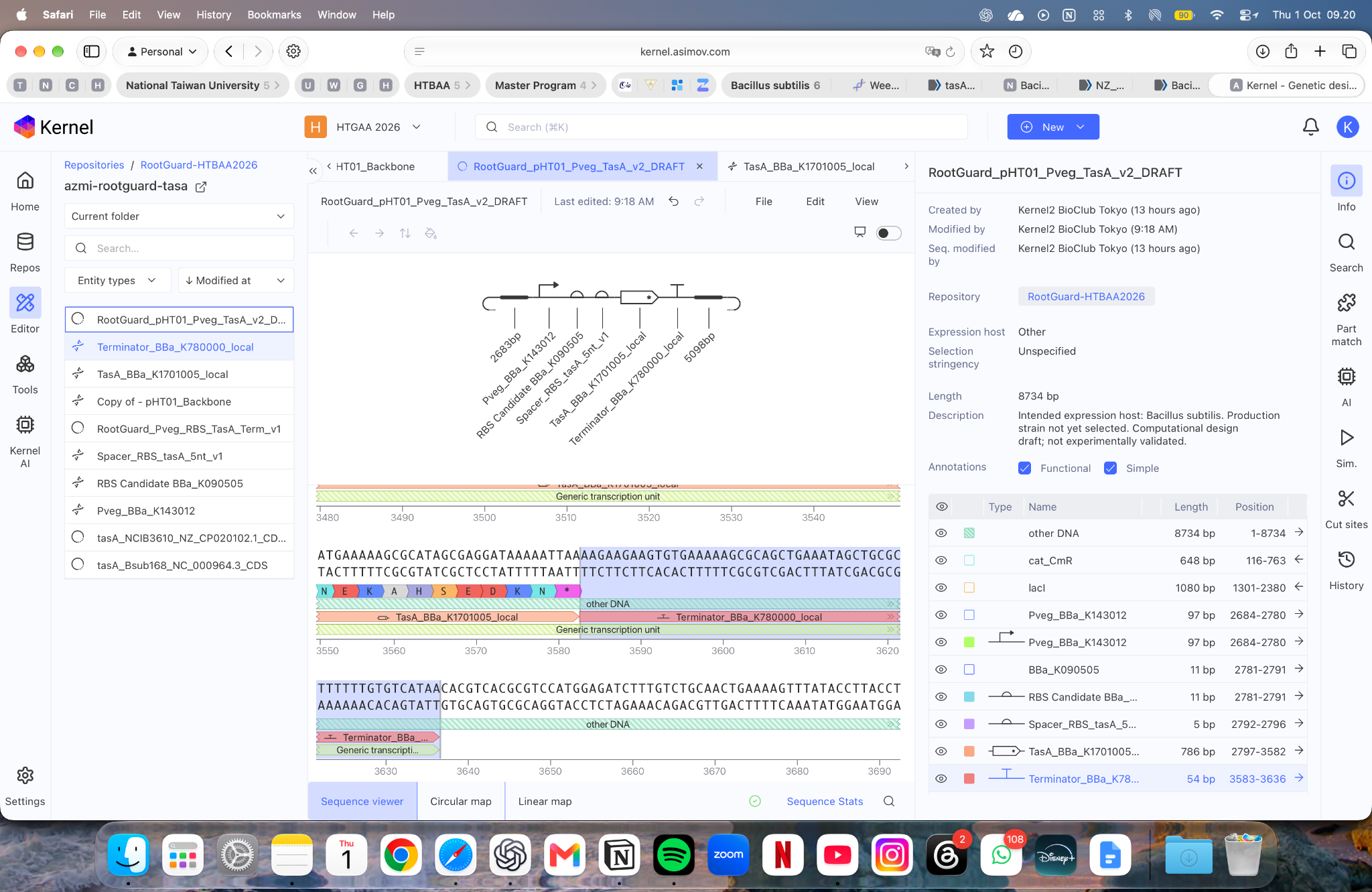
Evidence captured on 1 October at 09:20 WIB: 8,734-bp v2, five functional parts, host description and repository. Simple and functional labels can overlap because they refer to the same DNA interval.
7. Interpreting validator warnings
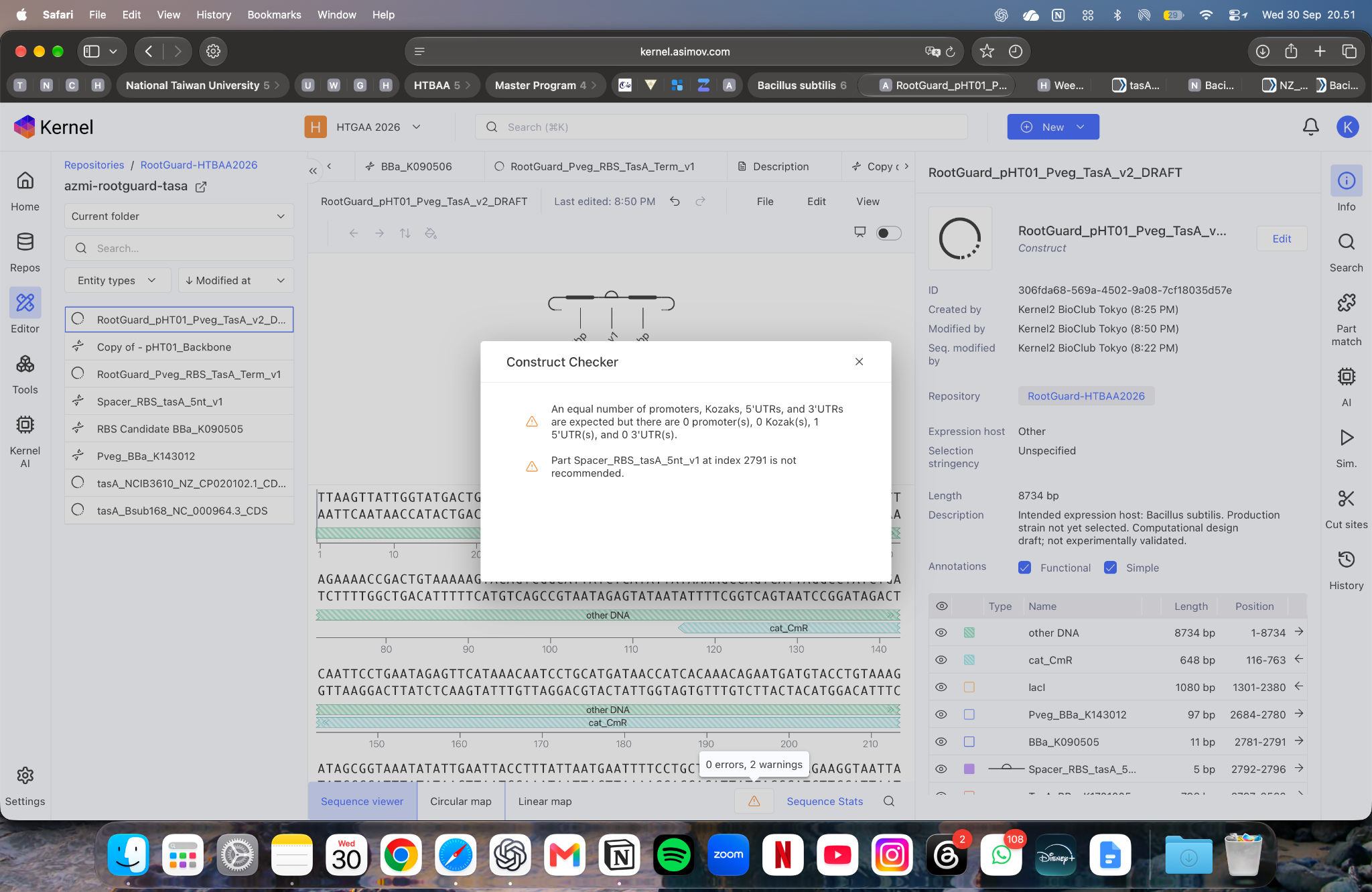
At 20:51 on 30 September, v2 displayed 0 errors, 2 warnings. The dialog referred to a promoter/Kozak/UTR imbalance and a local spacer that was not recommended. Its promoter count of zero did not establish that Pveg DNA was missing; the functional promoter representation was incomplete at that stage. The later export includes the correct promoter type.
I did not add Kozak or poly(A) elements to the bacterial design to satisfy a generic validator message. I also retained the terminal TAA rather than removing it because of differences in validator or CDS-type handling. An appropriate stop at the end of a CDS differs from an internal stop in the reading frame.
A more recent complete dialog establishing that both v2 warnings have disappeared is unavailable. The 0 errors, 0 warnings result for the 786-bp candidate belongs to a different object and does not establish that the full v2 construct is free of warnings.
8. Exporting and checking the sequence and map
I exported and checked the v2 GenBank file around 09:30 on 1 October. Its DNA matched the prepared draft exactly; that check passed 16 assertions. The five functional parts had the intended positions and orientations. The native CDS, backbone flanks and RBS–spacer–ATG junction remained consistent.
The Kernel PNG was received around 10:09. The original PNG does not show part names, so the report pairs it with a coordinate table and a labeled editor screenshot. The PNG is retained without modifying its contents.

A digital map; it does not establish that protein or biofilm has been produced.
On 2 October, I rechecked the recovered files. All 25 local checks passed, covering CDS identity, translation, length, typed annotations, unchanged flanks and codon changes. The results are recorded in the reverification JSON. This was a local file check, without rerunning every Kernel tool or generating new experimental results.
9. Interpreting 100% and 93.4% sequence-search results
The successful route used Kernel global search, including Cmd+K on Mac, followed by pasting the complete CDS. After the BLAST results appeared, I checked hit names, repositories, percentage identity, and query and subject lengths and coordinates.
The native CDS showed 100% identity across 786 bp to BBa_K1701005 on 30 September. The synonymous candidate showed 93.4% identity across 786 bp at 12:25 on 1 October because 52 of its 786 bases had changed. Translation of the local files showed the same protein sequence: a DNA change does not necessarily change the encoded protein.
The candidate also produced a 100% local self-match. This helped identify the object but was not independent confirmation. The search covers repositories indexed by Kernel; I do not describe it as an independent BLAST search across the entire NCBI database. The displayed E value of zero is the tool’s numerical presentation, not a statement that the probability is exactly zero.
10. Codon optimization: constraint, alternative and evidence limits
The visible Simple v0.3 menu offered Chinese hamster, human, E. coli and yeast. No B. subtilis option appeared. I asked Kernel AI in English to keep the control names clear, but its response did not establish an available Bacillus option. I did not select another organism as an equivalent host.
The external alternative used DNA Chisel, the match_codon_usage method, the b_subtilis_1423 table and seed 20261001. The candidate retains ATG, TAA and all 261 aa. Its results were:
| Check | Result |
|---|---|
| Length | Unchanged at 786 bp |
| Protein | Identical, 261 aa |
| Changed bases | 52 substitutions |
| Changed codons | 47 synonymous codons |
| GC | 37.66% → 42.49% |
| Longest homopolymer | 6 → 7 bases |
| Profile-matching objective | −88.18 → −12.36; not CAI or measured expression |
I imported the candidate as a separate object. Its host metadata was corrected to Other, with the intended Bacillus host described. The 11:59 screenshot is consistent with the local file’s length and GC content; the editor validator showed zero errors and zero warnings.
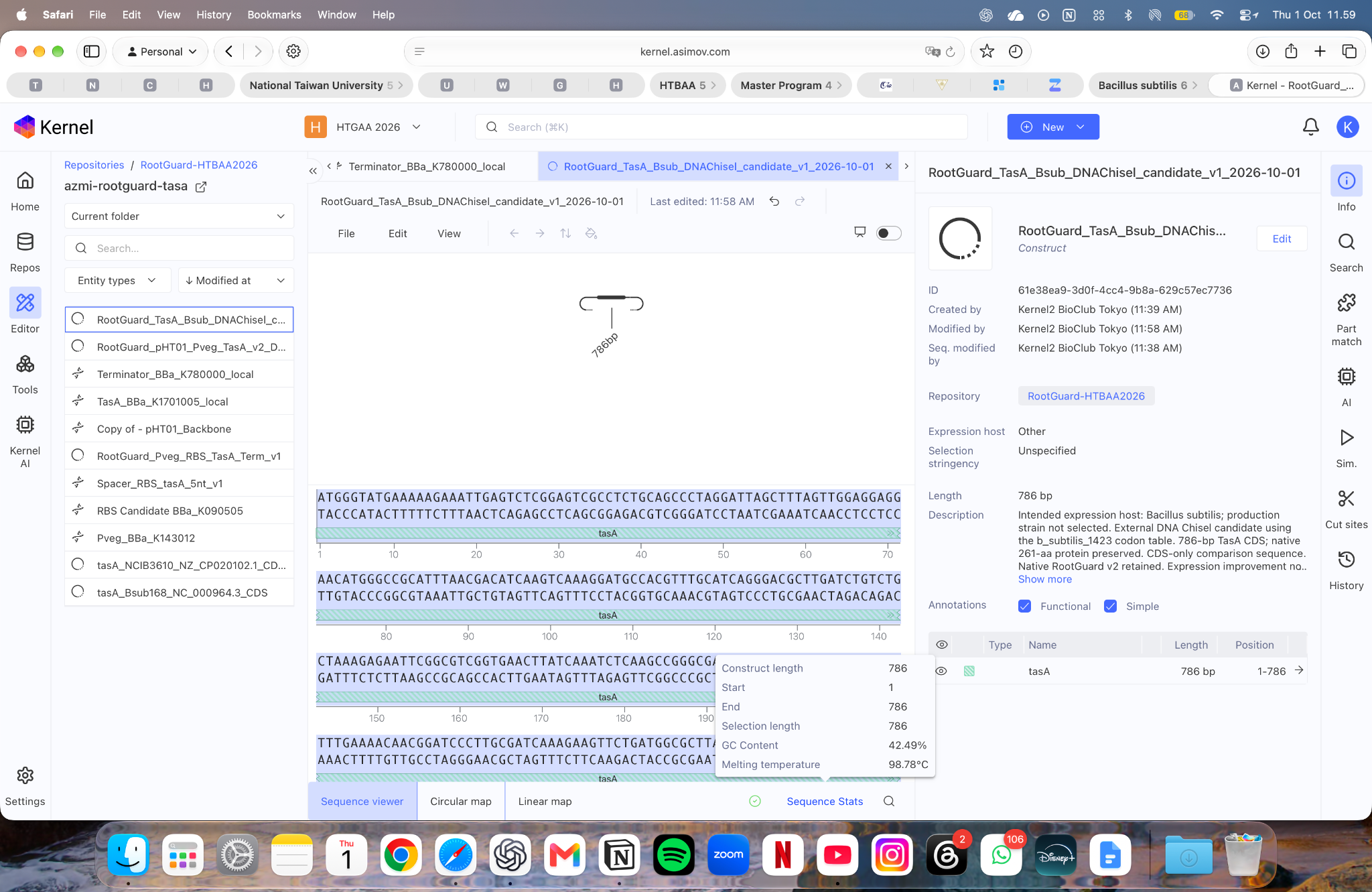
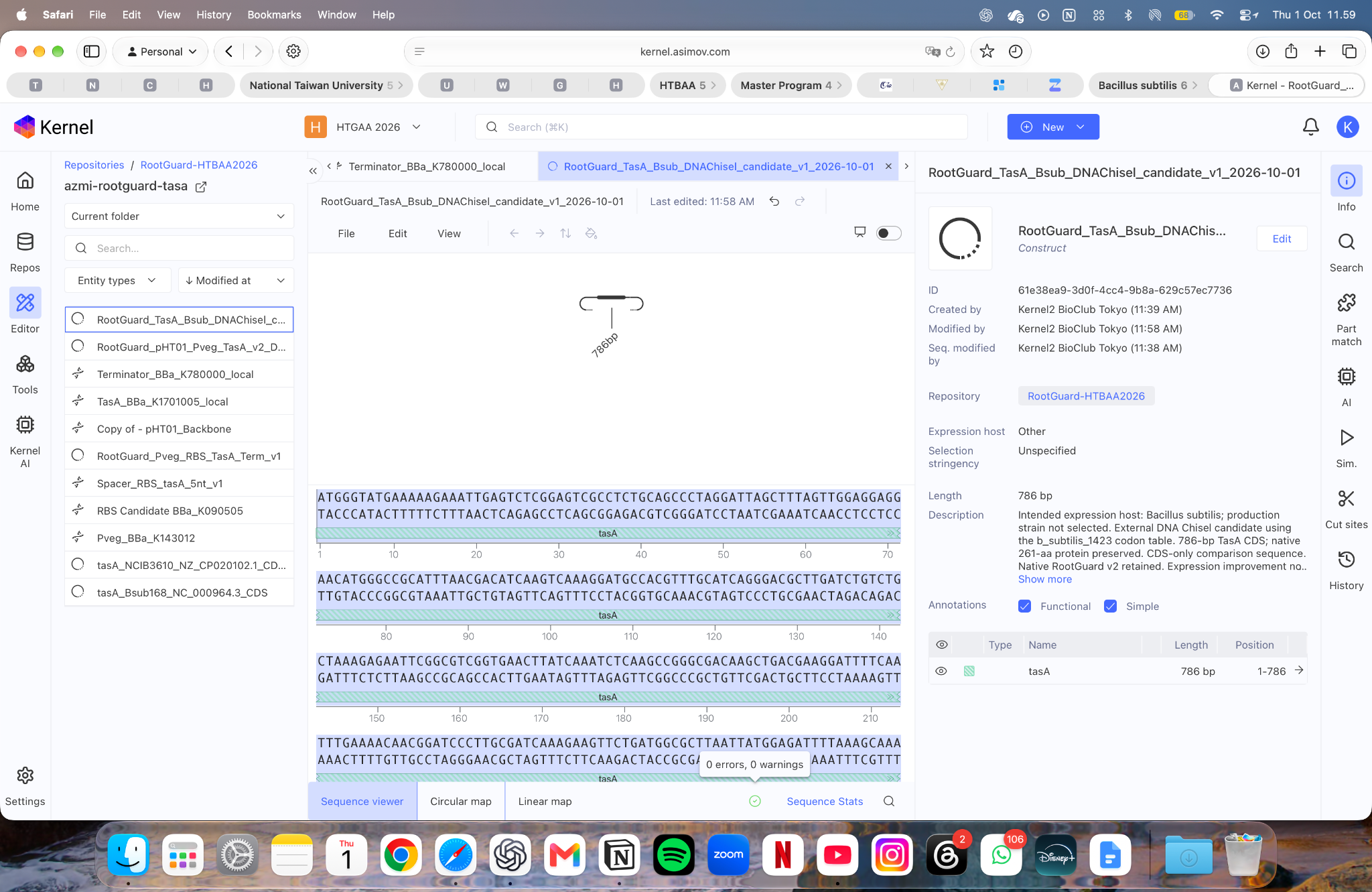
The displayed melting temperature of 98.78°C is not interpreted as a bacterial growth temperature; the calculation conditions were not shown. The candidate remains a CDS-only comparison. A complete candidate re-export from Kernel has not been compared with the source-file hash, and instructor acceptance of the external optimization alternative remains unconfirmed.
11. SecureDNA results and interpretation
The visible route was Tools → Biosecurity sequence scanner, using SecureDNA and Scan for Biohazards. The v2 workflow was checked at 09:54, and the candidate at 12:14, on 1 October. Both screens displayed No flagged sequences detected. V1 had previously also returned a no-flags result.
The intended nucleotide input was the complete v2 sequence or the complete candidate. The sequence ends visible on screen were consistent with the files, but the interface did not provide a full-input hash, an independent length count or a database version. The report therefore limits its conclusion to the screen evidence available.
A no-flags sequence result does not establish TasA expression, matrix formation or the safety of a living strain for environmental use. The official tool documentation provides further context.
12. Timeline and publication record
| Date / time | Event | Result or decision |
|---|---|---|
| 29 September | CDS and parts assembled as v1 | 953-bp cassette without a plasmid backbone |
| 30 September, 17:15 | Native sequence search | K1701005 match: 100% across the complete 786 bp |
| 30 September, 19:23–20:26 | pHT01 DNA checked; v2 prepared and imported | 8,734-bp v2 with provisional replacement boundaries |
| 30 September, 20:51 | Host metadata corrected; validator reviewed | 0 errors, 2 warnings; no eukaryotic elements added to the bacterial design |
| 1 October, 06:58–09:20 | Functional parts corrected and linked | Pveg, RBS, local TasA and local terminator available |
| 1 October, 09:30–10:09 | GenBank QC, v2 screening and PNG export | Matching exported DNA; no screening flags; PNG received |
| 1 October, 11:14–11:59 | Limited optimizer host options; external comparison and candidate import | Separate CDS-only candidate encoding the same protein |
| 1 October, 12:14–12:25 | Candidate screening and search | No flags; public hit 93.4%; local self-match 100% |
| 2 October | Reverification and package revision | Consistent local files; Parts 0–6 narrative and evidence updated |
| 2 October, 20:34 WIB | Main-report revision committed and published | Commit a019cc5431192135213c789370ce6617d920201e; server time 13:34:23 UTC, equivalent to 20:34:23 WIB |
| 2 October, after the commit | Live publication checked | Revision date 2 October 2026 and Parts 0–6 visible; seven report images and five documentation images loaded (10 unique images combined); 21 unique downloads identical to local file bytes |
| 2 October | Publication documentation finalized | Follow-up commit d5871fe8d9c1e47b75a6f709ae1e6e182b2bb2d4 recorded the publication and corrected documentation backlinks |
| 2 October | English translation prepared | Documentation translated into English; the preceding publication checks refer to revisions published before this translation |
V1 was published on 30 September. The revised HW2 report was subsequently published through the browser to the course repository on 2 October 2026. The main-report commit records the revision that replaced the earlier narrative. The live HW2 report and live documentation page were both accessible. Publication documentation was finalized in the follow-up commit.
The live checks showed the revision date and Parts 0–6, all seven inline images in the main report, and all five inline images in the documentation (10 unique images across both pages). All 21 unique downloads from the main report matched local files byte-for-byte in the initial post-publication check. A screenshot of the public page was saved as HW2_published_2026-10-02.png among the accompanying output files. Successfully loaded live pages provide evidence of the build output; build logs were not inspected. The two documentation backlinks to the main report were changed to absolute URLs because Hugo had routed the previous ../ links to the homepage. The evidence manifest and package checksums were aligned with the publication record. These checks describe the published revisions preceding this English translation.
13. Evidence checklist and remaining work
| Evidence | Status at this revision |
|---|---|
| Repository and folder names, and construct ID | Recorded in screenshots and the report |
| Typed parts, positions and orientations | Recorded in v2 screenshots and GenBank |
| Native CDS and protein, start/stop codons and reading frame | Recorded in FASTA and QC files |
| Native and candidate sequence searches | Recorded in original screenshots |
| Optimizer host list and alternative method | Documented; Bacillus-specific optimization in Kernel remains incomplete |
| Before/after codon comparison | Recorded in QC, CSV, script and table snapshot |
| Candidate statistics and validator | Recorded; distinct from the full-v2 warning state |
| V2 and candidate screening results | Recorded, with limits on input provenance |
| Original Kernel PNG | Retained; interpreted alongside the coordinate table and labeled screenshot |
| Biological measurements | Unavailable; the proposed measurements remain a validation plan |
| Revision commits and live pages | Main and publication-documentation commits recorded; both live pages accessible |
| Report and documentation images | Seven and five inline images loaded; 10 unique images combined |
| Main-report downloads | 21 unique downloads identical to local bytes in the initial post-publication check |
| Evidence of build output | Live pages loaded successfully; build logs were not inspected |
Publication and live-page checks for the preceding revisions are complete. Two course requirements still need confirmation: workspace naming and membership for HTGAA versus HTBAA 2026, and a Bacillus-specific optimization route in Kernel or instructor acceptance of the external alternative. Strain selection, TapA/SipW requirements, regulatory-part performance, vector boundaries and retention on biochar remain validation questions stated in HW2. Publication does not establish the design’s biological function.
I can proceed with Homework 3 while seeking confirmation of those two HW2 requirements. HW3 specifies a protein target, so this next assignment does not require waiting for changes to the RootGuard plasmid. Class notes, a glossary and study materials can be developed alongside that work.
Sources and AI assistance
The primary sources are the HW2 handout, syllabus, supplied HW1 material/PDF, NCBI/iGEM/vector/software references linked in the main report, actual export files, supplied screenshots and the Notion journal. This record was prepared with ChatGPT by OpenAI; Kernel AI was used to ask about host support. Examples of the requests and the complete English Kernel AI prompt are included in the package. A control that was not observed is not reported as having been used successfully.
I also used Codex desktop (OpenAI) on 2 October 2026 to recover the material, check coverage of Parts 0–6, review file consistency and prepare the upload package. No new optimization run, screening run or experiment was performed in this session. The original request was written in Indonesian; the following is an English translation of that request:
Please prepare the fully revised write-up, including documentation and results, answering every requirement and question in Homework 2, as Markdown for the website or as the files that need to be included on the site. Can the finished version also be uploaded directly?
Codex subsequently assisted with publishing the revision through the browser and checking the live pages on the same date. The following is an English translation of the original Indonesian publication request:
Can you help me promptly publish this Homework 2 assignment to the website, replacing the previous version?
This documentation was then translated into English on 2 October 2026. The English renderings of the two requests above are translations, not verbatim English prompts. The linked Kernel AI prompt remains in its original English wording.