Week 6 HW: Cultivarium and RootGuard
Student: Naufal Tsabitul Azmi
Portal inspection and handout checked: 10 November 2026 (WIB)
Status: Parts 0–4 are answered as a documented investigation and experimental plan. Portal records, literature results, neighbor data, and my proposed experiments are distinguished below. No culture, engineering, drying, storage, or plant experiment was performed for RootGuard in this assignment.
RootGuard is my proposed biochar-supported bacterial formulation for maize under water limitation in Sumbawa. Its first question is whether a cocoa-pod-husk and okara biochar carrier can improve bacterial recovery after drying and storage. The original Bacillus subtilis strain remains unselected. For this homework, I investigate the non-model alternative MVY-004, displayed by the Portal as Priestia aryabhattai and deposited as DSM 114786. This is an exploration of a candidate, not a decision that it has already replaced the original project organism. [2,3,9]
The official HW6 handout is the assignment authority. It allows an organism with related genes or a similar industry application when a direct producer of the HW1 product is not available. It also explicitly allows unavailable strain-table fields to remain blank. Its Due field was blank when checked; I do not infer a deadline from that document. [1]
| Requirement | Answer and evidence status |
|---|---|
| Part 0: account and exploration | Account accessed; search, species/strain pages, Data, and Taxonomy Browser inspected |
| Part 1: non-model choice and strain table | Exact MVY-004 record and formulation literature; unavailable Portal fields left blank |
| Part 1: genetic methods and alternate lead | One displayed target-species method label critically checked; ten displayed P. megaterium method labels reported separately |
| Part 2: neighbor information | All nine same-genus CVM strain pages individually checked; family-level CVM022 provides the separate assay/genome table |
| Part 3: unknowns and next experiments | Three proposed studies with readouts, controls, and interpretation; no performed experiments claimed |
| Part 4: final-project tools | Specific intended uses of Portal and PRISM; Vault discussed as future use |
| AI reflection | Codex assistance disclosed; Portal AI and Vault were not queried |
Evidence labels: a Portal screen describes the strain actually screened; literature results belong to the cited study; species methods and computational predictions are leads, not measurements on every strain; my experiments below are plans.
Part 0: Account and Portal exploration
Assignment prompt: Create an account and explore Data, Taxonomy Browser, and search. What familiar species and types of information do you notice?
I created my account and accessed Cultivarium. With AI assistance, I used the search window, species and strain pages, Taxonomy Browser, and Data catalogue. B. subtilis was familiar from my RootGuard concept. Searching for a less familiar agricultural relative led me to P. aryabhattai.
I encountered several different information types: external culture-collection metadata, Cultivarium growth and antibiotic screens, ORI-screen results, genome records, publications, Reported Methods, and computational culture predictions. Their availability differs by record. A prediction is not a measured growth result, and a species description is not evidence for every strain. [3–7]
Part 1: Choice of a non-model organism
1.1 Organism, relevance, and identification method
Assignment prompt: Which non-model organism did you choose, why is it relevant to your HW1 product or a related application, and how did you identify it?
I selected MVY-004, displayed by the Portal as Priestia aryabhattai, also deposited as DSM 114786. It is a comparatively less-characterized agricultural isolate rather than a standard laboratory chassis. The exact strain has published phosphate-solubilization and mineral-fertilizer-pellet storage work. This connects it to both a beneficial-microbe application and the formulation question in RootGuard. It does not mean that the bacterium naturally produces the complete RootGuard formulation. [3,8,9]
I first considered AB211 from literature, then searched the Portal under Priestia aryabhattai and its former name, Bacillus aryabhattai. The strain selector showed B8W22 and MVY-004, but not AB211. I therefore chose the available MVY-004 record and checked exact-strain literature. I did not transfer AB211 measurements into the MVY-004 table. [3,4,8]
The MVY-004 study provides a formulation precedent: viable-cell recovery was studied during storage in mineral-fertilizer pellets. Mineral pellets differ from my proposed biochar carrier, so that paper does not establish biochar protection, a RootGuard shelf life, or a maize benefit. [8]
1.2 Exact-strain information
Assignment prompt: Select a specific strain, copy the strain-information table, and leave unavailable information blank.
| Category | Target strain data displayed in the Portal |
|---|---|
| Species name | Priestia aryabhattai [3] |
| Strain name | MVY-004; DSM 114786; Portal ID BacDive175296 [3] |
| Link | MVY-004 strain-information page |
| Growth media and temperature | Growth medium: Temperature: 30 °C, in external BacDive metadata [3] |
| Susceptible antibiotics and MIC90 | |
| Functional ORIs | |
| Genome size | |
| Number of publications listed for this strain |
Blank entries were inspected and were not displayed for MVY-004. They do not mean zero, a failed test, or biological impossibility. The target record has no CVM identifier and did not display in-house assay data. [3]
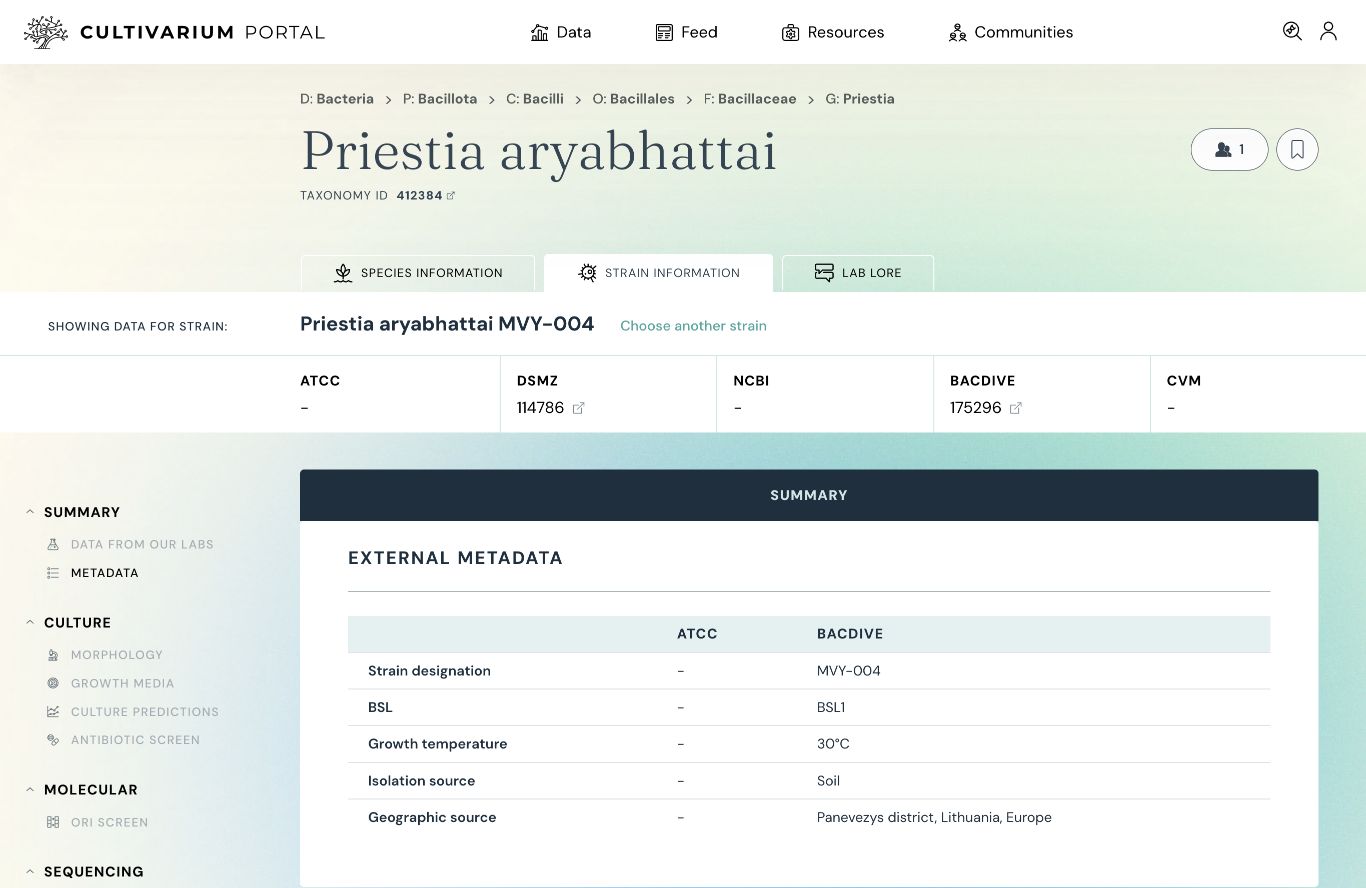
Figure 1. Portal record inspected on 10 November 2026. The 30 °C value is external metadata; disabled sections do not establish negative experimental results. Source: Cultivarium Portal, reference 3.
1.3 What the information enables and what is missing
Assignment prompt: In a separate paragraph, explain what you can do with this information, what is missing, and why that information matters.
The exact strain identifiers and 30 °C metadata give me a traceable starting point for a cultivation plan. The target-species page separately displayed 3,505 publications and one publication tagged under Reported Methods. The target strain page displayed no strain-specific publication count, so I did not copy the species total into the strain table. [3,4]
The missing medium entry matters for establishing reproducible growth and colony recovery. Missing susceptibility and ORI results matter if later work requires a selectable, maintained genetic construct. A target genome would support identity resolution and sequence-level design; a publication index would help locate relevant prior work, but would not replace reading those papers. These gaps limit my confidence in an engineered-expression plan more than in an initial native-strain formulation study.
The primary MVY-004 study reports LB cultivation near 30 °C, while the DSMZ record provides its own cultivation information. These are supplemental exact-strain sources, not measurements from Cultivarium, and I keep them separate from the Portal table. The 16S accession KY882273 is not a whole genome and cannot provide genome size. [8,9]
There is also an identity discrepancy to resolve: the Portal places MVY-004 under P. aryabhattai, whereas DSMZ labels DSM 114786 as Priestia sp. I retain the Portal label for this assignment and the stable MVY-004/DSM identifier, while treating species identity as a question to verify before engineering. [3,9]
1.4 All reported genetic methods for the selected species
Assignment prompt: List all species-level genetic methods, say how many are available, and give the oldest-to-newest research years. If none are available, report that and consider a suggested next closest organism.
The P. aryabhattai species page displayed one method label, supported by one unique publication, with a year range of 2023–2023. These are the complete displayed entries at inspection. [4]
| Portal category | Method label | Publications shown for this label | Oldest | Newest |
|---|---|---|---|---|
| Genetic Engineering | Other | 1 | Yang et al., 2023 | Yang et al., 2023 |
The oldest and newest links refer to the same paper, not two methods or two independent studies. Checking the paper changes its practical interpretation: it examines natural transcriptomic responses and RT-qPCR in SK1-7. Construction of ME2-overexpressing strains is described as future work. I therefore report the Portal classification, while recognizing that it does not validate DNA delivery, editing, or a plasmid workflow for MVY-004. [10]
1.5 A practical alternate genetic-method lead: Priestia megaterium
Although the selected species has a displayed entry, it does not establish a usable MVY-004 engineering toolkit. I therefore also examined the same-genus species P. megaterium as a practical alternate lead. This answers the next-closest-organism question without interpreting the single “Other” label as sufficient engineering evidence. Same-genus placement is the basis for this lead; I have not established that it is the closest species by genome distance. [5,12]
The P. megaterium species page displayed ten category/method labels, 63 publications overall, and an overall displayed oldest-to-newest range of 1980–2024. The table records the Portal labels, counts, and endpoint links; I did not independently validate every paper behind those labels. [12]
| Category | Method label | Label count displayed | Oldest linked publication | Newest linked publication |
|---|---|---|---|---|
| Transformation | Electroporation | 1 | Zhao et al., 2018 | Zhao et al., 2018 |
| Transformation | Conjugation | 2 | Floccari et al., 1994 | Richhardt et al., 2010 |
| Transformation | Transduction | 2 | Garbe et al., 1984 | Vary et al., 2007 |
| Transformation | Other | 13 | Brown et al., 1980 | Richards et al., 2020 |
| Genetic Engineering | Replicating Plasmid | 10 | Wen et al., 1987 | Knobloch et al., 2012 |
| Genetic Engineering | Homologous Recombination | 4 | Lee et al., 2001 | Zhou et al., 2012 |
| Genetic Engineering | Gene Expression | 6 | Wittchen et al., 1998 | Mormino et al., 2021 |
| Genetic Engineering | Tn Mutagenesis | 2 | Mesak et al., 2000 | Mesak et al., 2000 |
| Genetic Engineering | RNAi | 1 | Bunk et al., 2010 | Bunk et al., 2010 |
| Genetic Engineering | Other | 25 | Vary, 1992 | Nehru et al., 2024 |
Count interpretation: the Portal displays category badges of Transformation 18 and Genetic Engineering 47. Their sum is 65, while the overall publication count is 63. The individual method-label counts are also not a deduplicated paper total. I retain the displayed counts rather than summing them to invent a number of unique studies or successful methods. Ten is the number of displayed category/method rows, not a claim that ten workflows are validated for MVY-004. [12]
These entries would help me locate candidate delivery, maintenance, or expression approaches to assess. I would still need to read the relevant original papers and test any proposed transfer to the exact target strain. The P. megaterium species-method literature and the strain-level assay availability examined next are different types of evidence.
Part 2: Neighbor strains and missing information
2.1 Searching the nearest available taxonomic level
Assignment prompt: Traverse Taxonomy Browser to identify a nearby strain with information that fills the gaps in Part 1. Explain the related level.
I started within the genus Priestia. Taxonomy Browser listed nine CVM strains in that genus, all under P. megaterium. I used the strain selector to identify the records, then opened all nine individual strain pages. After the loading indicators for the growth-media, antibiotic-screen, ORI-screen, and genome sections cleared, these four section links remained disabled and no results were displayed in them. CVM114 additionally displayed external metadata and culture predictions; I did not treat those as in-house assay results. This describes the information accessible in the inspected sections, not failed assays or proof that no data exist elsewhere. [5,12–14]
| Individual same-genus strain page | Four assay/genome sections after loading | Other evidence used |
|---|---|---|
| CVM114 / ATCC 14581 | Growth media, antibiotic screen, ORI screen, and genome disabled; no results displayed in these sections | External metadata and culture predictions present; kept separate from assays |
| CVM219 | Same four sections disabled; no results displayed | No additional evidence used |
| CVM236 | Same four sections disabled; no results displayed | No additional evidence used |
| CVM238 | Same four sections disabled; no results displayed | No additional evidence used |
| CVM248 | Same four sections disabled; no results displayed | No additional evidence used |
| CVM253 | Same four sections disabled; no results displayed | No additional evidence used |
| CVM259 | Same four sections disabled; no results displayed | No additional evidence used |
| CVM260 | Same four sections disabled; no results displayed | No additional evidence used |
| CVM370 | Same four sections disabled; no results displayed | No additional evidence used |
This check concerns those four assay/genome sections. It does not establish that publication loading completed on every page or that each strain has no publications.
The Data catalogue also did not list a Priestia or megaterium entry with the needed screen results during my search. I therefore moved up to family Bacillaceae and selected Bacillus licheniformis CVM022, which has displayed culture, antibiotic, ORI-screen, and genome information. [6,7]
This is my available-data neighbor at the family level after inspecting all nine same-genus CVM strain pages. I have not ranked every Bacillaceae strain by genome distance or proved that CVM022 is the single closest genome within that family. The practical conclusion is narrower: the inspected same-genus CVM records did not display results in the four assay/genome sections, while this family-level comparator did.
2.2 Separate neighbor table
Assignment prompt: For each category missing in Part 1, provide the neighbor species, related level, category, and available data.
Neighbor identity: B. licheniformis Gibson 46 / 46 / 1264; ATCC 14580; DSM 13; CVM022; Portal strain ID 279010. Its strain-information page is the source of the entries below. The assay and genome entries describe this neighbor. The publication count is an index displayed by the Portal, not a verified count of direct studies on this strain. [7]
| Neighbor species and strain | Related level | Category missing in target | Neighbor data |
|---|---|---|---|
| B. licheniformis CVM022 | Family Bacillaceae | Growth medium | HCM TE at 30 °C is reported as favorable in the Cultivarium growth screen |
| B. licheniformis CVM022 | Family Bacillaceae | Antibiotic MIC90 | Twelve antibiotic/media combinations; individual MIC90 values below |
| B. licheniformis CVM022 | Family Bacillaceae | Functional ORIs | No positive results found for this strain under the tested screen conditions |
| B. licheniformis CVM022 | Family Bacillaceae | Genome size | 4,227,253 bp; one contig; Portal describes the size as draft/estimated; accession GCA_034478925.1 |
| B. licheniformis CVM022 | Family Bacillaceae | Publications listed | 728 on the neighbor strain page; not an estimate for MVY-004 |
The ORI row is a reported negative screen result, not a positive functional ORI recommendation. This is different from the target’s missing ORI information.
2.3 Neighbor antibiotic screen and interpretation
All twelve displayed rows show Resistant: No. Cultivarium defines this label as MIC90 falling within the tested range; it is not a clinical susceptibility category. The common screen conditions were TSB pH 10, 30 °C, and 15 hours. MIC90 values below are in µg/mL. [7]
| Antibiotic as displayed | MIC90 (µg/mL) | Antibiotic as displayed | MIC90 (µg/mL) |
|---|---|---|---|
| Apramycin | 32 | Kanamycin | 4 |
| Carbenicillin | 1 | Rifampicin | 0.5 |
| Chloramphenicol | 4 | Spectinomycin | 64 |
| Erythromycin | 4 | Streptomycin | 4 |
| Gentamicin | 8 | Tetracycline | 0.5 |
| Thiostreptone | 0.5 | Trimethoprim | 0.5 |
I preserve “Thiostreptone” as displayed by the Portal. Its MIC90 calculation uses growth relative to the antibiotic-free control, with 10% of maximum OD600 as the threshold. These values cannot be transferred directly to MVY-004 or used as target-selection recommendations without target-specific testing. Similarly, a negative ORI screen does not show that every possible plasmid would fail. [7]
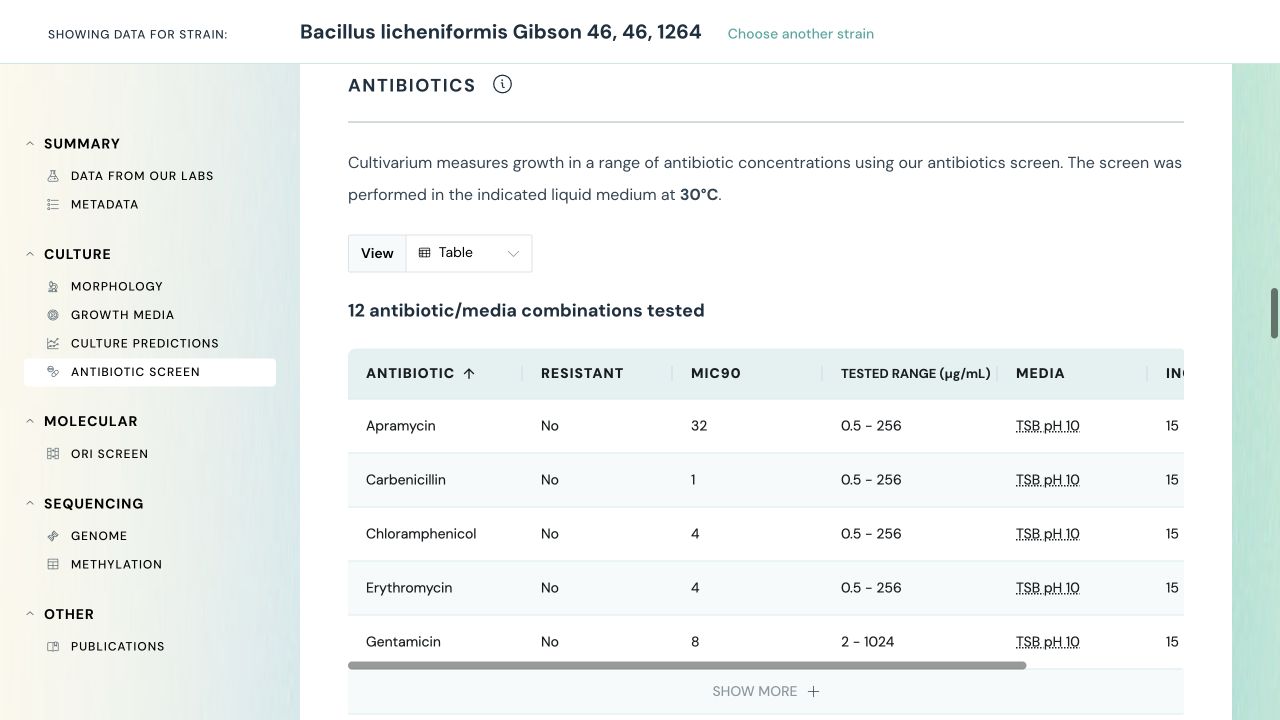
Figure 2. Partial view of the neighbor screen inspected on 10 November 2026. The complete twelve values are transcribed in the table above. These results belong to CVM022 and do not establish susceptibility in MVY-004. Source: Cultivarium Portal, reference 7.
Part 3: From information to the next experiments
3.1 What I know, what is missing, and my confidence
Assignment prompt: Review what is known and missing. How confident are you in designing an experiment, and what are the two or three biggest unknowns or risks?
I know the target record, its culture-collection identifier, a reported growth temperature, and an exact-strain formulation precedent. I still lack a resolved species identification, a target genome, susceptibility results, and a validated genetic toolkit. I have moderate confidence in defining an initial native-strain formulation study and low confidence in designing an engineered-expression system.
My three main unknowns are: target identity and cultivation baseline; whether the carrier improves recoverable cells; and whether genetic parts would work if later required. The following studies are planned work, not experiments I have performed.
3.2 Unknown 1: Is the target identity and cultivation baseline reliable?
Assignment prompt: What experiment would you try next, what would you read out, and what would the result tell you?
I would obtain an authenticated MVY-004 source and verify its identity against the deposit and reference sequence. The disagreement between the Portal species label and the DSMZ designation makes this necessary. If species resolution remains unclear, genome-based comparison would be more informative than assigning a genome size from a 16S record.
I would then compare growth and recoverable colonies using exact-strain literature conditions as the initial reference. HCM TE from the family-level neighbor is only an additional candidate condition. Readouts would be identity evidence, growth curves, and reproducible colony recovery from independent cultures. The result would establish a cultivation and recovery baseline for formulation testing; it would not establish a production optimum or plant benefit.
3.3 Unknown 2: Does the proposed carrier improve recoverable cells?
Assignment prompt: What experiment, readouts, and interpretation would address the formulation risk?
I would compare the biochar-supported preparation with a carrier-free preparation at equal initial viable-cell doses. Measurements would cover the initial preparation, after drying, and defined storage points. Carrier-only and extraction-recovery controls would help distinguish contamination, carrier retention, and loss of recoverability. Independent culture and formulation batches would be compared.
The primary comparative readout would be the recovered fraction of the matched starting CFU dose. CFU per gram would additionally describe the carrier formulation. Better recovery could reflect survival, easier extraction, or both, so I would interpret it alongside recovery controls. The published mineral-pellet study provides a precedent, not a predicted shelf life for biochar. A later native-function assay could test phosphate-solubilization activity separately from cell recovery. [8]
3.4 Unknown 3: Would genetic parts work if a later aim needs them?
Assignment prompt: What would you test before assuming that neighbor growth or plasmid information transfers to the target?
I would begin the formulation study with the native strain. If a later aim requires engineered expression, I would first establish target-specific susceptibility data and an experimentally supported delivery and maintenance strategy. The family-level comparator did not yield a positive ORI in its screen, and the species-level “Other” entry does not validate MVY-004 engineering.
A limited reporter feasibility test would need controls and separate readouts for DNA delivery, sequence-confirmed maintenance or integration, and expression. No antibiotic concentration or ORI would be assumed to transfer from CVM022. The P. megaterium methods table provides reading leads rather than proof of transferability. This stage would determine whether a more complex genetic design is realistic.
Maize response would require a separate controlled experiment comparing carrier-supported cells, dose-matched free cells, carrier alone, and untreated plants. Storage recovery, a genome prediction, or an assay in another plant system would not substitute for that evidence.
Part 4: Relevance to my final project
Assignment prompt: How could the Cultivarium Portal, Vault, or PRISM help your living-system design? Identify a specific tool, its relevance, and how you intend to use it.
The Portal’s strain pages and Taxonomy Browser let me compare a candidate’s biological interest with the evidence needed to work with it. Here, I used the strain selector to avoid treating AB211 as an available Portal record, metadata to trace MVY-004, and Taxonomy Browser plus Data to find a comparator with displayed screens. For RootGuard, I would use these tools to justify candidate selection and record the practical limits of available evidence. [3–7]
Reported Methods helps me find papers, but the Yang et al. example shows why I need to inspect the original work. My intended use is to locate candidate methods, confirm the strain actually tested, and separate demonstrated results from future proposals before adopting a genetic design. [4,10,12]
For the next stage, I would use PRISM to record handling steps, sample identities, extraction choices, and deviations during a real recovery experiment. Its official description concerns converting laboratory recordings into editable protocols. This could improve documentation and reproducibility; it would not itself validate survival or plant efficacy. I have not used PRISM for an experiment. [11]
Vault could support future questions about Cultivarium data, but I did not query it during this inspection. I would require source records, strain identifiers, units, and conditions before using a generated summary. My specific first priority remains the native-strain formulation and recovery study, while the original B. subtilis concept remains a separate baseline.
AI use and critical reflection
Assignment prompt: Portal AI use is welcome but optional. If you use AI, remain critical about helpful recommendations and shortcomings.
I used OpenAI Codex to assist literature discovery, inspect my logged-in Cultivarium pages, extract tables, audit this answer, and prepare the coursework page. My task to the assistant was to access Cultivarium, answer every HW6 description, and then audit and publish the work in the format of my other homework pages. I did not use the Portal AI or Vault, so I cannot report recommendations from those tools. [1]
The assistant helped identify an exact-strain storage study for MVY-004 and compare Portal fields without filling missing values by inference. One limitation was the earlier AB211 literature choice: that strain did not appear in the inspected Portal selector. Another was the Portal genetic-method classification, which needed checking against its paper. A further limitation was treating strain-selector radio labels as evidence of data availability. I corrected this by opening all nine same-genus CVM strain pages and checking the actual assay/genome sections after their loading indicators cleared.
These examples show why I need to check AI suggestions and database categories against exact strain records and primary sources. This page records an investigation and experimental plan; it does not present any new biological validation.
References and source locations
Portal data and displayed counts were inspected on 10 November 2026. Portal strain pages require an account. The numbered sources below distinguish the assignment, project context, Portal records, primary literature, and collection records.
- HTBAA Homework 6 official assignment.
- RootGuard current project presentation.
- Cultivarium target strain MVY-004 and external metadata.
- Cultivarium P. aryabhattai species and Reported Methods.
- Cultivarium Priestia genus in Taxonomy Browser.
- Cultivarium Data catalogue.
- Cultivarium CVM022 strain screens and genome.
- Mažylytė et al., 2022: MVY-004 biomineral-fertilizer study. Accessible primary-study full text, Vilnius University.
- DSMZ exact deposit DSM 114786.
- Yang et al., 2023: SK1-7 transcriptomic study.
- Cultivarium introduction to PRISM.
- Cultivarium P. megaterium species methods and strain selector.
- Cultivarium P. megaterium CVM114 / ATCC 14581 record.
- Cultivarium P. megaterium CVM219 record and CVM370 record.