Week 3 HW: Cell-Free Reaction Design
Part A: Compare cell-free reaction compositions
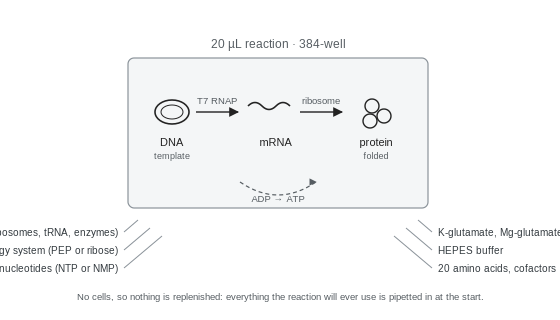
1. Why does the concentration of potassium glutamate and magnesium glutamate differ between compositions? Which is more sensitive?
They do different jobs. Potassium sets ionic strength and is needed in bulk; the base buffer alone supplies 200 mM. Magnesium is a catalytic cofactor at 8–10 mM: it holds the ribosomal subunits associated, screens the charge on mRNA and tRNA, and is required by T7 RNA polymerase and the aminoacyl-tRNA synthetases.
Magnesium is far more sensitive. In Jewett & Swartz Table II, magnesium peaks sharply at 20 mM and loses 25–60% of yield 4–12 mM either side. Potassium stays above 0.9 of maximum anywhere from 150 to 225 mM.
Free magnesium is also not added magnesium. Phosphate-bearing components chelate it, and PEP releases inorganic phosphate as it is consumed, so the magnesium optimum moves with the energy system. The two matched PETase references need 300 nL and 225 nL with nothing about the ribosome changed. Potassium has no comparable coupling.
Glutamate is the counter-ion in both cases because chloride is inhibitory at these concentrations.
2. How does a PEP+NTP formulation differ from a Ribose+NMP formulation?
A cell-free reaction has no metabolism to replenish ATP, so ATP must be regenerated. PEP+NTP supplies finished triphosphates plus phosphoenolpyruvate as a high-energy phosphate donor. Ribose+NMP supplies cheaper monophosphates and relies on the lysate’s surviving central metabolism to phosphorylate them up.
| PEP + NTP | Ribose + NMP | |
|---|---|---|
| Observed mean | 314.60 | 274.79 |
| Replicate CV | 2.8% | 15.5% |
| Amino acid mix | 400 nL | 1600 nL |
About 13% lower yield and five times the replicate variability, using four times the amino acids.
3. Compare two cell-free reaction compositions from the literature
PANOx-SP (Jewett & Swartz 2004) against the cost-optimised direction in Olsen et al. (2026).
| PANOx-SP lineage | Cost-optimised | |
|---|---|---|
| Design goal | Mimic the E. coli cytoplasm | Minimise cost per gram |
| Energy | PEP | Cheap carbon source, native metabolism |
| Nucleotides | Full NTP set | Monophosphates |
| Cofactors | Folinic acid, NAD, CoA, spermidine, putrescine, oxalate | Trimmed |
| Reproducibility | CV 2.8% | CV 15.5% |
Both use glutamate salts rather than chloride and supply all twenty amino acids. The disagreement is which additions earn their cost.
Part B: Design one reaction composition for each protein
sfGFP. No disulfide bonds, reducing conditions. Kept near the reference and adjusted magnesium glutamate and potassium phosphate only. This is the control that shows whether the reaction worked at all.
PETase (TfCut2). One disulfide bond, so the formulation stays close to sfGFP. Added PEG 8000: TfCut2 is an interfacially active cutinase and adsorbs to the polystyrene over a 20-hour incubation. Protein on the wall is invisible to the assay, so the failure reads as poor expression when it is poor recovery.
Reteplase. Nine disulfide bonds, so the oxidising formulation: DTT-free lysate with iodoacetamide, cysteine quench, GSSG/GSH, and DsbC. Adjusted DsbC and HEPES-KOH. DsbC is $5.63 of a $5.70 reaction, 98.8% of reagent cost, so it is the only cost lever that matters on this target.
Community reagent: Brij-35, a non-ionic surfactant. Chosen from the failure mode above — it coats hydrophobic surfaces and keeps partially hydrophobic protein in solution. It was missing from the designer when I proposed it and has since been added at a 10% v/v stock.
Forum. Joined the cfps-coopetition channel.