Week 4 HW: CFPS Batch, Data Analysis, Metascience
A. Design a batch of cell-free reaction compositions
Hypothesis. Glutathione acidifies the oxidising Reteplase reaction (Olsen et al. 2026). If HEPES buffering is limiting at the reference 57.5 mM, raising it should recover yield — and a well-buffered reaction should reach reference titer at half the DsbC.
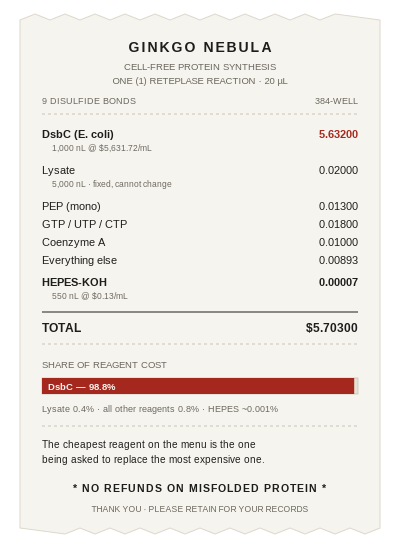
Why. DsbC is $5.632 of a $5.703 Reteplase reaction, 98.8% of reagent cost. HEPES is $0.00007. Lysate, which dominates the other two targets, is 0.4% here. So the only question that matters for cost on this target is how little DsbC will still fold the protein, and buffering is the cheapest thing that might allow less of it.
Crossing the two also removes a confound: a DsbC titration at fixed HEPES has glutathione present throughout and pH drifting over the incubation, so differences along the titration have two possible causes.
The batch. Three HEPES levels × two DsbC levels. All other reagents held at reteplase_standard, water absorbing the difference.
| Sample | DsbC (nL) | HEPES (nL) | HEPES (mM) | Water (nL) | Total |
|---|---|---|---|---|---|
perera_rtp_hepes_dsbc_01 | 1,000 | 550 | 57.5 | 625 | 20,000 |
perera_rtp_hepes_dsbc_02 | 1,000 | 850 | 72.5 | 325 | 20,000 |
perera_rtp_hepes_dsbc_03 | 1,000 | 1,150 | 87.5 | 25 | 20,000 |
perera_rtp_hepes_dsbc_04 | 500 | 550 | 57.5 | 1,125 | 20,000 |
perera_rtp_hepes_dsbc_05 | 500 | 850 | 72.5 | 825 | 20,000 |
perera_rtp_hepes_dsbc_06 | 500 | 1,150 | 87.5 | 525 | 20,000 |
Sample 01 reproduces reteplase_standard exactly as the in-batch anchor. The HEPES ceiling is set by the reference recipe’s 625 nL of water. All six validate against CFPSReagentList and Sample from the repository’s models.py; every volume is a multiple of 25 nL.
What each outcome means. Titer rising with HEPES at both DsbC levels means acidification is limiting. Sample 06 matching sample 01 means half the DsbC at higher buffer holds reference titer, a ~50% cut in cost per gram. HEPES helping only at 1,000 nL DsbC means the two interact and DsbC titrations must control pH. No HEPES effect means buffering is already sufficient, which is a useful negative for six wells.
This complements the DsbC titration another student is running rather than duplicating it.
B. Research team discussion, data analysis, metascience
1. Current status of my ideas
Main line is above: pH as a controlled variable in the Reteplase arm.
Second: surfactant rescue for PETase. TfCut2 adsorbs to polystyrene over a 20-hour incubation in a high surface-to-volume well, so the assay would under-report expression that actually happened. Brij-35 was my community reagent proposal and has since been added to the designer.
I did not run an agent to mass-produce compositions. Agent suggestions converge — Brij-35 surfaced repeatedly across different people’s agents — so they are correlated rather than independent, and many correlated compositions take plate space without adding information.
Least sure about: whether pH drift is large enough to matter at 57.5 mM in this lysate over this incubation. That is what the batch is for.
2. Data analysis: 384-well versus 96-well deep-well
The same 80 designs, same lysate lot, run in both formats.
These are not the same reaction. The 384 run was 20 µL read directly; the quad run was 40 µL in 96-well deep-well plates, compressed back to a 384 read plate. Volume is itself a variable.
The 96-well format yields more, with less noise.
| Quad 96-well | 384-well | |
|---|---|---|
| Median design titer | 2.71 g/L | 0.36 g/L |
| Median replicate CV | 7.2% | 14.6% |
| Designs with CV > 20% | 4 of 80 | 32 of 80 |
Median per-design fold is 7.3×.
The ranking does not transfer. Spearman ρ = −0.12 across the 80 shared designs. Top-10 overlap is 0 of 10. The family order inverts: 384 gives PANOx > Ginkgo3 > RFopt, quad gives Ginkgo3 ≈ RFopt > PANOx. The 384 run’s top nine designs are all PANOx; in quad they rank 58–72.
Agreement varies by block — K-phosphate titration holds at ρ = +0.84, while glucose and K-glutamate titrations run to −0.71 and −0.75. Glucose reverses sign, helping in quad and hurting in 384.
Three candidate explanations, untested: evaporative concentration in the deep well, which would lower the apparent magnesium and potassium optima and lift low-Mg recipes into range, matching the observed pattern; better aeration under a larger headspace; and a base buffer lot difference that cannot be separated from format without a same-buffer side-by-side.
This matters because the workflow is 384 → 96 → 2 mL and assumes 384 rankings identify what to carry forward. At ρ = −0.12 that fails, and the effect is reproducible across two runs, so it is systematic rather than noise. The mitigation is to carry a fixed reference panel through both formats so the offset is measured, and to treat 384 as a screen for failure rather than a ranking of success — the K-phosphate block shows which reagent matters does transfer even when how much does not.
3. Metascience: one rubric criterion
Does the result change what we do next, whichever way it comes out? Score each proposal by what each possible outcome would cause the group to do differently. A proposal where every outcome leads to the same next step scores zero.
Novelty rewards the merely untested, and something can be untested because nobody had a reason. Hypothesis strength fails more subtly: the strongest-sounding hypotheses are the most likely to be confirmed, and a confirmed expectation teaches least. Decision-relevance is harder to game, since you must state in advance what each outcome would change.
The 96-well report is the argument for it. Selecting on round-one titer would carry forward exactly the designs that stop winning at the next scale.
Against my own criterion: it favours people who can already articulate consequences, which disadvantages the students this course exists to bring in. It should be paired with a reserved allocation giving every participant at least one composition on the plate.