Week 1 HW: Final Project Ideas
HTBAA Homework #1: Automated Biomanufacturing as a Discovery Engine for Biosensors
Course: How to Biomanufacture (Almost) Anything 2026 Assignment: Homework #1 — Biomanufacturing Proposal Due: Tuesday, September 22
1. What I Want to Biomanufacture, and Why
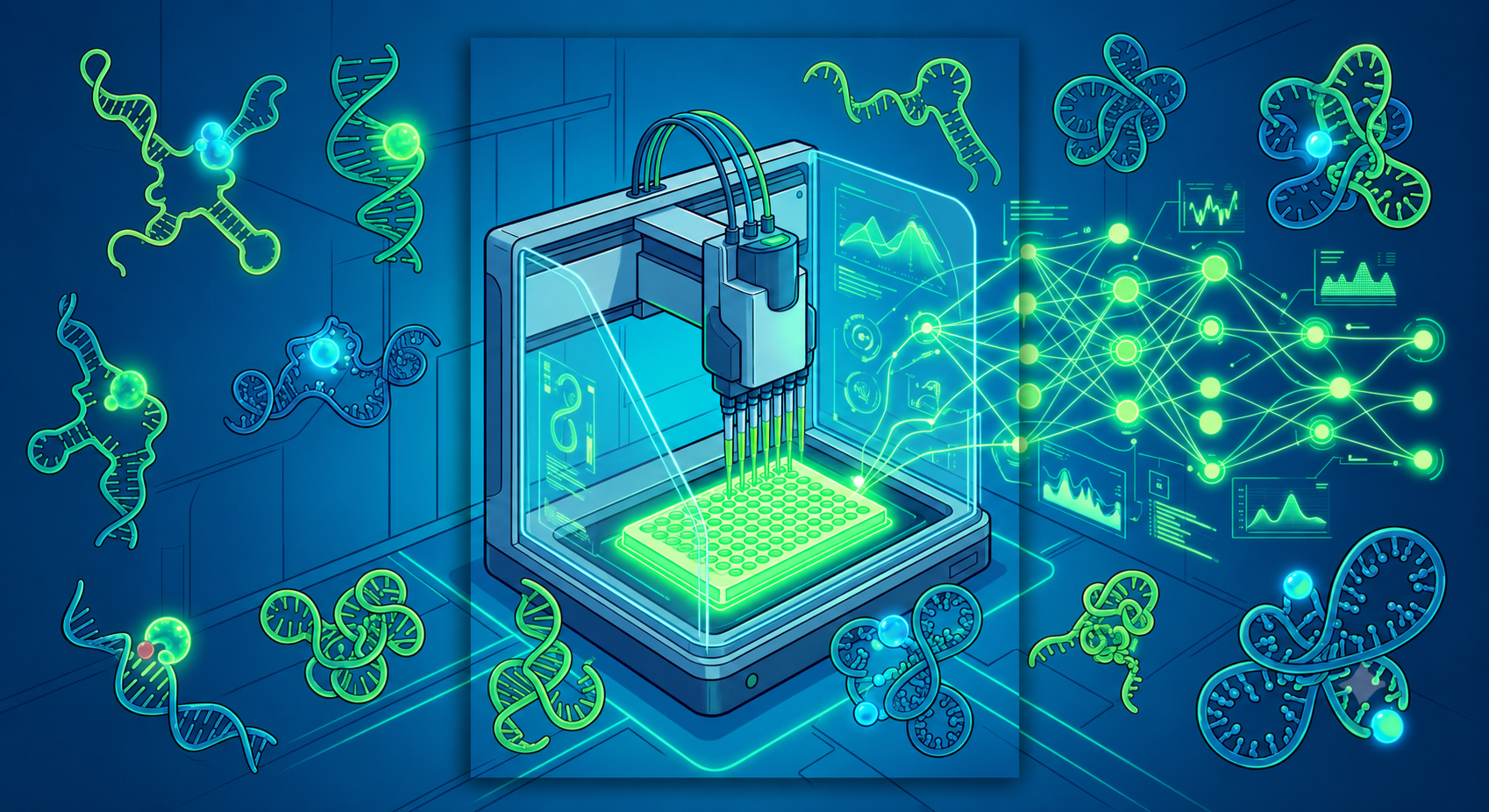
Most biosensor development treats “biomanufacturing” as the last step of the pipeline: once a laboratory has identified a promising aptamer or engineered protein switch, that molecule is scaled up and produced. My proposal inverts that relationship. I want to biomanufacture the biosensors themselves, but as the output of a closed, automated discovery loop in which biomanufacturing infrastructure is also the instrument that generates the data used to train and continually fine-tune the computational model that designs the sensors. In other words, the “product” is twofold: (i) a validated family of nucleic-acid (aptamer) and protein-based biosensors for a target class of analytes, and (ii) a progressively improving, experimentally grounded design model — a lab-in-the-loop system — that gets better at proposing new sensors with each iteration.
Motivation. Biosensor discovery today is bottlenecked by two disconnected worlds. On one side, structure- and sequence-based generative and predictive models (e.g., protein-language models, RNA structure predictors) can propose enormous numbers of candidate binders quickly and cheaply. On the other side, our ability to know whether a candidate actually binds a target analyte, with what affinity and specificity, still depends on comparatively slow, manual, low-throughput wet-lab assays (SELEX rounds, ELISA-type binding assays, biolayer interferometry). Asin-Garcia et al. (2025) argue that biomanufacturing more broadly is limited less by a lack of biological ideas than by a lack of research infrastructure that can consolidate automation, data, and expertise into reproducible pipelines. I want to apply that same infrastructural logic to biosensor discovery specifically: rather than manually deciding which experiment to run next, an automated pipeline should decide which data is missing, generate a protocol to acquire it, execute that protocol in an automated or cloud laboratory, and feed the result back into the model. This is directly motivated by, and would make direct use of, the specific case of trRosettaRNA2 (Wang, Peng and Yang, 2026), an RNA structure-prediction network that I examined as a template chassis for this idea (described in Section 2).
Who this is for. The intended beneficiaries are twofold: (a) practising biosensor developers (academic labs, diagnostics companies) who need custom aptamer/protein sensors for a novel analyte and currently must run SELEX or directed-evolution campaigns nearly from scratch each time; and (b) downstream users of the sensors — for instance, environmental monitoring programmes needing rapid, low-cost detection of an emerging contaminant class (e.g., per- and polyfluoroalkyl substances, PFAS) or public-health programmes needing point-of-care diagnostics for a metabolite panel. I think this is interesting/important because it reframes automated biomanufacturing not simply as a scale-up tool, but as a data-generation instrument for machine learning — the same conceptual shift that high-throughput “biofoundry” thinking has brought to strain engineering (Petzold and Mukhopadhyay, 2025) should be brought to affinity-reagent discovery, where public training data (e.g., existing aptamer/SELEX databases, RNA structure databases) is sparse relative to the size of chemical and sequence space that needs to be searched.
2. What Living System Would I Use?
I propose a cell-free transcription–translation (TX-TL) system, most likely derived from Escherichia coli lysate, as the primary chassis, complemented by an in vitro transcription system for RNA aptamer candidates. I choose a cell-free chassis over a whole living cell for three reasons, drawing on Karim and Jewett’s (2021) review of cell-free biomanufacturing: cell-free systems (i) have shorter development times because there is no strain-construction or transformation step between designing a sequence and testing it, (ii) tolerate reaction conditions and candidate molecules (including some that might be toxic or growth-inhibiting to a living cell) that would otherwise compromise cell viability, and (iii) their open reaction environment makes it straightforward to add an analyte directly to the reaction and read out a biosensor’s response in the same well, which is exactly what a screening-and-training loop requires.
High-level system description.
- Inputs: a linear DNA template (or plasmid) encoding a candidate aptamer or protein-based biosensor construct fused to a reporter (e.g., a fluorescent or luminescent output, or a riboswitch-controlled reporter gene for RNA aptamers); crude E. coli lysate containing the transcription/translation machinery; an energy/amino-acid/NTP master mix; and a dilution series of the target analyte (or a decoy panel of non-target molecules, to screen for specificity).
- Biological process: the cell-free extract transcribes and translates (or, for RNA aptamers, only transcribes) the candidate sequence. If the candidate is a functional biosensor, analyte binding alters folding or allosteric behaviour in a way that is coupled to the reporter signal (e.g., a fluorogenic aptamer scaffold such as a Spinach/Broccoli-type aptamer, or an allosteric transcription-factor-based protein switch).
- Outputs: a dose–response curve (signal vs. analyte concentration) for every candidate sequence tested, plus a specificity profile against the decoy panel. Each of these dose–response measurements becomes a labelled data point (sequence → binding/response behaviour) for the computational model described below.
Assumptions. I assume: (a) a reporter architecture can be found or engineered that is at least loosely generalisable across many candidate sequences within a design round, so that a lack of signal can be attributed to a lack of binding rather than to a broken reporter; (b) cell-free extracts can be produced in large, characterised batches so that batch-to-batch variability is a manageable (if non-trivial — see Section 5) source of noise; and (c) for the RNA-aptamer arm of the project, a suitable in vitro selection or rational-design starting library exists so that the model is not designing from a fully naïve sequence space in round one.
Model and its structural analogue. As requested, I examined the trRosettaRNA2 repository (YangLab-SDU, GitHub) and its associated manuscript (Wang, Peng and Yang, 2026) as a concrete example of how a “living-system-adjacent” computational model for nucleic-acid biosensors could be structured and where a fine-tuning step could realistically be inserted. trRosettaRNA2 is an end-to-end deep network for RNA 3D structure prediction, organised as: (i) a pre-trained secondary-structure (SS) module, trained on large public RNA sequence/structure corpora, which outputs base-pairing probabilities as prior information; (ii) a two-track transformer, RNAformer (12 blocks), which jointly updates an MSA representation (dimensions n × L × c) and a pairwise representation (L × L × c); (iii) an SS-aware structure module (8 blocks) that folds this information into 3D atomic coordinates, with the whole SS→RNAformer→structure loop recycled up to three times; and (iv) an optional Rosetta-based energy-minimisation step to relax steric clashes. Critically, the whole network is comparatively small (~30 million parameters), and — as the repository name signals — the SS module is already a pre-trained, swappable component: the authors explicitly support substituting a custom SS input for their own predicted one.
This is precisely the structure my proposal needs. A biosensor design model built on this kind of architecture would use the pre-trained SS/structure backbone to represent candidate aptamer sequences, and I would insert the transfer-learning step not by retraining the ~30M-parameter backbone from scratch each round, but by (a) freezing the pre-trained SS and RNAformer weights, (b) inserting lightweight, low-rank adapter layers into the RNAformer and structure-module blocks, and (c) appending a new, small property-prediction head that maps the model’s pair/structure embeddings onto a functional read-out — binding affinity or reporter fold-change against a specific analyte — a target the base model was never trained to predict. Only the adapters and the new head would be updated after each round of automated experiments. The main limitation I identified from reviewing the repository is that trRosettaRNA2 is trained purely to predict structure, with no functional or ligand-binding labels anywhere in its training objective (the “Training” section of the repository is explicitly not yet released, underscoring how little of this pipeline is turnkey); bridging structure prediction to function prediction is the genuine scientific gap this proposal must close, and it is precisely the gap that the automated experiment-generation loop is meant to fill with real binding data.
3. How Would I Use Automation?
I would automate two connected parts of the workflow using a desktop liquid-handling robot (e.g., an Opentrons OT-2 or similar) for prototyping, feeding into a cloud-lab-style platform for scale-out once a design–build–test–learn (DBTL) cycle has been validated manually.
What gets automated, and why.
- Build/assembly and reaction setup. The liquid handler assembles each cell-free reaction: dispensing lysate, energy mix, DNA template for each candidate sequence, and the analyte dilution series, across a 96- or 384-well plate. This is the natural first target for automation because it is repetitive, error-prone by hand at the volumes required (sub-microlitre to low-microlitre), and must be done identically across every candidate to keep the resulting dataset comparable — a requirement Petzold and Mukhopadhyay (2025) identify as central to converting high-throughput technologies into usable biomanufacturing data rather than noisy one-off measurements.
- Measurement and sampling. A plate reader (fluorescence/luminescence) integrated with the liquid-handling deck automatically reads every well at fixed time intervals, producing kinetic dose–response curves rather than single end-point reads, which gives the downstream model richer labels per experiment.
- The active-learning “agent” step. This is the automation layer that is most specific to my proposal and least standard in existing biofoundry workflows: after each round, an agent script inspects the current model’s loss landscape (per Section 4) and the uncertainty of its property-prediction head across sequence space, and selects the next batch of candidate sequences and analyte concentrations that are expected to be most informative (e.g., via uncertainty sampling or a Bayesian-optimisation acquisition function) rather than the most likely to succeed. This selection is converted programmatically into a new liquid-handling protocol (a worklist of wells, volumes, and template identities), which is submitted to the automated or cloud-lab platform without a human manually re-designing the plate map each round.
I automate the build and test stages rather than the learn stage (which remains computational) because these are the stages where manual labour scales linearly with the number of candidates and rounds, whereas the model-fitting step scales primarily with compute. Automating sampling/measurement also directly addresses reproducibility: Petzold and Mukhopadhyay (2025) emphasise that automated, standardised sampling and measurement is what allows high-throughput data to actually be pooled across rounds and used to train models, rather than being idiosyncratic to whichever person ran a given plate.
4. How Much Would I Need to Make, and How Long Would It Take?
(a) How much?
I define the meaningful scale as: enough of the final, validated aptamer/protein sensor construct to manufacture 100,000 point-of-care lateral-flow-style test strips, a plausible pilot deployment scale for an environmental or public-health screening programme (e.g., a regional PFAS-in-drinking-water screening effort).
Assumptions (back-of-envelope, order-of-magnitude):
- Each test strip requires approximately 1 pmol of active sensor construct per strip (a typical order-of-magnitude loading for a lateral-flow aptamer capture/reporter element).
- Molecular weight of an RNA aptamer of ~40 nucleotides ≈ 13,000 g/mol (≈325 g/mol per nucleotide × 40 nt).
- Mass per strip = 1 × 10⁻¹² mol × 1.3 × 10⁴ g/mol = 1.3 × 10⁻⁸ g = 13 ng.
- For 100,000 strips: 100,000 × 13 ng = 1.3 × 10⁶ ng = 1.3 mg of purified aptamer.
- Applying a conservative 10× safety/loss factor for purification, quality control, and manufacturing losses: ≈13 mg of final purified aptamer needed.
- Converting to reaction scale: a typical in vitro transcription reaction yields on the order of 1–2 mg RNA per mL of reaction under optimised conditions. At 1.5 mg/mL, producing 13 mg requires ≈9 mL of IVT reaction volume (before purification losses already included above), which is a trivially small, easily automatable production run once the sequence is finalised — the bottleneck in this proposal is not this final manufacturing step but the discovery loop that precedes it.
(b) How long?
Two very different timeframes apply, matching the prompt’s note that prototyping and scaled manufacturing may use different automation technologies.
Discovery-loop time (prototyping, desktop liquid handler). Assume each DBTL round tests 176 candidate sequences × 1 buffer/decoy control condition across a 384-well plate (leaving room for a concentration series), that assembly + measurement (kinetic read, 6 time points) takes the liquid-handling platform and plate reader ≈4 hours per round, and that model retraining (adapter fine-tuning only, not full backbone retraining) on a single modern GPU takes ≈1–2 hours given the small (“last-mile”) dataset size. If convergence to a validated top candidate requires 8–10 rounds (a reasonable estimate for an active-learning campaign refining a pre-existing structural prior rather than searching from a naïve library), total discovery time ≈ 10 rounds × (4 h wet-lab + 2 h compute + ~18 h overnight incubation/QC buffer) ≈ 10 rounds × 1 day/round = roughly 2 working weeks, plus time for initial cell-free extract preparation and the trained backbone’s initial fine-tuning setup — call it 4–6 weeks end-to-end for a first validated sensor family, consistent with the general expectation in the automation literature that biofoundry-style automation compresses DBTL cycle time from months to weeks (Petzold and Mukhopadhyay, 2025).
Manufacturing-scale time (cloud lab / parallel IVT reactors). Once the sequence is fixed, producing the 9 mL (scaled up with a safety margin to, say, 100 mL of pooled reaction across parallel automated reactors to allow for purification losses and QC replicates) is limited by IVT reaction time (typically 2–4 hours per batch) and purification (a few hours per batch via automated column or magnetic-bead purification on the same robotic deck). Running, for example, 10 parallel 10 mL reactions on a cloud-lab platform, the entire 100 mL production run could be completed, purified, and QC’d in under two working days, i.e., manufacturing at this pilot scale is fast relative to the multi-week discovery phase — the discovery loop, not the manufacturing step, is the rate-limiting stage of this proposal, which is itself an argument for why automating the discovery loop (not just the production loop) is the more valuable target for this project.
5. What I Don’t Know Yet
- Data efficiency of the fine-tuning step. Each automated round is likely to generate only tens to a few hundred new labelled sequence–function data points. It is not established whether adapter-based fine-tuning of a structure-prediction backbone like trRosettaRNA2 can meaningfully shift a downstream binding-affinity prediction head with datasets this small, or whether many more rounds (and therefore much more automation throughput) would be needed before the model’s loss on held-out sequences meaningfully improves. I would need to run a pilot active-learning simulation on an existing public aptamer affinity dataset to estimate a realistic learning curve before committing to a wet-lab round structure.
- Whether structural embeddings transfer to functional (binding) prediction at all. trRosettaRNA2’s pre-trained representations encode 3D geometry, not ligand-binding energetics; a candidate can be predicted with high structural confidence (high pLDDT) and still fail to bind a small-molecule analyte, or vice versa. I do not yet know how strongly (if at all) the model’s structural embeddings correlate with functional binding behaviour, and this would need to be measured empirically — likely in round one of the wet-lab loop — before the acquisition function in Section 3 can be trusted to select informative experiments rather than structurally interesting but functionally irrelevant ones.
- Reproducibility of the cell-free chassis as a measurement instrument. Because this proposal relies on cell-free extract not just as a production system but as the sensor for generating training labels, batch-to-batch variability in lysate activity (a known practical issue for cell-free systems generally) could be mistaken by the model for genuine sequence-to-function signal, corrupting the training data. I would need to characterise extract batch variability directly (e.g., via repeated reference-construct controls in every plate) and determine whether it can be normalised out computationally or whether it requires a dedicated, larger-scale, more tightly controlled extract-production process before the loop can be trusted to run with minimal human oversight.
Use of AI
I used Claude (Anthropic), specifically the Claude Sonnet 5 model, as a research and drafting assistant for this assignment. My prompts asked Claude to: (i) extract accurate, citable information relevant to biomanufacturing infrastructure, cell-free systems, and high-throughput automation (ii) fetch and read the public trRosettaRNA2 GitHub repository and associated documentation to summarise its model architecture and identify a scientifically reasonable point to insert a transfer learning finetuning step (iii) help structure and draft this homework response around my own proposed idea, following the four-question framework and Harvard citation style specified in the assignment.
All conceptual framing, the specific target application, the back-of-envelope calculations, and the final list of unknowns reflect my own reasoning and judgement, refined through this AI-assisted drafting and research process; I reviewed the architecture description of trRosettaRNA2 and the calculations for accuracy
References
Asin-Garcia, E., Fawcett, J.D., Batianis, C. and Martins dos Santos, V.A.P. (2025) ‘A snapshot of biomanufacturing and the need for enabling research infrastructure’, Trends in Biotechnology, 43(5), pp. 1000–1014. Available at: https://doi.org/10.1016/j.tibtech.2024.10.014.
Averesch, N.J.H., Berliner, A.J., Nangle, S.N., Zezulka, S., Vengerova, G.L., Ho, D., Casale, C.A., Lehner, B.A.E., Snyder, J.E., Clark, K.B., Dartnell, L.R., Criddle, C.S. and Arkin, A.P. (2023) ‘Microbial biomanufacturing for space-exploration—what to take and when to make’, Nature Communications, 14, 2311. Available at: https://doi.org/10.1038/s41467-023-37910-1.
Karim, A.S. and Jewett, M.C. (2021) ‘Toward sustainable, cell-free biomanufacturing’, Current Opinion in Biotechnology, 69, pp. 136–144. Available at: https://doi.org/10.1016/j.copbio.2020.12.012.
Petzold, C.J. and Mukhopadhyay, A. (2025) ‘From bench to biofactory: high-throughput technologies and automated workflows to accelerate biomanufacturing’, Current Opinion in Biotechnology, 94, 103320. Available at: https://doi.org/10.1016/j.copbio.2025.103320.
Wang, W., Peng, Z. and Yang, J. (2026) ‘Predicting RNA 3D structure and conformers using a pre-trained secondary structure model and structure-aware attention’, Nature Machine Intelligence (in press). Available at: https://doi.org/10.1038/s42256-026-01223-x. Code repository: YangLab-SDU (2026) trRosettaRNA2 [GitHub repository]. Available at: https://github.com/YangLab-SDU/trRosettaRNA2 (Accessed: 22 September 2026).
Yap, W.S., Choudhury, D. and Suntornnond, R. (2023) ‘Towards biomanufacturing of cultured meat’, Trends in Biotechnology, 41(3), pp. 292–294. Available at: https://doi.org/10.1016/j.tibtech.2023.01.014.
Ye, J.-W., Lin, Y.-N., Yi, X.-Q., Yu, Z.-X., Liu, X. and Chen, G.-Q. (2023) ‘Synthetic biology of extremophiles: a new wave of biomanufacturing’, Trends in Biotechnology, 41(3), pp. 342–357. Available at: https://doi.org/10.1016/j.tibtech.2022.11.010.
Zhang, Y.-H.P., Sun, J. and Ma, Y. (2017) ‘Biomanufacturing: history and perspective’, Journal of Industrial Microbiology & Biotechnology, 44, pp. 773–784. Available at: https://doi.org/10.1007/s10295-016-1863-2.