I’m Oleg Gutsol, founder of Elemin. I am building Elemin around MAIA (Microbial AI for Agriculture), an genomic AI system for discovering beneficial microorganisms, and Athanor, an automated manufacturing system for producing them.
Through How To Biomanufacture Almost Anything, I want to connect microbial discovery with practical experience in cultivation, measurement, and automation.
From microbial discovery to automated production
My proposed project is to manufacture small research batches of a living microbial crop-protection inoculant and build a workflow that records production and measures viable output and retained biological activity.
Can we manufacture a beneficial microorganism reproducibly while preserving the biological function that made it worth selecting?
I plan to establish the workflow with a characterized reference strain, then use it to evaluate additional organisms and eventually an accessible MAIA-selected candidate.
Week 1: Final Project Ideas — the product, living system, automation workflow, scale estimates, and technical unknowns.
Week 4 LAB: Cloud Lab — nine proposed cell-free formulations, exact recipes, costs, and the analysis plan.
Final Project — the proposed direction and intended deliverables.
Subsections of Oleg Gutsol — HTBAA Fall 2026
From microbial discovery to automated production
I want to manufacture a living microbial crop-protection inoculant and build an automated workflow that measures whether each batch remains viable and biologically active.
1. What I want to make—and why
I am building Elemin around two connected systems: MAIA (Microbial AI for Agriculture), an AI system for discovering beneficial microorganisms, and Athanor, an automated manufacturing system for producing them.
MAIA generates candidates from genomic evidence. Turning a promising candidate into a useful product introduces another set of questions: Can it be grown reproducibly? Does it retain its useful function after production? How long does that function last? Which measurements should an automated production system trust?
For this course, I want to make small research batches of a single-strain liquid bacterial inoculant intended for biological crop protection. Each batch would have a documented strain identity, viable concentration, functional measurement, and production history.
The long-term audience is growers, including producers of tree crops such as coffee and cacao. The immediate output is a characterized research prototype and a production workflow that can later be applied to MAIA-selected candidates.
My central question is:
Can we manufacture a beneficial microorganism reproducibly while preserving the biological function that made it worth selecting?
This connects what I am already building in software with what I need to learn at the bench.
2. What living system I would use
My proposed starting organism is Bacillus velezensis FZB42, a well-characterized research reference. Its documented products include bacillomycin D, fengycin, and surfactin, providing a biological basis for investigating crop-protection activity. Koumoutsi et al., 2004
DSMZ lists FZB42 as Risk Group 1. It also explicitly restricts commercial use and transfer to third parties, so I would use it as a research reference under the applicable terms. A subsequent Elemin product would require a strain with suitable commercial rights. Final organism selection and sourcing would be agreed with the host lab. DSMZ strain record
The high-level process is:
Identified starter culture + nutrients + water + oxygen → controlled microbial growth → recovery and liquid formulation → measured living product.
The microorganisms are themselves the manufactured product. I would measure viable output and retained biological activity separately, because a dense culture does not necessarily make an effective inoculant.
Once the reference workflow works, a useful comparison would be Pseudomonas protegens Pf-5, a documented biological-control research strain with a different production and formulation challenge. It would serve as a reference comparator; I would not assume which organism performs better. ATCC strain record
The subsequent discovery step would be to apply the established workflow to an accessible MAIA-selected strain whose exact genome and culture identity have been matched.
3. How I would use automation
I would build the first Athanor prototype around programmable liquid handling, recorded culture measurements, and software that connects every result to its strain and production recipe.
An Opentrons OT-2, subject to node availability, would automate repetitive preparation, transfers, dilutions, and assay setup. These are established capabilities of the platform. Culture incubation and measurements would use the host lab’s available equipment, with manual transfers recorded where instrument integration is unavailable. Opentrons OT-2
The workflow would have four parts:
Prepare and identify. Assign strain, recipe, batch, and sample identifiers; automate suitable preparation steps.
Produce and record. Collect available growth and process measurements alongside instrument actions and manual interventions.
Measure quality. Determine viable concentration and activity in one quantitative, instructor-approved antagonism assay, with appropriate controls.
Choose the next experiment. Compare batches by usable viable output, retained activity, reproducibility, and hands-on effort; use the results to select the next production condition or candidate.
My main engineering deliverable would be an executable workflow and a batch report linking what was intended, what happened, and what was produced.
If time and equipment permit, I would investigate whether inexpensive optical measurements predict independently measured batch quality. That relationship would need calibration and testing; fluorescence or growth alone would not be treated as proof of potency or absence of contamination.
4. How much I would make—and how long it would take
Course prototype
My initial target is three independent batches at approximately 100 mL working volume each. This is enough to begin measuring production variability while keeping the work manageable.
For planning, I assume:
Harvest concentration: 10⁹ colony-forming units per mL (CFU/mL).
Recovery into the research formulation: 50%.
Estimated recovered output per batch:
100 mL × 10⁹ CFU/mL × 0.5 = 5 × 10¹⁰ CFU
Three batches would therefore yield approximately 1.5 × 10¹¹ CFU, before allocating material to measurements and storage studies.
These are planning assumptions, not demonstrated performance for FZB42. As an order-of-magnitude reference, a published manufacturing study of a different strain, B. subtilis CW-S, reported approximately 10⁹ CFU/mL at laboratory scale and 2 × 10⁹ CFU/mL at industrial scale. Transfer to my strain and equipment must be measured. CW-S manufacturing study
Assuming a 72-hour production cycle, including preparation, growth, recovery, and turnaround, three sequential batches would require approximately nine days of production, followed by completion of quality measurements. I would allocate four to six weeks for setup, initial qualification, repeat batches, and short-term stability observations.
Meaningful manufacturing scale
For an industrial thought experiment, I would consider one application across 1,000 hectares.
I assume an illustrative requirement of 10¹³ CFU/hectare. This is a capacity-planning assumption; an effective agricultural dose would require separate plant and field evidence.
Total required viable output:
1,000 ha × 10¹³ CFU/ha = 10¹⁶ CFU
At the assumed harvest concentration and recovery:
10¹⁶ CFU ÷ (10⁹ CFU/mL × 0.5) = 20,000,000 mL = 20,000 L of culture broth
With a 1,000 L working-volume reactor, this requires 20 batches. At an assumed 72-hour cycle, production would take:
One reactor: 60 days.
Four parallel reactors: 15 days.
Final quality testing and distribution would add time. Lower recovery or loss of viability before application would increase the required production.
At this scale, automation would shift from laboratory liquid handling to instrumented bioreactors, controlled material transfers, process monitoring, and batch-quality decisions.
The calculation shows why I need to measure both yield and retained function. Athanor’s proposed production close to use also makes the delivery interval important: the best organism for fresh local supply may differ from the best organism for prolonged storage.
5. The three biggest unknowns
Does useful activity survive production?
I need to establish whether batches retain measurable biological activity after growth, recovery, and formulation. An antagonism assay would establish activity under its test conditions; demonstrating crop protection would require subsequent plant studies.
What viable yield and stability can I achieve reproducibly?
I need to measure variation between independent batches and changes during storage. These results will determine how much usable product reaches the intended point of application.
Which measurements can support automated decisions?
I need to learn whether accessible process measurements predict independently measured quality, and whether the workflow remains useful when moving from a reference strain to a MAIA-selected candidate.
What success would look like
A successful course project would deliver characterized living research batches, a repeatable automated workflow, and a dataset connecting strain identity, production conditions, viability, and biological activity.
Those results would give MAIA experimental evidence about its candidates and give Athanor a first tested production workflow. Lab access would allow me to connect genomic predictions to measurements that software alone cannot provide.
AI assistance
I used Claude via Claude Code and OpenAI Codex for research, drafting, and critical review. Representative prompts included:
“Now, based on what I am doing with MAIA, I want to propose growing the most beneficial to the mission of MAIA microbial products. Analyze everything and help me narrow what I should do.”
“While the point of taking this course for me is learning automation and biomanufacturing, I want to biomanufacture useful things for Elemin, what should the homework #1 proposal be?”
“Review Claude session ‘66. HTGAA microbial products strategy’ and let me know if I should consider anything else.”
Published findings are linked above; proposed production quantities, recovery, application requirement, and scheduling are identified as assumptions.
Cell-free synthesis
My proposal is to test three formulations per protein, with four technical replicates each: nine formulations and 36 experimental wells. The objective is to maximize useful protein output per dollar.
Status: proposed experiments; no current group results. The recipes below have been checked for volume, stock-menu compliance, and ingredient cost. They have not been submitted or executed. Their order is not a measured performance ranking.
This page follows the assignment structure used in Xiangtao Shi’s Week 4 write-up. The scientific and execution constraints come from the original coopetition brief. Where older experiments differ, I use them as evidence to inform a hypothesis, while keeping the current brief’s requirements.
A. Design a batch of cell-free reaction compositions
The objective and constraints
I interpret the brief’s cost objective as maximize output/$, equivalent to minimizing $/output when output is positive. For sfGFP, the output is fluorescence-calibrated protein yield. For TfCut2 and reteplase, it is the target-specific activity measured by the prescribed assay. These are three separate competitions; their assay units cannot be combined into one protein ranking.
All proposed reactions contain 20 µL, including the eventual reactions in 2 mL tubes:
Fixed input
Volume per reaction
Requirement
Base buffer
2 µL
Organizer’s fixed base
Lysate
5 µL
Standard for sfGFP and TfCut2; DSB lysate for reteplase
Matching DNA template
2 µL
50 nM stock; 5 nM final
Adjustable stocks and water
11 µL
Original brief’s reagent menu; 25 nL increments
I retain the supplied constructs: sfGFP m9134733, TfCut2 m9307404 (the menu calls its template template_petase), and reteplase/vtPA m9307400. I also retain the prescribed synthesis schedules: 20 hours at 30 °C for sfGFP and TfCut2; 10 hours at 30 °C, 2 hours at 4 °C, and 8 hours at ambient temperature for reteplase.
Our group’s quarter of the human plate allocation corresponds to four 384-well plates per target per round. This page documents a focused shortlist within that allocation. Twelve experimental wells per target do not make a complete plate submission: a full plate requires 80 unique formulations × four replicates, alongside the organizer’s reserved controls and standards.
The nine formulations
ID
Protein
Proposed formulation
Ingredients / reaction
S1
sfGFP
B anchor
$0.026015783
S2
sfGFP
A tube-diversity contender
$0.0253368025
S3
sfGFP
B with 30 mM orthophosphate package
$0.026028383
T1
TfCut2
Target standard, zero added DsbC
$0.026188533
T2
TfCut2
Ribose/NMP alternative, zero added DsbC
$0.026844325
T3
TfCut2
Standard with no extra cysteine
$0.026178933
R1
Reteplase
PEP/NTP, zero added DsbC
$0.071148250
R2
Reteplase
PEP/NTP, 0.5 µM DsbC
$0.634348250
R3
Reteplase
PEP/NTP, 5 µM DsbC reference
$5.703148250
The ingredient total for four replicates of every formulation is $26.260950, approximately $26.26: $0.309524 for sfGFP, $0.316847 for TfCut2, and $25.634579 for reteplase.
These estimates use the original brief’s stock prices, including DNA, base buffer, and lysate. They exclude controls, assay reagents, source dead volume, consumables, labor, and compute. They are reaction-ingredient estimates, not a quote for running the experiment.
sfGFP: retain two credible backgrounds and test the phosphate package
Batch hypothesis: historical A and B formulations provide credible, inexpensive starting points; increasing B’s orthophosphate package may improve output under the current process.
S1 — B anchor. This is my main starting candidate because its historical formulation family has evidence across plate and tube formats. It combines ribose, nucleotide monophosphates, and nucleoside supplementation with a defined ion and amino-acid background.
S2 — A alternative. I retain A because historical tube performance makes it valuable even though its plate performance was weaker. A and B differ in many ingredients, so this comparison tests complete formulations rather than identifying one causal ingredient. The Smith et al. preprint supports keeping format transfer in the selection strategy; it does not predict the output of these adapted recipes with the current lysate.
S3 — B with 30 mM orthophosphate. Relative to S1, both phosphate-mix stocks increase from 300 to 600 nL, and water decreases from 2,175 to 1,575 nL. Nominal added orthophosphate rises from 15 to 30 mM. This also adds 22.5 mM known potassium, so any improvement would support the combined stock change, not an isolated phosphate mechanism.
Magnesium, energy metabolism, and oxygen availability interact in CFPS. I therefore keep the rest of B intact instead of combining several speculative changes. Concentrations calculated from added stocks and base buffer are nominal totals, not measurements of free magnesium or reaction pH. Olsen et al., 2026
Exact sfGFP recipes — expand stock-volume table
All values in the three recipe columns are nL. Lysate: organizer standard lysate.
Stock names and concentrations follow the original brief. The manifest includes exact stock keys, components, and prices.
TfCut2: inexpensive backgrounds and one paired cysteine change
Batch hypothesis: useful heat-retained TfCut2 activity may be obtained without purchased DsbC; a second metabolic background and a smaller supplemental cysteine load provide two inexpensive alternatives.
T1 — Target standard, no added DsbC. This is the economical anchor, adapted from a target-specific historical formulation. Omitting purchased DsbC is an experimental choice, not proof that folding assistance has no biological role.
T2 — Ribose/NMP alternative, no added DsbC. This retains a distinct target-relevant formulation family. Its nucleotide, ion, and amino-acid composition differs from T1, so it cannot isolate the effect of ribose alone.
T3 — Standard with no supplemental cysteine. This changes only cysteine stock from 400 to 0 nL and water from 3,850 to 4,250 nL. The fixed base still provides 1 mM cysteine; the experiment removes the additional 4 mM. This is a low-confidence hypothesis about reducing extra thiol load. No matched result demonstrates a benefit, and the standard lysate’s DTT means this change does not establish an oxidizing environment.
The deeper review replaced an earlier low-dose DsbC condition with T3. At the brief’s prices, even 25 nL of DsbC stock raises the standard reaction cost about 6.38-fold. A negative result at that small dose would be weak evidence about whether a larger dose could help. T3 offers a cleaner, inexpensive comparison, although the evidence does not establish it as the uniquely best third choice.
Exact TfCut2 recipes — expand stock-volume table
All values in the three recipe columns are nL. Lysate: organizer standard lysate.
Stock names and concentrations follow the original brief. The manifest includes exact stock keys, components, and prices.
Reteplase: test whether folding assistance earns its cost
Batch hypothesis: DsbC supplementation may increase active reteplase, but its cost is large enough that a low-activity, low-dose formulation could still deliver more activity per dollar.
R1, R2, and R3 use the same PEP/NTP and glutathione background, with added DsbC at 0, 0.5, and 5 µM, respectively. They use the organizer’s DSB lysate. No additional lysate treatment or IAM addition is proposed.
Condition
100 µM DsbC stock
Water
Role
R1: 0 µM added DsbC
0 nL
1,775 nL
Cheapest comparator
R2: 0.5 µM DsbC
100 nL
1,675 nL
Tenfold dose reduction from R3
R3: 5 µM DsbC
1,000 nL
775 nL
Historically tested high-dose reference
The deeper review replaced an earlier 0.125 µM condition with 5 µM. An all-low-dose panel could produce three weak results without reaching a useful folding regime. Related tPA studies support testing micromolar folding assistance, but do not establish the optimum for this construct and process. Yin and Swartz, 2004; Yang et al., 2019
R3 is not a validated positive control. The historical background required adaptation to the original menu, including removal of potassium oxalate; the current lysate and DsbC carrier may differ. Increasing DsbC stock also increases its carrier. The organizer’s execution controls remain necessary.
At the supplied price of $5,632/mL for DsbC stock, the economic comparison is unusually demanding:
Cheaper condition
Activity needed to beat R3 on activity/$
R1: no added DsbC
More than 1.2475% of R3’s activity
R2: 0.5 µM DsbC
More than 11.1228% of R3’s activity
These thresholds follow from the complete ingredient-cost ratios; they are not predicted activities. If the assay cannot quantify activity this low, a below-quantification result may leave the economic winner unresolved. It does not establish zero activity or a cheap winner.
All values in the three recipe columns are nL. Lysate: organizer DSB lysate.
Stock
Stock concentration
R1
R2
R3
Base buffer
10X
2,000
2,000
2,000
Cell lysate
1X
5,000
5,000
5,000
Reteplase DNA
0.050µM
2,000
2,000
2,000
17 amino acid mix
0.050M
400
400
400
Ammonium glutamate
1M
200
200
200
Adenosine 5′-triphosphate (ATP)
0.100M
250
250
250
CoA
0.05M
100
100
100
Cytidine 5′-triphosphate (CTP)
0.100M
175
175
175
DsbC
0.0001M
0
100
1,000
Folinic acid
10g/L
50
50
50
Guanosine 5′-triphosphate (GTP)
0.100M
175
175
175
HEPES-KOH pH 7.5
1M
550
550
550
Magnesium glutamate Mg(Glu)2
0.500M
225
225
225
NAD
0.100M
75
75
75
Glutathione (oxidized)
0.17M
475
475
475
Phosphoenolpyruvic acid cyclohexylammonium salt
0.1M
6,000
6,000
6,000
Putrescine
0.500M
50
50
50
Glutathione (reduced)
0.1M
200
200
200
Spermidine
0.250M
125
125
125
Uridine 5′-triphosphate (UTP)
0.100M
175
175
175
Nuclease-free water**
N/A
1,775
1,675
775
Total
20,000
20,000
20,000
Stock names and concentrations follow the original brief. The manifest includes exact stock keys, components, and prices.
Exact files and proposed well placement
The expandable tables above show every stock used by at least one formulation in each panel. Volumes are in nL, including water and fixed inputs. The JSON files include all 61 original-menu stock keys, with unused stocks set to zero.
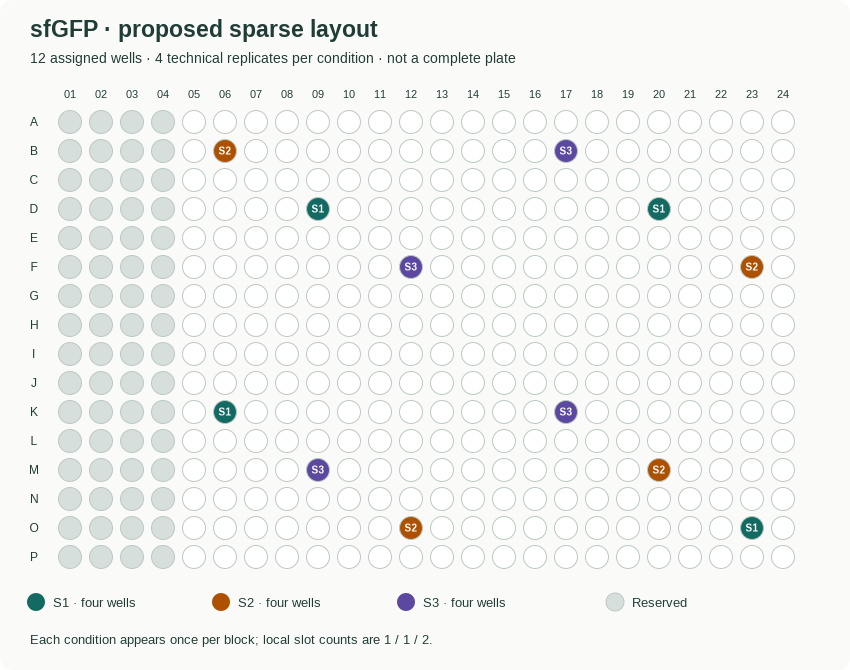
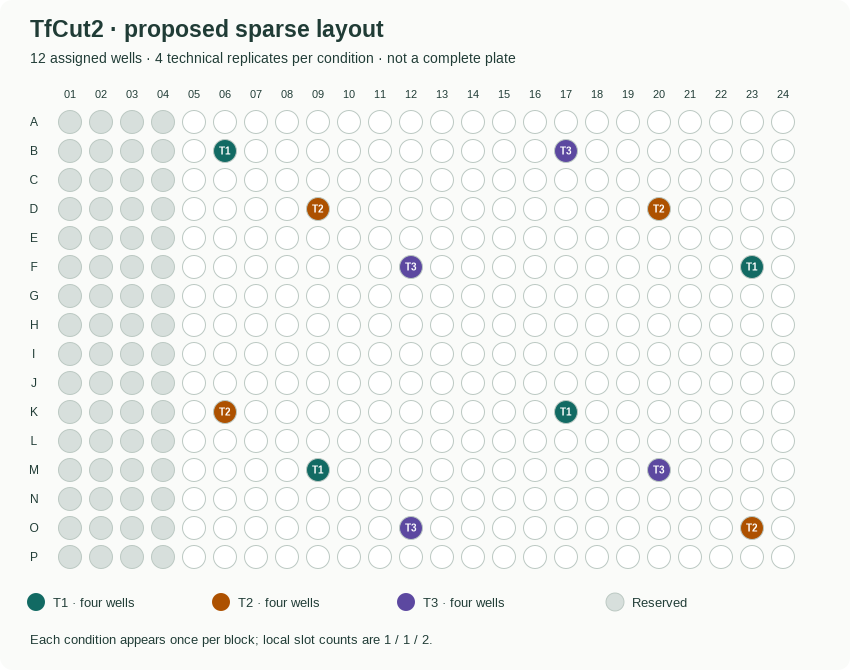
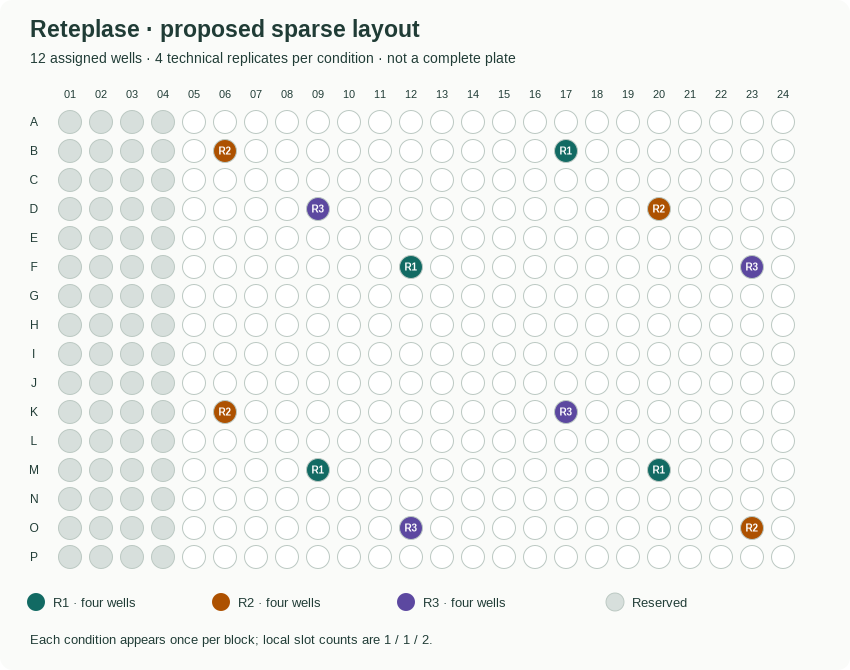
For each target, I propose one replicate of every condition in each of four spatial blocks. Condition positions are randomized within the blocks, with every condition occupying each local slot at least once. This avoids grouping all four copies together or assigning one dose to the same relative position throughout the plate.
sfGFP: proposed plate map and well coordinates
Condition
Replicate 1
Replicate 2
Replicate 3
Replicate 4
S1
D09
D20
K06
O23
S2
B06
F23
O12
M20
S3
F12
B17
M09
K17
TfCut2: proposed plate map and well coordinates
Condition
Replicate 1
Replicate 2
Replicate 3
Replicate 4
T1
B06
F23
M09
K17
T2
D09
D20
K06
O23
T3
F12
B17
O12
M20
Reteplase: proposed plate map and well coordinates
Condition
Replicate 1
Replicate 2
Replicate 3
Replicate 4
R1
F12
B17
M09
M20
R2
B06
D20
K06
O23
R3
D09
F23
O12
K17
Columns 1–4 remain reserved. Each map assigns only 12 experimental wells; 308 experimental positions on each proposed plate remain unassigned. These are planning maps to integrate into complete plates, not upload-ready submissions. The condition labels S1–R3 are reading aids; the downloads retain stable full sample IDs.
Validation confirms that every recipe totals 20,000 nL, uses nonnegative integer multiples of 25 nL, preserves fixed input volumes, uses the matching DNA template, and has four identical technical replicates. Current stock availability and the complete organizer submission still need execution-stage validation.
B. Research team discussion, data analysis, and metascience
What the historical sfGFP report teaches me
I reviewed the supplied sfGFP quad-96 reference report alongside its archived data. These are historical results, not results from my proposed panel.
Reported metric
Quad-96 run
384-well comparison
Median design-well concentration
2.71 g/L
0.36 g/L
Median within-design replicate CV
7.2%
14.6%
Designs with CV above 20%
4 of 80
32 of 80
Median target-control concentration
2.65 g/L
0.35 g/L
The median matched-design concentration ratio was 7.3×, calculated across 77 designs with a 384-well mean of at least 0.05 g/L. Separate calibration curves mapped the same fluorescence to concentrations differing by approximately 1.3× over the relevant range. Calibration therefore matters, but does not by itself explain the reported concentration difference. Across all 80 compared designs, Spearman rank correlation was approximately −0.12, and none of the top ten designs was shared between runs.
There is an important qualification to the assignment’s “same 20 µL reaction” wording: the report states 40 µL in the quad-96 run and 20 µL in the 384-well run. The runs shared lysate lot 20260722-39-L, but used different base-buffer lots (20260512-2-BB versus 20260721-4-BB), dates, and read handling. Quad samples were compressed, hand-diluted twofold, and reread later; concentrations were corrected for that dilution.
Oxygen access and evaporation are plausible contributors, but these runs do not isolate them. Evaporation can also increase concentration without a proportional increase in protein mass. Stronger signals may account for part of the lower CV. I would not apply a universal 7.3× multiplier to my recipes, or change the current brief’s 20 µL in every format requirement.
My practical conclusion is to preserve credible formulation diversity through advancement. A recipe with a good tube prior should not be discarded solely because a different format favors another recipe. That is why S2 remains in the shortlist. I would nominate candidates using output/$ and transfer evidence; organizer selection is not guaranteed.
How I would analyze the new results
The assay determines what “useful output” means:
Target
Competition readout
What it does not establish
sfGFP
Fluorescence-calibrated titer
Total expressed protein independent of fluorophore maturation
TfCut2
pNP-hexanoate activity after the specified 60 °C, 10-minute heat treatment
PET depolymerization performance
Reteplase
IPR-AMC cleavage activity
Clinical fibrinolytic potency or complete disulfide connectivity
Before ranking, I would check calibration, blanks, execution controls, saturation, and the valid kinetic window. A positive raw slope, even with a high fit R², is not sufficient evidence of target activity.
One concrete discrepancy needs reconciliation with the executed metadata: the TfCut2 protocol table states a 600× dilution, while the listed transfers imply (100/20) × (180/5) × (60/10) = 1,080×. I would use the actual recorded transfers rather than silently correcting historical results. A common multiplier may cancel within one plate, but it changes absolute activities and comparisons across runs.
For each formulation, I would report all four well values, the mean, variability, and uncertainty, then divide valid calibrated output by its complete reaction ingredient cost. Four technical replicates mean n = 4; kinetic timepoints do not create additional independent replicates. Shared blank and calibration uncertainty must remain part of the comparison.
Technical exclusions should have predefined, recorded QC reasons. Below-quantification and saturated measurements should remain distinct from measured inactivity. I would keep close or censored comparisons unresolved rather than manufacture a precise winner.
What the next round would depend on
Qualified result
Next decision
sfGFP or TfCut2 candidates have similar output/$
Preserve credible formulation diversity and test transfer; avoid overinterpreting small differences
R1 has quantifiable reteplase activity
Compare activity/$ directly; R2 needs about 8.92× more activity to beat it
R2 and R3 are active
R2 wins economically if it retains more than 11.12% of R3’s activity
Only R3 is quantifiable
Explore the intervening dose range; retain cheaper conditions as unresolved if their plausible activity could still win
All reteplase conditions are weak
Check assay sensitivity, controls, stock activity, and the adapted background before assigning a biochemical cause
My proposed experiment-selection criterion
Would either outcome change the next decision?
I would favor a proposal that states a credible baseline, one decision it can resolve, the output difference needed to justify its cost, and whether the assay can measure that difference. The reteplase ladder is a concrete example: its expensive reference earns a place by making the lower-dose comparison more informative.
For sfGFP B and the TfCut2 standard, fixed inputs already account for approximately 93.43% and 93.92% of ingredient cost. Their main opportunity is reliable output improvement. For reteplase, DsbC changes the cost structure, making dose and assay sensitivity central to the decision.
C. Agentic contribution
I used AI-assisted research and independent review to narrow a much larger design space into a small, auditable proposal. The workflow was:
Extract the original brief’s fixed inputs, permitted stocks, prices, assay definitions, and format progression.
Review available student proposals and primary CFPS literature, including searches in English, Spanish, Chinese, and Russian. Treat translated material and duplicate datasets as the same evidence.
Compare historical recipes and raw data with report conclusions, checking construct identity, reaction volume, lysate, and assay differences.
Recalculate complete ingredient costs and the activity thresholds that would change an economic decision.
Challenge the initial recommendations through separate reviews of biology, assay interpretation, and experimental design.
Generate exact recipes and proposed spatial layouts, then independently verify totals, allowed stocks, fixed inputs, replicate identity, and cost arithmetic.
The most useful outcome was revision: the final panel replaces the TfCut2 low-dose DsbC condition with a paired supplemental-cysteine test, and broadens reteplase from an all-low-dose set to 0 / 0.5 / 5 µM DsbC. The review also identified assay and historical-format ambiguities that would otherwise make a numerical ranking look more certain than it is.
This is an agent-assisted design contribution. I have not submitted an agent proposal, contacted the organizer through an agent, or run the experiment. The remaining decisive evidence is experimental: current-lot output, assay sensitivity, and transfer to the final format.
Use of AI
I used Claude and OpenAI Codex for literature discovery, historical-data review, calculations, criticism of the experimental strategy, recipe generation, validation, and this write-up. Representative prompts included:
“Let’s do top 3 experiments per protein.”
“The previous course might have differed from this one, I would stick to the requirements of the original task description document.”
“Do another deeper pass, to ensure that everything that needs to be considered has been. What would a top professional in this field do here?”
The literature search was broad but is not an exhaustive systematic review. Claims supported only by a mechanistic argument are identified as hypotheses. Neither AI agreement nor a valid recipe file establishes an experimentally optimal formulation.
I want to manufacture a living microbial crop-protection inoculant and build an automated workflow that measures whether each batch remains viable and biologically active.
The project connects MAIA, my system for discovering beneficial microorganisms, with Athanor, my system for automated production. I would begin with a characterized research reference and use the resulting workflow to evaluate additional candidates.
Intended deliverables
Three independent, characterized research batches of a single-strain liquid inoculant.
A repeatable workflow for preparation, production records, and quality measurements.
A dataset linking exact strain identity, production conditions, viable output, and retained biological activity.
The initial work would establish repeatability and measurement quality. A second strain comparison and calibrated optical monitoring are possible extensions.